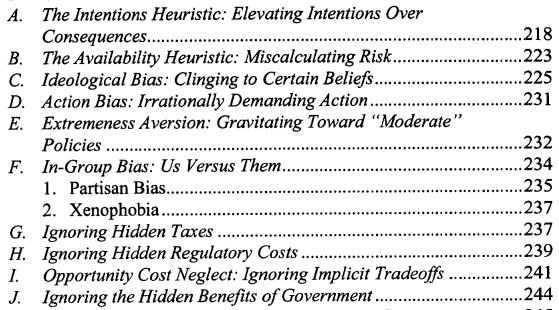
Source: Gary Lucas and Slavisa Tasic‘s "Behavioral Public Choice and the Law" (West Virginia Law Review, 2015) via Bryan Caplan
Celebrating humanity's flourishing through the spread of capitalism and the rule of law
21 Apr 2016 Leave a comment
in applied price theory, comparative institutional analysis, constitutional political economy, economics of bureaucracy, economics of information, Public Choice Tags: behavioural public choice, growth of government, rational irrationality, size of government
Source: Gary Lucas and Slavisa Tasic‘s "Behavioral Public Choice and the Law" (West Virginia Law Review, 2015) via Bryan Caplan
21 Apr 2016 Leave a comment
in economic history, economics of bureaucracy, economics of crime, economics of media and culture, law and economics, politics - USA, Public Choice, rentseeking Tags: bribery and corruption

In the book Plunkitt of Tammany Hall William Riordan published many of George Washington Plunkitt’s thoughts about government and about big city machines. In the link below, you can find the passage that explains the difference between honest and dishonest graft.
Honest graft is using your connections and knowledge as a government official to enrich yourself. It is essentially what we would now call “insider trading.”
Honest graft is when a goverment official goes out (for example) and buys up land because he knows a city project will need that land and he will be able to make a lot of money by buying the land now while no one else knows that it is about to be bought by the city. He can buy it cheap and then sell it at a higher price to the city.
Dishonest graft consists of doing things like blackmailing people who are doing illegal or semi-illegal things. It can also consist of actually taking money directly from the city treasury.
It is more of what you would expect mobsters to do–things like forcing prostitutes to pay money to police in order to be allowed to work in a given area rather than being arrested.
Source: How does George Plunkitt define “honest/dishonest graft”? | eNotes.

15 Apr 2016 Leave a comment
in constitutional political economy, economics of bureaucracy, income redistribution, politics - USA, Public Choice, rentseeking Tags: rational ignorance, rational irrationality, special interests, voter demographics
08 Apr 2016 Leave a comment
in applied price theory, constitutional political economy, development economics, economic history, economics of bureaucracy, economics of crime, growth disasters, growth miracles, International law, law and economics, property rights, rentseeking
Tax havens and offshore financial centres are vital to the economic development of poor countries. There are plenty of countries, poor countries, where the ability to move funds offshore is fundamental to successful investment. That is missed in the reporting of the Panama Papers:
Consider the big names that have shown up so far on the list. With the notable exception of Iceland, these are not countries I would describe as “capitalist”: Russia, Pakistan, Iraq, Ukraine, Egypt. They’re countries where kleptocratic government officials amass money not through commerce, but through quasi-legal extortion, or siphoning off the till. This is an activity that has gone on long before capitalism, and probably before there was money.
Tax havens and offshore financial centres offer a way in which entrepreneurs can make an honest investment, secure a return and put it aside safely from the reach of the minister’s cousin who wants to muscle in once the business succeeded.
A major problem in poor countries is short time horizons for investment. Entrepreneurs must make their money quickly.
Many years ago there is a survey of entrepreneurs in Russia and Poland. It was in the early 1990s. Each was asked whether an investment project that doubled their money in two years was worth the risk. The Russian entrepreneurs mostly said no, the Polish entrepreneur said yes.
So insecure are the returns from investment in Russia at that time that the phenomenal returns were required before an investment was made. They would only invest if they could double the money in two years.
Many years ago, Mancur Olson wrote an insightful book about prosperity and dictatorships. He introduced the concept of rights intensive production.
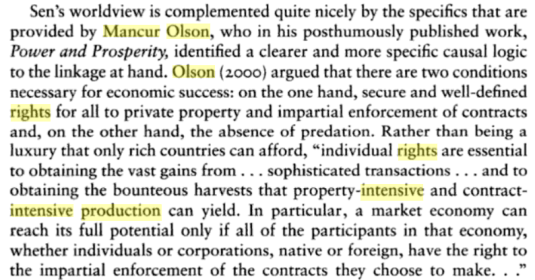
As countries become more and more developed, investment horizons lengthen and depends more and more upon the enforcement of contract and property rights in a tolerably honest way.
Instead of being the first entrepreneur to introduce the most basic technologies and profit handsomely, entrepreneurs are introducing a product upgrade or new product that is a minor improvement on current offerings. Such investments will take time to pay off.
In many developing countries, China as an example, property rights are insecure. One way to secure your investment is to take the proceeds offshore to a tax haven. If everything goes wrong, at least you got some nest egg overseas.
As many developing countries have corrupt politicians and dishonest courts, the way to secure gains from honest investments is to move some of the profits offshore. That is why tax havens are essential to poor countries growing richer.
One of the sources of Hong Kong prosperity was investors would deal with a Hong Kong-based company with the requisite political and economic links to China. They could enforce their contracts in China against their Hong Kong assets because the contract was based in Hong Kong under British law.
If the local legal system is inadequate, entrepreneurs well look overseas for mechanisms to force contracts and secure their returns on investments against confiscation.
16 Mar 2016 Leave a comment
in economics of bureaucracy, international economic law, international economics, law and economics, politics - New Zealand, property rights, Public Choice, rentseeking Tags: crony capitalism, customs unions, free trade agreements, international investment law, investor state dispute settlement, preferential trading agreements
15 Mar 2016 Leave a comment
in economics of bureaucracy, international economics, politics - New Zealand, Public Choice, rentseeking Tags: customs unions, free trade agreements, preferential trading agreements, TPPA, trade creation, trade diversion
Trade diversion occurs when preferential trading agreements cause imports to shift from low cost countries to higher cost countries. Rather than gaining tariff revenue from inexpensive imports from world markets, a country may import expensive products from member countries but not gain any tariff revenue. An example of trade diversion is when Britain closed its doors to New Zealand agricultural exports after joining the common market.
Preferential trading agreements are trade agreements between countries in which they lower tariffs for each other but not for the rest of the world. The mass media mislabel them free trade agreements.
Under trade diversion, the partner country benefits from this change as an exporter, but the importing country loses due to this higher cost, as does the third country whose exports fall.
The loss to the importing country is not visible to consumers, who find the higher-cost product cheaper due to the absence of tariff. The country as a whole loses, with that loss being lost tariff revenue – lost to cover the cost of the higher cost imports from a member of the new preferential trading agreement.

It does not take much trade diversion to make a preferential trading agreement welfare reducing because of this switch to high cost producers.
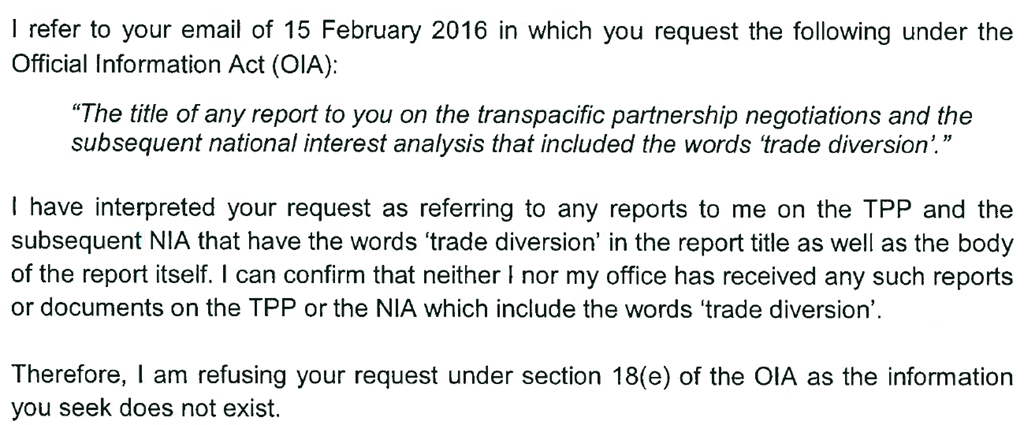
The New Zealand Minister of Trade and the Ministry of Foreign Affairs and Trade did not discuss this major risk even from the simplest preferential trading agreement in recent policy analysis of the TPPA as my Official Information Act request has revealed. The term trade version does not appear in any of their analysis.
Adherents of the natural trading partner hypothesis argue that preferential trade agreements are more likely to improve welfare if participating countries already trade disproportionately with each other. Opponents of the hypothesis claim that the opposite is true: welfare gains are likely to be greater if participating countries trade less with each other. The powerful critique by Bhagwati and Panagariya (1996) is now widely accepted and one hears little justification of on preferential trading agreements on the grounds of the natural trading partners hypothesis
08 Mar 2016 Leave a comment
in applied welfare economics, economic history, economics of bureaucracy, labour economics, politics - USA, poverty and inequality, Public Choice, welfare reform Tags: 1996 US welfare reforms, pessimism bias, social insurance, welfare state
From @EugeneSteuerle: Combined tax rates and creating a 21st century social welfare budget tpc.io/1GCdrYF http://t.co/aNRPqz5gAc—
Tax Policy Center (@TaxPolicyCenter) June 28, 2015

The only alternative offered by the Centre for American Progress is send them on a course. This response, which is the standard policy response to any labour market crisis, will not solve poverty, mush less inequality.
Will more education decrease inequality? A simulation provided an answer. nyti.ms/1xw5m9W http://t.co/paQp19BEWc—
The Upshot (@UpshotNYT) March 31, 2015
05 Mar 2016 Leave a comment
in constitutional political economy, economic history, economics of bureaucracy, Public Choice, rentseeking
I find many explanations of the fall of the USSR disappointing because many want to believe in people power and popular rebellions.
The rise and fall of mercantilism view of the USSR put forward by Pete Boettke will be the foundation of better explanations. By analysing communism as a rent-seeking society, the process of social and political evolution can be embedded into the history of the rise and fall of mercantilism.
More freedom in Russia and China came as an unintended by-product of a constitutional struggle over who would control the rules under which the economy prospered (or failed to prosper) and the sharing within the elite.
After the death of Stalin, the Soviet Nomenklatura used both co-option and political repression to encourage loyalty to the communist regime. As Grossman noted:
Under Stalin’s leadership the nomenklatura, after initially emphasizing a strategy of co-option, then experimented with political repression as a substitute for co-option, and finally, in response to the threats posed by German militarism and the onset of the Cold War, employed a combination of intense political repression and co-option. As a result, membership in the CPSU increased rapidly, then decreased sharply, before increasing rapidly again. After Stalin was gone the nomenklatura, having learned the cost of Stalin’s repressive excesses, adopted a policy that combined more co-option with less intense political repression. As a result, membership in the CPSU increased steadily, then levelled off, until the rapprochement between the United States and China, the emergence of Islamic fundamentalism, and the escalation of the cold war arms race resulted in yet more co-option and in the final episode of growth in party membership.
More and more of the general public in Russia and China were co-opted into the winning circle through peacefully adaptations when threats of revolution were minimal.
The cost of co-opting people into the Communist Party was a decrease in the standard of living of members of the Nomenklatura, whereas the cost of political repression was the danger that members of the Nomenklatura would themselves be victimized.
These successive minor reforms were mutual beneficial constitutional exchanges as suggested by Roger Congleton’s brilliant recent book on his king-and-council template and in Herschel Grossman’s earlier paper on co-option in the communist party from 1953 to 1989.
The USSR broke apart as the result of an internal power struggle within a new generation of leaders who grew up in a climate of corruption and high living.
Perestroika and glasnost should be viewed as nothing much more than the usual system reforms and rotations of patronage that were launched after the appointment of all previous Soviet leaders. As Anderson and Boettke explain
…upon closer examination, the succession of Gorbachev in general and the perestroika/glasnost “reform” program in particular bear a close resemblance to other, earlier Soviet government policy adjustments which followed shifts in the top leadership. Gorbachev’s behaviour as a “reformer” over the period 1985 to 1989 can be explained by reference to the incentives facing the dictator of a socialist state based on the distribution of economic privilege and political patronage… Gorbachev’s period of “reform” was not an extraordinary example of the role of ideology or vision in human affairs, but a more routine episode of rent-seeking in action.
Political and economic power was devolved to the 15 republics in the old USSR because this is the only way to operate a mercantilist state.
These local leaders formed their own alliances and declared succession from the USSR when the centre was too weak to fight. Local military units defected with them to a new rent-seeking coalition.
The fall of soviet communism led to a drawn out struggle for access to patronage and state monopolies and a new and better paid manifestation of the old mercantilism but ex-KGB owned and run under Putin.
28 Feb 2016 Leave a comment
in economics of bureaucracy, environmental economics, global warming, politics - New Zealand, Public Choice, transport economics Tags: carbon footprint, carbon offsets, Left-wing hypocrisy, New Zealand Greens, rational irrationality
Living the clean, green lifestyle means more than just buying carbon-offs in the same way that indulgences for sins were sold by the mediaeval Catholic Church. Russell Norman was an MP for 9 of the 12 months covered by this chart. He consistently had one of the smallest carbon footprints of a Green MP even when he was still co-leader of the Greens and not just a backbench MP.
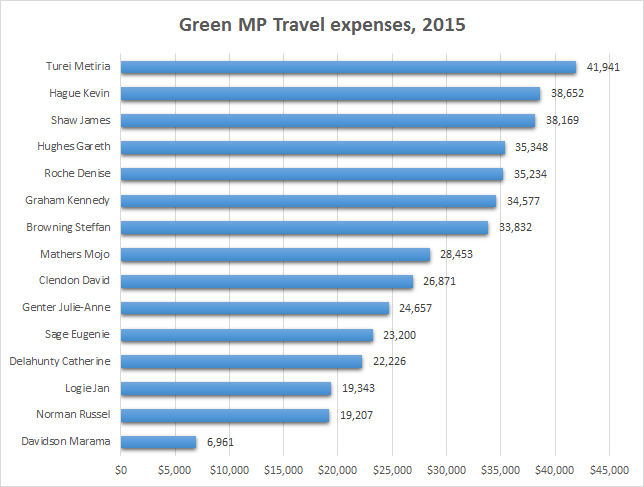
Source: New Zealand Parliament – Members’ expense disclosure from 1 October to 31 December 2015.
28 Feb 2016 1 Comment
in economics of bureaucracy, environmental economics, global warming, politics - New Zealand, Public Choice, rentseeking, transport economics Tags: carbon footprint, New Zealand Greens, rational irrationality
10 of the 14 green MPs have above-average air travel expenses – have an above average carbon footprint for a member of the New Zealand Parliament. It is not easy to be Green.
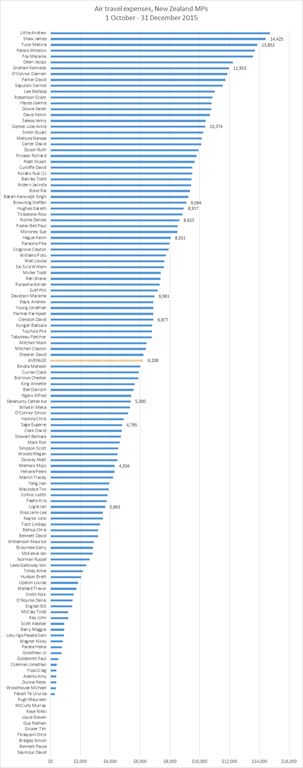
Source: New Zealand Parliament – Members’ expense disclosure from 1 October to 31 December 2015.
25 Feb 2016 Leave a comment
in economics of bureaucracy, international economics, politics - New Zealand
What gave Amnesty International its strength, appeal and political credibility was most could agree with its opposition to the imprisonment of prisoners of conscience and to torture and that political prisoners should be put on trial.
Including child poverty as part of its most recent international annual report proves Robert Conquest’s 3rd law of politics: the behaviour of any bureaucratic organization can best be understood by assuming that it is controlled by a secret cabal of its enemies

Source: 2015/16 Annual report – The State of the World’s Human Rights | Amnesty International NZ.
Amnesty International should not be giving people reasons not to join. It should stick to its original mission, which most people support. An NGO with members from across the political spectrum has much more credibility and influence.
25 Feb 2016 Leave a comment
in applied welfare economics, comparative institutional analysis, economics of bureaucracy, Public Choice
I learnt at the Australian Productivity Commission that the first law of public policy development is plagiarise, plagiarise, plagiarise. Why be original? Copy the successes of others, improve upon them, but do not repeat their failures, just learn from them.
I developed this policy insight from my experience at the Productivity Commission with a smart-arse Commissioner – that was the chairman’s private description of him in a conversation with me, not mine.
This Commissioner with whom I had countless arguments would respond to the many US studies I had marshalled by always asking for Australian evidence – what is the Australian evidence?
He knew that there was no Australian data or studies so he could slow the whole policy process down through this appeal to data chauvinism. The Americans are swimming in data and that is before you get to their cross-sectional data with 50 states.
 Ever since then, I regarded data chauvinism – the request for Australian evidence and studies or New Zealand evidence and studies – as a stalling tactic designed either to defend the status quo.
By and large, all the local evidence shows when it augments the US studies is how a local regulation or tax screws things up further. Local evidence rarely served the interests of my opponents who were fighting against deregulation or privatisation.

It is a good public policy – you are much more likely to implement a proposal or act on a particular empirical study – if there are half a dozen to a dozen overseas studies preferably in several different countries showing much the same thing. Beware the man of one study. Milton Friedman (1957) rightly preferred to emphasize the congruence of evidence from a number of different sources and with due attention to the quality of the data:
I have preferred to place major emphasis on the consistency of results from different studies and to cover lightly a wide range of evidence rather than to examine intensively a few limited studies.
The role of empirical evidence is to resolve disagreements – to bring people closer together. One study in one country rarely does that. Many studies in many countries about the same topic of controversy is far more persuasive.
Celebrating humanity's flourishing through the spread of capitalism and the rule of law
Celebrating humanity's flourishing through the spread of capitalism and the rule of law
Celebrating humanity's flourishing through the spread of capitalism and the rule of law
Celebrating humanity's flourishing through the spread of capitalism and the rule of law
Celebrating humanity's flourishing through the spread of capitalism and the rule of law
Celebrating humanity's flourishing through the spread of capitalism and the rule of law
Celebrating humanity's flourishing through the spread of capitalism and the rule of law
Celebrating humanity's flourishing through the spread of capitalism and the rule of law
A History of the Alt-Right
Econ Prof at George Mason University, Economic Historian, Québécois
Celebrating humanity's flourishing through the spread of capitalism and the rule of law
Scholarly commentary on law, economics, and more
Beatrice Cherrier's blog
Celebrating humanity's flourishing through the spread of capitalism and the rule of law
Celebrating humanity's flourishing through the spread of capitalism and the rule of law
Celebrating humanity's flourishing through the spread of capitalism and the rule of law
Why Evolution is True is a blog written by Jerry Coyne, centered on evolution and biology but also dealing with diverse topics like politics, culture, and cats.
Celebrating humanity's flourishing through the spread of capitalism and the rule of law
A rural perspective with a blue tint by Ele Ludemann
DPF's Kiwiblog - Fomenting Happy Mischief since 2003
Celebrating humanity's flourishing through the spread of capitalism and the rule of law
The world's most viewed site on global warming and climate change
Tim Harding's writings on rationality, informal logic and skepticism
A window into Doc Freiberger's library
Let's examine hard decisions!
Commentary on monetary policy in the spirit of R. G. Hawtrey
Thoughts on public policy and the media
Celebrating humanity's flourishing through the spread of capitalism and the rule of law
Politics and the economy
A blog (primarily) on Canadian and Commonwealth political history and institutions
Reading between the lines, and underneath the hype.
Economics, and such stuff as dreams are made on
"The British constitution has always been puzzling, and always will be." --Queen Elizabeth II
Celebrating humanity's flourishing through the spread of capitalism and the rule of law
Celebrating humanity's flourishing through the spread of capitalism and the rule of law
WORLD WAR II, MUSIC, HISTORY, HOLOCAUST
Undisciplined scholar, recovering academic
Celebrating humanity's flourishing through the spread of capitalism and the rule of law
Res ipsa loquitur - The thing itself speaks
In Hume’s spirit, I will attempt to serve as an ambassador from my world of economics, and help in “finding topics of conversation fit for the entertainment of rational creatures.”
Researching the House of Commons, 1832-1868
Articles and research from the History of Parliament Trust
Reflections on books and art
Posts on the History of Law, Crime, and Justice
Celebrating humanity's flourishing through the spread of capitalism and the rule of law
Exploring the Monarchs of Europe


Recent Comments