What do the top income earners in Australia earn on average?

Source: topincomes-parisschoolofeconomics

As with New Zealand, plenty of people in the top income brackets in Australia would regard themselves as middle class – entrepreneurs and professionals who made their way up from the bottom.

As with New Zealand, there is a major spike in top earnings around the time of the 1985 tax reform when the top tax rate was cut from 66% to 49% in Australia.

Source: topincomes-parisschoolofeconomics

As for trans-Tasman comparisons, the top 10% and top 5% in Australia do earn more than their compatriots in New Zealand.

The top 1% in Australia are much better performers than the top 1% in New Zealand, but then again wages and incomes are about a third higher in Australia as compared to New Zealand.

The Australian 0.5% are clearly superior to their New Zealand rivals, earning at least 50% more than them on average.

The New Zealand chart is in New Zealand dollars in 2011; the Australian chart is in Australian dollars in 2010.

A reason for the higher earnings of the Australian top 1% is the larger economy offers a greater superstar effect.

Globalisation and technological changes would allow the Australian best performers, including the top managers and top chief executives, in a given field to serve a bigger market and thus reap a greater share of its revenue. But this would also reduce the spoils available to the less gifted in the business. Australia, as the seven times larger economy, allows their best performers to serve bigger domestic markets.


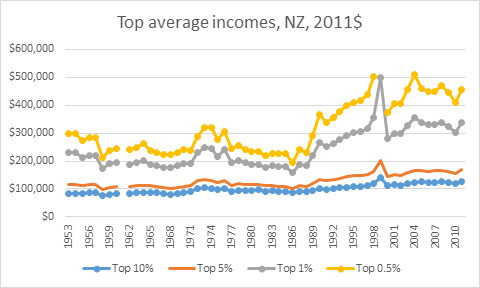
How much do the top income earners actually earn in NZ?

Source: topincomes-parisschoolofeconomics

Note: top income share data for adults for New Zealand adults go back only as far as 1953.

To begin with, a large number of people who see themselves as middle class will have to reclassify themselves in terms of class membership.

More importantly, they will have to pick up on their class consciousness because they are either in the top 10% as any successful professional is because the average income of the top 10% in New Zealand is $128,000. With a bit of luck, these members of the ruling class will be able to afford a house in Auckland without having to borrow from mum and dad.

Pretty much every successful professional is in the top 5% in New Zealand, with an average income of $170,000.

These rich have a lot of people look down upon and order about as junior or senior members of the ruling class, even if they did know they were a member of the ruling class until they looked at the diagram above. Welcome to the ruling class. Goodbye to the middle-class. Get over it.

As for the top 1% in New Zealand, they have an average income in 2011 of $336,000. Once again, successful professionals, successful entrepreneurs and what’s left of the rentier class will have to accept that supreme power as the ruling class of the capitalist system is open to just about anybody who does well at university and enters the professions. Are there no standards?

As for the top 0.5%, data on the top 0.1% stopped in 1989, they earned an average of $457,000 a year in 2011. That is starting to look like good money, though you do have to brush shoulders with celebrities, athletes and more than a few successful small entrepreneurs, but at least you are starting to earn a lot more than your average suburban doctor who is a member of the top 10%.

The ruling class is not what it used to be – the rentier class, old money. That the rich of today – the ruling class of the capitalist system – is open to many ordinary people who are new rich or just plain urban professionals, athletes, musicians and celebrities is a common finding all round the world. As Piketty and Saez explained for the USA:

This rise in top income shares is not due to the revival of top capital incomes, but rather to the very large increases in top wages (especially top executive compensation).

As a consequence, top executives (the “working rich”) have replaced top capital owners at the top of the income hierarchy over the course of the twentieth century.

Many of the rich both in New Zealand and overseas are working rich who made their money themselves and came from middle class or upper middle-class backgrounds.

Many of these rich are well educated smart people rather than the inheritors of wealth. The working rich and most of the rich of the 21st century must be well educated because so many of them are professionals in occupations where you must succeed at university to get in the ground floor, or they are athletes, musicians and other celebrities who must work their way up from the bottom.

A large number of New Zealanders who regarded themselves as middle class action are part of the rich – the top 10%, top 5% and banging on the doors of the top 1% or better – so they better start carrying themselves about with the airs and graces of the ruling class. Better practice by putting a plum in your mouth.

p.s. There was a big spike in top incomes in 1999. It seems like a lot of people in New Zealand brought forward income in 1998 and 1999 in anticipation of the election of a Labour Party government in the 1999 New Zealand general election, and an immediate increase in the top tax rate from 33% to 39% for incomes over $60,000.


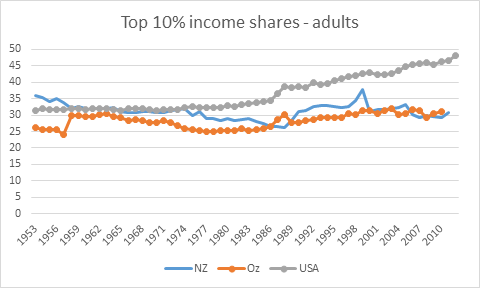
The top 10% are a bunch of bludgers in New Zealand too

Source: topincomes-parisschoolofeconomics

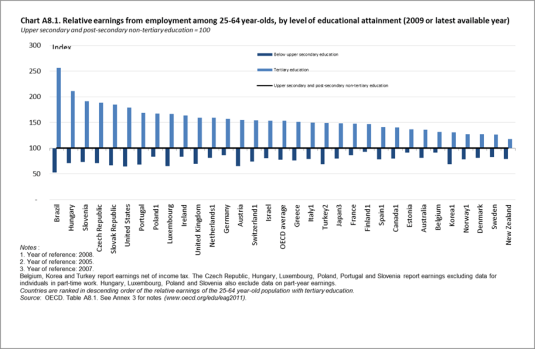
One reason why the top 10% in New Zealand have been a pretty ordinary lot compared to the USA is New Zealand’s university graduate premium – the college premium as it is known in the USA – is at the very bottom of the OECD ladder at about 18% – rock bottom 32nd out of 32 – the wooden spoon.

The College premium in the USA is about 64%, as shown in the OECD data below from OECD Education at Glance. Naturally, this high College premium in the USA should show up in well educated, highly skilled people earning a lot more than those that don’t go to college and don’t go to graduate school.

Stats link: http://dx.doi.org/10.1787/888932460515

Little wonder that the USA top 10% are breaking away from the pack. This slow increase in the income share of the top 10% since the early 1970s coincided with large numbers, including many more women in long duration professional degrees, going to university.

Prior to the mid-1970s, the College premium in the USA had been falling for about a decade because of large numbers of people going on to College and many of these two graduate school to get a draft deferment.

People married younger then so by the time people were at the end of College or graduate school, they were usually married with children and got of further draft deferment and aged out of the draft system.

The top 1% in New Zealand have been bone lazy for at least 60 years now

Source: topincomes-parisschoolofeconomics

Note: top 1% income share data for adults for New Zealand adults go back only as far as 1953.

The top 1% in New Zealand have had a good 60 years to immiserate the proletariat and what are they done? Nothing!

The top 1% share of national income is much the same as it was in 1953! The Australian top 1% haven’t done much better. Bludgers, the lot of them.

What do the Occupy movement have to protest about in New Zealand if the rich haven’t been getting richer?

@bryce_edwards New Zealand’s war on the poor – a fact check

Bryce Edwards has shown in today’s column that he knows nothing about inequality in New Zealand, despite the statistics being at his fingertips:

Under capitalism there’s always going to be a war against the poor.

The process by which we divide up the resources of any society normally involves exploiting the majority for the benefit of the minority.

It’s called inequality. And this is how it is in New Zealand: those who have the most power look for ways to extract that money for themselves, or at least retain the status quo.

Against this are those who want to have a more equal society. It’s an age-old political issue, and one that has traditionally been at the heart of the left-right political divide.

In 2014 this concern about inequality has been a key feature of politics, underpinning much of what has occur…

Although the rich appear to have been winning for three decades in their ‘war against the poor’, perhaps the tide is turning?

There’s still every indication of severe poverty and inequality in this country.

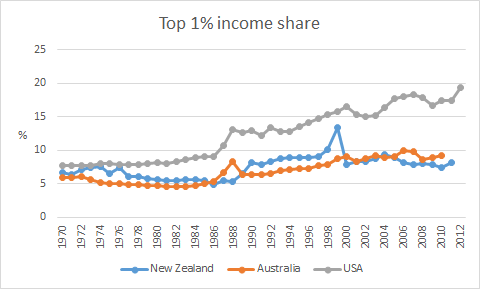
Firstly, inequality has not increased in New Zealand for at least 20 years when either measured in figure 1 by the Gini coefficient or in figure 2, the top 1% income shares. Both the Gini coefficient and the top 1% income shares have not risen for 20 years.

Figure 1: Gini coefficient New Zealand 1980-2015

Source: Bryan Perry, Household incomes in New Zealand: Trends in indicators of inequality and hardship 1982 to 2013. Ministry of Social Development (July 2014).

Figure 2: Top 1% income shares, USA, New Zealand and Australia, 1970-2012
Source: top incomes database

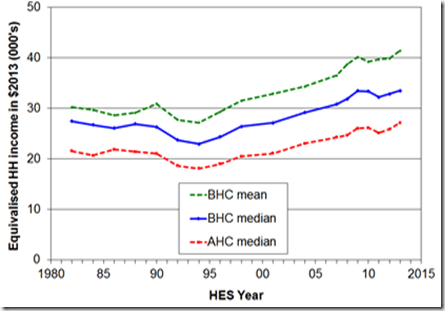
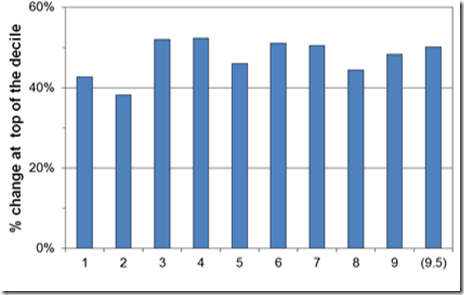
Secondly, the benefits of the economic boom that lasted 15 years from the early 1990s until the onset of the global financial crisis would spread broadly across all sections of the New Zealand community. As shown in figure 3, both before and after housing costs increased. As shown in figure 4, real household incomes increased pretty much evenly across all of the 10 income deciles between 1994 and 2013.

Figure 3: Real household income trends before housing costs (BHC) and after housing costs (AHC), 1982 to 2013 ($2013)

Source: Bryan Perry, Household incomes in New Zealand: Trends in indicators of inequality and hardship 1982 to 2013. Ministry of Social Development (July 2014).

Figure 4: Real household incomes (BHC), changes for top of income deciles, 1994 to 2013

Source: Bryan Perry, Household incomes in New Zealand: Trends in indicators of inequality and hardship 1982 to 2013. Ministry of Social Development (July 2014).

Thirdly, as shown in figure 5, between 1994 and 2010, real equivalised median household income rose 47% from 1994 to 2010; for Māori, this rise was 68%; for Pasifika, the rise was 77%. Median household income increases of nearly 50% in 16 years should be celebrated.

Figure 5: Real equivalised median household income (before housing costs) by ethnicity, 1988 to 2013 ($2013).


Source: Bryan Perry, Household incomes in New Zealand: Trends in indicators of inequality and hardship 1982 to 2013. Ministry of Social Development (July 2014).

The massive improvements in Māori incomes since 1992 were based on rising Māori employment rates, fewer Māori on benefits, more Māori moving into higher paying jobs, and greater Māori educational attainment. Māori unemployment reached a 20-year low of 8 per cent from 2005 to 2008.

Over the last more than two decades in New Zealand, there has been sustained income growth spread across all of New Zealand society contrary to the warmed over Marxism of Bryce Edwards. Perry (2014) reviews the data every year for the Ministry of Social Development. He concluded that:

Overall, there is no evidence of any sustained rise or fall in inequality in the last two decades.

The level of household disposable income inequality in New Zealand is a little above the OECD median.

The share of total income received by the top 1% of individuals is at the low end of the OECD rankings.

Bryce Edwards’ analysis was in the typical Marxist tradition – it had no gender analysis. He failed to mention that New Zealand has the smallest gender wage gap of all the industrialised countries.

As he did not notice these great successes in household incomes, incomes of every decile, Māori economic development and the empowerment of women, Bryce Edwards had nothing to add in terms of either consolidating or improving on them.

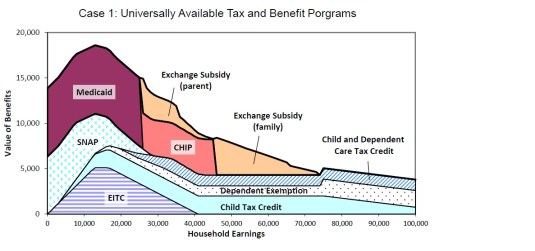
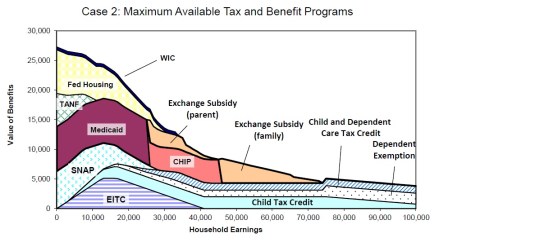
The shape of the welfare state in the USA

For able-bodied adults, there is limited help in lean times.

One in five Americans on Medicaid; this image does not include those on Medicare –those over 65 who get their healthcare paid by the government.

Image


Edmund Phelps on corporatism in the 21st century

Image

Withering away of the proletariat alert: the New Zealand Labour Party is redefining up the working class

The vanguard of the working class has decided the working classes are a bit too small these days to survive politically. The party vote of the New Zealand Labour Party was its lowest since its foundation in 1919 in the New Zealand 2014 general election.

Small-businesses owners, the self-employed and those on contracts are “workers”, Labour’s new leader Andrew Little says. Little has used his first major speech as leader to challenge Labour to update its definition of working people:

People on middle incomes, people who own a small business, people who work on contract who are doing their best to earn a crust and get ahead, they are feeling forgotten – mostly because in policy terms they are

Back in the day, a large number of Labour Party politicians were asked why did they join the Labour Party. Their answer was the Labour Party promised a better deal for the working man.

On the decline

Unfortunately for the New Zealand Labour Party, the traditional working class is simply are not enough votes to form a government even when you add in the precariat. The party vote of the Labour Party in New Zealand in the last two general elections is been in about 24%. Two thirds of the  New Zealand electorate gave their party vote to non-left parties. The party vote of the Labour Party and the green party summed to only 33% of the vote.

At the bottom: The 'precariat' group is 'marked by the lack of any significant amount of economic, cultural or social capital', said Professor Mike Savage, of the London School of Economics and Political Science

What is worse, if you are to believe these Daily Mail graphics, both the traditional working class and precariat area are a bit old, in case of the working class, they are retirement age. The average age of the working class is 66 and the average age of the precariat is 50.

Financially insecure

Even the emergent service worker class is a bit of a disappointment for the Labour Part because they don’t seem to be the stock of shop-floor militancy, higher taxes, more regulation and a more generous welfare state. The emergent service workers have semi-skilled and skilled jobs with career structures and the potential for self-employment.

All in all, the left-wing political parties in New Zealand are in a bit of trouble.The green party is tapped out at a party vote of 10% because their hard left policies limit their growth into the middle class vote. The withering away of the proletariat is leading to a withering away the Labour Party.

Both the Labour Party and the Greens are full of university educated, middle-class radicals whose higher tax and bigger government agenda simply doesn’t appeal to the middle-class vote.

Occupy Wall Street and the Tea Party compared

The relative importance of capitalism and the British welfare state in abolishing destitution

HT: Andrew Newell

Image

Secret Tapes of the final Copenhagen Summit negotiations, starring Obama, Brown, Sarko & Merkel

In Copenhagen’s final private negotiations, Obama, Brown, Sarko and Merkel sat down with He Yafei, the Chinese vice-minister of foreign affairs. There is a tape of this meeting at Der Spiegel

He Yafei was the smartest guy in the room. Wen Jiabao refused to attend most of the negotiating sessions.

Given the choice of walking out or sitting down with a vice-minister, they chose humiliation. One response of Obama was:

It would be nice to negotiate with somebody who can make political decisions.

There were still two important placeholders, X and Y, in the draft agreement. They marked the spots where the percentage targets for reductions in greenhouse gas emissions, for the industrialized nations and emerging countries respectively, were to be entered.

China and India were unwilling to make that commitment. They had reached their own agreement with Brazil and South Africa.

"We have all along been saying ‘Don’t prejudge options!,’" said a representative of the Indian delegation*, prompting Merkel to burst out: "Then you don’t want legally binding!"

The entire discussion at Der Spiegel in multiple parts should be read while listening to the tape.

Tax Burdens: Some Facts (For a Change) | Pundit 2011

via Tax Burdens: Some Facts (For a Change) | Pundit.

The Economics of Elysium

Is Growth of Government Inevitable? | Sam Peltzman video

James Tobin on limiting the domain of inequality


Previous Older Entries Next Newer Entries

Bassett, Brash & Hide

Celebrating humanity's flourishing through the spread of capitalism and the rule of law

Truth on the Market

Scholarly commentary on law, economics, and more

The Undercover Historian

Beatrice Cherrier's blog

Matua Kahurangi

Celebrating humanity's flourishing through the spread of capitalism and the rule of law

Temple of Sociology

Celebrating humanity's flourishing through the spread of capitalism and the rule of law

Velvet Glove, Iron Fist

Celebrating humanity's flourishing through the spread of capitalism and the rule of law

Why Evolution Is True

Why Evolution is True is a blog written by Jerry Coyne, centered on evolution and biology but also dealing with diverse topics like politics, culture, and cats.

Down to Earth Kiwi

Celebrating humanity's flourishing through the spread of capitalism and the rule of law

NoTricksZone

Celebrating humanity's flourishing through the spread of capitalism and the rule of law

Homepaddock

A rural perspective with a blue tint by Ele Ludemann

Kiwiblog

DPF's Kiwiblog - Fomenting Happy Mischief since 2003

The Dangerous Economist

Celebrating humanity's flourishing through the spread of capitalism and the rule of law

Watts Up With That?

The world's most viewed site on global warming and climate change

The Logical Place

Tim Harding's writings on rationality, informal logic and skepticism

Doc's Books

A window into Doc Freiberger's library

The Risk-Monger

Let's examine hard decisions!

Uneasy Money

Commentary on monetary policy in the spirit of R. G. Hawtrey

Barrie Saunders

Thoughts on public policy and the media

Liberty Scott

Celebrating humanity's flourishing through the spread of capitalism and the rule of law

Point of Order

Politics and the economy

James Bowden's Blog

A blog (primarily) on Canadian and Commonwealth political history and institutions

Science Matters

Reading between the lines, and underneath the hype.

Peter Winsley

Economics, and such stuff as dreams are made on

A Venerable Puzzle

"The British constitution has always been puzzling, and always will be." --Queen Elizabeth II

The Antiplanner

Celebrating humanity's flourishing through the spread of capitalism and the rule of law

Bet On It

Celebrating humanity's flourishing through the spread of capitalism and the rule of law

History of Sorts

WORLD WAR II, MUSIC, HISTORY, HOLOCAUST

Roger Pielke Jr.

Undisciplined scholar, recovering academic

Offsetting Behaviour

Celebrating humanity's flourishing through the spread of capitalism and the rule of law

JONATHAN TURLEY

Res ipsa loquitur - The thing itself speaks

Conversable Economist

In Hume’s spirit, I will attempt to serve as an ambassador from my world of economics, and help in “finding topics of conversation fit for the entertainment of rational creatures.”

The Victorian Commons

Researching the House of Commons, 1832-1868

The History of Parliament

Articles and research from the History of Parliament Trust

Books & Boots

Reflections on books and art

Legal History Miscellany

Posts on the History of Law, Crime, and Justice

Sex, Drugs and Economics

Celebrating humanity's flourishing through the spread of capitalism and the rule of law

European Royal History

Exploring the Monarchs of Europe

Tallbloke's Talkshop

Cutting edge science you can dice with

Marginal REVOLUTION

Small Steps Toward A Much Better World

NOT A LOT OF PEOPLE KNOW THAT

“We do not believe any group of men adequate enough or wise enough to operate without scrutiny or without criticism. We know that the only way to avoid error is to detect it, that the only way to detect it is to be free to inquire. We know that in secrecy error undetected will flourish and subvert”. - J Robert Oppenheimer.

STOP THESE THINGS

The truth about the great wind power fraud - we're not here to debate the wind industry, we're here to destroy it.

Lindsay Mitchell

Celebrating humanity's flourishing through the spread of capitalism and the rule of law

Alt-M

Celebrating humanity's flourishing through the spread of capitalism and the rule of law

croaking cassandra

Economics, public policy, monetary policy, financial regulation, with a New Zealand perspective

The Grumpy Economist

Celebrating humanity's flourishing through the spread of capitalism and the rule of law

International Liberty

Restraining Government in America and Around the World