A challenge for @GarethMorgannz on disagreement in public policy making
21 Apr 2016 Leave a comment
in applied price theory, comparative institutional analysis, constitutional political economy, politics - New Zealand, Public Choice, rentseeking Tags: action bias, conjecture refutation, motivated reasoning, The fatal conceit, The pretense to knowledge

SPECIFIC TYPES OF IRRATIONALITY THAT CAUSE GOVERNMENT FAILURE
21 Apr 2016 Leave a comment
in applied price theory, comparative institutional analysis, constitutional political economy, economics of bureaucracy, economics of information, Public Choice Tags: behavioural public choice, growth of government, rational irrationality, size of government
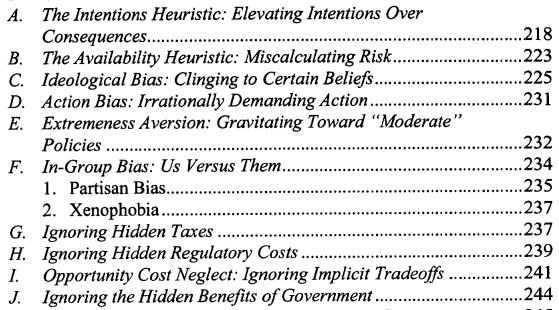
Source: Gary Lucas and Slavisa Tasic‘s "Behavioral Public Choice and the Law" (West Virginia Law Review, 2015) via Bryan Caplan
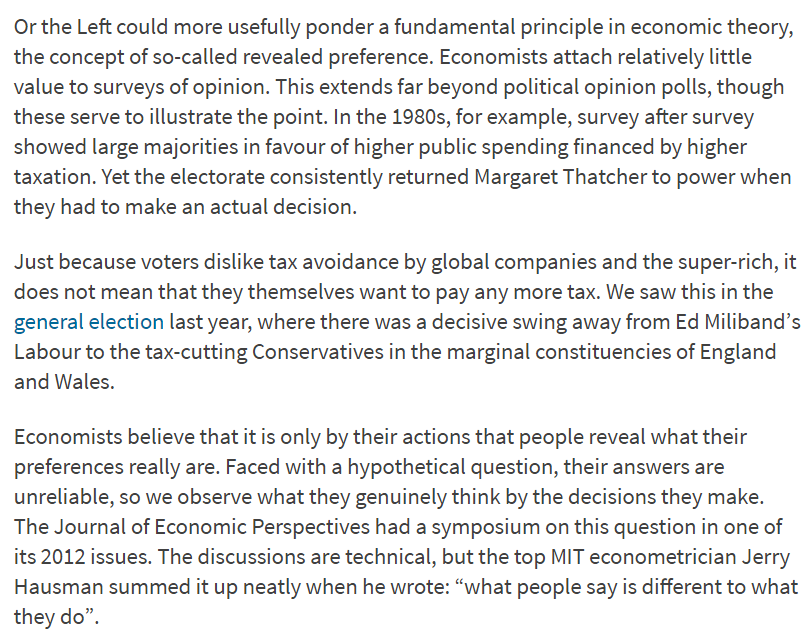
Forget avoidance outrage: public’s real attitude to tax is revealed by their actions @JordNZ
21 Apr 2016 Leave a comment
in applied price theory, constitutional political economy, economic history, economics of media and culture, politics - Australia, politics - New Zealand, politics - USA, Public Choice, public economics Tags: British economy, British politics, expressive voting, growth of government, rational irrationality, revealed preference, size of government, voter demographics
George Plunkitt of Tammany Hall on the difference between honest and dishonest political graft
21 Apr 2016 Leave a comment
in economic history, economics of bureaucracy, economics of crime, economics of media and culture, law and economics, politics - USA, Public Choice, rentseeking Tags: bribery and corruption

In the book Plunkitt of Tammany Hall William Riordan published many of George Washington Plunkitt’s thoughts about government and about big city machines. In the link below, you can find the passage that explains the difference between honest and dishonest graft.
Honest graft is using your connections and knowledge as a government official to enrich yourself. It is essentially what we would now call “insider trading.”
Honest graft is when a goverment official goes out (for example) and buys up land because he knows a city project will need that land and he will be able to make a lot of money by buying the land now while no one else knows that it is about to be bought by the city. He can buy it cheap and then sell it at a higher price to the city.
Dishonest graft consists of doing things like blackmailing people who are doing illegal or semi-illegal things. It can also consist of actually taking money directly from the city treasury.
It is more of what you would expect mobsters to do–things like forcing prostitutes to pay money to police in order to be allowed to work in a given area rather than being arrested.
Source: How does George Plunkitt define “honest/dishonest graft”? | eNotes.

Left-wing Biases, Too, May Block Progress on Climate Change @GarethMP @JulieAnneGenter
20 Apr 2016 Leave a comment
in applied price theory, applied welfare economics, economics of media and culture, energy economics, environmental economics, global warming, Public Choice Tags: antimarket bias, carbon emissions, climate alarmists, expressive voting, greenhouse gases, nuclear power, rational irrationality

Source: Liberal Biases, Too, May Block Progress on Climate Change – The New York Times.

Source: Mr. Sanders’s war on clean energy – The Washington Post.
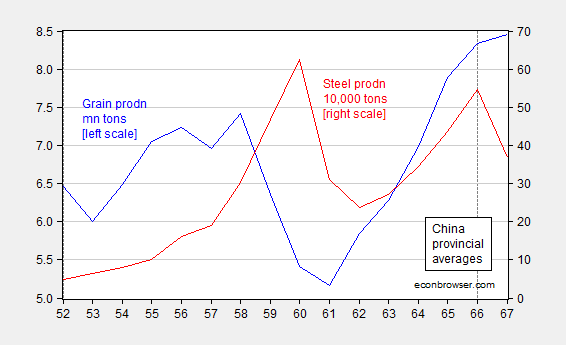
Thinking about The Great Leap Forward | Econbrowser
19 Apr 2016 Leave a comment
in applied price theory, applied welfare economics, comparative institutional analysis, development economics, economic growth, economic history, growth disasters, industrial organisation, law and economics, Marxist economics, Public Choice, rentseeking Tags: China, economics of planning, extreme poverty, famine, Great Leap Forward
P.T. Bauer on @BernieSanders extending #fightfor15 to entire Third World!
19 Apr 2016 Leave a comment
in applied welfare economics, behavioural economics, constitutional political economy, development economics, economic history, growth disasters, growth miracles, P.T. Bauer, politics - USA, Public Choice Tags: 2016 presidential election, antiforeign buyers, George Orwell, living wage, rational irrationality, The fatal conceit, The pretense to knowledge
India tried that in the 1950s as part of its five-year plans. It did not work that well. Bauer said that in development economics there is a “need to restate the obvious.”
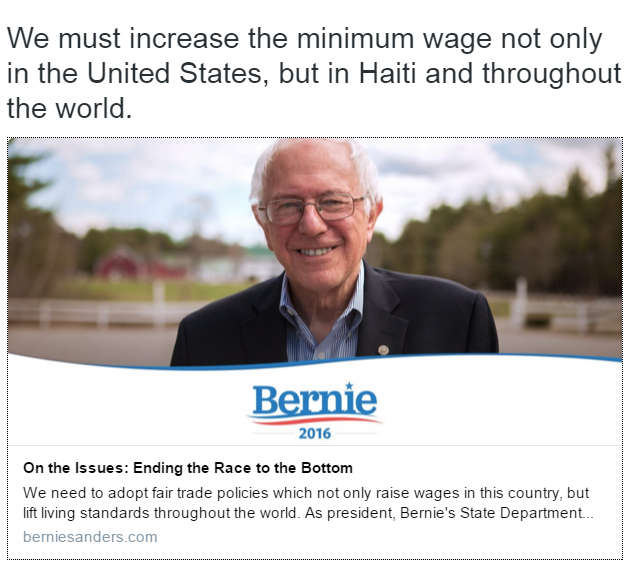
Source: Ending the Race to the Bottom – Bernie Sanders.
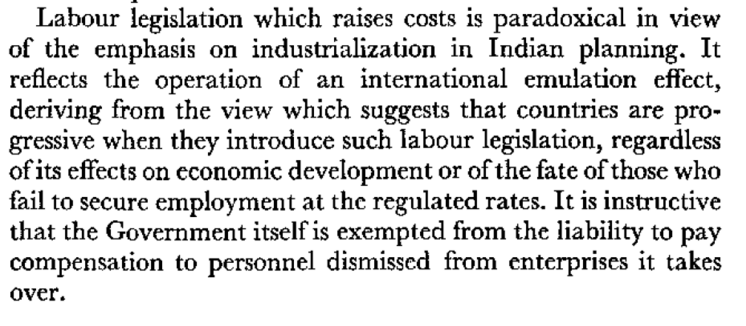
Source: Indian Economic Policy and Development – P. T. Bauer (1959) – Google Books
<p><img src="http://quotes.lifehack.org/media/quotes/quote-George-Orwell-we-have-now-sunk-to-a-depth-39424.png" /></p> <p>
Americans used to be much more trusting of government
15 Apr 2016 Leave a comment
in constitutional political economy, economics of bureaucracy, income redistribution, politics - USA, Public Choice, rentseeking Tags: rational ignorance, rational irrationality, special interests, voter demographics
How the “Daisy” Ad Changed Everything About Political Advertising
14 Apr 2016 Leave a comment
in politics - USA, Public Choice Tags: Attack Ads, economics of advertising, political advertising
I love attack ads. They actually tell you something and bring the contrasts between the candidates into sharp focus.
Put another way, the firm believed that viewers should not be given too much information to put their minds and emotions to work. And Daisy Girl’s DNA has continued to provide instructions for today’s political advertising: Ronald Reagan’s famous 1984 “Bear” spot used the animal to symbolize the Soviet Union without explicitly making the association. In 2004, Bush’s campaign skillfully employed the same technique with a spot that used wolves to symbolize al Qaeda.
Voting is not a purely rational act. As the late journalist Joe McGinnis observed, it’s a “psychological purchase” of a candidate. It’s often no less rational than buying a car or a house. DDB understood that arguing with voters would be a losing proposition. To persuade someone, especially in the political realm, a campaign must target emotions. Voters don’t oppose a candidate because they dislike his or her policies; they often oppose the policies because they dislike the candidate.
Reagan’s optimistic 1984 “Morning in America” spot was a good example of this kind of appeal. So was George H.W. Bush’s dark, fear-inducing “Revolving Door” spot in 1988 that exploited the controversy over a prison furlough program of his Democratic opponent, Michael Dukakis. Bernie Sanders’ “America” spot is a current example. They are all very different ads, but are aimed at generating a non-rational, emotional response.
DDB also believed that giving data and facts was less persuasive than telling a story. The best spots provide an experience. In addition to evoking emotions and not repeating what the viewer already knew, many of the DDB spots from 1964 had a narrative arc to them. A good example in 1964 was a Johnson spot reminding viewers of the many harsh attacks on Goldwater by his former GOP opponents. The gold standard for subsequent spots in this genre may be Bill Clinton’s 60-second “Journey” spot from 1992, in which he touted his small-town American values by recounting his childhood in Hope, Arkansas.
Source: How the “Daisy” Ad Changed Everything About Political Advertising | History | Smithsonian
@CFigueres seriously mistaken on carbon emissions and global poverty
13 Apr 2016 Leave a comment
in applied welfare economics, development economics, economic history, energy economics, environmental economics, global warming, growth disasters, growth miracles, Public Choice, rentseeking Tags: climate alarmism, extreme poverty, global poverty, The Great Escape
Picking winners and @stevenljoyce’s repayable grants to 11 more tech start-ups @JordNZ
13 Apr 2016 Leave a comment
in applied price theory, entrepreneurship, industrial organisation, politics - New Zealand, Public Choice, rentseeking, survivor principle Tags: corporate welfare, creative destruction, entrepreneurial alertness, Hollywood economics, industry policy, picking losers, picking winners
 Minister for Science and Innovation Steven Joyce picked a few more winners today. Eleven more start-up technology companies are to be funded $450,000 each in repayable loans to commercialise their technology. The loans are from Callaghan Innovation’s incubator network.
To cut a long diatribe short, I find these sums of money rather piddling. I have encountered this corporate welfare program before at a presentation.
My reaction then as is now: by handing out such small grants, some will succeed, some will fail. Importantly, there will never be one big disaster to bring the whole show down. There is political safety in diversification.

This is not the case with, for example, film subsidies. If Sir Peter Jackson and others finally produce a box office bomb, it will be all too glaring that the taxpayers backed a Hollywood loser with hundreds of millions of dollars. $500 million in subsidies in the case of Avatar.

By peppering small sums of money across the economy, there is no similar risk from this repayable grant scheme for the commercialisation of products.

#Illinois politicians have no shame about their gerrymanders
11 Apr 2016 Leave a comment
in constitutional political economy, politics - USA, Public Choice Tags: gerrymanders
Deposit insurance
11 Apr 2016 Leave a comment
in applied price theory, business cycles, economic history, economics, economics of regulation, global financial crisis (GFC), macroeconomics, monetary economics, Public Choice, rentseeking Tags: bank runs, banking crises, banking panics, deposit insurance, Thomas Sargent
Many of the key issues about what modern macroeconomics has to say on global financial crises and deposit insurance are discussed in a 2010 interview with Thomas Sargent
Sargent said that two polar models of bank crises and what government lender-of-last-resort and deposit insurance do to arrest or promote them were used to understand the GFC. They are polar models because:
- in the Diamond-Dybvig and Bryant model of banking runs, deposit insurance and other bailouts are purely a good thing stopping panic-induced bank runs from ever starting; and
- in the Kareken and Wallace model, deposit insurance by governments and the lender-of-last-resort function of a central bank are purely a bad thing because moral hazard encourages risk taking unless there is regulation or there is proper surveillance and accurate risk-based pricing of the deposit insurance.
In the Diamond-Dybvig and Bryant model, if there is government-supplied deposit insurance, people do not initiate bank runs because they trust their deposits to be safe. There is no cost to the government for offering the deposit insurance because there are no bank runs! A major free lunch.
Tom Sargent considers that the Bryant-Diamond-Dybvig model has been very influential, in general, and among policy makers in 2008, in particular.
Governments saw Bryant-Diamond-Dybvig bank runs everywhere. The logic of this model persuaded many governments that if they could arrest the actual or potential runs by convincing creditors that their loans were insured, that could be done at little or no eventual cost to taxpayers.
In 2008, the Australian and New Zealand governments announced emergency bank deposit insurance guarantees. In Bryant-Diamond-Dybvig style bank panics, these guarantees ward off the bank run and thus should cost nothing fiscally because the deposit insurance is not called upon. These guarantees and lender of last resort function were seen as key stabilising measures. These guarantees were called upon in NZ to the tune of $2 billion.
- 1. The Diamond-Dybvig and Bryant model makes you sensitive to runs and optimistic about the ability of deposit insurance to cure them.
- The Kareken and Wallace model’s prediction is that if a government sets up deposit insurance and doesn’t regulate bank portfolios to prevent them from taking too much risk, the government is setting the stage for a financial crisis.
- The Kareken-Wallace model makes you very cautious about lender-of-last-resort facilities and very sensitive to the risk-taking activities of banks.
Kareken and Wallace called for much higher capital reserves for banks and more regulation to avoid future crises. This is not a new idea.
Sam Peltzman in the mid-1960s found that U.S. banks in the 1930s halved their capital ratios after the introduction of federal deposit insurance. FDR was initially opposed to deposit insurance because it would encourage greater risk taking by banks.

Late on Friday afternoon, Stuff posted an op-ed piece calling for the introduction of a (funded) deposit insurance scheme in New Zealand. It was written by Geof Mortlock, a former colleague of mine at the Reserve Bank, who has spent most of his career on banking risk issues, including having been heavily involved in the handling of the failure, and resulting statutory management, of DFC.
As the IMF recently reported, all European countries (advanced or emerging) and all advanced economies have deposit insurance, with the exception of San Marino, Israel and New Zealand. An increasing number of people have been calling for our politicians to rethink New Zealand’s stance in opposition to deposit insurance. I wrote about the issue myself just a couple of months ago, in response to some new material from the Reserve Bank which continues to oppose deposit insurance.
Different people emphasise different arguments in making the case for New Zealand to…
View original post 1,963 more words
@BarackObama nails safe spaces on campuses
09 Apr 2016 Leave a comment
in economics, economics of education, economics of media and culture, liberalism, Public Choice
@JulieAnneGenter tax havens underwrite The Great Escape from extreme poverty in developing countries
08 Apr 2016 Leave a comment
in applied price theory, constitutional political economy, development economics, economic history, economics of bureaucracy, economics of crime, growth disasters, growth miracles, International law, law and economics, property rights, rentseeking
Tax havens and offshore financial centres are vital to the economic development of poor countries. There are plenty of countries, poor countries, where the ability to move funds offshore is fundamental to successful investment. That is missed in the reporting of the Panama Papers:
Consider the big names that have shown up so far on the list. With the notable exception of Iceland, these are not countries I would describe as “capitalist”: Russia, Pakistan, Iraq, Ukraine, Egypt. They’re countries where kleptocratic government officials amass money not through commerce, but through quasi-legal extortion, or siphoning off the till. This is an activity that has gone on long before capitalism, and probably before there was money.
Tax havens and offshore financial centres offer a way in which entrepreneurs can make an honest investment, secure a return and put it aside safely from the reach of the minister’s cousin who wants to muscle in once the business succeeded.
A major problem in poor countries is short time horizons for investment. Entrepreneurs must make their money quickly.
Many years ago there is a survey of entrepreneurs in Russia and Poland. It was in the early 1990s. Each was asked whether an investment project that doubled their money in two years was worth the risk. The Russian entrepreneurs mostly said no, the Polish entrepreneur said yes.
So insecure are the returns from investment in Russia at that time that the phenomenal returns were required before an investment was made. They would only invest if they could double the money in two years.
Many years ago, Mancur Olson wrote an insightful book about prosperity and dictatorships. He introduced the concept of rights intensive production.
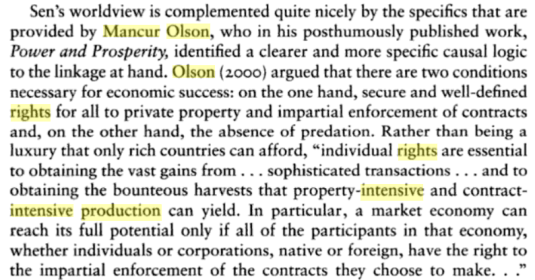
As countries become more and more developed, investment horizons lengthen and depends more and more upon the enforcement of contract and property rights in a tolerably honest way.
Instead of being the first entrepreneur to introduce the most basic technologies and profit handsomely, entrepreneurs are introducing a product upgrade or new product that is a minor improvement on current offerings. Such investments will take time to pay off.
In many developing countries, China as an example, property rights are insecure. One way to secure your investment is to take the proceeds offshore to a tax haven. If everything goes wrong, at least you got some nest egg overseas.
As many developing countries have corrupt politicians and dishonest courts, the way to secure gains from honest investments is to move some of the profits offshore. That is why tax havens are essential to poor countries growing richer.
One of the sources of Hong Kong prosperity was investors would deal with a Hong Kong-based company with the requisite political and economic links to China. They could enforce their contracts in China against their Hong Kong assets because the contract was based in Hong Kong under British law.
If the local legal system is inadequate, entrepreneurs well look overseas for mechanisms to force contracts and secure their returns on investments against confiscation.


Recent Comments