Rothbard on Conspiracy Theory
16 Mar 2016 Leave a comment
in Austrian economics, economics, Public Choice, rentseeking Tags: conspiracy theories, interest group capture, special interests
@toddmcclaymp #MFAT hasn’t heard of trade diversion? @DavidShearerMP #TPPANoWay @KennedyGraham
15 Mar 2016 Leave a comment
in economics of bureaucracy, international economics, politics - New Zealand, Public Choice, rentseeking Tags: customs unions, free trade agreements, preferential trading agreements, TPPA, trade creation, trade diversion
Trade diversion occurs when preferential trading agreements cause imports to shift from low cost countries to higher cost countries. Rather than gaining tariff revenue from inexpensive imports from world markets, a country may import expensive products from member countries but not gain any tariff revenue. An example of trade diversion is when Britain closed its doors to New Zealand agricultural exports after joining the common market.
Preferential trading agreements are trade agreements between countries in which they lower tariffs for each other but not for the rest of the world. The mass media mislabel them free trade agreements.
Under trade diversion, the partner country benefits from this change as an exporter, but the importing country loses due to this higher cost, as does the third country whose exports fall.
The loss to the importing country is not visible to consumers, who find the higher-cost product cheaper due to the absence of tariff. The country as a whole loses, with that loss being lost tariff revenue – lost to cover the cost of the higher cost imports from a member of the new preferential trading agreement.

It does not take much trade diversion to make a preferential trading agreement welfare reducing because of this switch to high cost producers.
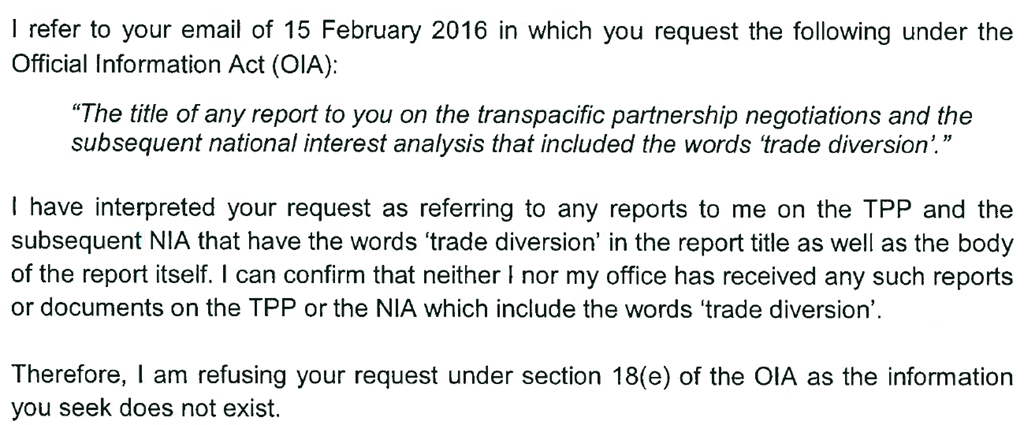
The New Zealand Minister of Trade and the Ministry of Foreign Affairs and Trade did not discuss this major risk even from the simplest preferential trading agreement in recent policy analysis of the TPPA as my Official Information Act request has revealed. The term trade version does not appear in any of their analysis.
Adherents of the natural trading partner hypothesis argue that preferential trade agreements are more likely to improve welfare if participating countries already trade disproportionately with each other. Opponents of the hypothesis claim that the opposite is true: welfare gains are likely to be greater if participating countries trade less with each other. The powerful critique by Bhagwati and Panagariya (1996) is now widely accepted and one hears little justification of on preferential trading agreements on the grounds of the natural trading partners hypothesis
Dodging the #Trump Bullet: @zingales (2011) on @realdonaldtrump’s previous run for president
14 Mar 2016 Leave a comment
in economics of media and culture, politics - USA, Public Choice, rentseeking
Read what Zingales wrote five years ago on City Journal that was part of what was cut out of his book “A Capitalism for the People” because Donald Trump running seriously for president was never supposed to happen.
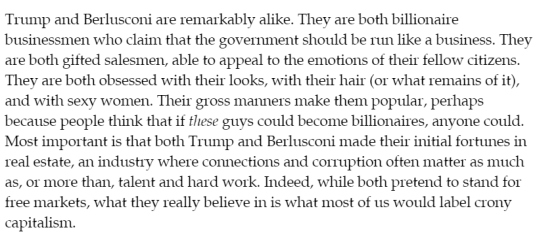
Source: Dodging the Trump Bullet | City Journal.
Zingales is no kinder in his recent op-ed recalling the lost book chapter, which is paywalled.
Hilarious story of Oberlin cry-baby students fleeing to safe rooms
13 Mar 2016 Leave a comment
in economics of media and culture, liberalism, politics - USA, Public Choice Tags: cry-baby left, political correctness, safe rooms, safe spaces
An Economic Approach to School Integration: Public Choice with Tie-ins
12 Mar 2016 Leave a comment
in applied price theory, constitutional political economy, discrimination, economics of education, economics of media and culture, rentseeking
Thomas Borcherding “An Economic Approach to School Integration: Public Choice with Tie-ins.” Public Choice, 1977, argues that a reason for racial or ethnic discrimination in the public sector is politics encourages the coercive transfer of income from the racial, religious or ethnic group to those with more political influence.
Race can be used as a means of organizing coalitions to lobby for fiscal and economic discrimination in favour of even a previously unprejudiced group.
Preferences of each group to locate in a common geography and the severe control over entry or exit from the group that such things as skin colour, language, caste, and religious dogma impose make the organization of racial or ethnic coalitions by political entrepreneurs fairly cheap and minimises free riding and defection.
Prejudice may reinforce the solidarity of each group and help to monitor via custom, mores, and folkways the behavior of those that would attempt to bring persons of other groups into the former coalition. Further, prejudice may also serve as a device to rationalize exploitation of another group by fiscal or other means.

Borcherding argues that integration, racial balancing, quotas, and busing of school children take on a new logic when income transfers can be tied to fairly immutable characteristics such as race.
Mixing of children by race reduces the ability of a white dominated school board to differentially favour its own partisans’ children and to discriminate against those of blacks.
This paper anticipated Becker’s point that the competition among pressure groups for political influence for looks for lower cost ways of redistributing wealth so as to as much as possible limits the largess as much as possible to the pressure groups that lobby for it and their allies.
@UKIP supporters are slightly to the left of @LibDems supporters
12 Mar 2016 Leave a comment
in economics of media and culture, Public Choice
Data generated by 17,281 England-only users of the WhoGetsMyVoteUK application. Before to the 2015 general election, users expressed their opinions on thirty policy statements including taxation, welfare, the EU and immigration. Their answers were matched with the party or parties that best corresponded with those views.

Where UKIP supporters distinguish themselves from other parties is on the cultural dimension. They are, to use David Goodhart’s phrase, far more “communitarian” (i.e. anti-immigration, anti-EU, localist, anti gay marriage and English nationalist) than “cosmopolitan” Green, Labour and Liberal Democrat supporters, while Conservative supporters occupy a “middle-of-the-road” position on the cultural scale.
This conforms well to Ford and Goodwin’s characterisation of UKIP as older blue-collar workers who feel threatened by social change and cling to past certainties. In this respect, UKIP is similar to other right-wing populist parties in Europe that draw their support from globalisation’s “losers”…
Solution aversion and the anti-science Left
11 Mar 2016 1 Comment
in applied price theory, applied welfare economics, comparative institutional analysis, constitutional political economy, economics of regulation, energy economics, environmental economics, global warming, health economics, law and economics, politics - Australia, politics - New Zealand, politics - USA, property rights, Public Choice Tags: antiscience left, climate alarmism, geo-engineering, GMOs, growth of knowledge, gun control, motivated reasoning, nuclear power, political persuasion, solar power, solution aversion, wind power
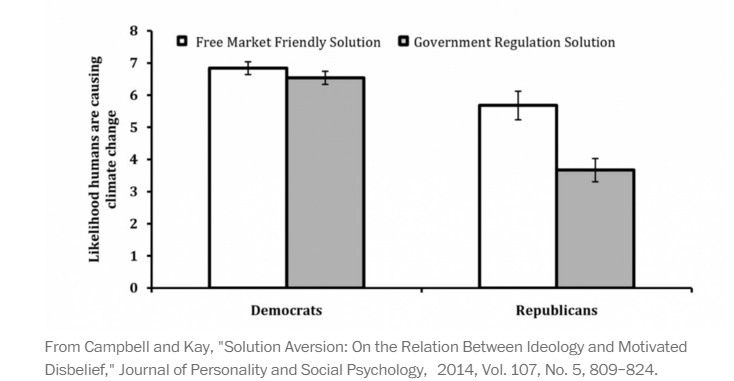
Climate science is the latest manifestation of solution aversion: denying a problem because it has a costly solution. The Right does this on climate science, the Left does it on gun control, GMOs, and plenty more. Cass Sunstein explains:
It is often said that people who don’t want to solve the problem of climate change reject the underlying science, and hence don’t think there’s any problem to solve.
But consider a different possibility: Because they reject the proposed solution, they dismiss the science. If this is right, our whole picture of the politics of climate change is off.
Some psychologists wasted grant money on lab experiments to show that people that think the solution to a problem is costly tend to rubbish every aspect of the argument. Any politician will tell you you do not concede anything. Sunstein again:
Campbell and Kay asked the participants whether they agreed with the IPCC. And in both, about 80 percent of Democrats did agree; the policy solutions made no difference.
Republicans, in contrast, were far more likely to agree with the IPCC when the proposed solution didn’t involve regulatory restrictions…
Here, then, is powerful evidence that many people (of course not all) who purport to be skeptical about climate science are motivated by their hostility to costly regulation.
The Left is equally prone to motivated readings. For example, it was found that those on the left are much more concerned about home invasions when gun control can reduce them rather than increase them.
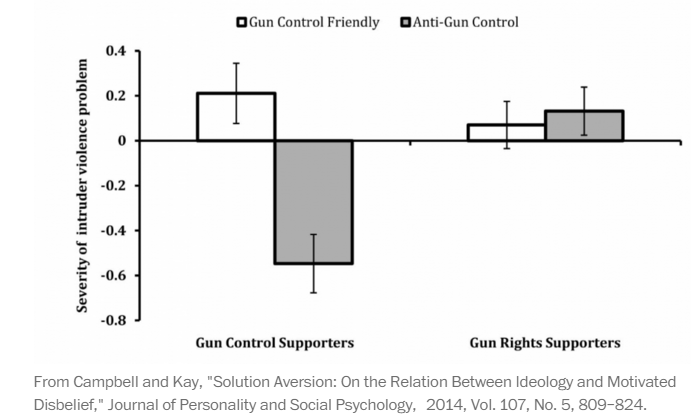
The Left picks and chooses which scientific consensus as it accepts. The overwhelming consensus among researchers is biotech crops are safe for humans and the environment. This is a conclusion that is rejected by the very environmentalist organisations that loudly insist on the policy relevance of the scientific consensus on global warming.
Previously the precautionary principle was used to introduce doubt when there was no doubt. But when climate science turned in their favour, environmentalists wanted public policy to be based on the latest science.
The Right is welcoming of the science of nuclear energy or geo-engineering. The Left rejects it point-blank. Their refusal to consider nuclear energy as a solution to global warming is a classic example of solution aversion. Let he who is without sin cast the first stone.
@BernieSanders and @realdonaldtrump trade in fear and blame
08 Mar 2016 Leave a comment
in economics of media and culture, politics - USA, Public Choice, television
This @amprog conservative antipoverty dictionary does not add up
08 Mar 2016 Leave a comment
in applied welfare economics, economic history, economics of bureaucracy, labour economics, politics - USA, poverty and inequality, Public Choice, welfare reform Tags: 1996 US welfare reforms, pessimism bias, social insurance, welfare state
From @EugeneSteuerle: Combined tax rates and creating a 21st century social welfare budget tpc.io/1GCdrYF http://t.co/aNRPqz5gAc—
Tax Policy Center (@TaxPolicyCenter) June 28, 2015

The only alternative offered by the Centre for American Progress is send them on a course. This response, which is the standard policy response to any labour market crisis, will not solve poverty, mush less inequality.
Will more education decrease inequality? A simulation provided an answer. nyti.ms/1xw5m9W http://t.co/paQp19BEWc—
The Upshot (@UpshotNYT) March 31, 2015
Directors’ Law vindicated again – the American middle class think there are undervalued
06 Mar 2016 Leave a comment

Why did communism fall in the USSR?
05 Mar 2016 Leave a comment
in constitutional political economy, economic history, economics of bureaucracy, Public Choice, rentseeking
I find many explanations of the fall of the USSR disappointing because many want to believe in people power and popular rebellions.
The rise and fall of mercantilism view of the USSR put forward by Pete Boettke will be the foundation of better explanations. By analysing communism as a rent-seeking society, the process of social and political evolution can be embedded into the history of the rise and fall of mercantilism.
More freedom in Russia and China came as an unintended by-product of a constitutional struggle over who would control the rules under which the economy prospered (or failed to prosper) and the sharing within the elite.
After the death of Stalin, the Soviet Nomenklatura used both co-option and political repression to encourage loyalty to the communist regime. As Grossman noted:
Under Stalin’s leadership the nomenklatura, after initially emphasizing a strategy of co-option, then experimented with political repression as a substitute for co-option, and finally, in response to the threats posed by German militarism and the onset of the Cold War, employed a combination of intense political repression and co-option. As a result, membership in the CPSU increased rapidly, then decreased sharply, before increasing rapidly again. After Stalin was gone the nomenklatura, having learned the cost of Stalin’s repressive excesses, adopted a policy that combined more co-option with less intense political repression. As a result, membership in the CPSU increased steadily, then levelled off, until the rapprochement between the United States and China, the emergence of Islamic fundamentalism, and the escalation of the cold war arms race resulted in yet more co-option and in the final episode of growth in party membership.
More and more of the general public in Russia and China were co-opted into the winning circle through peacefully adaptations when threats of revolution were minimal.
The cost of co-opting people into the Communist Party was a decrease in the standard of living of members of the Nomenklatura, whereas the cost of political repression was the danger that members of the Nomenklatura would themselves be victimized.
These successive minor reforms were mutual beneficial constitutional exchanges as suggested by Roger Congleton’s brilliant recent book on his king-and-council template and in Herschel Grossman’s earlier paper on co-option in the communist party from 1953 to 1989.
The USSR broke apart as the result of an internal power struggle within a new generation of leaders who grew up in a climate of corruption and high living.
Perestroika and glasnost should be viewed as nothing much more than the usual system reforms and rotations of patronage that were launched after the appointment of all previous Soviet leaders. As Anderson and Boettke explain
…upon closer examination, the succession of Gorbachev in general and the perestroika/glasnost “reform” program in particular bear a close resemblance to other, earlier Soviet government policy adjustments which followed shifts in the top leadership. Gorbachev’s behaviour as a “reformer” over the period 1985 to 1989 can be explained by reference to the incentives facing the dictator of a socialist state based on the distribution of economic privilege and political patronage… Gorbachev’s period of “reform” was not an extraordinary example of the role of ideology or vision in human affairs, but a more routine episode of rent-seeking in action.
Political and economic power was devolved to the 15 republics in the old USSR because this is the only way to operate a mercantilist state.
These local leaders formed their own alliances and declared succession from the USSR when the centre was too weak to fight. Local military units defected with them to a new rent-seeking coalition.
The fall of soviet communism led to a drawn out struggle for access to patronage and state monopolies and a new and better paid manifestation of the old mercantilism but ex-KGB owned and run under Putin.
How the Curly effect explains @realdonaldtrump @berniesanders
04 Mar 2016 Leave a comment
in constitutional political economy, politics - USA, Public Choice
Why are conspiracy theorists so trusting of citizen initiated binding referendums?
04 Mar 2016 Leave a comment
in comparative institutional analysis, constitutional political economy, politics - New Zealand, Public Choice
After reflecting far more than I should on some conspiracy laden testimony at Parliament yesterday, one of the things I recall was a demand that the approval of the TPPA be put to binding referendum. The conspiracy theorist at hand was deeply concerned about how that treaty was encroaching on New Zealand’s sovereignty.
Why did this conspiracy theorist assume that a binding referendum will go his way and that opposing conspiracy theorists will not put up their own binding referendums in which he will lose?
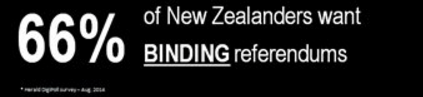
The major drawback of citizen initiated referendums is any bunch of people can put them up much to the annoyance of those who will be a victim of the law to be passed.

Just as rotation of power is inherent to Parliamentary democracy, the ability of the crazies to the either the left or the right of you to initiate their own binding citizen initiated referendums. The first referendum is likely to be on one of the following:
- decriminalising marijuana,
- banning smoking,
- voluntary euthanasia,
- a living wage,
- life means life in prison,
- same-sex marriages,
- marriage is between a man and a woman,
- entrenching the Treaty of Waitangi,
- abolishing the Maori seats,
- entrenching the Maori seats,
- stop school closures,
- capital punishment; and
- future referendums not be binding.
Binding referenda are unworkable. Parliament can’t amend them later as we learn from the implementation of the law and unintended consequences arise. Every new law is riddled with unintended consequences and blow-backs.
Do you really want to have to have another referendum to undo a binding referendum that turned out to be a bit of a mistake? One of the few redeeming features of the Parliament that is sovereign – a parliament for can make or unmake any law whatsoever – is it can repeal its mistakes quickly.
The first citizens initiated referendum was held on 2 December 1995. The question was
Should the number of professional fire-fighters employed full-time in the New Zealand Fire Service be reduced below the number employed in 1 January 1995?
Turnout was low as the referendum was not held in conjunction with a general election, and the measure was voted down easily, with just over 12% voting “Yes” and almost 88% voting “No”.
The key to constitutional design is not empowering you and yours – it is how to restrain those crazies to the Left or the Right of you, as the case may be, when they get their hands on the levers of power, as they surely will in three, six or nine years’ time.
The one inevitability of democracy is power rotates – unbridled power and binding referenda lose their shine when you must share that power with the opposing side of politics who put up their own referendum question.
Constitutions are brakes, not accelerators. Much of constitutional design is about checks and balances and the division of power to slow the impassioned majority down.
Conspiracy theorists that pretty much sore losers. The last thing they want is a binding referendum on a topic on which they are going to vote no.

The problem of constitutional design was ensuring that government powers would be effectively limited. The constitutions were designed and put in place by the classical liberals to check or constrain the power of the state over individuals.
The motivating force of the classical liberals was never one of making government work better or even of insuring that all interests were more fully represented. Built in conflict and institutional tensions were to act as constraints on the power and the size of government.
Modern democracy is government subject to electoral checks. Citizens do have sufficient knowledge and sophistication to vote out leaders who are performing poorly or contrary to their wishes. Modern democracy is the power to replace governments at periodic elections.
The power of the electorate to turn elected officials out of office at the next election gives elected officials an incentive to adopt policies that do not outrage public opinion and administer the policies with some minimum honesty and competence.
Too many want to remake democracy with the faculty workshop as their model. Such deliberation has demanding requirements for popular participation in the democratic process, including a high level of knowledge and analytical sophistication and an absence, or at least severe curtailment, of self-interested motive. The same goes for citizen initiated binding referendums.
The rotation of power is common in democracies, and the worst rise to the top, so it is wise to design constitutional safeguards to minimise the damage done when those crazies to the right or left of you get their chance in office, as they will.
State power was something that classical liberals feared, and the problem of constitutional design is insuring that such power would be effectively limited. Conspiracy theorists lose all their fear of power by drinking on the heady wine of citizens initiated referendum. Be careful for what you wish for.


Recent Comments