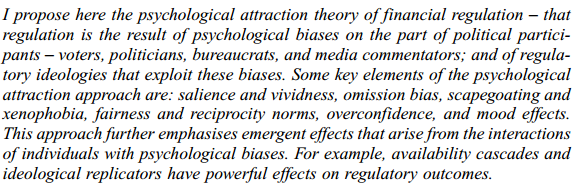
“Psychological Bias as a Driver of Financial Regulation,” David Hirshleifer, European Financial Management, 14(5), November, (2008):856-874.
Celebrating humanity's flourishing through the spread of capitalism and the rule of law
06 May 2016 Leave a comment
in comparative institutional analysis, constitutional political economy, economics of bureaucracy, economics of regulation, financial economics, Public Choice Tags: behavioural public choice, rational irrationality
“Psychological Bias as a Driver of Financial Regulation,” David Hirshleifer, European Financial Management, 14(5), November, (2008):856-874.
04 May 2016 Leave a comment
in applied price theory, development economics, economic history, economics, economics of crime, economics of regulation, entrepreneurship, Gordon Tullock, growth disasters, growth miracles, income redistribution, law and economics, Public Choice, rentseeking Tags: bribery and corruption, Tullock paradox
30 Apr 2016 Leave a comment
in comparative institutional analysis, constitutional political economy, energy economics, environmental economics, global warming, Public Choice, rentseeking Tags: European Union, expressive voting, green rent seeking, Italy, renewable energy, solar power, wind power
Massimo Tavoni and Caterina Gennaioli published a nice paper showing that corruption and violence was higher in the high wind provinces of Italy after the installation of wind generators. They built on earlier work about countries with abundant renewable resources and weak institutions. The main question in their paper
… is whether an increase in the expected returns of investments in wind energy, following the introduction of the new policy regime based on a green certificate system, has driven economic agents, namely bureaucrats and entrepreneurs, to engage more in rent seeking activities.
As they studied Italy, there is no surprise about the answer which was yes. High winds ensure high returns of the wind farm investment, but whether this translates into more bribery depends on institutional quality. There was more corruption, and so especially in high-wind provinces of Italy.
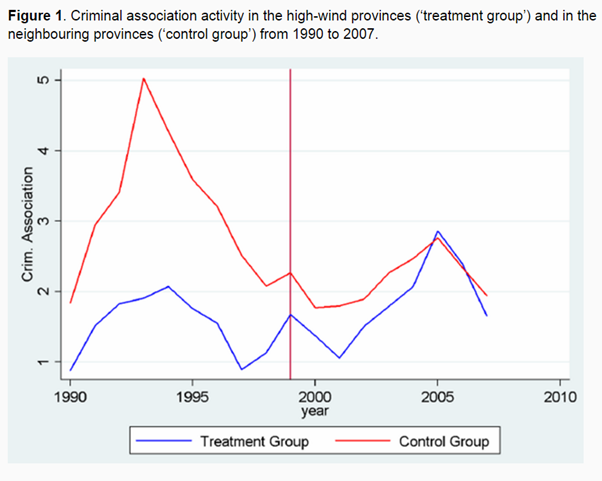
Source: Green policy and corruption | VOX, CEPR’s Policy Portal.
The construction of an average wind park is associated with an increase of criminal association activity of 6%. Italy will have more corruption than elsewhere in the old European Union.
The wider problem is renewable energy is a celebrity technology. In the context of expressive politics, so many cheer for solar and wind power that standards drop in terms of who qualifies for subsidies and who should lose support when their investments do not turn out as promised.
https://twitter.com/CountCarbon/status/715136022414299138
Wind power is not new, it is intermittent, is unsuitable for modern work, and is land constrained but it is still subsidised. Green rent seeking is a real risk even in countries with the best political institutions.
29 Apr 2016 Leave a comment
in labour economics, labour supply, Public Choice Tags: lottery winners, voter demographics
28 Apr 2016 Leave a comment
in applied price theory, applied welfare economics, environmental economics, global warming, Public Choice Tags: carbon pricing, carbon tax, climate alarmism, cost benefit analysis, expressive voting, mitigation and adaptation, rational irrationality
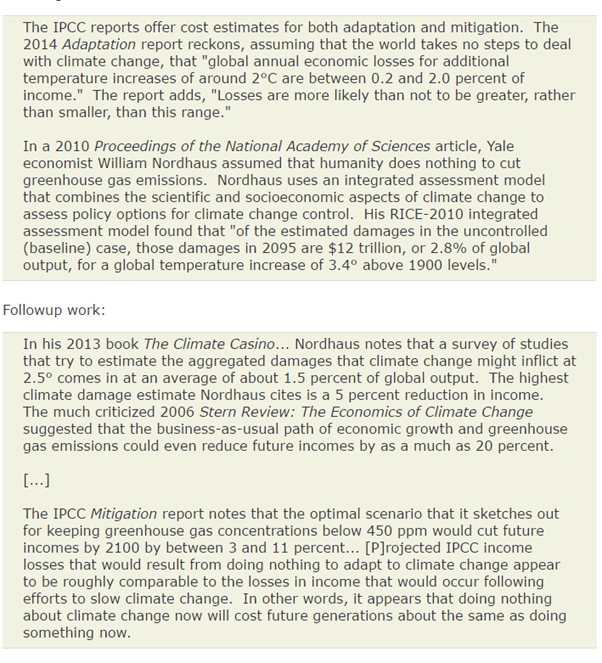
Source: Global Warming, Cost-Benefit Analysis, and The End of Doom, Bryan Caplan | EconLog | Library of Economics and Liberty from Ron Bailey (2016) The End of Doom: Environmental Renewal in the Twenty-first Century.
27 Apr 2016 Leave a comment
in applied price theory, business cycles, economics of bureaucracy, economics of regulation, fiscal policy, macroeconomics, monetary economics Tags: anti-market bias, antiforeign bias, expressive voting, lags on monetary policy, makework bias, rational rationality, tax incidence, The fatal conceit, The pretense to knowledge
I used to argue that the quality of public policy making would double if public policy analysts remembered the first 6 weeks of microeconomics 101 but on reflection more than that is required.
Could we economists today ever show such self-restraint about our own expert recommendations? https://t.co/2UE12JuIgn—
William Easterly (@bill_easterly) November 24, 2015
I picked up my initial insight out when working as a graduate economist in the Australian Department of Finance. That was a few years ago.
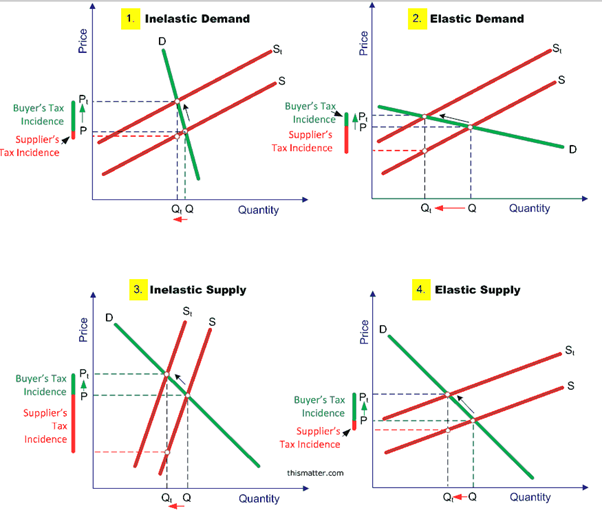
I am now concluded that policy analysts also need to know the basics of the economics of tax incidence. Who pays the tax depends on the elasticities of supply and demand rather than who writes the check to the taxman.
The number of times that I have read media and public policy analysis saying who pays the tax is the writer of the cheque to the taxman is beyond counting.
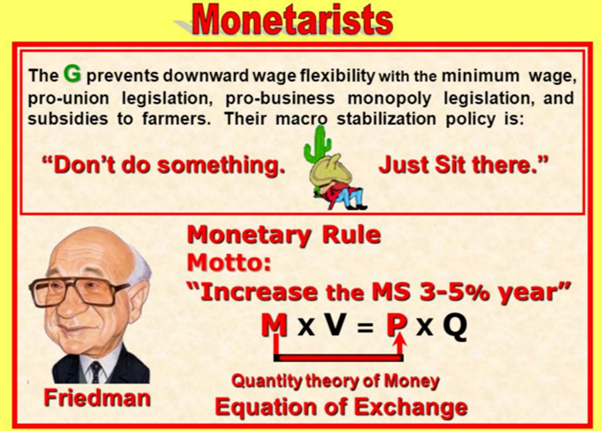
There is also what to do about unemployment and inflation. Do not just do something, sit there might be good advice on most occasions. As Tim Kehoe and Gonzalo Fernandez de Cordoba explain in the context of first do no harm:
Looking at the historical evidence, Kehoe and Prescott conclude that bad government policies are responsible for causing great depressions.
In particular, they hypothesize that, while different sorts of shocks can lead to ordinary business cycle downturns, overreaction by the government can prolong and deepen the downturn, turning it into a depression.
26 Apr 2016 Leave a comment
in constitutional political economy, development economics, Public Choice Tags: The Philippines
26 Apr 2016 Leave a comment
in applied price theory, development economics, economic history, growth disasters, growth miracles, Public Choice, rentseeking Tags: anti-market bias, economics of socialism, rational irrationality, The Great Escape, The Great Fact
A new World Bank study shows the dramatic reductions in global poverty and inequality as a result of the spread of market institutions and freer trade.

Source: Capitalism, Global Trade, and the Reduction in Poverty and Inequality | Cato @ Liberty
24 Apr 2016 Leave a comment
in economics of regulation, energy economics, environmental economics, global warming, Public Choice, rentseeking Tags: antimarket bias, antiscience left, green rent seeking, Greenpeace, nuclear power, pessimism bias, rational irrationality, wind power

24 Apr 2016 Leave a comment
in economics of education, human capital, income redistribution, labour economics, minimum wage, poverty and inequality, rentseeking Tags: Director's Law, IQ, rational irrationality, social justice warriors
The majority of New Zealanders do not qualify for university. Perhaps Labour and the Greens should spend more time worrying about those who do not achieve university entrance standard.

Source: School leavers with NCEA level 3 or above | Education Counts.
Anyone who achieve university entrance standard is among the intellectual elite. They have a head start in life. Labour and the Greens are preoccupied with giving those with a head start in life more freebies.
24 Apr 2016 Leave a comment
in applied welfare economics, politics - New Zealand, Public Choice, rentseeking, urban economics Tags: Auckland, housing affordability, land supply, land use planning, NIMBYs, Resource Management Act, urban limits, zoning
New Zealand housing prices were pretty flat up for the two decades until the passage of the Resource Management Act (RMA) in 1993. They then soared well before any foreign buyers such as from China entered the market.
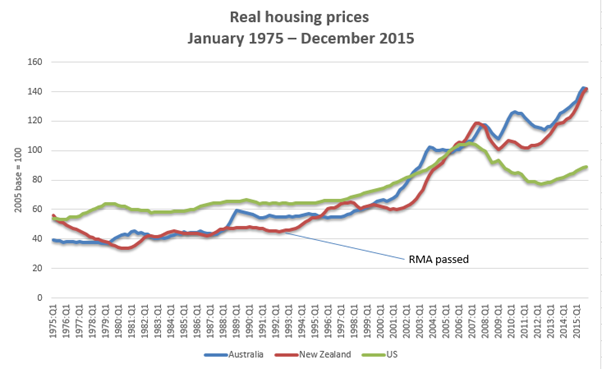
Source: International House Price Database – Dallas Fed December 2015; nominal housing prices for each country is deflated by the personal consumption deflator for that country.
Most of the housing price rises were under the watch of a Labour Government – a party which is supposed to look out for working families.
The failure of the Labour Party to nip the problem in the bud when they had a working majority in Parliament means future solutions run into the political problem that any significant increase in supply of land may push many with recent mortgages such as in Auckland into negative equity.
Since they left office in 2008, leaving land supply regulation in a mess, the approach of Labour has been political opportunism rather than supporting RMA reform.
Labour recently admitted the need to increase the supply of land, but have not put forward practical ideas to increase the supply of land.
The National Party is not much better in terms of real solutions to regulatory constraints on the supply of land.
23 Apr 2016 1 Comment
in applied price theory, applied welfare economics, economics of regulation, labour economics, labour supply, occupational choice, occupational regulation, Public Choice, rentseeking Tags: adverse selection, barriers to entry, moral hazard, occupational licensing, occupational regulation
The 2015 Current Population Survey in the USA added a question about whether you needed a licence or a certificate to practice your occupation. One in 4 Americans say they need a licence or certificate. 22.4% need a license and 3.1% need a certificate among employed over the age of 16 in the USA.
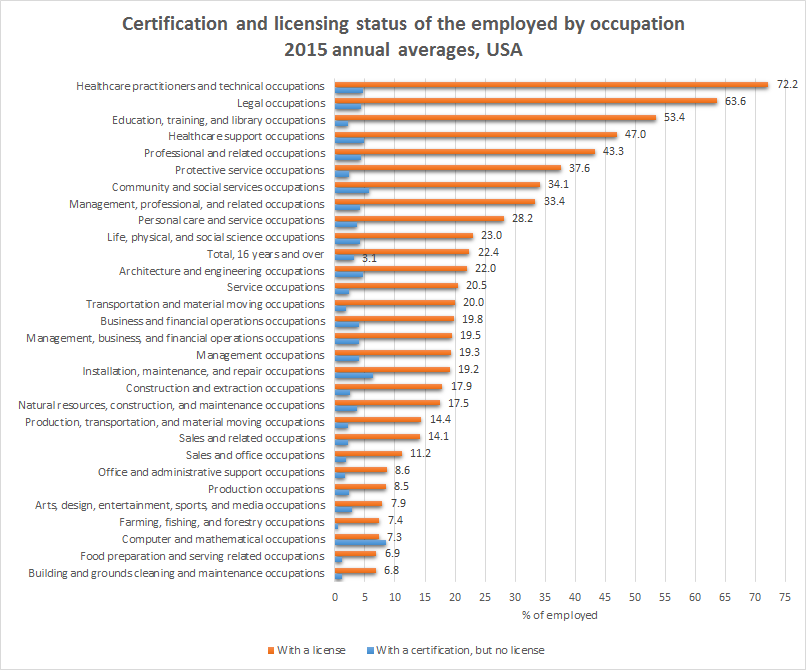
Source: Bureau of Labour Statistics, Labor Force Statistics from the Current Population Survey (2015), Certification and licensing status of the employed by occupation Table 5.
This estimate of 25% is less than the 30% estimated by Kleiner and Vorotnikov (2015) using a Harris Poll. Kleiner and Vorotnikov (2015) also found that some American states regulate twice as many occupations as others. This diversity in federalism strains any public interest explanation of occupational regulation.
Occupational regulation is more likely to be an issue for those who finished further education. It would have been better if the estimate by the Bureau of Labour Statistics was for adults and not have included teenagers.
The purpose of occupational regulation is to protect buyers from quacks and lemons – to overcome asymmetric information about the quality of the provider of the service.
The main issue with quacks in the labour market is whether there is a large cost of less than average quality service, and is there a sub-market who will buy less than average quality products in the presence of competing sellers competing on the basis of quality assurance. This demand for assurance creates opportunities for entrepreneurs to profit by providing assurance of quality.
Mostly disciplinary investigations and deregistrations under the auspices of occupational regulation are for gross misconduct and criminal convictions rather than the shading of quality.
22 Apr 2016 Leave a comment
in economics of bureaucracy, economics of media and culture, television Tags: Yes Minister
22 Apr 2016 2 Comments
in comparative institutional analysis, constitutional political economy, politics - New Zealand, Public Choice Tags: head of state, New Zealand republic
The principal argument against the republic is it results in a president as the head of state.
In the last Republican debate in Australia in 1999, the Republican movement split between those who wanted an appointed president and an elected president.
An elected president would quickly get ideas above his station because of their popular mandate.
Imagine Gareth Morgan as president. He is a great New Zealander, but heads of state are supposed to be seen and not heard.

It would be a good pub quiz game to list the people would be wholly unsuited as president but would be likely to be elected. Boring people such as those who currently occupy the position such as judges and retired military would not have much of a chance of being elected. A vote for president would be the ultimate protest vote.
The Irish president, for example, is elected but is completely circumscribed in powers. The only power they have to exercise independently is whether to dissolve parliament after a motion of no confidence.
A president elected by the New Zealand House of Representatives would still have some sort of independent mandate and sooner or later would get ideas above their station, which is to be seen but not heard.
21 Apr 2016 Leave a comment
in economics of media and culture, Public Choice, public economics Tags: West Wing
Celebrating humanity's flourishing through the spread of capitalism and the rule of law
Celebrating humanity's flourishing through the spread of capitalism and the rule of law
Celebrating humanity's flourishing through the spread of capitalism and the rule of law
Celebrating humanity's flourishing through the spread of capitalism and the rule of law
Celebrating humanity's flourishing through the spread of capitalism and the rule of law
Celebrating humanity's flourishing through the spread of capitalism and the rule of law
Celebrating humanity's flourishing through the spread of capitalism and the rule of law
Celebrating humanity's flourishing through the spread of capitalism and the rule of law
A History of the Alt-Right
Econ Prof at George Mason University, Economic Historian, Québécois
Celebrating humanity's flourishing through the spread of capitalism and the rule of law
Scholarly commentary on law, economics, and more
Beatrice Cherrier's blog
Celebrating humanity's flourishing through the spread of capitalism and the rule of law
Celebrating humanity's flourishing through the spread of capitalism and the rule of law
Celebrating humanity's flourishing through the spread of capitalism and the rule of law
Why Evolution is True is a blog written by Jerry Coyne, centered on evolution and biology but also dealing with diverse topics like politics, culture, and cats.
Celebrating humanity's flourishing through the spread of capitalism and the rule of law
A rural perspective with a blue tint by Ele Ludemann
DPF's Kiwiblog - Fomenting Happy Mischief since 2003
Celebrating humanity's flourishing through the spread of capitalism and the rule of law
The world's most viewed site on global warming and climate change
Tim Harding's writings on rationality, informal logic and skepticism
A window into Doc Freiberger's library
Let's examine hard decisions!
Commentary on monetary policy in the spirit of R. G. Hawtrey
Thoughts on public policy and the media
Celebrating humanity's flourishing through the spread of capitalism and the rule of law
Politics and the economy
A blog (primarily) on Canadian and Commonwealth political history and institutions
Reading between the lines, and underneath the hype.
Economics, and such stuff as dreams are made on
"The British constitution has always been puzzling, and always will be." --Queen Elizabeth II
Celebrating humanity's flourishing through the spread of capitalism and the rule of law
Celebrating humanity's flourishing through the spread of capitalism and the rule of law
WORLD WAR II, MUSIC, HISTORY, HOLOCAUST
Undisciplined scholar, recovering academic
Celebrating humanity's flourishing through the spread of capitalism and the rule of law
Res ipsa loquitur - The thing itself speaks
In Hume’s spirit, I will attempt to serve as an ambassador from my world of economics, and help in “finding topics of conversation fit for the entertainment of rational creatures.”
Researching the House of Commons, 1832-1868
Articles and research from the History of Parliament Trust
Reflections on books and art
Posts on the History of Law, Crime, and Justice
Celebrating humanity's flourishing through the spread of capitalism and the rule of law
Exploring the Monarchs of Europe


Recent Comments