From the Economist: The international tax system has long suffered from two related problems: firms go to great lengths to book profits in low-tax jurisdictions, and governments thus have strong incentives to compete with each other in cutting levies so as to attract investment [only a dirigiste would consider this a problem]. Hoping to forestall…
Can President Trump break the International Corporate Tax Cartel?
Can President Trump break the International Corporate Tax Cartel?
01 Feb 2025 Leave a comment
in entrepreneurship, financial economics, fiscal policy, industrial organisation, International law, macroeconomics, politics - USA, Public Choice, public economics Tags: taxation and entrepreneurship, taxation and investment
Reviewing Covid experiences and policies
01 Feb 2025 Leave a comment
in applied price theory, applied welfare economics, comparative institutional analysis, economic growth, economics of bureaucracy, economics of regulation, health economics, macroeconomics, politics - New Zealand, Public Choice Tags: economics of pandemics

Michael Reddell writes – I’ve spent the last week writing a fairly substantial review of a recent book (“Australia’s Pandemic Exceptionalism: How we crushed the curve but lost the race”) by a couple of Australian academic economists on Australia’s pandemic policies and experiences. For all its limitations, there isn’t anything similar in New Zealand. What […]
Reviewing Covid experiences and policies
Reviewing Covid experiences and policies
30 Jan 2025 Leave a comment
in applied price theory, applied welfare economics, economic history, economics of bureaucracy, economics of regulation, fiscal policy, health and safety, health economics, labour economics, labour supply, law and economics, macroeconomics, politics - Australia, politics - New Zealand, property rights, Public Choice Tags: economics of pandemics

I’ve spent the last week writing a fairly substantial review of a recent book (“Australia’s Pandemic Exceptionalism: How we crushed the curve but lost the race”) by a couple of Australian academic economists on Australia’s pandemic policies and experiences. For all its limitations, there isn’t anything similar in New Zealand. What we do have is […]
Reviewing Covid experiences and policies
My 92nd St. Y debate with Robert Kuttner on income inequality
29 Jan 2025 Leave a comment
in applied price theory, entrepreneurship, human capital, income redistribution, industrial organisation, labour economics, labour supply, liberalism, Marxist economics, politics - USA, poverty and inequality, Public Choice Tags: top 1%
Here goes: Ex po st, the Manhattan audience swung thirty (!) points in my favor, compared to the pre-debate poll. This was a fun event for me.
My 92nd St. Y debate with Robert Kuttner on income inequality
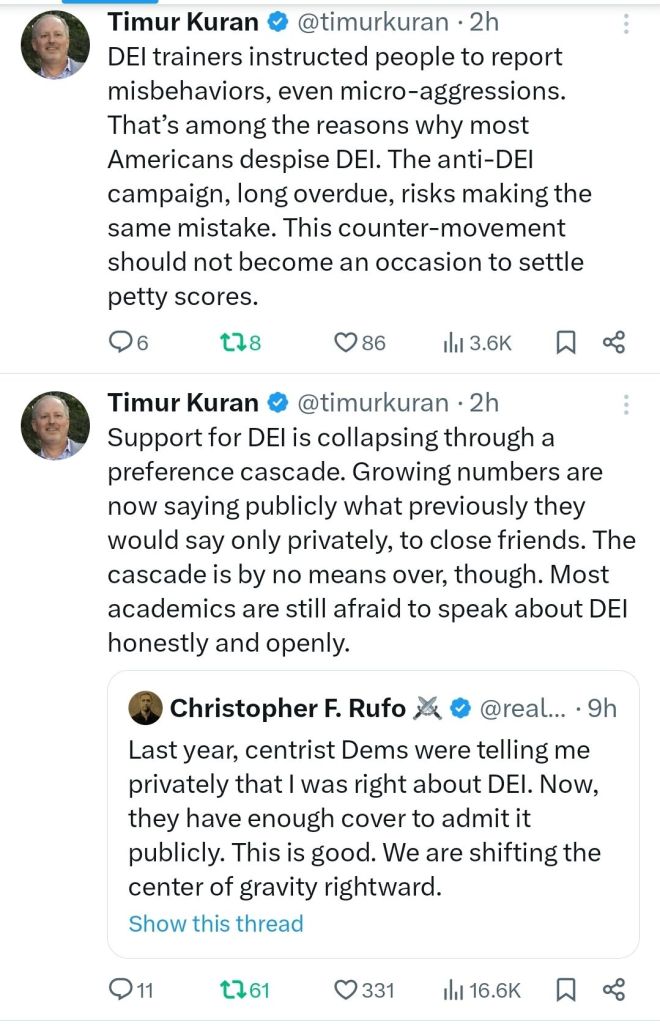
The DEI preference cascade
23 Jan 2025 Leave a comment
in applied price theory, behavioural economics, discrimination, economics of bureaucracy, economics of education, economics of information, economics of media and culture, economics of regulation, gender, labour economics, law and economics, liberalism, Marxist economics, politics - USA, property rights, Public Choice Tags: affirmative action, Age of Enlightenment, free speech, political correctness, racial discrimination, regressive left, sex discrimination
DON BRASH: Equality is not a dirty word
21 Jan 2025 Leave a comment
in discrimination, health economics, income redistribution, law and economics, liberalism, Marxist economics, politics - New Zealand, property rights, Public Choice, rentseeking Tags: constitutional law, racial discrimination
Surely, in a liberal democracy, there are few words more chilling to read written in earnest than the “flawed concept of ‘equality’”. But there they were, in print, in an opinion piece by the National Urban Māori Authority’s Lady Tureiti Moxon published in the NZ Herald on Tuesday last week. The Treaty Principles Bill has…
DON BRASH: Equality is not a dirty word
Good Riddance, Joe Biden
20 Jan 2025 Leave a comment
in applied price theory, budget deficits, economic growth, economic history, economics of regulation, energy economics, environmental economics, fiscal policy, global warming, industrial organisation, labour economics, macroeconomics, monetary economics, politics - USA, Public Choice, rentseeking, survivor principle Tags: 2024 presidential election, regressive left
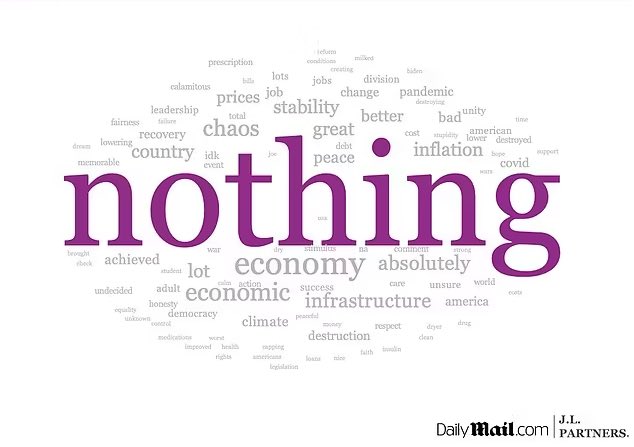
This is the last full day of Joe Biden’s dismal presidency, so let’s do what we did with Justin Trudeau and reflect on his pathetic legacy. I’ve already provided my own economic assessment of Biden’s record, so now let’s review how he is seen by others. We’ll start with the American people. According to a […]
Good Riddance, Joe Biden
Bill Maher’s latest monologue: the L.A. fires and progressive politics
19 Jan 2025 Leave a comment
in economics of bureaucracy, economics of climate change, economics of natural disasters, environmental economics, environmentalism, global warming, law and economics, politics - USA, property rights, Public Choice Tags: climate alarmism
After a vacation hiatus, Bill Maher is back with a monologue called, “New rules: political firestorm.” Here he parses blame for the L.A. fires between unavoidable causes (no rain, lots of brush) and avoidable ones (blockheaded politicians). The latter, he says, involves cuts in the firse-department budget, stolen or nonfunctional hydrants, empty reservoirs, exposed power […]
Bill Maher’s latest monologue: the L.A. fires and progressive politics
Further proof the Council just made things worse
17 Jan 2025 Leave a comment
in applied price theory, comparative institutional analysis, economics of bureaucracy, economics of regulation, entrepreneurship, industrial organisation, politics - New Zealand, Public Choice, public economics, rentseeking, survivor principle
Stuff reports: Reading Cinemas is set to return to Wellington after it was revealed on Tuesday night that the cinema chain’s owner, Reading International, intends to undertake a redevelopment of the old building. The company has entered into a Sale and Purchase Agreement with Prime Property Group, with part of the deal including a seismic upgrade […]
Further proof the Council just made things worse
Margaret Thatcher, Michael Curley, and the 19th Theorem of Government
16 Jan 2025 Leave a comment
in applied price theory, applied welfare economics, Austrian economics, comparative institutional analysis, constitutional political economy, economic growth, economic history, economics of regulation, energy economics, environmental economics, financial economics, fiscal policy, human capital, income redistribution, international economics, labour economics, labour supply, law and economics, liberalism, libertarianism, macroeconomics, Marxist economics, politics - USA, poverty and inequality, property rights, Public Choice, public economics, regulation, rentseeking
In this 12-second video, Margaret Thatcher is talking about the Labour Party in the United Kingdom, but her warning has universal application. And when I say her warning has universal application, I’m not joking. Politicians generally can’t resist the temptation to buy votes. And I fear that this can and will happen at all levels […]
Margaret Thatcher, Michael Curley, and the 19th Theorem of Government
Winston Peters: “Principles of the Treaty of Waitangi – Deletion” Bill…
15 Jan 2025 Leave a comment
in comparative institutional analysis, constitutional political economy, discrimination, economic history, law and economics, politics - New Zealand, property rights, Public Choice, rentseeking Tags: constitutional law
The New Zealand Centre for Political Research dipped into the Parliamentary archives and retrieved Winston Peters’ speech on the first reading of New Zealand First’s “Principles of the Treaty of Waitangi – Deletion” Bill on 8 June 2005 Rt Hon WINSTON PETERS (Leader—NZ First) : I move, That the Principles of the Treaty […]
Winston Peters: “Principles of the Treaty of Waitangi – Deletion” Bill…
Not a useful question
14 Jan 2025 Leave a comment
in applied price theory, politics - New Zealand, Public Choice, transport economics Tags: state ownership
Radio NZ report: A new poll has found close to half of New Zealanders want the new Interislander ferries to be rail-enabled. The government is still considering replacement options after ditching Labour’s iRex project citing a large cost blowout, in particular from upgrading port infrastructure, taking the pricetag upwards of $3 billion. Horizon Research has found 48 […]
Not a useful question
Noah Smith on L.A: fire lessons
13 Jan 2025 Leave a comment
in applied price theory, economics of bureaucracy, economics of natural disasters, environmental economics, environmentalism, income redistribution, law and economics, politics - USA, property rights, Public Choice, rentseeking, urban economics Tags: unintended consequences
The best piece I have seen so far, here is one bit: Basically, the lessons I take away from the horrific L.A. fires are: The insurance industry as we know it is in big trouble. Climate change is making wildfires worse, but there’s not much we can do about that right now. Forest management needs […]
Noah Smith on L.A: fire lessons
‘A Huge Win’: Woke ‘Cartel’ Of Financial Giants Dealt Death Blow 11 Days Before Trump Takes Office
13 Jan 2025 Leave a comment
in applied price theory, economics of climate change, energy economics, entrepreneurship, environmental economics, environmentalism, financial economics, global warming, politics - USA, Public Choice, rentseeking Tags: efficient markets hypothesis
“The news of BlackRock’s departure from NZAM should be music to the ears of every American consumer,” Will Hild, executive director of conservative nonprofit Consumers’ Research, told the Daily Caller News Foundation. “NZAM is an illegitimate cartel of asset managers pushing harmful and costly net zero policies across the entire economy. The activities of NZAM and its members raise prices on Americans everywhere from the gas pump to the grocery store.”
‘A Huge Win’: Woke ‘Cartel’ Of Financial Giants Dealt Death Blow 11 Days Before Trump Takes Office
Some Links
12 Jan 2025 Leave a comment
in applied price theory, budget deficits, development economics, economic growth, economic history, economics of regulation, entrepreneurship, fiscal policy, global financial crisis (GFC), great recession, growth disasters, growth miracles, human capital, income redistribution, industrial organisation, international economics, job search and matching, labour economics, labour supply, macroeconomics, monetary economics, poverty and inequality, Public Choice, rentseeking, survivor principle, unemployment
TweetGMU Econ alum Holly Jean Soto busts the myth of “greedflation.” Scott Lincicome identifies an interesting contrast between the facts and opinion about China. George Will decries the spinelessness of the modern U.S. Congress. A slice: The incoming president will be able, on a whim, to unilaterally discombobulate international commerce — and the domestic economy…
Some Links


Recent Comments