Did the British Empire REALLY Drive the Industrial Revolution? IEA Debates
06 Jun 2024 Leave a comment
in applied price theory, comparative institutional analysis, constitutional political economy, economic history, economics of bureaucracy, growth disasters, growth miracles, income redistribution, Public Choice, rentseeking Tags: Age of Discovery, age of empires, economics of colonialism
A Primer on Marginal Tax Rates, Part IV: The Combined Burden of Levies on Income, Payroll, and Consumption
02 Jun 2024 Leave a comment
in Public Choice, public economics Tags: taxation and investment, taxation and labour supply
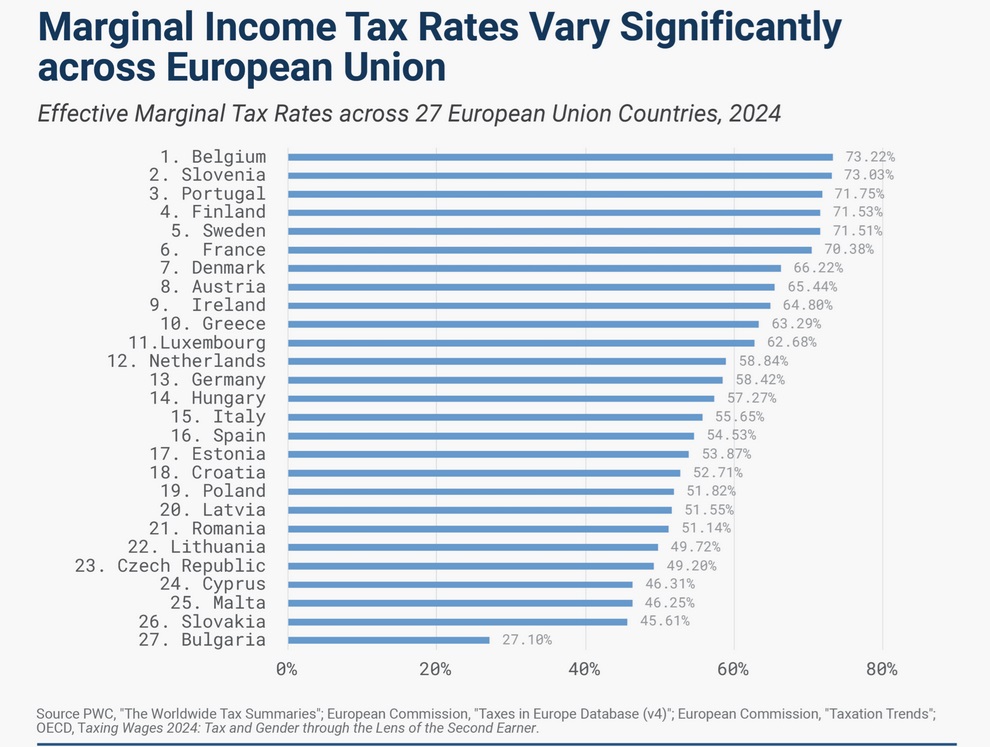
When I think of the world’s most mistreated taxpayers, a few options come to mind. Cam Newton, the quarterback who faced a marginal tax rate of nearly 200 percent on his Super Bowl bonus. The 8,000 French households who had to surrender more than 100 percent of their income in 2012. The unfortunate Spanish laborer […]
A Primer on Marginal Tax Rates, Part IV: The Combined Burden of Levies on Income, Payroll, and Consumption
“Democracy is on the Ballot”: California Democrats Seek to Prevent Voters from Approving New Taxes
01 Jun 2024 Leave a comment
in constitutional political economy, income redistribution, law and economics, Public Choice, public economics Tags: constitutional law

“Democracy is on the ballot.” That mantra of President Joe Biden and other democrats has suggested that “this may be our last election” if the Republicans win in 2024. A few of us have noted that the Democrats seem more keen on claiming the mantle of the defenders of democracy than actually practicing. Democrats have […]
“Democracy is on the Ballot”: California Democrats Seek to Prevent Voters from Approving New Taxes
Karen Chhour Skewers The Maori Party
31 May 2024 Leave a comment
in economic history, economics of crime, economics of education, income redistribution, labour economics, law and economics, liberalism, Marxist economics, politics - New Zealand, poverty and inequality, property rights, Public Choice, public economics Tags: child abuse, child poverty, crime and punishment, family poverty, law and order

Article is by Chris Lynch and I have pinched this one from The BFD Blog. `ĀCT MP Karen Chhour has responded to the Maori Party’s “divisive outbursts.” Co-leader Rawiri Waititi said yesterday, ‘It’s now time for us to step comfortably into our rangatiratanga and to not give too much to this Pakeha Government with their […]
Karen Chhour Skewers The Maori Party
The Huge Potential Benefits of Charter Schools
30 May 2024 Leave a comment
in economics of bureaucracy, economics of education, managerial economics, organisational economics, politics - New Zealand, Public Choice
Alwyn Poole writes – In New Zealand we have approximately 460 high schools. The gaps between the schools that produce the best results for students and those at the other end of the spectrum are enormous. In terms of the data for their leavers, the top 30 schools have an average of 87% of their […]
The Huge Potential Benefits of Charter Schools
India, Dependency, and the 17th Theorem of Government
28 May 2024 Leave a comment
in applied price theory, development economics, economic history, financial economics, growth disasters, growth miracles, income redistribution, macroeconomics, Public Choice, public economics, rentseeking Tags: India
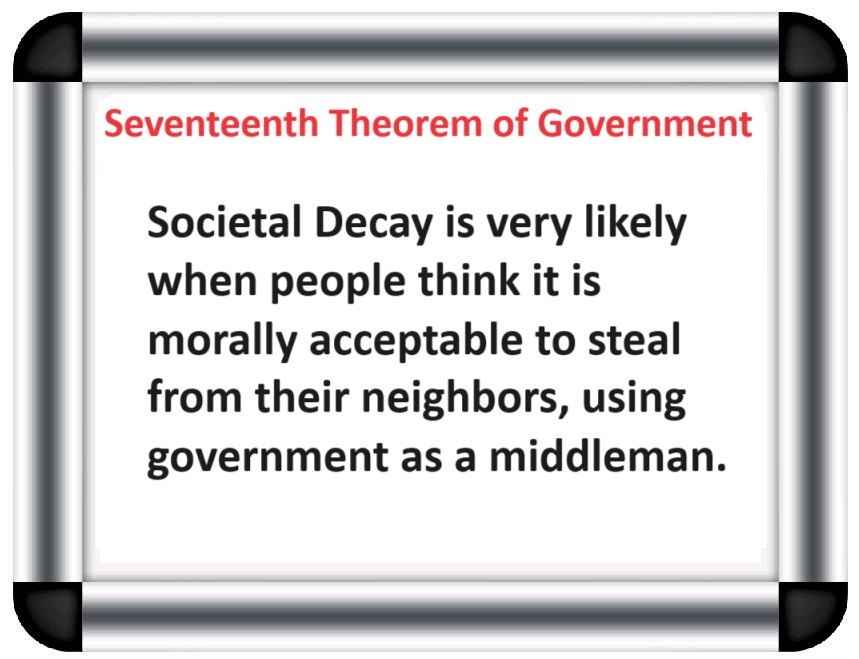
I released my First Theorem of Government in 2015 and today I’m going to unveil the 17th iteration in the series. But I’ll confess upfront that I’m doing a bit of recycling. My latest Theorem is very similar to something I shared back in 2014. I decided to upgrade my 2014 column to a Theorem […]
India, Dependency, and the 17th Theorem of Government
The cost of colonialism
26 May 2024 Leave a comment
in development economics, economic history, growth disasters, growth miracles, income redistribution, law and economics, Public Choice, rentseeking, transport economics Tags: China

Charter Schools are a worthwhile addition to our school system – but ACT is mis-selling why they are Good and Labour is mis-selling why they are Bad.
22 May 2024 Leave a comment
in economics of bureaucracy, economics of education, managerial economics, organisational economics, personnel economics, politics - New Zealand, Public Choice
We know the old saying, “Never trust a politician”, and the Charter School debate is a good example of it. Charter Schools receive public funding, yet “are exempt from most statutory requirements of traditional public schools, including mandates around .. human capital management .. curriculum & instructional practices, and governance & management structures”. That’s a…
Charter Schools are a worthwhile addition to our school system – but ACT is mis-selling why they are Good and Labour is mis-selling why they are Bad.
Debunking Bad Class Warfare and Debunking Nonsensical Class Warfare
19 May 2024 Leave a comment
in applied price theory, economic history, economics of education, entrepreneurship, human capital, income redistribution, industrial organisation, labour economics, labour supply, occupational choice, politics - USA, poverty and inequality, Public Choice Tags: taxation and entrepreneurship, taxation and investment

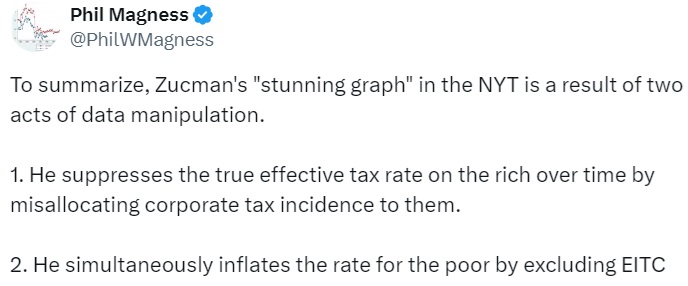
Like Thomas Piketty, Gabriel Zucman is a French economist who promotes economically destructive class-warfare tax policy. He’s also infamous for dodgy data manipulation, as Phil Magness explains in this Reason discussion. The interview lasts for 64 minutes, and I recommend the entire discussion. Yes, that’s a lot of time, but Phil has encyclopedic knowledge and […]
Debunking Bad Class Warfare and Debunking Nonsensical Class Warfare
Is it time to take the Interislander away from Kiwirail?
17 May 2024 Leave a comment
in applied price theory, economics of bureaucracy, industrial organisation, law and economics, managerial economics, politics - New Zealand, privatisation, property rights, Public Choice, survivor principle, theory of the firm, transport economics
The Herald reports: KiwiRail’s seemingly endless requests for more money is damning. At one point, KiwiRail assured Robertson when he was the Finance Minister that the worst-case scenario would be an extra $300 million before requesting $1.2 billion a few months later. Not what most people regard as worst case. It’s no wonder Ministry of Transport officials […]
Is it time to take the Interislander away from Kiwirail?
Bish delivers for Wellington
13 May 2024 Leave a comment
in economics of bureaucracy, environmental economics, law and economics, politics - New Zealand, property rights, Public Choice, urban economics Tags: housing affordability, land supply, zoning
Chris Bishop announced: “I have agreed with the Council’s alternative recommendations in nine instances, relating to development around Adelaide Road, the walkable catchment around the City Centre Zone (including Hay St), character precincts, building heights and controls on the interface of the City Centre Zone and Moir and Hania Street, setbacks for 1-3 residential units, […]
Bish delivers for Wellington
The Rise and Decline and Rise Again of Mancur Olson
09 May 2024 Leave a comment
in applied price theory, comparative institutional analysis, constitutional political economy, development economics, economic history, growth disasters, growth miracles, history of economic thought, income redistribution, industrial organisation, law and economics, property rights, Public Choice, public economics, rentseeking

Mancur Olson’s The Rise and Decline of Nations is one of my favorite books and a classic of public choice. Olson may well have won the Nobel prize had he not died young. He summarized his book in nine implications of which I will present four: 2. Stable societies with unchanged boundaries tend to accumulate […]
The Rise and Decline and Rise Again of Mancur Olson
DON BRASH: Letter sent to the Vice Chancellor AUT
09 May 2024 Leave a comment
in economics of bureaucracy, economics of education, law and economics, liberalism, Marxist economics, politics - New Zealand, Public Choice Tags: Age of Enlightenment, free speech, political correctness, racial discrimination, regressive left
The following was written on behalf of Hobson’s Pledge: Dear Vice Chancellor Damon Salesa, We are a group of New Zealanders whose primary objective is to fight for equality under the law and advance the vision Governor William Hobson expressed at Waitangi in 1840. He is said to have spoken the following words to each…
DON BRASH: Letter sent to the Vice Chancellor AUT
Dishonest Pimping for a Global Wealth-Tax Cartel
07 May 2024 Leave a comment
in applied price theory, economic growth, economic history, entrepreneurship, human capital, income redistribution, industrial organisation, labour economics, labour supply, macroeconomics, Marxist economics, politics - USA, Public Choice, public economics Tags: taxation and entrepreneurship, taxation and investment, wealth tax
Everything you need to know about wealth taxation can be summarized in two sentences. The biggest problem with most tax systems is the pervasive tax bias against income that is saved and invested, which discourages the accumulation of capital that helps to finance future growth. Wealth taxes would dramatically increase the tax bias against saving […]
Dishonest Pimping for a Global Wealth-Tax Cartel
Why have the media ignored this outrageous speech?
07 May 2024 Leave a comment
in discrimination, income redistribution, law and economics, liberalism, Marxist economics, politics - New Zealand, Public Choice, rentseeking Tags: free speech, political correctness, racial discrimination, regressive left
Read the whole tweet. A Member of Parliament got up in the House and said the Government (which has a Cabinet which is 35% Māori) wants to exterminate Māori. Has the media reported this, with the editorials decrying such nonsensical and abusive language? Imagine if an ACT MP said in the House that a Labour-led […]
Why have the media ignored this outrageous speech?


Recent Comments