
Who gains from global warming alarmism?
18 Feb 2015 2 Comments
in environmental economics, global warming, Public Choice, rentseeking Tags: activists, climate alarmism, global warming, green rent seeking
It’s not easy to be green: the cost of fossil fuels divestments to the New Zealand superannuation fund
17 Feb 2015 Leave a comment
in economics of bureaucracy, energy economics, environmental economics, environmentalism, financial economics, global warming, Public Choice, rentseeking Tags: efficient market hypothesis, fossil fuel disinvestment, Global disinvestment day, Green Party of New Zealand, index linked investing, privatisation, state ownership
The Green Party of New Zealand wants the New Zealand superannuation fund to sell its $676 million in fossil fuel investments. For those not in the know, this government investment fund is worth about $25 billion and is funded by present taxes to pay for the universal old age pension in New Zealand. Its current investment strategy seems to rely heavily on index linked funds that minimise management and trading costs.
The Government uses the Fund to save now in order to help pay for the future cost of providing universal superannuation.
In this way the Fund helps smooth the cost of superannuation between today’s taxpayers and future generations.
In common with the endowment funds of the American universities, that $676 million is about 2% of the total New Zealand superannuation portfolio of about NZ$25 billion.

Any portfolio manager risks considerable fees if she must monitor the entire portfolio because 2% is of dubious moral stature.

The main cost of divestiture is compliance costs to prevent fossil fuel investments drifting back into the portfolio through the routine day to day investments of other companies within their portfolios as these other firms expand into new businesses or diversified. The entire portfolio must be monitored for this risk.

American universities found that fossil fuels divestment rules out indexed linked funds as a class, along with their low management and trading fees. Ethical investors must move to actively managed investment funds which are perhaps a third more expensive in management fees.

If a move to a fossil fuel free portfolio rules out passive indexed linked funds, that is a major risk to future returns of the New Zealand superannuation fund. Would this fossil fuels disinvestment including selling the recently acquired Z petrol station network by the New Zealand superannuation fund?
Z Energy now owns and manages these businesses, which include:
- a 15.4 per cent stake in Refining NZ who runs New Zealand’s only oil refinery.
- a 25 per cent stake in Loyalty New Zealand who run Fly Buys
- over 200 service stations
- about 90 truck stops
- pipelines, terminals and bulk storage
As usual, in the course of argument for disinvestment by the government investment fund, the Green Party makes an excellent argument for the privatisation not only of state owned enterprises but of the New Zealand superannuation fund.
Rather than have one victory at a time, the Greens want the NZ superannuation fund to use the funds from the disinvestment to reinvest in pet projects of politicians. The green party co-leader said:
Money released from divestment can be reinvested in the rapidly growing renewable energy and energy efficiency sectors, helping to hasten the transition of our economy to a low-carbon future.
This makes government investment funds the playthings of politicians so they can never match the returns of a genuinely privately owned investment fund.
Deciding science by voting – updated
13 Feb 2015 1 Comment
in economics of religion, environmental economics, global warming, Public Choice, rentseeking Tags: appeal to authority, climate alarmism, conjecture and refutation, global cooling, global warming, JS Mill, logical fallacies, marketing, persuasion
 One of the troubling aspects of climate alarmism is its repeated appeals to authority. Rather odd for a bunch left-wingers trying to overthrow the status quo and the established order.
The most obvious manifestation of this tactics to go on about how there is a consensus of scientists, the science is settled or the debate is over.

These repeated and unimaginative appeals to authority are either to champion the existing scientific views about global warming or to suggest that previous scientific predictions of global cooling in the 1960s and 1970s were only a minority view.

Again, an appeal to authority is an odd communication strategy for the climate alarmists. Their movement is made up more of young people because of the overweening conceit of youth. Many of their recruits are young people.The debate over the causes of global warming and its likelihood must be repeated over and over again, if only to introduce and socialise their new recruits to the arguments and counterarguments.
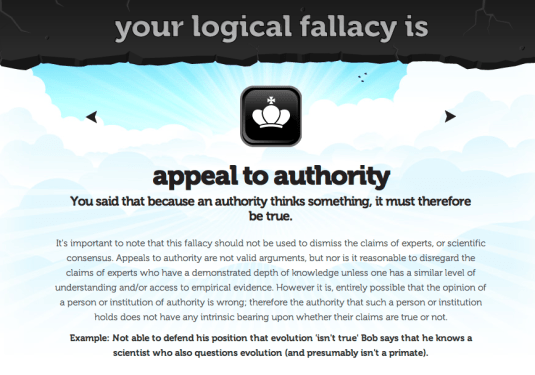
One of the reasons I changed my mind on the economics and politics of climate science is these repeated appeals to authority and general bully boy tactics made me suspicious of the underlying merits of the arguments canvassed.

The only profession I know of which actually does take a vote on what is the truth in a scientific sense is psychiatrists. Their American annual conference has a vote on what to put out their professional diagnostic manual. This science by voting never went well with various psychiatric disorders voted in and out of their professional diagnostic manual on the basis of politics, cultural bias and the medicalisation of human distress.

John Stuart Mill emphasise the value of even completely false arguments in keeping us on our toes. His scenarios involves both parties of opinion, majority and minority, having a portion of the truth but not the whole of it. He regards this as the most common of the three scenarios, and his argument here is very simple. To enlarge its grasp of the truth the majority must encourage the minority to express its partially truthful view.
J.S. Mill pointed out that critics who are totally wrong still add value because they keep you on your toes and sharpened both your argument and the communication of your message.
If the righteous majority silences or ignores its opponents, it will never have to defend its belief and over time will forget the arguments for it. As well as losing its grasp of the arguments for its belief, J.S. Mill adds that the majority will in due course even lose a sense of the real meaning and substance of its belief. What earlier may have been a vital belief will be reduced in time to a series of phrases retained by rote. The belief will be held as a dead dogma rather than as a living truth.
Three scenarios – the majority is wrong, partly wrong, or totally right – exhaust for Mill the possible permutations on the distribution of truth, and he holds that in each case the search for truth is best served by allowing free discussion.
Mill thinks history repeatedly demonstrates this process at work where silencing falsehood led to dogmas rather than living truth. He offered Christianity as an illustrative example. By suppressing opposition to it over the centuries Christians ironically weakened rather than strengthened Christian belief. Mill thinks this explains the decline of Christianity in the modern world. Christians forgot why they were Christians and in the Reformation could not successfully rebut who came up with valid criticisms of their existing profession of faith.
Going on about how climate science is settled and the debate is over is bad tactics for the climate alarmists. Attempts to close the debate this way provokes suspicion among those who expect some attempt to persuade them rather than to instruct them from on high. Presumptuousness is never a good persuasion tactic nor is dismissiveness.
A salesman trying to sell a product would never use any of the persuasion tactics or selling tactics of the climate alarmists. They would quickly go out of business if they did.

The Unappreciated Success Of Charter Schools
10 Feb 2015 Leave a comment
in economics of education, Public Choice, rentseeking, unions Tags: charter schools, School choice



Stranger than fiction: The reason why Zinedine Zidane was almost sacked as main coach of real Madrid B
30 Jan 2015 1 Comment
in economics of regulation, occupational regulation, rentseeking, sports economics Tags: Eurosclerosis, occupational regulation, soccer, Spain

Zinedine Zidane is one of the top 5 soccer players of all time (World Cup 1998, Euro Cup 2000, etc).
He retired and became assistant coach for Real Madrid in 2013 and in August 2014, main coach for Real Madrid B.

A director of the Spanish National Football Coach Education Centre because he does not have a three year higher education degree in Soccer coaching.
Zinedine Zidane was fined and expelled from Spanish league. His lawyer found a loophole due to his French citizenship and saved the day.
Zidane made his professional debut aged 16. Too busy becoming one of the greatest players of all time to spend three years at university. He spent his first weeks at his first club mainly on cleaning duty as a punishment for punching an opponent who mocked his ghetto origins.
HT: Lee Ohanian via John Cochrane
Mendicant NZ artist denounces neoliberalism and tall poppy syndrome in same breath
28 Jan 2015 Leave a comment
in economics of media and culture, politics - New Zealand, rentseeking Tags: corporate welfare, green hypocrisy, Left-wing hypocrisy, neoliberalism, rent seeking, starving artists, tall poppy syndrome, Yes Prime Minister
Man Booker Prize author Eleanor Catton from New Zealand managed in the same interview in India to denounce the neoliberalism of New Zealand’s current government and then denounce the tall poppy syndrome that cuts down artistic elites such as herself down to size when they become successful.
At the moment, New Zealand, like Australia and Canada, (is dominated by) these neo-liberal, profit-obsessed, very shallow, very money-hungry politicians who do not care about culture
This is tremendous a hypocrisy: to denounce a neoliberal philosophy that supposedly favours the elite over the working class and then complain about members of the elite such as herself are not supported sufficiently from the taxpayers’ tough:
We have this strange cultural phenomenon called “tall poppy syndrome”; if you stand out, you will be cut down…
If you get success overseas then very often the local population can suddenly be very hard on you. Or the other problem is that the local population can take ownership of that success in a way that is strangely proprietal.
Catton manages to denounce neoliberalism and the capitalist competition that entails but then gets quite annoyed over the fact the successful people aren’t rewarded and recognised by the country.
What hypocrisy. She denounces neoliberalism and then complains about been cut down because of her success. If you’re an opponent of neoliberalism, there is some obligation on you to argue for a levelling of income and wealth, including your own.
It betrays an attitude towards individual achievement which is very, uncomfortable. It has to belong to everybody or the country really doesn’t want to know about it…
I’ve really struggled with my identity as a New Zealand writer. I feel uncomfortable being an ambassador for my country when my country is not doing as much as it could, especially for the intellectual world.
Catton is particularly upset over the fact that New Zealand is expected to share her fame with them some way. Obviously, Catton believes in private profits, private fame at social losses and public subsidies for the arts. Having to share what she earns is not part of her opposition to neoliberalism.
From each in accordance with their ability, to each in according to their need is the heart of the anti-neoliberal philosophy, or is it Robert Nozick’s capitalistic acts between consenting adults where it is from each as they choose, to each as they are chosen, especially if you’re a successful artist.
Such is the price neoliberalism is Eleanor Catton, like every other able-bodied adult, is expected to earn a living for themselves by producing something that someone wants a profitable global for them rather than expect a hand-out from the government simply because of the desire of the recipients to receive the money. In her case, her claim for government hand-outs is because she happens to be artistic.
Jim Hacker: “So they insult me and then expect me to give them more money?”
Sir Humphrey: “Yes, I must say it’s a rather undignified posture. But it is what artists always do: crawling towards the government on their knees, shaking their fists.”
Jim Hacker: “Beating me over the head with their begging bowls.”
Bernard Woolley: “Oh, I am sorry to be pedantic, Prime Minister, but they can’t beat you over the head if they’re on their knees. Unless of course they’ve got very long arms.”

Richest queue in India (world perhaps) and cronyism at its best..
28 Jan 2015 Leave a comment
in growth disasters, growth miracles, politics - USA, Public Choice, rentseeking Tags: cronyism, India, President Obama, rent seeking


This picture is quite an interesting one. It shows India’s richest businessmen queuing to wait to meet US President Barack Obama patiently. It is ironical in many ways to see the rich and mighty queue like school children waiting for their score card or something. In many ways it is a score card of future where the chosen guys would either get to invest in US or be a partner of US money into India.
It clearly shows the power of politics. Those who keep talking of free markets and so on should see how politics dominates the game. At the end of the day, you have to get closer to the politique to see your empire grow.
But this is also an example of cronyism where business and politics get real close. Deals are signed amidst favorites and it is dubbed as competition. Most of cronyism happens behind the scenes and this is all…
View original post 55 more words
Is surge pricing by Uber another name for overtime and weekend pay
28 Jan 2015 Leave a comment
in applied price theory, economics of media and culture, economics of regulation, Public Choice, rentseeking, transport economics Tags: barriers to entry, compensating differentials, peakload pricing, taxi regulation, Uber

Uber is in strife of late for charging more at peak times - Uber calls it surge pricing. We don’t object paying more for a meal at a restaurant at dinner time rather than at lunchtime but the same people object to paying more for the taxi late at night where the driver must risk the dangers of solitary night-time work and picking up strangers who might have had a few too many.

Under Uber’s now-national policy, price surging is capped during disasters and states of emergency at the fourth-highest nonemergency surge seen in the previous two months.

We all expect to pay more for air tickets at peak times, such as school holidays and Christmas. Indeed, one reason we are able to delay booking is we know seats will be available because they are selling at a premium for those who booked late. Others who make their plans early quite enjoy getting the cheaper for early bird bookings.

Is surge pricing another name for over time and night and weekend pay? Union contracts provide for overtime pay, if you work more than the specified 8 hours a day.
The Holidays Act in New Zealand provides that if an employee works at the weekends, they are paid at 150% of the normal rate; and double party on public holidays. Not many employees object of this wage premium for work in it inconvenient times. Cafes and restaurants routinely charge of 10-15% price premium on public holidays to cover this overtime pay.

As would be expected under the theory of compensating differentials, there are wage premiums for jobs where the worker must work at inconvenient or unsocial times, in jobs with a greater risk of injury, or otherwise work more unpleasant than the average.

Viscusi estimated the wage premium for hazardous jobs to be rather large in the United States:
The extra pay for job hazards, in effect, establishes the price employers must pay for an unsafe workplace.
Wage premiums paid to U.S. workers for risking injury are huge; they amount to about $245 billion annually (in 2004 dollars), more than 2 percent of the gross domestic product and 5 percent of total wages paid. These wage premiums give firms an incentive to invest in job safety because an employer who makes the workplace safer can reduce the wages he pays.
Those who don’t like Uber’s surge pricing can always hail a cab. As I remember from American TV programmes, at peak times, prospective customers on the side of the road hail cabs at peak times with several fingers raised to indicate how much more than the standard fare, they are willing to pay.

There is nothing new under the sun. Uber’s app allows you to do the price bidding for a taxi on your cellphone rather than out in the cold
The relationship between housing prices and the Wharton Land Use Index
24 Jan 2015 Leave a comment
in rentseeking, urban economics Tags: Edward Gleaser, green rent seeking, land supply, land use regulation, zoning

Note: the Wharton Land Use Index measures the restrictiveness of a metropolitan area’s land use regulations.
 Utopia, you are standing in it!
Recent Comments