
Piketty and Capital Taxation in the 21st Century
20 Jan 2015 Leave a comment
in applied price theory, applied welfare economics, economic growth, economic history, income redistribution, macroeconomics, Public Choice, public economics, rentseeking Tags: Leftover Left, Thomas Piketty

Posner and Easterbrook opine upon the law and economics of rent control
20 Jan 2015 1 Comment
in applied price theory, applied welfare economics, law and economics, property rights, Public Choice, rentseeking, Richard Posner Tags: Frank Easterbrook, rent control, Richard Posner
POSNER, Circuit Judge, with whom EASTERBROOK, Circuit Judge, joins in 819 F. 2d 732 – Chicago Board of Realtors Inc v. City of Chicago:
The stated purpose of the ordinance is to promote public health, safety, and welfare and the quality of housing in Chicago. It is unlikely that this is the real purpose, and it is not the likely effect.
Forbidding landlords to charge interest at market rates on late payment of rent could hardly be thought calculated to improve the health, safety, and welfare of Chicagoans or to improve the quality of the housing stock.
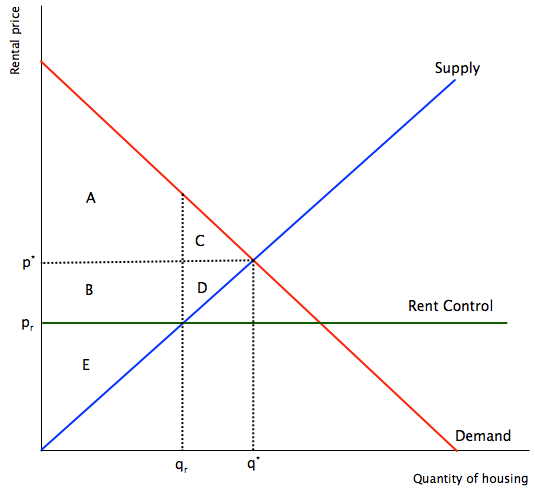
But it may have the opposite effect. The initial consequence of the rule will be to reduce the resources that landlords devote to improving the quality of housing, by making the provision of rental housing more costly. Landlords will try to offset the higher cost (in time value of money, less predictable cash flow, and, probably, higher rate of default) by raising rents. To the extent they succeed, tenants will be worse off, or at least no better off.
Landlords will also screen applicants more carefully, because the cost of renting to a deadbeat will now be higher; so marginal tenants will find it harder to persuade landlords to rent to them. Those who do find apartments but then are slow to pay will be subsidized by responsible tenants (some of them marginal too), who will be paying higher rents, assuming the landlord cannot determine in advance who is likely to pay rent on time. Insofar as these efforts to offset the ordinance fail, the cost of rental housing will be higher to landlords and therefore less will be supplied–more of the existing stock than would otherwise be the case will be converted to condominia and cooperatives and less rental housing will be built…
The provisions that authorize rent withholding, whether directly or by subtracting repair costs, may seem more closely related to the stated objectives of the ordinance; but the relation is tenuous. The right to withhold rent is not limited to cases of hazardous or unhealthy conditions. And any benefits in safer or healthier housing from exercise of the right are likely to be offset by the higher costs to landlords, resulting in higher rents and less rental housing.
The ordinance is not in the interest of poor people. As is frequently the case with legislation ostensibly designed to promote the welfare of the poor, the principal beneficiaries will be middle-class people.
They will be people who buy rather than rent housing (the conversion of rental to owner housing will reduce the price of the latter by increasing its supply); people willing to pay a higher rental for better-quality housing; and (a largely overlapping group) more affluent tenants, who will become more attractive to landlords because such tenants are less likely to be late with the rent or to abuse the right of withholding rent–a right that is more attractive, the poorer the tenant. The losers from the ordinance will be some landlords, some out-of-state banks, the poorest class of tenants, and future tenants.
The landlords are few in number (once owner-occupied rental housing is excluded–and the ordinance excludes it). Out-of-staters can’t vote in Chicago elections. Poor people in our society don’t vote as often as the affluent. See Filer, An Economic Theory of Voter Turnout 81 (Ph.D. thesis, Dept. of Econ., Univ. of Chi., Dec. 1977); Statistical Abstract of the U.S., 1982-83, at pp. 492-93 (tabs. 805, 806). And future tenants are a diffuse and largely unknown class.
In contrast, the beneficiaries of the ordinance are the most influential group in the city’s population. So the politics of the ordinance are plain enough, cf. DeCanio, Rent Control Voting Patterns,Popular Views, and Group Interests, in Resolving the Housing Crisis 301, 311-12 (Johnson ed. 1982), and they have nothing to do with either improving the allocation of resources to housing or bringing about a more equal distribution of income and wealth.
A growing body of empirical literature deals with the effects of governmental regulation of the market for rental housing. The regulations that have been studied, such as rent control in New York City and Los Angeles, are not identical to the new Chicago ordinance, though some–regulations which require that rental housing be "habitable"–are close. The significance of this literature is not in proving that the Chicago ordinance is unsound, but in showing that the market for rental housing behaves as economic theory predicts: if price is artificially depressed, or the costs of landlords artificially increased, supply falls and many tenants, usually the poorer and the newer tenants, are hurt…
Gabriel Kolko on the rise in the mixed economy
19 Jan 2015 1 Comment
in Public Choice, rentseeking Tags: Gabriel Kolko, rent seeking

And the Oscar for “Best Tax Break” Goes to…
17 Jan 2015 Leave a comment
in economics of media and culture, movies, politics - New Zealand, politics - USA, Public Choice, rentseeking Tags: corporate welfare, film subsidies

HT: http://economics21.org/commentary/oscars-tax-break-american-sniper-2015-01-16 and http://www.washingtonexaminer.com/how-this-years-oscar-nominees-got-government-handouts/article/2558717
The economic models of global warming are crude, unsophisticated, static, and untested by data?
17 Jan 2015 Leave a comment


The marvel of the market: the remarkable foresight of young adults in choosing what to study
16 Jan 2015 1 Comment
in Alfred Marshall, Armen Alchian, economics of education, George Stigler, human capital, job search and matching, labour economics, occupational choice, politics - New Zealand, rentseeking Tags: 2nd laws of supply and demand, Alfred Marshall, Armen Alchian, george stigler, search and matching, skills shortgaes
Known but yet to be exploited opportunities for profit do not last long in competitive markets, including hitherto unnoticed opportunities for the greater utilisation and development of skills and experience (Hakes and Sauer 2006, 2007; Ryoo and Rosen 2004; and Kirzner 1992). Moneyball is the classic example of entrepreneurial alertness to hitherto unexploited job skills which were quickly adopted by competing firms (Hakes and Sauer 2006, 2007).
There is considerable evidence that the demand and supply of human capital responds to wage changes. For example, over- or under-supplied human capital moves either in or out in response to changes in wages until the returns from education and training even out with time (Ryoo and Rosen 2004; Arcidiacono, Hotz and Kang 2012; Ehrenberg 2004).
As evidence of this equalisation of returns on human capital investments across labour markets, the returns to post-school investments in human capital are similar – 9 to 10 percent – across alternative occupations, and in occupations requiring low and high levels of training, low and high aptitude and for workers with more and less education (Freeman and Hirsch 2001, 2008). There is evidence that workers with similar skills in similarly attractive jobs, occupation and locations earn similar pay (Hirsch 2008; Vermeulen and Ommeren 2009; Rupert and Wasmer 2012; Roback 1982, 1988).
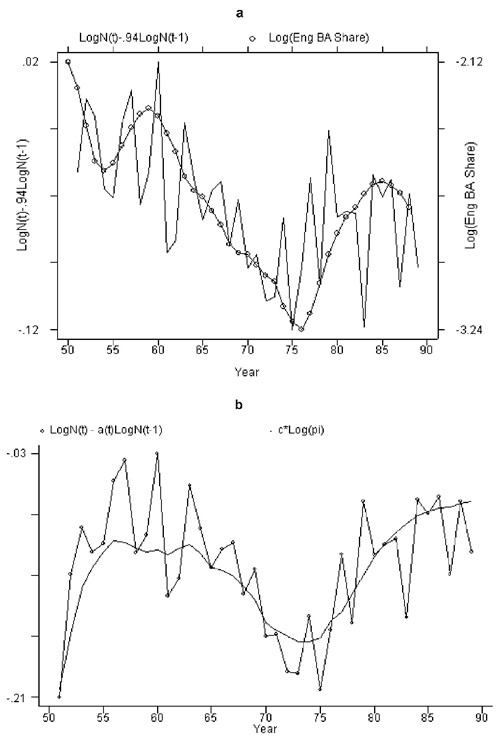
Ryoo and Rosen (2004) found that the labour supply and university enrolment decisions of engineers is “remarkably sensitive” to career earnings prospects. Graduates are the main source of new engineers. Engineers who moved out into other occupations such as management did not often moved back to work again as professional engineers. Ryoo and Rosen (2004) observed when summarising their work that:
Both the wage elasticity of demand for engineers and the elasticity of supply of engineering students to economic prospects are large. The concordance of entry into engineering schools with relative lifetime earnings in the profession is astonishing.
Ryoo and Rosen (2004) found several periods of surplus in the market for engineers. These periods of shortage or surplus corresponded to unexpected demand shocks in the market for engineers such as the end of the Cold War.
Figure 1: New entry flow of engineers: a, actual vs. imputed from changes in stock of engineers; b, time-varying coefficients.
Source: Ryoo and Rosen (2004)
Ryoo and Rosen (2004) noted that importance of permanent versus transitory changes in earnings. Transitory rises and falls in earnings prospects have much less influence on occupational choices and the educational investments of students.
In light of these findings that the supply of engineers rapidly adapted to changing market conditions, Ryoo and Rosen (2004) questioned whether public policy makers have better information on future labour market conditions than labour market participants do. When politicians get worked up about skill shortages, the markets for scientists and engineers often where they make extravagant claims about the ability of the market to adapt to changing conditions because of the long training pipeline involved in university study, including at the graduate level.
There can be unexpected shifts in the supply or demand for particular skills, training or qualifications. These imbalances even themselves out once people have time to learn, update their expectations and adapt to the new market conditions (Rosen 1992; Ryoo and Rosen 2004; Bettinger 2010; Zafar 2011; Arcidiacono, Hotz and Kang 2012; Webbink and Hartog 2004).
For example, Arcidiacono, Hotz and Kang (2012) found that both expected earnings and students’ abilities in the different majors are important determinants of student’s choice of a college major, and 7.5% of students would switch majors if they made no forecast errors.
The wage premium for a tertiary degree was low and stable in New Zealand in the 1990s (Hylsop and Maré 2009) and 2000s (OECD 2013). This stability in the returns to education suggests that supply has tended to kept up with the demand for skills at least over the longer term at the national level. There were no spikes and crafts that would be the evidence of a lack of foresight among teenagers in choosing what to study.
All in all, the remarkable sensitivity of engineers to a career earnings prospects, the frequent changes of college majors by university students in response to changing economic opportunities, and the stability of the returns on human capital over time suggest that the market for human capital is well functioning.
The argument that the market was not working well was assumed rather than proven. Likewise, the case for additional subsidies for science, technology, engineering and mathematics because of perceived skill shortages has not been made out. There is a large literature showing that the market for professional education works well.
The onus is on those who advocate intervention to come up with hard evidence, rather than innate pessimism about markets that are poorly understood because of a lack of attempts to understand it. Studies dating back to the 1950s by George Stigler and by Armen Alchian found that the market for scientists and engineers works well and the evidence of shortages were more presumed than real.
A 50 billion note
14 Jan 2015 Leave a comment
Suburban rent seeking and green rent seeking are a dangerous brew for housing affordability
13 Jan 2015 Leave a comment


P.T. Bauer on development economics and comparative institutional analysis
09 Jan 2015 Leave a comment


Recent Comments