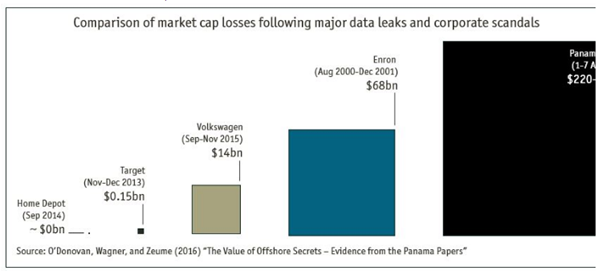
Guess how much value the #PanamaPapers data leak destroyed? US$ 230 billion worldwide! Read… https://t.co/EsHGvNex7g pic.twitter.com/dOZh9UTIGz
— Hannes Wagner (@hanneswagner) April 28, 2016
The sharemarket speaks: The Value of Offshore Secrets – Evidence from the #PanamaPapers
21 May 2016 Leave a comment
in financial economics, industrial organisation, public economics Tags: Panama papers, tax savings
Don’t let Mal and Bill get their grubby paws on your Super boy Bill well they got that smallest of the bill coming up your super
20 May 2016 Leave a comment
in politics - Australia, public economics Tags: 2016 Australian federal election
@TheAusInstitute has not heard of Ireland’s 12.5% company tax and European tax harmonisation
19 May 2016 Leave a comment
in politics - Australia, politics - New Zealand, politics - USA, public economics Tags: company tax rate, Ireland, race to the bottom, tax competition, tax harmonisation, taxation and investment
The Australia Institute has been running the line that cutting the Australian company tax rate just means more tax revenue for offshore tax departments. They will tax the larger after-tax Australian dividends in the home country of the foreign investor if Australia were to cut its company tax rate.
Source: David Richardson, Company tax cuts: An Australian gift to the US Internal Revenue Service How a cut to the Australian company tax rate would result in a windfall for the United States Treasury. Australia Institute (May 2015).
The Australia Institute obviously has not picked up on the relentless bullying that Ireland was subject to by the rest of the European Union over its 12.5% company tax.
The Irish company tax rate of 12.5% was initially on export profits. To finesse European Union member state complaints about that 12.5% company tax rate on discrimination grounds, the Irish government extended that low rate to all companies in 1995.
I am yet to see a minister of finance welcoming a company tax cut in a competing jurisdiction, rubbing his hands in anticipation of greater tax revenues on the foreign profits of companies headquartered in his country.
If there is no race to the bottom in company tax rates, you must wonder why there is substantial efforts within the European Union on tax harmonisation regarding company tax?
France and Germany are pushing plans to introduce a minimum corporation tax rate across the continent, it was reported today, in a move that could result in higher taxes on British companies.
European officials will debate plans to set a EU-wide floor on corporation tax in order to crack down on tax havens such as Ireland and Luxembourg, it emerged.
If there is an ounce of sense in what the Australia Institute said about foreign taxmen benefiting from low company taxes in Australia, high corporate tax rate countries such as Germany, France and the USA should welcome low company tax rates in destination countries for foreign investment originating in those countries but they do not. Rather than seek tax harmonisation, high tax country should welcome low company taxes in competing investment destinations but they do not.
About $2 trillion in profits is held offshore by American businesses because they do not pay company tax in the USA until they actually repatriate the profits to the USA. This is common. You wonder what the purpose of tax havens is if a company tax rate cut in Australia is so easily captured by the IRS?
Studies of the company tax in the USA suggest that a cut in that company tax would lead to large inflows of foreign investment into the USA boosting wages significantly.
How big are @JohnKeyPM’s $3 billion in tax cuts & threshold changes in 2017 going to be?
17 May 2016 Leave a comment
in politics - New Zealand, public economics Tags: 2017 New Zealand election
On morning radio on Monday, Prime Minister John Key said "We are not ruling that out for 2017 or campaigning on it for a fourth term in 2017, but having a bigger one, to be blunt, than $1 billion." Asked how much was needed to deliver meaningful tax cuts, he said: "$3 billion, I reckon."
The table below uses the Treasury scoring of how much tax cuts can be delivered through $3 billion if they include changes in the income tax thresholds as well. That scoring is static. That is, no behavioural changes are assumed as the result of the tax cuts on labour supply, investment or entrepreneurship.
Source: computed from Revenue Effect of Changes to Key Tax Rates, Bases & Thresholds for 2015/16 — The Treasury – New Zealand.
How big are @JohnKeyPM’s $3 billion tax cuts in 2017 going to be?
16 May 2016 Leave a comment
in politics - USA, public economics Tags: 2017 New Zealand election
On morning radio this morning, Prime Minister John Key said "We are not ruling that out for 2017 or campaigning on it for a fourth term in 2017, but having a bigger one, to be blunt, than $1 billion." Asked how much was needed to deliver meaningful tax cuts, he said: "$3 billion, I reckon."
The table below uses the Treasury scoring of how much tax cuts can be delivered through $3 billion. That scoring is static. That is, no behavioural changes are assumed as the result of the tax cuts on labour supply, investment or entrepreneurship.
Source: computed from Revenue Effect of Changes to Key Tax Rates, Bases & Thresholds for 2015/16 — The Treasury – New Zealand.
The big sensitivity is how the company tax rate cut scoring treats offsets for dividend imputation credits. If there is no change in the other tax rates, a cut in the company tax forgoes $225 million a year per percentage point because some of it is clawed back through dividend imputation. The costing of the company tax cut by the Treasury when the other income tax rates are changed is assumed to be $350 million per percentage point. When calculating the dividend imputation offset, the Treasury assumes that shareholders are on an average tax rate of 30%.
If the Prime Minister chooses not to match the company tax rate announced by the Liberal National party government in Australia ahead of their election, there is certainly more room for individual income tax cuts.
Most @BernieSanders’ supporters don’t want to #FeelTheBern in their hip-pocket
13 May 2016 Leave a comment
in politics - USA, public economics Tags: 2016 presidential election, Bernie Sanders, expressive voting, Left-wing hypocrisy, rational ignorance, rational irrationality
66 percent of Sanders supporters are unwilling to pay more than $1,000 in higher taxes for universal health care. This includes the 8 percent of Sanders supporters who aren’t willing to pay anything more!
Source: Most Bernie Sanders supporters aren’t willing to pay for his revolution – Vox.
Sanders supporters want free public college tuition but 14 percent said they don’t want to pay additional taxes for it; another half said they would only pay up to $1,000 a year!
Source: Most Bernie Sanders supporters aren’t willing to pay for his revolution – Vox.
@JulieAnneGenter Twitter feed rules on NZ as top #taxhaven @JordNZ #Panamapapers
10 May 2016 Leave a comment
With friends like these, the #UBI will not live to face its enemies @jordNZ
09 May 2016 Leave a comment
in applied price theory, applied welfare economics, politics - New Zealand, politics - USA, public economics, rentseeking Tags: universal basic income
Running around saying that Universal Basic Income will make work optional leaves open the question of who will be the suckers who actually do the work and pay enormous taxes to fund the idyllic lifestyle of the bohemian rest.
![]()
Source: What If Everybody Didn’t Have to Work to Get Paid? – The Atlantic.
Did top income earners pay less income tax after @JohnKeyMP was elected?
08 May 2016 Leave a comment
in politics - New Zealand, public economics Tags: superstar wagers, superstars, top 1%, top incomes
#NewZealand’s top 1% is getting even lazier under neoliberal @johnkeyMP
07 May 2016 Leave a comment
in politics - New Zealand, public economics Tags: entrepreneurial alertness, Leftover Left, reactionary left, superstar wagers, superstars, top 1%
The share of incomes of the top 1% in New Zealand has not increased since the 1950s – they are just bone lazy at extracting labour surplus.
Veteran left-wing grumbler Max Rashbrooke was good enough to collect Inland Revenue Data data that show that getting even lazier under right-wing government elected in 2008. Their share of taxable income has dropped from 9% when labour lost power to 8.4% now. These figures exclude capital gains.
Johan Norberg on Tax Havens
07 May 2016 Leave a comment
in comparative institutional analysis, entrepreneurship, public economics Tags: bribery and corruption, tax havens
Does invested $1 in retrofitting saves $6 in health expenditure? @PhilTwyford @PeterDunneMP @AndrewLittleMP
05 May 2016 Leave a comment
in economics of regulation, energy economics, health economics, politics - New Zealand, public economics Tags: cost benefit analysis, economics of housing, economics of insulation, energy efficiency gap, The fatal conceit, The pretense to knowledge, valuation of life
Various bold claims have been made about the payoff from investing more in retrofitting insulation into housing. The government recently spent $600 million on such retrofitting of insulation.
https://twitter.com/PhilTwyford/status/728137160113557505
There is a private member’s bill before Parliament to introduce minimum standards for rental properties with regard to insulation and other matters. Little is by the Leader of the Opposition Andrew Little said for the consequences for rents of this additional expense to landlords.
Ian Harrison of Tail Risk Economics initially estimated that the $600 million invested in retrofitting of insulation will save barely half of that:
After correcting for this major error and taking a more realistic view of the benefit estimates in other studies, the net benefits of $630 million disappear.
The $600 million insulation investment will probably generate benefits of closer to $170 million, for an economic loss of $430 million.
After meeting with Ian, I read through the rather dull background documents behind a cost benefit analysis relied upon by the government to spend the $600 million dollars.
The most interesting part of the cost benefit analysis is most of the benefits come from fewer cardiovascular related hospitalisation of the elderly and not from respiratory diseases among children.
I found the error was far more fundamental than a incorrect transfer of a calculation between tables discussed in the first publication by Harrison. I had to read the background documents several times to understand what had been done wrong.
The cost benefit analysis for the Warm Up New Zealand Heat Smart Programme assumes that the number of elderly occupants of the newly insulated house increases by one each year and after 5 years, one of these dies but is replaced by a new elderly occupant.
We have modelled the probability of a vulnerable person avoiding mortality as a result of the intervention. The probability of this is (112.7/1000)*0.27= 0.03 (3%). We treat avoidance of mortality by treatment in each year as independent events.
The multi-year benefit calculated above would accrue based on the life years gained as a result of deaths avoided in year one.
However, we would expect these benefits to accrue in year two for different vulnerable individuals (aged 65 and over with a cardiovascular related hospitalisation in previous 18 months), and for different individuals again in every subsequent year that the treatment continues to have an effect, i.e. an on-going stream of benefits of $1,050.74 per year. This assumes a constant proportion of people aged 65+ who have recently been hospitalised with circulatory problems….( p.38).
In the first year of the new insulation, the first occupant benefits and the net present value is included in the benefit cost analysis calculation – the erroneous benefit cost analysis calculations which its authors still defend.
In the 2nd year, another elderly person moves into that same house and the same calculation is done for them. In the following year, yet another elderly person moves into the same house and the net present value calculation is repeated.
By the end of 5 years, there are 5 occupants in this house all benefiting from the same insulation investment. In the 6th year, the first elderly occupant dies to be replaced by a new elderly occupant who then gains from the insulation upgrade.
There was double counting of the number of people who benefited from the insulation as Iain Harrison explains
The analysis assumed that there was not one, but five occupants who had been hospitalised with a cardiovascular illness in the previous 18 months in each of the relevant insulated houses. There should have been only one such occupant.
The retrofitting of insulation was estimated to cost $600 million. Iain Harrison estimated the benefits to be $300 million, not $1.2 billion. That is a benefit cost ratio of 0.5.
Source: Iain Harrison, The mortality reduction benefits of insulation: the error identified.
Why is GST but not company tax incidence so easy to understand
28 Apr 2016 Leave a comment
in public economics Tags: company tax, rational irrationality, tax incidence, taxation and entrepreneurship, taxation and investment
The tax incidence of sales taxes is understood by everybody but who pays company tax is stubbornly misunderstood. The seller is sending the tax cheque to the taxman does not fool anyone regarding who ultimately pays sales taxes.
Everyone expects that sales tax increases such as of the GST or VAT will be passed on to buyers but sometimes a little bit is absorbed in terms of lower profits by sellers if it is more than the market can bear.
When it comes to company taxes, this intuitive understanding of the economics of the incidence of taxes completely disappears. There is a strong belief that only investors pay the company tax in the form of dividends.
The notion that investors may reduce their investment and therefore the amount of capital with which workers can work is stoutly denied as is the implications for lower than otherwise wages because of this.
The possibility that the entire company tax may show up as lower wages when capital is internationally mobile is just not even contemplated. This is despite foreign direct investment being welcomed on the grounds that more capital means higher wages for local workers.

Likewise, when a factory is re-located offshore, it is understood that that will harm wages. That understanding does not carry through to company tax incidence when the factory relocates offshore because of low company taxes rather than import competition.
Who will pay @johnkeypm’s great big new land tax?
26 Apr 2016 Leave a comment
in politics - New Zealand, public economics Tags: housing affordability, land supply, land tax
A critical aspect of a land tax rarely addressed in public debate is its “economic incidence – or who actually bears the burden of the – tax as opposed to its statutory incidence, or who literally pays the tax.
John Key has floated a land tax as an option to deal with rising land prices in Auckland if a large number of buyers are foreign.
It is pretty standard public economics the elasticities of supply and demand essential to working out who actually pays tax rather than who sends the cheque.
More of the taxes paid by either the buyer or seller who is demand or supply is more inelastic; responds less to changes in price.
In the case of land, supply is looked upon as highly inelastic. Because of this lack of responsiveness of suppliers to changes in price, most to all of the tax is paid by sellers of land.
Since supply is fixed, the same amount of land is still available The owner now has a lower after-tax rental return of his land. As the Australian Treasury explains
As the capital value of the land is equal to the discounted present value of all the future expected rental returns, a lower rental return implies a one-off fall in the value of all land. Owners of land bear the incidence of the land value tax even if they sell their land in response to the tax.
This reduction in the rental value of land will mean future buyers will pay less for land. The price of land will fall in the future because returns are less after-tax.
The introduction of a land tax by John Key will mean the price of land might fall by the present value of the land tax. Zodrow explains
In principle, the economic incidence of all of these capitalization effects is on the owners of land and housing at the time of the imposition of the tax, when the effects are “capitalized” as one-time changes in the prices of these assets..
Recent Comments