Not coincidentally, countries with high marginal income tax rates have low levels of long hours worked per week.
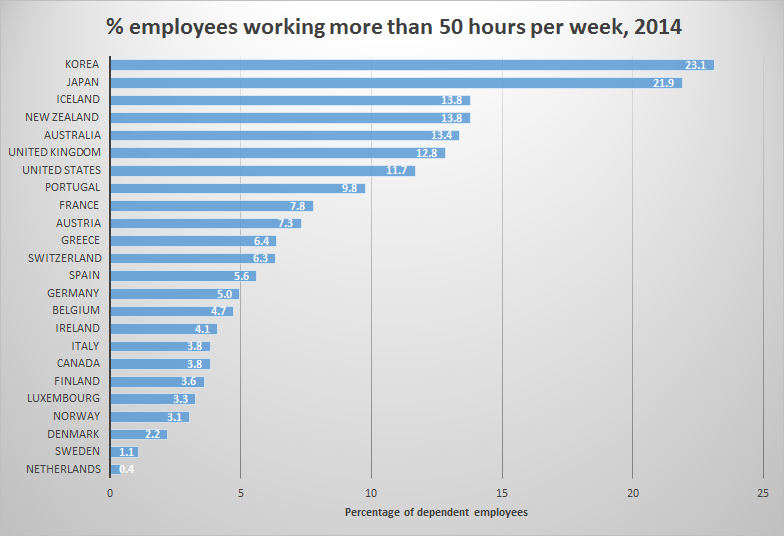
Data extracted on 14 Aug 2016 01:52 UTC (GMT) from OECD.Stat; Data does not include the self-employed.
Celebrating humanity's flourishing through the spread of capitalism and the rule of law
15 Aug 2016 6 Comments
in labour economics, labour supply, occupational choice, public economics Tags: hours worked, taxation and labour supply
Not coincidentally, countries with high marginal income tax rates have low levels of long hours worked per week.
Data extracted on 14 Aug 2016 01:52 UTC (GMT) from OECD.Stat; Data does not include the self-employed.
03 Aug 2016 Leave a comment
in applied price theory, economic history, economics, income redistribution, Public Choice, public economics, Rawls and Nozick Tags: British politics, Leftover Left
13 Jul 2016 Leave a comment
in politics - USA, public economics Tags: envy, superstars, taxation and entrepreneurship, taxation and investment, top 1%, top 10%
04 Jul 2016 Leave a comment
in applied price theory, politics - Australia, public economics

If the Australian Institute’s analysis of company tax cuts is to be believed, European Union member states must be rubbing their hands in glee at the extra tax revenue that will flow to them because of Britain’s plans to cut its company tax rate to 15%.
Their analysis is a company tax cut in Australia, or in this case Britain, will simply mean more taxes will be paid in the home country of the foreign investing owned company when it repatriates dividends.
Ireland was relentlessly bullied over its 12.5% company tax rates by the rest of the European Union. Facts speaks louder than words and the Australia Institute economic analysis.
You do wonder why losing finance ministers complain about lowering of company taxes as a race to the bottom. They are complaining because they are losing foreign investment to lower company tax jurisdictions.
03 Jul 2016 Leave a comment
in applied welfare economics, politics - New Zealand, poverty and inequality, Public Choice, public economics
Rashbrooke in the snap-shot quote describes the massive new taxes to fund a universal basic income as a policy shift for which middle New Zealand must be prepared properly over many years. But the purpose of these great big new taxes is to ensure that those with whom the modern welfare state was designed to protect our left no worse off, not better off, just as good as they were under the previous regime of social insurance. Why take that journey when you can target their poverty directly to the current welfare state?
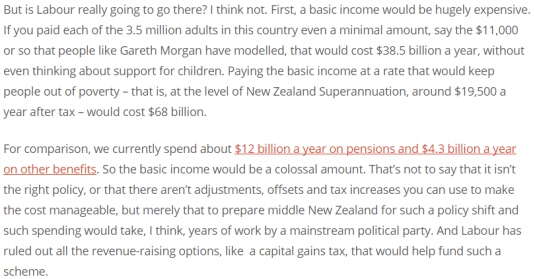
Source: Is Labour really going to deliver a UBI? – Inequality: A New Zealand Conversation.
28 Jun 2016 Leave a comment
in development economics, economics of media and culture, growth disasters, growth miracles, health economics, Public Choice, public economics Tags: drug prices, intellectual monopolies, patents and copyrights
24 Jun 2016 Leave a comment
in applied price theory, politics - Australia, politics - USA, public economics
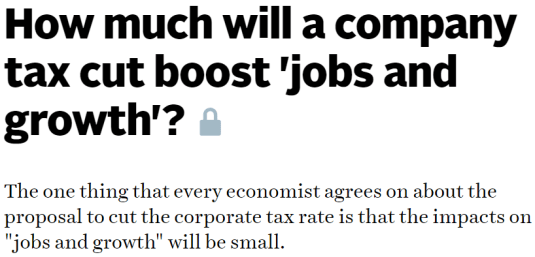
Source: Company tax cut won’t help Australian economy, jobs – Crikey.
It is unfortunate that the Australia Institute today misspoke when it claimed that every economist agrees that the effect of a company tax rate cut is small.
The top economists in the field of public economics disagree. Their views are freely available on the Internet. They are easiest to find by googling the words abolish the corporate tax. Optimal rate of tax on capital is zero are other good words to Google.
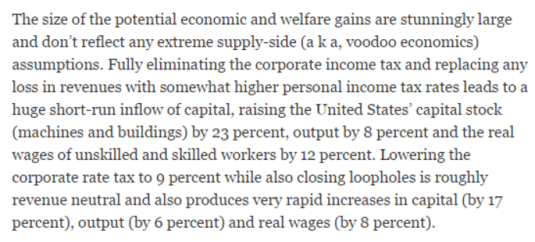
Source: Abolish the Corporate Income Tax – The New York Times.
It has been well known for decades of the optimal rate of tax on income from capital and from capital gains are zero. The Australia Institute has joined with Paul Krugman in not reporting this as Greg Mankiw explains
Paul Krugman responds to my post about a recent column of his. He is correct that not all economists agree that low capital taxation is desirable; he appropriately cites Diamond and Saez, who are on the high-capital-tax side of this debate. FYI, here is another recent paper, written in part as a response to Diamond and Saez, which finds that optimal rates of capital taxation, while positive, are quite low.
But that is not really the issue. If Paul had said “reasonable economists disagree, here are the arguments, and here is why I tend to favor one side rather than the other” I would not have objected.
Instead, in his original column, he wrote as if there were no reasonable arguments for the policy pursued by the Bush administration, and he attributed the most vile motives to those who advanced the policy.
This episode illustrates a fundamental difference between Paul and me. I try not to assume the worst in other people, just because they disagree with me.
Taxes on incomes from capital should be much lower because capital migrates from high-tax to low-tax locations, reducing capital-to-labour ratios in the higher company tax countries.
The low-tax on income from capital countries experience higher capital-to-labour ratios, a higher marginal product of labour, and higher wages. Robert Lucas described abolishing taxes on income from capital is one of the few genuinely free lunches out there in applied welfare economics.
Mankiw and Weinzierl “Dynamic Scoring: A Back-of-the-Envelope Guide,” Journal of Public Economics (September 2006): 1415-1433 argue that, in the long run, about 17% of a cut in individual income taxes is recouped through higher economic growth. For a cut in company taxes, their figure is 50%.
The Australia Institute manages to put itself in the contradictory position of saying a company tax rate just means more revenue for the IRS in the USA but Google, Facebook and other multinationals managed to avoid tax on a massive stale through tax havens. If the former is correct, their less company tax in Australia means more company tax paid in the USA means multinationals must be rather unsuccessful at avoiding tax through tax havens.
Multinationals are both avoiding company tax in Australia and offshore and paying it in full in the USA if Australia’s company taxes cut if the Australian Institute is to be believed today.
More than 50% of US corporate profits earned abroad are made in nations considered tax havens on.wsj.com/1h2Uitv http://t.co/6L8Hqislxd—
Nick Timiraos (@NickTimiraos) September 29, 2015
The Australia Institute obviously has not picked up on the relentless bullying that Ireland was subject to by the rest of the European Union over its 12.5% company tax.
The Irish company tax rate of 12.5% was initially on export profits. To finesse European Union member state complaints about that 12.5% company tax rate on discrimination grounds, the Irish government extended that low rate to all companies in 1995.
I am yet to see a minister of finance welcoming a company tax cut in a competing jurisdiction, rubbing his hands in anticipation of greater tax revenues on the foreign profits of multinationals that are headquartered in his country.
If there is an ounce of sense in what the Australia Institute said about foreign taxmen benefiting from low company taxes in Australia, high corporate tax rate countries such as Germany, France and the USA should welcome low company tax rates in destination countries for foreign investment originating in those countries but they do not.
Rather than seek tax harmonisation, high tax country should welcome low company taxes in competing investment destinations but they do not. Why is this so if the Australia Institute is making sense?
The Nordic countries follow optimal tax theory and have high but flat taxes on labour income, low taxes on business income and a high, broad-based consumption tax. That is the only way they can fund their welfare states.
The Nordics are alert to not killing the goose that laid the golden egg. Company taxes are relatively low in Scandinavian countries as compared to the USA so that businesses do not flee to other jurisdictions.

A large welfare state such as those in the Nordic countries require a significant amount of revenue, so the tax base in these countries must be broad. This also means higher taxes on consumption through the VAT or GST and higher taxes on middle-income taxpayers.
Business taxes are a less reliable source of revenue because of capital flight and disincentives to invest. Thus, the Nordics do not place above-average tax burdens on capital income and focus taxation on labour and consumption. All those nuances are lost if you are to believe the Australia Institute today.
23 Jun 2016 Leave a comment
in applied welfare economics, income redistribution, politics - USA, poverty and inequality, public economics Tags: expressive voting, social insurance, universal basic income
Firing the entire welfare state bureaucracy does not save the day for a universal basic income as Robert Greenstein explains
Suppose UBI provided everyone with $10,000 a year. That would cost more than $3 trillion a year — and $30 trillion to $40 trillion over ten years.
This single-year figure equals more than three-fourths of the entire yearly federal budget — and double the entire budget outside Social Security, Medicare, defense, and interest payments. It’s also equal to close to 100 percent of all tax revenue the federal government collects…
Where would the money to finance such a large expenditure come from? That it would come mainly or entirely from new taxes isn’t plausible.
We’ll already need substantial new revenues in the coming decades to help keep Social Security and Medicare solvent and avoid large benefit cuts in them. We’ll need further tax increases to help repair a crumbling infrastructure that will otherwise impede economic growth. And if we want to create more opportunity and reduce racial and other barriers and inequities, we’ll also need to raise new revenues to invest more in areas like pre-school education, child care, college affordability, and revitalizing segregated inner-city communities.
A UBI that’s financed primarily by tax increases would require the American people to accept a level of taxation that vastly exceeds anything in U.S. history. It’s hard to imagine that such a UBI would advance very far, especially given the tax increases we’ll already need for Social Security, Medicare, infrastructure, and other needs.
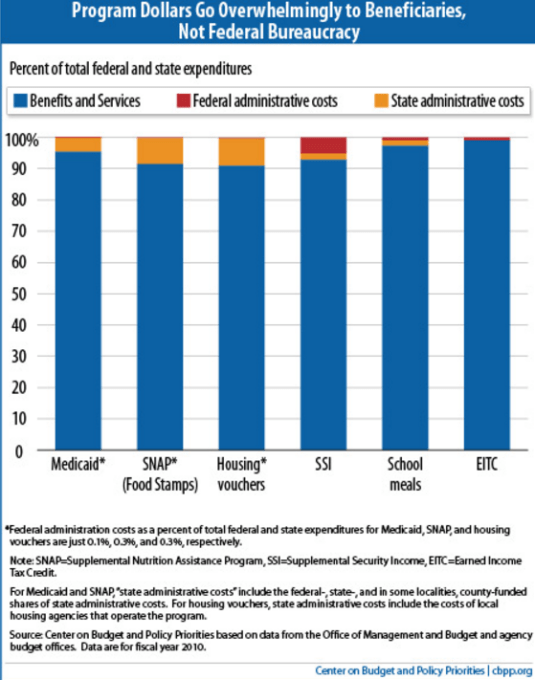
22 Jun 2016 Leave a comment
in applied welfare economics, politics - New Zealand, poverty and inequality, public economics
Before my two comments disappeared from Gareth Morgan’s Facebook page, I pointed out that his universal basic income of $11,000 per adult is as of last night at least triple pledged.

According to Gareth Morgan’s latest remark in the screenshot, people can use their universal basic income of $11,000 to pay their comprehensive capital tax bill. This new tax is proposed to fill the at least $10 billion gap in the funding of his universal basic income.
This is not possible because his universal basic income is already pledged to at least two other purposes that may use up a good part of the universal basic income of $11,000 per adult that he is proposing.
The first of these pledges is a by-product of adults under the age of 50 not being grandfathered in to the current level of generosity of New Zealand Superannuation – New Zealand’s universal old age pension.
Adults under the age of 50 under the Morgan Foundation’s universal basic income are expected to save part of their universal basic income. This saving is to make up for the $50 per week cut in New Zealand Superannuation when it is replaced by a universal basic income of $11,000 per adult. Gareth Morgan explains
Only people who are today under the age of 50 could be expected to retire under the UBI policy, the policy would not apply to existing superannuitants.
The key question is whether someone aged, say 40 today, would be better or worse off in retirement under the policy. And the answer is if they earn the average wage now, have an average house, they will tend to be neither better nor worse off.
For the 25 years prior to retirement they will receive the UBI on top of their wages. If they save a good portion of it they will have nest egg at retirement which they can use in retirement to supplement the UBI (which is more modest than today’s NZ Super).
In addition to this, the universal basic income makes those on a single parents benefit $150 a week worse off on the basic benefit that is not including lost accommodation supplements and additional child payments. The Morgan Foundation solution is to take part of the universal basic income of the other parent and give it to their children. Gareth Morgan explains again
It is totally feasible that the UBI of both parents could be required to be directed to support the children in the event of separation.
So in addition to the poor and ordinary families saving their universal basic income for as little as 15 years to making up for the $50 per week cut in support for old age pensioners, and the $150 plus cut in income support to single parents on a welfare benefit, the universal basic income also will be used to pay the comprehensive capital tax on the family home.
Somewhere buried in the universal basic income is it is the idea that it replaces existing welfare benefits. However, as most of the universal basic income has been pledged to other purposes such as saving for retirement, supporting children and paying the great big new tax in the family home, it will be very unwise to actually become unemployed, get sick, become a single parent or being invalid on the already meagre universal basic income as Geoff Simmons explains
With an unconditional basic income, most beneficiaries would be no better off than they are now (in fact sole parents would almost certainly receive a lower benefit).
There is a high risk that nothing will be left over from the Morgan foundation’s universal basic income to help you out when you fall in bad times because that universal basic income is already spoken for by your children, your retirement, and a capital tax bill.
Helping people out in times of misfortunes is the purpose of social insurance. The Morgan Foundation’s universal basic income fails this basic test set by Gareth Morgan
…let’s agree on what is a minimum income every adult should have in order to live a dignified life and then see what flows from that. We begin by specifying the income level below which we are not prepared to see anyone having to live.
At very best, and only very best, the Morgan Foundation’s universal basic income leaves some of those for whom social insurance was designed perhaps no worse. There are plenty of commonplace scenarios where individuals and families down on their luck are made much worse by a universal basic income replacing existing welfare benefits and plunged far deeper in poverty and hardship.
19 Jun 2016 Leave a comment
in applied welfare economics, economic history, politics - New Zealand, public economics
The chart below by poverty and inequality activists shows that Europeans, Maori and Pacifika are all much better off since 1988.
The increase in percentage terms for Maori and Pasifika household incomes is much larger than for Europeans as Bryan Perry (2015, p. 67) explains when commenting on table D6 sourced by Closer Together Whakatata Mai:
From a longer-term perspective, all groups showed a strong rise from the low point in the mid-1990s through to 2010. In real terms, overall median household income rose 47% from 1994 to 2010; for Maori, the rise was even stronger at 68%, and for Pacific, 77%. These findings for longer- term trends are robust, even though some year on year changes may be less certain. For 2004 to 2010, the respective growth figures were 21%, 31% and 14%.
The reforms of the 1980s known as Rogernomics stopped the long-term stagnation in real wages that started in about 1974 as the Facebook linked chart below shows.
The reforms of the early 1990s under a National Party government including a massive fiscal consolidation and the passing of the Employment Contracts Act was followed by the resumption of sustained growth in real wages with little interruption since. The good old days was long-term stagnation in wages. These economic reforms in the 1980s and 1990s also lead to a substantial decline in inequality.
New work by Chris Ball and John Creedy shows substantial *declines* in NZ inequality.
initiativeblog.com/2015/06/24/ine… http://t.co/f94fw4Bhae—
Eric Crampton (@EricCrampton) June 24, 2015
The wage stagnation in New Zealand in the 1970s and early 80s coincided with a decline in the incomes of the top 10%. When their income share started growing again for a short time in the 1980s, so did the wages of everybody after 20 years of stagnation.
The top 10% in New Zealand managed to restore their income share of the early 1970s and indeed the 1960s. That it is hardly the rich getting richer.
To paint pre-1984 New Zealand, pre-neoliberal New Zealand as an egalitarian paradise, as one of the most equal countries in the world, the Closer Together tweet and Max Rashbrooke both had to ignore 60% of the population and the inequalities they suffered.
“New Zealand up until the 1980s was fairly egalitarian, apart from Maori and women, our increasing income gap started in the late 1980s and early 1990s,” says Rashbrooke. “These young club members are the first generation to grow up in a New Zealand really starkly divided by income.”
Racism and patriarchy can sit comfortably with a fairly egalitarian society if you are to believe the Twitter Left. The biggest beneficiaries of the return of wages growth were Maori and New Zealand women. The gender wage gap in New Zealand is the smallest in the OECD.
Perry (2014) reviews the poverty and inequality data in New Zealand every year for the Ministry of Social Development. He concluded that:
Overall, there is no evidence of any sustained rise or fall in inequality in the last two decades. The level of household disposable income inequality in New Zealand is a little above the OECD median. The share of total income received by the top 1% of individuals is at the low end of the OECD rankings.
19 Jun 2016 Leave a comment

17 Jun 2016 Leave a comment
in applied price theory, comparative institutional analysis, public economics Tags: public goods
16 Jun 2016 Leave a comment
in applied price theory, development economics, environmental economics, global warming, international economic law, international economics, public economics
Oxfam joins others on the reactionary left in seeking to bully former colonies over their economic policies, in particular, their tax policies that promote tax havens.
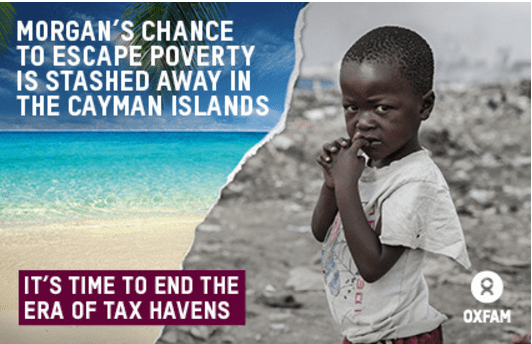
The Cayman Islands is a British overseas territory that chooses to stay British with limited self-government. If the British were to start bullying it over its tax haven and offshore financial centre policies, it would immediately seek independence.
This attempt by former colonial masters to bully small countries to toe their line on tax policies is not done in any way for the benefit of these former colonies and their economic development. It is old-fashioned imperialism with a new motivation, tax imperialism. The aim is to prevent capital flight and the erosion of the business tax base in developed countries.
This is a seething hypocrisy given that Oxfam was all for #TPPANoWay. It is OK to go your own way on tariffs, intellectual property and investment and other economic regulations but not taxes. Countries have a tariff sovereignty but not a tax sovereignty.
This is a self-serving neo-colonial hypocrisy. The sovereignty arguments for #TPPANoWay are identical to those for the right of countries to act as tax havens. Identical. Tariffs deny other countries export markets; tax havens deny other countries tax revenue.
Small island states were left-wing and environmentalist heroes on climate change at the most recent conference on global warming in Paris but are villains regarding tax havens. In both cases, these small countries are exercising their sovereignty regarding their foreign policies and economic policies.
Oxfam believes that the democratic rights of former colonies do not extend to shaping their own economic policies. Oxfam wants them to be put on a neo-colonial leash.

11 Jun 2016 Leave a comment
in applied price theory, applied welfare economics, comparative institutional analysis, constitutional political economy, economics, economics of information, income redistribution, Public Choice, public economics, rentseeking Tags: rational ignorance, rational irrationality, voter demographics
Celebrating humanity's flourishing through the spread of capitalism and the rule of law
Celebrating humanity's flourishing through the spread of capitalism and the rule of law
Celebrating humanity's flourishing through the spread of capitalism and the rule of law
Celebrating humanity's flourishing through the spread of capitalism and the rule of law
Celebrating humanity's flourishing through the spread of capitalism and the rule of law
Celebrating humanity's flourishing through the spread of capitalism and the rule of law
Celebrating humanity's flourishing through the spread of capitalism and the rule of law
Celebrating humanity's flourishing through the spread of capitalism and the rule of law
A History of the Alt-Right
Econ Prof at George Mason University, Economic Historian, Québécois
Celebrating humanity's flourishing through the spread of capitalism and the rule of law
Scholarly commentary on law, economics, and more
Beatrice Cherrier's blog
Celebrating humanity's flourishing through the spread of capitalism and the rule of law
Celebrating humanity's flourishing through the spread of capitalism and the rule of law
Celebrating humanity's flourishing through the spread of capitalism and the rule of law
Why Evolution is True is a blog written by Jerry Coyne, centered on evolution and biology but also dealing with diverse topics like politics, culture, and cats.
Celebrating humanity's flourishing through the spread of capitalism and the rule of law
A rural perspective with a blue tint by Ele Ludemann
DPF's Kiwiblog - Fomenting Happy Mischief since 2003
Celebrating humanity's flourishing through the spread of capitalism and the rule of law
The world's most viewed site on global warming and climate change
Tim Harding's writings on rationality, informal logic and skepticism
A window into Doc Freiberger's library
Let's examine hard decisions!
Commentary on monetary policy in the spirit of R. G. Hawtrey
Thoughts on public policy and the media
Celebrating humanity's flourishing through the spread of capitalism and the rule of law
Politics and the economy
A blog (primarily) on Canadian and Commonwealth political history and institutions
Reading between the lines, and underneath the hype.
Economics, and such stuff as dreams are made on
"The British constitution has always been puzzling, and always will be." --Queen Elizabeth II
Celebrating humanity's flourishing through the spread of capitalism and the rule of law
Celebrating humanity's flourishing through the spread of capitalism and the rule of law
WORLD WAR II, MUSIC, HISTORY, HOLOCAUST
Undisciplined scholar, recovering academic
Celebrating humanity's flourishing through the spread of capitalism and the rule of law
Res ipsa loquitur - The thing itself speaks
In Hume’s spirit, I will attempt to serve as an ambassador from my world of economics, and help in “finding topics of conversation fit for the entertainment of rational creatures.”
Researching the House of Commons, 1832-1868
Articles and research from the History of Parliament Trust
Reflections on books and art
Posts on the History of Law, Crime, and Justice
Celebrating humanity's flourishing through the spread of capitalism and the rule of law
Exploring the Monarchs of Europe


Recent Comments