Chris Bishop and Simon Court announced: Two new laws will be developed to replace the Resource Management Act (RMA), with the enjoyment of property rights as their guiding principle, RMA Reform Minister Chris Bishop and Parliamentary Under-Secretary Simon Court say. “The RMA was passed with good intentions in 1991 but has proved a failure in […]
After 30 years, there is hope
After 30 years, there is hope
27 Sep 2024 Leave a comment
in applied price theory, economics of bureaucracy, economics of regulation, environmental economics, environmentalism, income redistribution, law and economics, politics - New Zealand, property rights, Public Choice, rentseeking, transport economics, urban economics Tags: housing affordability, land supply, zoning
Renault CEO says sector could face billions in fines as EV sales slow
27 Sep 2024 1 Comment
in economics of climate change, economics of regulation, energy economics, environmental economics, environmentalism, global warming, transport economics Tags: electric cars

By Paul Homewood h/t Hugh Sharman Europe might not have a ZEV Mandate, but car makers still can’t escape the clutches of the eco loons: PARIS, Sept 7 (Reuters) – Europe’s autos industry could face fines of 15 billion euros ($17.4 billion) for carbon emissions due to slowing demand for electric […]
Renault CEO says sector could face billions in fines as EV sales slow
Second-hand electric car prices falling at faster and faster rate
22 Sep 2024 Leave a comment
in economics of climate change, energy economics, environmental economics, environmentalism, global warming, transport economics, urban economics Tags: electric cars

By Paul Homewood h/t Philip Bratby This hardly comes as a surprise! Electric vehicles (EVs) are losing value at an “unsustainable” rate as a slowdown in consumer demand sends used car prices tumbling, leasing companies have warned.
Second-hand electric car prices falling at faster and faster rate
Facts about Britain
22 Sep 2024 Leave a comment
in applied price theory, economic growth, economics of bureaucracy, economics of regulation, energy economics, environmental economics, industrial organisation, labour economics, law and economics, macroeconomics, Public Choice, resource economics, transport economics, urban economics Tags: British politics
Between 2004 and 2021, before Russia’s invasion of Ukraine, the industrial price of energy tripled in nominal terms, or doubled relative to consumer prices. With almost identical population sizes, the UK has under 30 million homes, while France has around 37 million. 800,000 British families have second homes compared to 3.4 million French families. Per capita electricity generation in the UK […]
Facts about Britain
EV Sales Collapse in Germany
21 Sep 2024 Leave a comment
in economics of climate change, economics of regulation, energy economics, environmental economics, environmentalism, global warming, transport economics Tags: electric cars
Germany has suffered a “spectacular” drop in electric car sales as the European Union faces growing calls to delay its net zero vehicle targets.
EV Sales Collapse in Germany
Pierson on Wellington cycleways
20 Sep 2024 Leave a comment
in politics - New Zealand, transport economics, urban economics Tags: celebrity technologies, cycleways
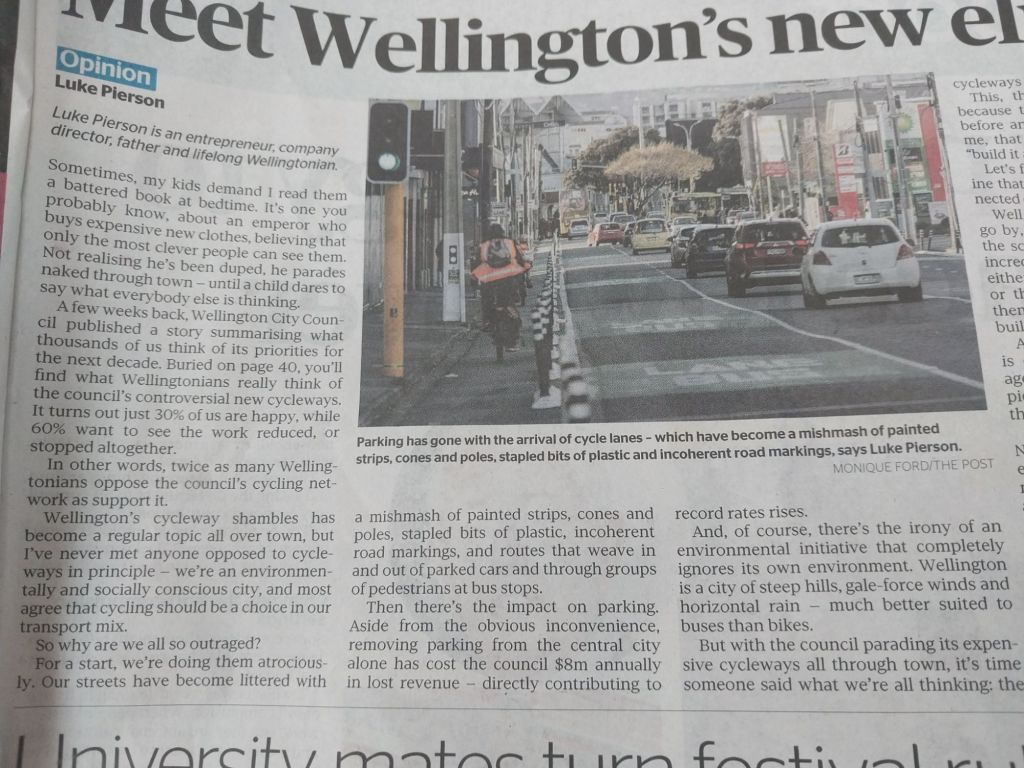
Lukje Pierson writes: A few weeks back, Wellington City Council published a story summarising what thousands of us think of its priorities for the next decade. Buried on page 40, you’ll find what Wellingtonians really think of the council’s controversial new cycleways. It turns out just 30% of us are happy, while 60% want to […]
Pierson on Wellington cycleways
Why Don’t We Have Flying Cars?
14 Sep 2024 Leave a comment
in economics of regulation, transport economics

In the 1970s the general aviation aircraft industry was selling 15,000 or more aircraft a year but that number fell by a factor of about 10 in the early 1980s. What happened? One factor was a massive increase in tort liability as discussed in my paper with Eric Helland, Product Liability and Moral Hazard: Evidence […]
Why Don’t We Have Flying Cars?
The End of the ISS is Coming but Why and What Will Replace it?
12 Sep 2024 Leave a comment
in transport economics Tags: space
Please legalise new supermarkets
11 Sep 2024 Leave a comment
in applied price theory, economics of regulation, environmental economics, politics - New Zealand, transport economics, urban economics Tags: land supply, zoning
Jaw-dropping bit from the Grocery Regulator, in interview at Interest.co.nz:“What we’ve been told by these players is when they come and they want to open up a large store in New Zealand, the cost to get a spade in the ground is double that of Australia,” he says in a new episode of the Of…
Please legalise new supermarkets
Uber messy
11 Sep 2024 Leave a comment
in applied price theory, comparative institutional analysis, economics of regulation, entrepreneurship, industrial organisation, labour economics, labour supply, law and economics, occupational choice, politics - New Zealand, property rights, Public Choice, transport economics, urban economics Tags: employment law, Uber
Caught a fun phone call from an accountant after this week’s column over at the Dom Post (and Christchurch Press, etc) on the court’s decision in the Uber case.If Uber drivers are employees, rather than contractors, as the Court sees things, how will depreciation on their cars be handled? Contractors can count all those expenses…
Uber messy
Rent controls make many tenants worse off in the Netherlands
10 Sep 2024 Leave a comment
in applied price theory, economic history, economics of regulation, income redistribution, Public Choice, rentseeking, transport economics, urban economics Tags: rent control
Rent controls have created shortages of housing, every time and in every place that they have been tried. In the latest futile attempt to create working rent controls, the Netherlands has worsened its housing shortage. As Bloomberg reported recently (paywalled, but try this alternative link):Two years ago, Nine Moraal and her two children moved into a…
Rent controls make many tenants worse off in the Netherlands
Uber ruling – driving in the wrong direction
09 Sep 2024 Leave a comment
in applied price theory, economics of regulation, labour economics, labour supply, law and economics, occupational choice, occupational regulation, property rights, Public Choice, rentseeking, transport economics, urban economics Tags: employment law, Uber
Dr Oliver Hartwich writes – Last week, an Uber driver surprised me in a conversation about the recent Court of Appeal decision classifying four Uber drivers as employees rather than contractors. My driver was blunt. He has no desire to be an employee. He values his flexibility to take breaks and drive when and where […]
Uber ruling – driving in the wrong direction
From the comments, on moving to the suburbs
07 Sep 2024 Leave a comment
in economic history, politics - USA, transport economics, urban economics
As Ed Banfield observed, the flight to the suburbs pre-dated the car because people prefer cheaper housing and more space: “The first elevated steam railroads were in New York in the 1870s, and twenty years later every sizable city had an electric trolley system. Railroads and trolleys enabled more people to commute and to commute […]
From the comments, on moving to the suburbs


Recent Comments