Transport Blog was making much of some data about how a lot of people used public transport and New Zealand in the 1950s:
Take Auckland as an example. According to Paul Mees [Transport for Suburbia, p. 21], in 1954 Auckland’s public transport network “accounted for 58 per cent of trips by motorized modes, private transport only 42 per cent. When walking and cycling, which were not surveyed, are taken into account, it is likely that fewer than a third of daily trips were by car.”
… public spending to enable car travel did not respond to existing demand – it was intended to shape future demand. (And in doing so, change the shape of the city).
…
“roads first” transport policies seem less like an exercise in meeting demands, and more of a component of a large social engineering programme.
Transport Blog forgot previous data it dugout on trends in car ownership per capita in New Zealand since 1925. There is an explosive growth in car ownership from the 1950s onwards with the post-war economic boom. The roadbuilding that followed responded to this growing wealth of the New Zealand people rather than the other way round.
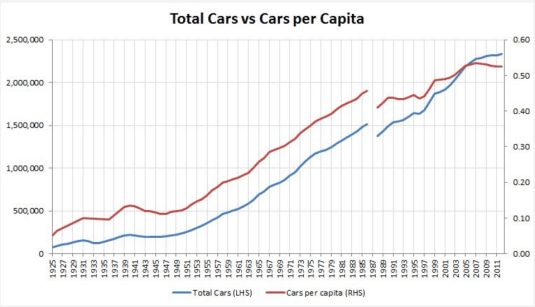
Source: The Infernal Combustion Engine « transportblog.co.nz.
People like owing and driving cars. Transport Blog begrudgingly admits in its post today that cars have some advantages.
Young people save up to buy a car not because they are duped by the enemies of public transport, they save because a car is a good way to get around.
Privately owned cars are more comfortable, faster, more private, more convenient in trip timing, and more flexible for multiple tasks on one trip than any form of public transit. What cannot be avoided as Anthony Downs explains is:
As household incomes rise around the world, more and more people shift from slower, less expensive modes of movement to privately owned cars and trucks.
Downs argues that it is time to settle down and accept what cities are:
…peak-hour traffic congestion is inescapable in large modern metropolitan areas the world over. Business firms want most people on the job during the same hours so that workers can interact efficiently. Many firms also want to locate in low-density establishments scattered across the landscape.
Households want a range of choices of where to live and work, and most want to live in low-density settlements that are separate from poorer households, use private vehicles for most travel and be able to carry out multiple errands on a single trip.



 Utopia, you are standing in it!
Recent Comments