Early Film Footage of London
08 Dec 2015 Leave a comment
in economic history, urban economics Tags: London
Auckland, Wellington and Canterbury housing costs to income ratios since 2007
04 Dec 2015 Leave a comment
in economic history, politics - New Zealand, urban economics
Global deaths from indoor and outdoor pollution
03 Dec 2015 1 Comment
in applied welfare economics, energy economics, environmental economics, health economics, transport economics, urban economics Tags: air pollution, indoor pollution, The Great Escape
@TransportBlog @JulieAnneGenter mode of commuting in Auckland, Wellington and Christchurch
01 Dec 2015 Leave a comment
in economics, transport economics, urban economics

Bugger all people commute by bus or train outside of Wellington. Even in Wellington taking the bus or the train has trouble staying well ahead of walking to work.
 Source: Ministry of Transport. (2015). 25 years of New Zealand travel: New Zealand household travel 1989–2014. Wellington: Ministry of Transport.
@NYTimeskrugman nails urban inequality @PhilTwyford @metiria
01 Dec 2015 Leave a comment
in economics of regulation, politics - New Zealand, urban economics

Source: Inequality and the City – The New York Times via Krugman: Deregulate Housing, David Henderson | EconLog | Library of Economics and Liberty.
The emergence of generation rent in the USA and UK
28 Nov 2015 1 Comment
in urban economics Tags: Generation Rent, housing prices
No Generation Rent in Deutschland or Nihon? Housing price to income ratios, USA, UK, Japan, Germany and New Zealand
27 Nov 2015 Leave a comment
in economic history, urban economics Tags: Generation Rent, housing affordability, housing prices
Japan and Germany seem to be pretty relaxed places to buy a house over the last 15 years. The USA had a bit of a bubble but it burst. New Zealand and the UK are dogs of places if you are young and house-hunting.
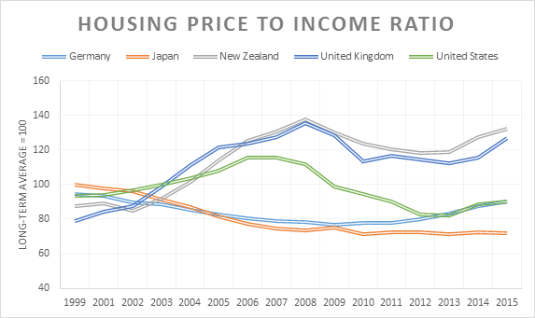
Source: OECD Economic Outlook November 2015, Annex Table 61.
@Maori_Party sold their people out to the NIMBYs
23 Nov 2015 Leave a comment
in applied price theory, economics of regulation, politics - New Zealand, urban economics
The Māori Party face the least political risks from deregulating land supply because so few Māori own their own homes. Less than half the rate of European New Zealanders. Māori home ownership rates peaked in 1991.
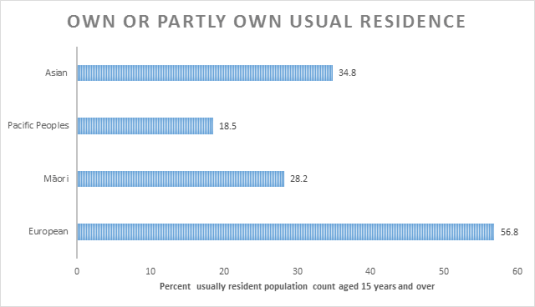
Source: 2013 Census QuickStats about housing.
Nonetheless, the Māori Party supplied the last two votes to vote down attempts to relax regulatory restrictions on the supply of land in New Zealand.
Source and notes: International House Price Database – Dallas Fed June 2015; nominal housing prices for each country is deflated by the personal consumption deflator for that country.
Their rationale for making land more expensive is a commitment to environmental principles. As the Māori Party coleader explained at the time:
We know there is considerable pressure and need for this Government to address the housing shortage, particularly in Auckland. However, one intent of the RMA, is to protect our environment for generations to come and this must remain paramount.
The 2014 policy manifesto of the party did not discuss housing supply or the need for reform of the RMA. It was mainly about social housing and the quality of rental house.
The chances of Māori increasing their homeownership rates rather than becoming leading members of Generation Rent requires a relaxation in restrictions in the RMA on the supply of land.
Auckland is up with London and New York in terms of housing unaffordability relative to median incomes. US cities with responsive land regulation don’t experience housing bubbles.
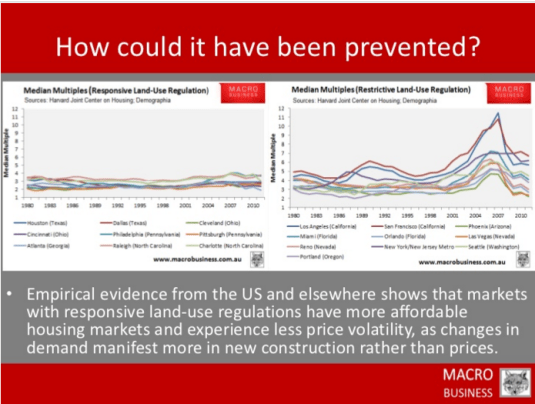
Glaeser and Gyourko summarised the findings of a number of studies on land supply and housing prices:
Recent research also indicates that house prices are more volatile, not just higher, in tightly regulated markets …. price bubbles are more likely to form in tightly regulated places, because the inelastic supply conditions that are created in part from strict local land-use regulation are an important factor in supporting ever larger price increases whenever demand is increasing. …. It is more difficult for house prices to become too disconnected from their fundamental production costs in lightly regulated markets because significant new supply quickly dampens prices, thereby busting any illusions market participants might have about the potential for ever larger price increases.
There has been a steady decline in housing affordability in New Zealand. The position is critical of the bottom 20% of the income ladder. Four in 10 now spend more than 30% of their disposable income on housing costs. Māori will be over-represented in this group but the party set-up to speak for them fails to do everything it can to make their housing cheaper.
NZ mode of commuting
23 Nov 2015 2 Comments
in politics - New Zealand, transport economics, urban economics
Bugger all people commute by bus or train outside of Wellington. Even in Wellington taking the bus or the train has trouble staying well ahead of walking to work.
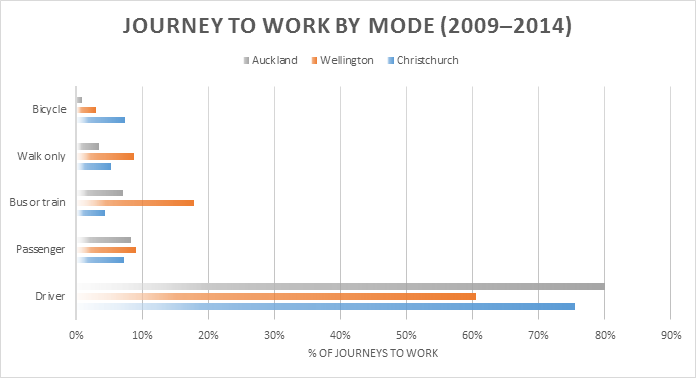
Source: Ministry of Transport. (2015). 25 years of New Zealand travel: New Zealand household travel 1989–2014. Wellington: Ministry of Transport.
@TransportBlog would #cyclists ever pass the precautionary principle?
17 Nov 2015 Leave a comment
in economics, transport economics, urban economics
If bikes were not invented until today, would they ever be allowed on the road by road safety regulators. Here is the business case: allow pedestrians to move around at high speed on the road including at night with poor visibility as long as they travel on a metal contraption.

Source: Ministry of Transport, Cyclists 2014.

Who spends more than half their income on housing in the UK?
12 Nov 2015 Leave a comment
in population economics, urban economics Tags: British economy, British politics, housing affordability
When did buying your own home become a good investment in Australia?
09 Nov 2015 Leave a comment
in economic history, politics - Australia, urban economics
When I left university, all my mates were in a fever pitch about buying a house because it was such a good investment. They didn’t mention that housing had been a dog of investment for the previous 10 years. Housing was a good investment for a couple years around the time of this feverish home buying by my friends as the chart below shows. I didn’t buy a house because I could rent houses that were far nicer and more convenient to work and that any I could buy in Canberra. That pretty much applies to today.
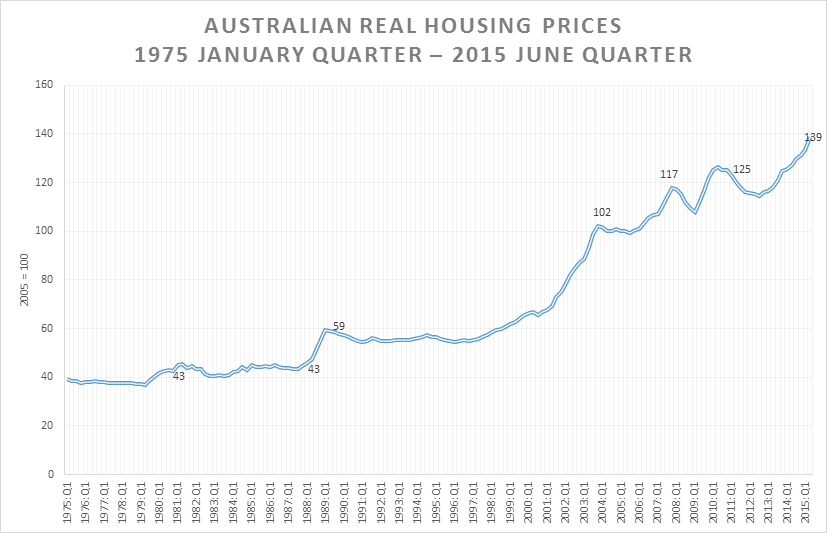
Source and notes: Dallas Fed International Housing Database July 2015 – The author acknowledge use of the dataset described in Mack and Martínez-García (2011); real housing prices are nominal housing prices deflated by a personal consumption deflator.
Through all the 1990s as the chart above shows in retrospect, I was too polite to inquire of friends about their house prices in case they had no equity in their own house after the bank took its slice. For all of the 1990s, investing in a house was a dog of an investment in Australia if the above chart is a reasonable national summary of what is a medium-sized country. Things then hit a fever pitch at the end of the 1990s with house prices doubling and then some across Australia.
When did buying your own home become an investment in New Zealand?
09 Nov 2015 Leave a comment
in economics of regulation, politics - New Zealand, Public Choice, rentseeking, urban economics
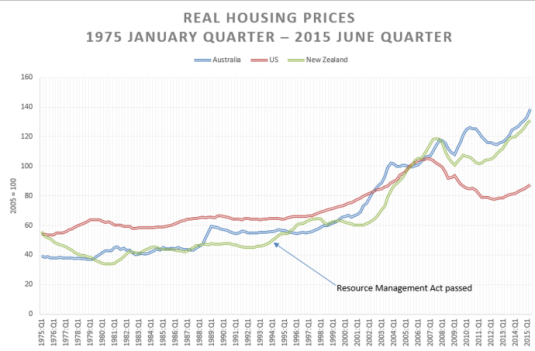
Buying a house became an investment in New Zealand coincidently with the passing of the Resource Management Act and all the restrictions on land supply it empowered. Prior to then buy a house was a good idea except if you want to make money because real housing prices in 1993 were the same as in the mid-70s.
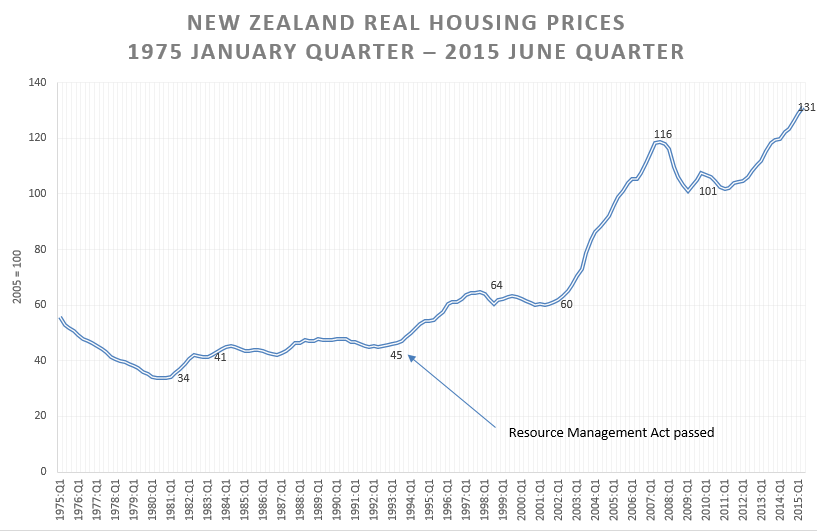
Source and notes: Dallas Fed International Housing Database July 2015 – The author acknowledge use of the dataset described in Mack and Martínez-García (2011); real housing prices are nominal housing prices deflated by a personal consumption deflator.
Housing prices rose by 50% in the first few years after the passage of the Resource Management Act. Housing prices doubled again in the last five years of the last Labour Government in New Zealand. With the economic recovery, housing prices increased again by 30% in the last four years or so.
The housing prices charted in deflated above are nationwide figures originally from nationwide nominal data published by the Reserve Bank of New Zealand and Quotable Value. They do not show the even faster growth in housing prices in, example, Auckland, Wellington and Christchurch and stagnant housing prices in declining regions, cities and towns of New Zealand.
@PhilTwyford fantastic @nzlabour policy breakthrough on housing affordability
08 Nov 2015 Leave a comment
in applied price theory, economics of regulation, fiscal policy, politics - New Zealand, urban economics Tags: housing affordability, land supply, New Zealand Greens, New Zealand Labour Party, RMA
Labour yesterday announced an excellent policy on housing affordability. The reforms proposed by Labour stress increasing the supply of land and improvements to local government finances surrounding infrastructure investments for new housing:
Labour will free up density and height controls to allow more medium density housing and reform the use of urban growth boundaries so they don’t drive up section costs. This will curb land bankers and speculators.
Labour has struck at the heart of two major constraints on urban land supply New Zealand: restrictions on density and height of new developments, and much more importantly, the use of urban growth boundaries to drive up land prices. These proposed regulatory reforms could not be more welcome.
The other shoe of Labour’s housing affordability reform proposals is improving the incentives for local councils to support new housing developments:
The other new element is changing the way we fund infrastructure for new developments. Currently those costs are either subsidised by the ratepayer or passed by the developer onto the price tag of a new home. That makes houses much more expensive. It also means they are paid off through mortgages at expensive bank interest rates.
Our new policy will see infrastructure funded by local government bonds, paid off over the lifetime of the asset through a targeted rate on the properties in the new development. This will substantially reduce the cost of new housing.
The reforms proposed by Labour to local government financing will reduce the financial burden on existing ratepayers of the local government funded infrastructure necessary to support new land developments.
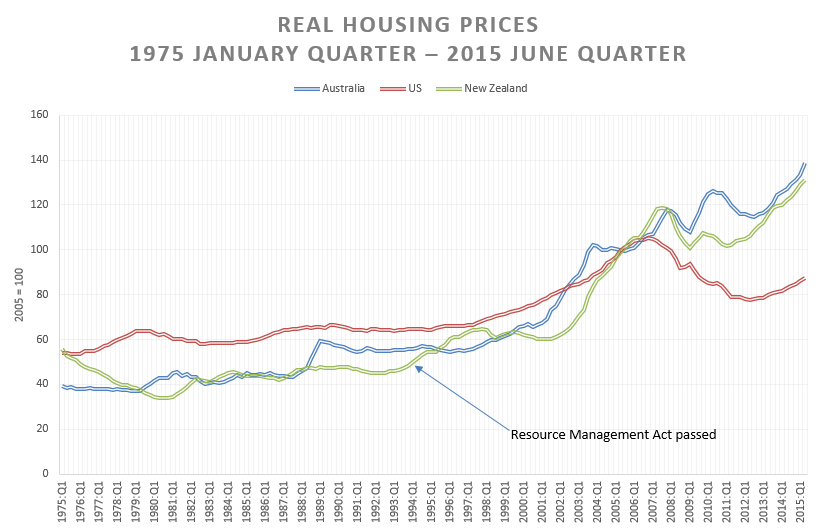
Source and notes: International House Price Database – Dallas Fed June 2015; nominal housing prices for each country is deflated by the personal consumption deflator for that country.
These Labour Party reforms are fantastic because the main party on the left-wing of New Zealand politics has faced up to restricted land supply as a key reason behind housing unaffordability. I wonder what the New Zealand Greens will think of these major new reforms.
Of course, nothing is perfect in the art of policy development. New Zealand Labour continue to want government to build 100,000 affordable houses and scapegoat foreigners for high housing prices.
A few more sensible economic and fiscal policy announcements such as those today by the New Zealand Labour Party and it will start looking like a credible alternative government.
The world’s most polluted cities
01 Nov 2015 Leave a comment
in development economics, environmental economics, growth miracles, urban economics Tags: air pollution, indoor pollution
https://twitter.com/wef/status/655654641145876483/photo/1
Live map shows the air-pollution level in hundreds of cities around the world buff.ly/1LyAECb http://t.co/Y89ESUhmWI—
Business Insider (@businessinsider) October 18, 2015


Recent Comments