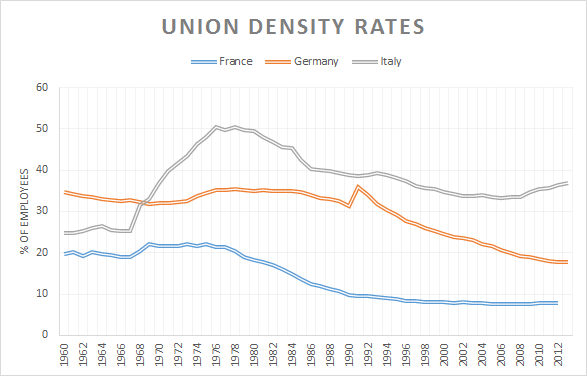
There are large differences in unionisation rates between the three countries. France has always had low levels of unionisation which halved since the 1970s. Italy had a sharp boost in union membership in the number of unions in the 1960s and 70s. This may have been associated with increased urbanisation. Union membership rate stayed pretty high in Italy ever since with a small taper downwards. Germany had stable unionisation rates prior to German unification after which the numbers about halved up in a slow taper.
Nothing much has happening to child poverty before housing costs in New Zealand since the early 1980s. It is after housing costs poverty that is crucifying the children in New Zealand.
From HES 2013 to HES 2014 median household income rose 5% in real terms (5% above the CPI inflation rate)…
On the AHC moving line measures, child poverty rates in HES 2014 are around the same as their peak after the GFC. A good amount of the rise from HES 2013 to HES 2014 is due to the large rise in the BHC median, as noted above, rather than a change in the numbers in low income per se.
The parties that oppose measures to increase the supply of land and reduce the cost of housing through reform of the Resource Management Act and its many restraints on the supply of land are the New Zealand Labour Party and New Zealand Greens.
All homeowners have an incentive to stop new housing because if developers build too many homes, prices fall, and housing is many families’ main asset. But in cities with many Democrats and Green Party members, environmental concerns might also be a factor. The movement might be too eager to preserve the past.
Rising inequality has been the norm in most developed countries, but few have seen it increase by as much as New Zealand.
Since the 1980s, New Zealand’s inequality – which had been low by OECD standards – drew closer to levels seen in more unequal countries like the United States.
They support this claim with a Gini Coefficient chart that I’ve been unable to source at the OECD. I therefore use another that is freely available in New Zealand and which I have used in the past. My data source on the Gini coefficient has the advantage of been a complete series back to the early 1980s rather than five yearly observations in the OECD data sourced by the Dominion Post.
Figure 1: Inequality in New Zealand and the OECD trend: the Gini coefficient
Source: Bryan Perry, Household incomes in New Zealand: Trends in indicators of inequality and hardship 1982 to 2013. Ministry of Social Development (July 2014), Figure J5.
Figure 1 shows there is no evidence of a substantive rise or fall in inequality in New Zealand since the mid 1990s. Nearly all of the increase in inequality was in the late 1980s and early 1990s. Not mentioning that nearly all of the increase was in a short period leads to a poor understanding of the data before their readers. Rising inequality is not an on-going problem in New Zealand. There was a large rise in inequality in the late 1980s and early 1990s.
The next figure that I’ve been able to reproduce is the income shares of the top 10%, top 5%, top 1% on top 0.5% income earners in New Zealand – see figure 2.
Our intrepid reporters in the Dominion Post claim that figure 2 shows that:
In 1986, the top 10 per cent took home 26.5 per cent of New Zealand’s income. In 1999, it was 37.8 per cent and in 2004, it was 33.2 per cent.
Oddly enough, our intrepid reporters decided to stop at 2004 for no particular reason. They also chose to truncate their chart at 1986 for no particular reason other than to lead the coincidence that the top 10% income shares were higher in the 1960s and 1970s that now– see figure 2 . That is, the top 10% in New Zealand earned more in the days before the scourge of neoliberalism came upon the New Zealand then after it – see figure 2. This detail was worth disclosing. Did neoliberalism reduce the income divide in New Zealand between the top 10% and the rest? Figure 2 suggests that it did.
The best that veteran grumbler Max Rashbrooke could spin to make these good old days of higher inequality than now to look like good old days before the scourge of neoliberalism beset New Zealand was to ignore the fortunes of the majority of the population in his dewy eyed view of his childhood:
New Zealand up until the 1980s was fairly egalitarian, apart from Māori and women, our increasing income gap started in the late 1980s and early 1990s
A more worthy analysis of figure 2 is to note that top income shares in New Zealand haven’t changed that much except for a bit of a spike in the late 1980s. This increase in inequality in New Zealand in the late 1980s and early 1990s – see figures 1 and 2 – was quickly followed by a long economic boom – see figure 3.
Figure 3: Real GDP per New Zealander and Australian aged 15-64, 2014 US$ (converted to 2014 price level with updated 2011 PPPs), 1.9 per cent detrended, 1956-2013
This boom after next to two decades of minimal real economic growth per working age New Zealander benefited everyone and, for example, the unemployment rate fell to a record low of 3.5% about 2005. The supposedly more egalitarian 1970s and 1980s were lost decades of growth – see figure 3.
Figure 4: Real equivalised median household income (before housing costs) by ethnicity, 1988 to 2013 ($2013)
Source: Bryan Perry, Household incomes in New Zealand: Trends in indicators of inequality and hardship 1982 to 2013. Ministry of Social Development (July 2014).
As shown in figure 4, between 1994 and 2010, real equivalised median New Zealand Pakeha household income rose by 47%; for Māori, this rise was 68%; for Pasifika, the rise in real equivalised median household income was 77%. These trends pass the difference principle developed by John Rawls.
The large improvements in Māori incomes since 1992 were based on rising Māori employment rates, fewer Māori on benefits or zero incomes, more Māori moving into higher paying jobs, and greater Māori educational attainment (Dixon and Maré 2007). Labour force participation rates of Māori increased from 45% in the late 1980s to about 62% in the last few years. Māori unemployment reached a 20-year low of 8 per cent from 2005 to 2008. That and the return of wages growth after years of stagnation as shown in figure 5 is something to celebrate.
Figure 5: real GDP per capita an average real wage, 1965 – 2014, New Zealand
The reporters in the Dominion Post also fell for the recent OECD analysis suggesting a connection between economic growth and inequality:
One study by the OECD suggests rising inequality was responsible for wiping a third off New Zealand’s economic growth in the past 30 years
It estimated the rate of New Zealand’s GDP growth was stunted by as much as 15.5 percentage points between 1990 and 2010 – more than any other OECD economy.
The analysis of the OECD depended crucially upon how greater inequality reduces the ability of the lower income families to invest in human capital:
The evidence strongly suggests that high inequality hinders the ability of individuals from low economic background to invest in their human capital, both in terms of the level of education but even more importantly in terms of the quality of education.
The OECD theory of inequality and lower growth is there is a financing constraint because of inequality that reduces economic growth because of less human capital accumulation by lower income families.
The OECD put a lot of their growth inequality nexus eggs in one basket. The OECD was implying that student loans and other government interventions are not closing credit constraints on financing higher education despite decades of rapidly rising tertiary education attainment, which is partially illustrated in figure 6.
This is interesting because in 2002, with Pedro Carneiro, James Heckman showed that lack of credit is not a major constraint on the ability of young Americans to attend college. They found that credit constraints prevent, at most, 4% of the U.S. population from attending. Credit constraints is weakening as a rationale for a lack of an accumulation of human capital, and can be easily solved.
Another difficulty for the OECD is the increase in inequality in New Zealand was, as noted before in figures 1 and 2, in the late 1980s and 1990s. To blame low economic growth to the tune of 15 percentage points on events of some 25 or 30 years ago is a long bow.
Higher education has been free for the low income families for several generations. Student loans are readily available. It is hard to believe that such a readily solvable problem is a major source of inequality and lower growth. Moreover, as Aghion said:
Economists and others have proposed many channels through which education may affect growth–not merely the private returns to individuals’ greater human capital but also a variety of externalities.
For highly developed countries, the most frequently discussed externality is education investments’ fostering technological innovation, thereby making capital and labour more productive, generating income growth.
Despite the enormous interest in the relationship between education and growth, the evidence is fragile at best.
The 15 percentage point reduction in New Zealand economic growth since the late 1980s because of inequality is so large over a 30 year period that this half a percentage point reduction on average per annum qualifies as an independent source of business cycle shocks and an equally implausible driver of real business cycles.
Our intrepid reporters closed by claiming large increases in child poverty:
In December last year, the second annual Child Poverty Monitor showed a slight decrease in the number of Kiwi children living in income poverty, from 27 per cent to 24 per cent. But 30 years ago, it was 14 per cent.
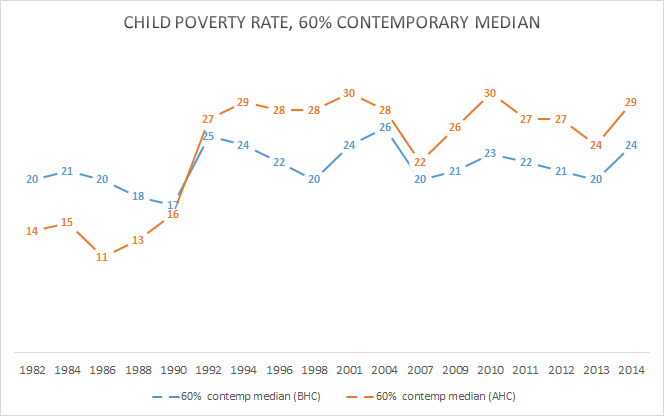
Figure 7 below shows their numbers, which is child poverty in New Zealand for poverty thresholds of 60% relative to a contemporary median measured both before and after housing costs.
Figure 7: % child poverty in New Zealand (before and after housing costs), 60% relative to contemporary median, 1982 – 2013
Source: Bryan Perry, Household incomes in New Zealand: Trends in indicators of inequality and hardship 1982 to 2013. Ministry of Social Development (July 2014), Tables F.6 and F.7.
The first thing to notice in figure 7 is before housing costs child poverty has been pretty stable for 30 years the New Zealand. Few celebrate this.
Figure 7 does show a large increase in after housing costs child poverty in the late 1980s. Since the early 1990s, after housing costs child poverty has slowly tapered down from the high 30% in the mid-1990s to 24% now – see figure 7.
In the longer run after housing costs child poverty rates in 2013 were close to double what they were in the late 1980s mainly because housing costs in 2013 were much higher relative to income than they were in the late 1980s.
– Bryan Perry, 2014 Household Incomes Report – Key Findings. Ministry of Social Development (July 2014).
Before housing costs child poverty in recent years as been the same as it was in 1982 – see figure 7. Although there were large cuts in the social security benefits in the 1991 mother of all budgets in New Zealand, before housing child poverty increased to 25% but was back to 20% by the mid 1990s.
As figure 7 shows, the problem was not income, but the rising costs of housing that had to be paid out of benefits and wages. The Left over Left will not let go of the 1991 benefit cuts even 25 years later despite the fact that the issue was rising housing costs rather than perpetually higher before housing costs child poverty.
The problem is not income, it is rising costs of housing. Increasing wages and benefits will not solve that if more money is simply chasing the same limited stock of land and urban housing.
A proper comparison of the diverging trends in figure 7 between before housing costs child poverty and after housing costs child poverty rates since 1982 gives a much clearer picture of what is increasing child poverty. It is rising housing costs as a result of regulation on the supply of new urban land.
The driver of inequality in New Zealand is government regulation of the land supply – policies supported by the middle-class and the left-wing parties. Rising inequality is not inequality between high and low income earners as suggested by the Dominion Post.
Closing The Gap – The Income Equality Project said today that “child poverty in New Zealand in 2014 was 24% as compared 14% in 1982”. What do they mean by this and what, importantly, does this trend imply for problem definition for child poverty policy?
Figure 1 below shows their numbers, which is child poverty in New Zealand after housing costs for poverty thresholds of 60% relative to a contemporary median as calculated by the Ministry of Social Development’s Brian Perry – the New Zealand expert on these matters.
Figure 1: % child poverty in New Zealand (before and after housing costs), 60% relative to contemporary median, 1982 – 2013
Source: Bryan Perry, Household incomes in New Zealand: Trends in indicators of inequality and hardship 1982 to 2013. Ministry of Social Development (July 2014), Tables F.6 and F.7.
The first thing to notice is, which is important, in figure 1 is before housing costs child poverty under the 60% relative to the contemporary median poverty threshold chosen by Closing The Gap – The Income Equality Project has been pretty stable for 30 years the New Zealand. Crisis, what crisis?
The top 1%’s New Zealand branch has not being doing its job – see figure 2. The New Zealand top 1% has failed miserably in further oppressing the proletariat, extracting more and more of their labour surplus, and grinding working class children into deeper and deeper poverty to increase their already excessive incomes – see figure 2. You’re fired as the until recently registered Democrat Donald Trump would say.
Figure 2: top income shares, New Zealand, Australia and USA
Before housing costs child poverty has not risen for 30 years as shown in figure 1, which is the chosen threshold of child poverty of the Closing The Gap – The Income Equality Project.
The story about trends in child poverty is very different for child poverty when after housing costs child poverty rates are estimated – see figure 1.
Figure 1 shows a large increase in after housing costs child poverty in New Zealand in the late 1980s when there was a deep recession and double-digit unemployment. Since the early 1990s, as figure 1 shows, after housing costs child poverty has slowly tapered down from the high 30% in the mid-1990s to 24% now and that is despite the global financial crisis, which was the top 1%’s fault if the Left over Left is to be believed.
For before housing costs child poverty – as can be seen from figure 1 – there was an increase in child poverty before housing costs when there was a deep recession at the end of the 1980s. After before housing costs child poverty is now the same as it was both 20 and 30 years ago – see figure 1 .
In the longer run after housing costs child poverty rates in 2013 were close to double what they were in the late 1980s mainly because housing costs in 2013 were much higher relative to income than they were in the late 1980s.
– Bryan Perry, 2014 Household Incomes Report – Key Findings. Ministry of Social Development (July 2014).
Now to the rub. If it is after housing costs child poverty that has risen in New Zealand and stayed high, as it has, the focus should be on what factors are driving up housing costs rather than what factors are driving down wages and incomes of ordinary worker. Before housing costs child poverty is no worse than it was 20 and 30 years ago – see figure 1.
New QV figures show Auckland house prices are up a massive 16.1% on last year, now estimated to reach $1m by Aug '16. http://t.co/DwAU79ozCy— New Zealand Labour (@nzlabour) June 09, 2015
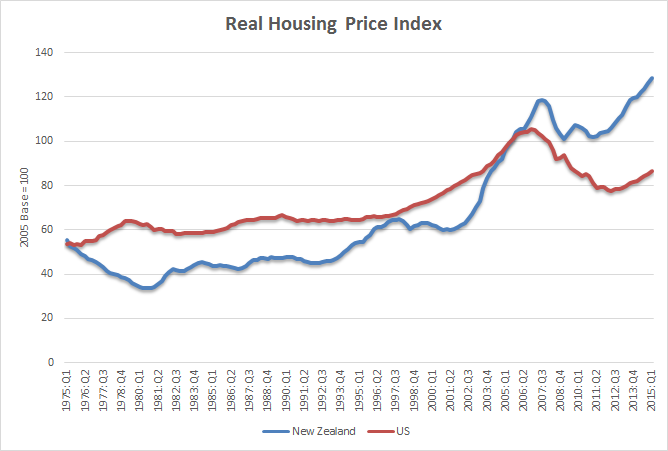
The cause of the large increase in housing costs and housing prices is abundantly clear. Restrictions on the supply of land that result from the Resource Management Act and policies made under that law such as the Auckland urban limit. That is the proper problem definition for public policy. Restrictions on land supply is driving up child poverty because more and more of the incomes of the poor is housing costs.
Source: Federal Reserve Bank of Dallas.
The most straightforward and fastest way of reducing child poverty and family poverty in New Zealand is lowering housing costs through deregulation of land supply.
Land supply deregulation is well within the realm of public policy choice. Parliament cannot legislate wage increases without accompanying productivity increases, but it can reduce restrictions on the supply of land as a result of the Resource Management Act.
Any discussion of child poverty and family poverty in New Zealand should refer to trends in both before and after housing cost in child poverty.
Will the Govt intervene in Auckland's housing crisis? Or will home ownership become a preserve of the wealthy? http://t.co/CK2AnCeuYB— Green Party NZ (@NZGreens) February 05, 2015
A comparison of these diverging trends between before housing cost and after housing costs child poverty rates since 1982 gives a much clearer picture of what is increasing child poverty. The cause is housing costs as a result of ever tightening regulation on the supply of new urban land and in particular in Auckland at the behest of the middle-class voters courted by the Greens and Labour Party. It is the left-wing parties in New Zealand which opposed the most practical steps to reduce child poverty, which is land supply deregulation.
The Government admits that its proposed insulation and smoke alarm standards for rental properties could push up rents by more than $3 a week. Under legislation to be introduced in October, social housing would have to be retrofitted with ceiling and underfloor insulation by next July, and all other rental homes by July 2019.
An important driver of lower quality housing in New Zealand is the restrictions on land supply. The costs of those restrictions, land makes up 60% of the cost of new houses rather than 40%. Land prices have doubled and tripled in a number of cities. As the Ministry of Business, Innovation and Employment has said:
The median price of sections has increased from $94,000 in 2003 to over $190,000 today (compared with $NZ 100,000 per section in the US), ranging from Southland ($82,000) to Auckland ($308,000)…
Section costs in Auckland account for around 60% of the cost of a new dwelling, compared with 40% in the rest of New Zealand.
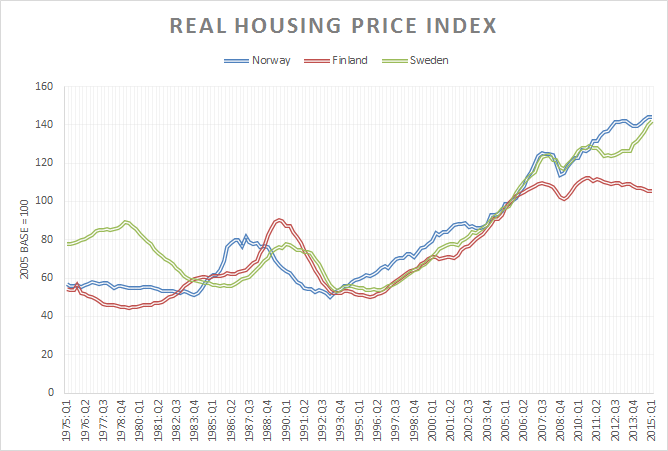
The RMA is the Resource Management Act and was passed just before New Zealand housing prices started to rise rapidly.
Source: Dallas Fed; Housing prices deflated by personal consumption expenditure (PCE) deflator.
Higher land prices for new houses spill into the prices of existing houses, which are now much more expensive than they need to be but for the RMA inspired land supply restrictions in Auckland and elsewhere in New Zealand.
One way in which homeowners and landlords can keep costs down when buying a house either for their own use or as an investment property is not to invest in insulation and smoke alarms. Deposits are less, mortgages are less and rents are less. It all adds up.
#nzqt today. John Key insists tht hungry kids in schools don't exist. Schools, teachers, parents insist tht they do. http://t.co/n1M3hTe5oh— Green Party NZ (@NZGreens) December 03, 2014
Put simply, you cannot argue that a few dollars is a lot of money to people on low incomes but ignore the consequences for their welfare of a $3 per week increase in their rents.
New QV figures show Auckland house prices are up a massive 16.1% on last year, now estimated to reach $1m by Aug '16. http://t.co/DwAU79ozCy— New Zealand Labour (@nzlabour) June 09, 2015
If tenants were willing to pay for insulation, landlords would provide well-insulated rental properties to service that demand. Walter Block wrote an excellent defence of slumlords in his 1971 book Defending the Undefendable:
The owner of ghetto housing differs little from any other purveyor of low-cost merchandise. In fact, he is no different from any purveyor of any kind of merchandise. They all charge as much as they can.
First consider the purveyors of cheap, inferior, and second-hand merchandise as a class. One thing above all else stands out about merchandise they buy and sell: it is cheaply built, inferior in quality, or second-hand.
A rational person would not expect high quality, exquisite workmanship, or superior new merchandise at bargain rate prices; he would not feel outraged and cheated if bargain rate merchandise proved to have only bargain rate qualities.
Our expectations from margarine are not those of butter. We are satisfied with lesser qualities from a used car than from a new car.
However, when it comes to housing, especially in the urban setting, people expect, even insist upon, quality housing at bargain prices.
Richard Posner discussed housing habitability laws in his Economic Analysis of the Law. The subsection was titled wealth distribution through liability rules. Posner concluded that habitability laws will lead to abandonment of rental property by landlords and increased rents for poor tenants.
What do-gooder would want to know that a warranty of habitability for rental housing will lead to scarcer, more expensive housing for the poor! Surprisingly few interventions in the housing market work to the advantage of the poor.
Will the Govt intervene in Auckland's housing crisis? Or will home ownership become a preserve of the wealthy? http://t.co/CK2AnCeuYB— Green Party NZ (@NZGreens) February 05, 2015
Certainly, there will be less rental housing of a habitability standard below that demanded by do-gooders in the new New Zealand legislation. In the Encyclopaedia of Law and Economics entry on renting, Werner Hirsch said:
It would be a mistake, however, to look upon a decline in substandard rental housing as an unmitigated gain.
In fact, in the absence of substandard housing, options for indigent tenants are reduced. Some tenants are likely to end up in over-crowded standard units, or even homeless.
The straightforward way to increase the quality of housing in New Zealand without increasing poverty is to increase the supply of land.
Govt advised even with best financial mgmt, not 1 treat, a family with 2 kids could still be down by $72 each week. http://t.co/VDLmdO8gz9— leah haines (@writeonleah) July 09, 2015
As land prices fall, both homebuyers and tenants will be able to pay for better quality fixtures and fittings because less of their limited income is paying for buying or renting the land.
CHART: Today’s new homes are 1,000 square feet larger than in 1973, and average living space per person has doubled http://t.co/vdBTwWsygG— Mark J. Perry (@Mark_J_Perry) June 27, 2015
Why Evolution is True is a blog written by Jerry Coyne, centered on evolution and biology but also dealing with diverse topics like politics, culture, and cats.
In Hume’s spirit, I will attempt to serve as an ambassador from my world of economics, and help in “finding topics of conversation fit for the entertainment of rational creatures.”
“We do not believe any group of men adequate enough or wise enough to operate without scrutiny or without criticism. We know that the only way to avoid error is to detect it, that the only way to detect it is to be free to inquire. We know that in secrecy error undetected will flourish and subvert”. - J Robert Oppenheimer.
Recent Comments