

via How the Rich and Poor Spend Money Today—and 30 Years Ago — The Atlantic.
Celebrating humanity's flourishing through the spread of capitalism and the rule of law
01 Apr 2015 Leave a comment
in labour economics, poverty and inequality, urban economics Tags: Generation Rent
01 Apr 2015 Leave a comment
in politics - New Zealand, politics - USA, urban economics Tags: Don Brash, land supply, Resource Management Act, zoning
21 Mar 2015 Leave a comment
in applied welfare economics, comparative institutional analysis, Marxist economics, politics - Australia, politics - New Zealand, politics - USA, poverty and inequality, urban economics Tags: Class war, Generation Rent, housing affordability, housing prices, land use regulation, RMA, Thomas Picketty, top 1%, wage stagnation
The other day, I replied to a rant by Bill Rosenberg about the decline in labour share of national income and its implications for income inequality and the great wage stagnation. The labour share of national income has dropped by at least 5% in most countries including New Zealand.

New data from the USA has found that the entire declining the value of the share of labour of national income is due to home ownership:
…the net capital share has increased since 1948, but when disaggregated this increase comes entirely from the housing sector: the contribution to net capital income from all other sectors has been zero or slightly negative, as the fall and rise have offset each other.
The capital share is rising because of the increased value of housing in countries with widespread home ownership. The concentration of capital ownership and wealth in the top 1% was a misplaced concern based on measurement error.
https://twitter.com/EconBizFin/status/581047721836060672
Piketty assumed the returns to capital were increasing across the entire economy. Rognlie found the trend to be almost entirely isolated to the housing sector. His 23 page long conference paper at the Brookings Institution started as a comment on a blog post on Marginal Revolution.

When Rognlie adjusted for the rapid depreciation inherent to investments in capital such as computer software, most of the rest of the increase in the capital share in recent decades in the USA and six other countries has came in housing.

A single sector such as housing is not the force that is shaping past and future of inequality as Piketty and others such as Bill Rosenberg in New Zealand have assumed. They attributed a growing share of income going to capital across the board as Tyler Cowan explains.
In the simplest version of the Piketty model, wealth grows more quickly than does the economy as a whole and thus the picture changes. The relative losers are no longer low earners but rather anyone who is not a capitalist. Any disparity is due not to their shortcomings in labour markets but rather to their lack of a high initial endowment.
The main driver of inequality is the tendency of returns on capital to exceed the rate of economic growth and company shares, businesses and other capital are owned by a narrow section of the community, and in particular by the top 1% of income earners. Trends in housing prices and the comings and goings of intangible capital is not part of that story.

Investment and depreciation of software and other intellectual property is not well handed, or even well measured in current national accounting systems as Edward Prescott has shown in a long research programme dating back 10 years. Intangible capital produced and owned by businesses is known to be big part of all investment in the economy but nearly all of it is recorded as an expense and therefore most is not part of GDP as currently measured.
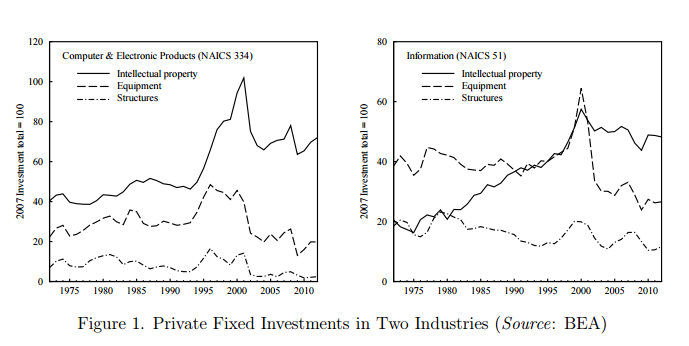
Source: Edward C. Prescott and Ellen R. McGrattan (2014)
Prescott estimated the value of intangible capital to be equal to about 60% of that of tangible capital in the US economy. Incorrect treatment of investment in intangible capital seriously underestimates investment, output, fluctuations in labour productivity and movements in the capital shares. The graph above shows that the recently introduced intellectual property classification in the US national accounts is both large and volatile relative to equipment and structures investments over the last 40 years. The graph below shows that including intangible capital completely changes the predictions of real business cycle models about trend US labour productivity in the 1990s.
Labor Productivity, for the Model, With and Without Intangible Investment (Real, Detrended) 1990-2003
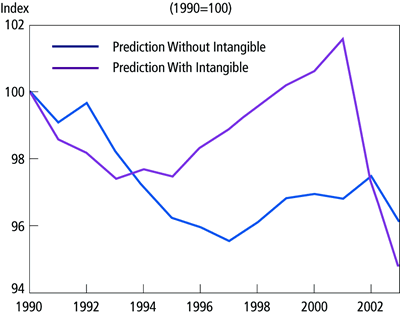
Source: McGrattan and Prescott, 2005, “Expensed and Sweat Equity,” Research Department Working Paper 636, Federal Reserve Bank of Minneapolis.
This depreciation adjustment for software investment is important because you can’t eat depreciation, as a shrewd observer noted. The rapid depreciation of software is depreciation – it cannot be redistributed from the top 1% to the downtrodden workers as some sort of income. Others have also earlier argued that Piketty’s claims rest on the recent increase in the price of housing.

The main reason for increases in the price of housing in New Zealand and elsewhere is restrictions on the supply of land by local councils. They are the real class enemy.

The metropolitan urban limit in Auckland increases land prices by 9 fold just inside that limit. As Tim Taylor said today:
The rise in capital income as a result of a long-term rise in land and housing prices across the high-income countries is a phenomenon that isn’t easily crammed into the usual disputes over whether capital owners are exploiting wage-earners.
The role of the housing sector and restrictions on land supply driving up housing prices in recent decades in shaping the future of inequality is perhaps underplayed given the many discussions of Generation Rent.

Housing affordability is a real crisis in New Zealand and many other countries with the younger generation no longer able to buy a house. They are condemned to decades of renting a house. They may never be able to afford a house on one income and perhaps two ordinary comes.
The future of inequality is between those who can and cannot afford a dream and a right for their parents and grandparents, which was to buy a house and pay the mortgage off within a couple of decades.

Young people used to buy a house shortly after leaving university and paid it off by their middle age when I was in my 20s and 30s. Back then, which was not all that long ago, ordinary workers could aspire to take out a mortgage and buy a house in the suburbs.

Unless there is a major deregulation of the supply of land in the big cities, home ownership for most in the community will really be a dream, rather than a dream of aspiration achieved by most by their 30s, if not often earlier through working and saving. The grandchildren of the baby boomers will become and perhaps already are Generation Rent.
21 Mar 2015 Leave a comment
in applied price theory, economics of regulation, environmental economics, politics - New Zealand, politics - USA, urban economics Tags: land supply, land use regulation, RMA, supply and demand, zoning

In areas with a readily available supply of land on which to construct new homes—either because of geography or few land-use restrictions—builders have been sensitive to increases in local demand and existing-home prices. When existing houses rise in price relative to the cost of new homes, prospective buyers are willing and able to buy new units.
Supply conditions determine how house price and construction react to shifting demand. When housing demand rises—perhaps due to rising incomes, lower mortgage interest rates or easier credit standards—the outward shift in demand produces sharply higher house prices with a small increase in the supply of newly built units in areas with less-plentiful land. By comparison, when there is a more-plentiful land supply, the amount of housing is more supply sensitive and a rise in demand results in a less-pronounced rise in house prices and a greater increase of newly constructed homes.
As a result, house prices rise less in these supply-sensitive areas during booms and they fall less in downturns. Similarly, prices swing more and homebuilding varies less in regions with less-sensitive housing supply.


24 Feb 2015 Leave a comment
in urban economics Tags: Edward Gleaser, housing affordability, land supply, land use regulation, zoning
22 Feb 2015 Leave a comment
in labour economics, liberalism, politics - New Zealand, poverty and inequality, urban economics, welfare reform Tags: child poverty, housing affordability, land supply, Left-wing hypocrisy, RMA, zoning
24 Jan 2015 Leave a comment
in rentseeking, urban economics Tags: Edward Gleaser, green rent seeking, land supply, land use regulation, zoning

Note: the Wharton Land Use Index measures the restrictiveness of a metropolitan area’s land use regulations.
23 Jan 2015 Leave a comment
in applied price theory, applied welfare economics, economics of regulation, geography, law and economics, politics - New Zealand, politics - USA, rentseeking, urban economics Tags: agglomeration, green rent seeking, land supply, zoning
the implied cost of housing restrictions across the whole U.S., and Chang and Enrico find that aggregate output is lower by about 10-14% because of them.
Last post on the NBER growth session. Chang-Tai Hsieh (Chicago) and Enrico Moretti (Berkeley) presented a paper on wage dispersion across cities in the U.S. Wage dispersion (New Yorkers earn more than people in Cleveland) either represents compensation for living costs (housing in New York is more expensive than in Cleveland), a real difference in productivity (New Yorkers are more productive than Clevelanders), or some combination of the two.
What Chang and Enrico find is that the increase in wage dispersion across cities in the U.S. over the last thirty-ish years is due almost entirely to rising house prices in six cities: NY, DC, Boston, San Fran, San Jose, and Seattle. Wages have gone up rapidly in those cities, but that is basically just compensating their citizens for the higher costs of living.
Now, given the costs of living, the allocation of population across cities in the U.S. is…
View original post 274 more words
22 Jan 2015 Leave a comment
in applied price theory, politics - New Zealand, urban economics Tags: Andrew Little, Dominion Post, economic literacy, housing affordability, media bias, rational irrationality, Resource Management Act, zoning

The editorial in today’s Dominion Post about the proposed reforms in New Zealand to the Resource Management Act to increase of urban land supply and make housing more affordable actually supported some absolute nonsense economic analysis by the Leader of the Opposition, Andrew Little:
Labour leader Andrew Little says part of the problem is in fact low and in many areas stagnating wages.
That is correct, but this merely points to a huge problem that successive governments have failed to solve. Nor is this Government likely to do much by way of living wage reforms or other non-market solutions.
The alleged professional journalist who wrote this editorial is ignorant of the most basic workings of the economy which he could pick up as an ordinary consumer and home owner.
If consumers become wealthier because of higher wages, they will use this increased income to demand more housing and land.
If the supply of land is fixed or otherwise constrained from expanding much, the only thing that will happen is that the price will go up with more money chasing the same amount of land and housing.
This will benefit the existing home owners in New Zealand. Workers who don’t own homes will simply have to pay more of their now higher wages to buy houses. Once again, the Labour Party betrays the interests of the working class to win middle-class home owner votes.
Celebrating humanity's flourishing through the spread of capitalism and the rule of law
Scholarly commentary on law, economics, and more
Beatrice Cherrier's blog
Celebrating humanity's flourishing through the spread of capitalism and the rule of law
Celebrating humanity's flourishing through the spread of capitalism and the rule of law
Celebrating humanity's flourishing through the spread of capitalism and the rule of law
Why Evolution is True is a blog written by Jerry Coyne, centered on evolution and biology but also dealing with diverse topics like politics, culture, and cats.
Celebrating humanity's flourishing through the spread of capitalism and the rule of law
Celebrating humanity's flourishing through the spread of capitalism and the rule of law
A rural perspective with a blue tint by Ele Ludemann
DPF's Kiwiblog - Fomenting Happy Mischief since 2003
Celebrating humanity's flourishing through the spread of capitalism and the rule of law
The world's most viewed site on global warming and climate change
Tim Harding's writings on rationality, informal logic and skepticism
A window into Doc Freiberger's library
Let's examine hard decisions!
Commentary on monetary policy in the spirit of R. G. Hawtrey
Thoughts on public policy and the media
Celebrating humanity's flourishing through the spread of capitalism and the rule of law
Politics and the economy
A blog (primarily) on Canadian and Commonwealth political history and institutions
Reading between the lines, and underneath the hype.
Economics, and such stuff as dreams are made on
"The British constitution has always been puzzling, and always will be." --Queen Elizabeth II
Celebrating humanity's flourishing through the spread of capitalism and the rule of law
Celebrating humanity's flourishing through the spread of capitalism and the rule of law
WORLD WAR II, MUSIC, HISTORY, HOLOCAUST
Undisciplined scholar, recovering academic
Celebrating humanity's flourishing through the spread of capitalism and the rule of law
Res ipsa loquitur - The thing itself speaks
In Hume’s spirit, I will attempt to serve as an ambassador from my world of economics, and help in “finding topics of conversation fit for the entertainment of rational creatures.”
Researching the House of Commons, 1832-1868
Articles and research from the History of Parliament Trust
Reflections on books and art
Posts on the History of Law, Crime, and Justice
Celebrating humanity's flourishing through the spread of capitalism and the rule of law
Exploring the Monarchs of Europe
Cutting edge science you can dice with
Small Steps Toward A Much Better World
“We do not believe any group of men adequate enough or wise enough to operate without scrutiny or without criticism. We know that the only way to avoid error is to detect it, that the only way to detect it is to be free to inquire. We know that in secrecy error undetected will flourish and subvert”. - J Robert Oppenheimer.
The truth about the great wind power fraud - we're not here to debate the wind industry, we're here to destroy it.
Celebrating humanity's flourishing through the spread of capitalism and the rule of law
Celebrating humanity's flourishing through the spread of capitalism and the rule of law
Economics, public policy, monetary policy, financial regulation, with a New Zealand perspective
Celebrating humanity's flourishing through the spread of capitalism and the rule of law
Restraining Government in America and Around the World




 Utopia, you are standing in it!
Recent Comments