
A blackguard whose faulty vision sees things as they are, not as they ought to be. Hence the custom among the Scythians of plucking out a cynic’s eyes to improve his vision.
Celebrating humanity's flourishing through the spread of capitalism and the rule of law
24 May 2014 Leave a comment
in applied price theory, liberalism Tags: Devil's dictionary
A blackguard whose faulty vision sees things as they are, not as they ought to be. Hence the custom among the Scythians of plucking out a cynic’s eyes to improve his vision.
14 May 2014 Leave a comment
in applied welfare economics, entrepreneurship, labour economics, liberalism, politics - USA, technological progress Tags: Piketty, poverty versus inequality
The French are poorer that the 3rd poorest American state: Arkansas. The EU-15 as a whole would qualify to be the 49th poorest American state.
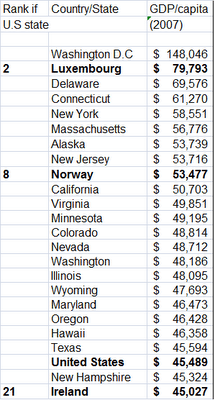
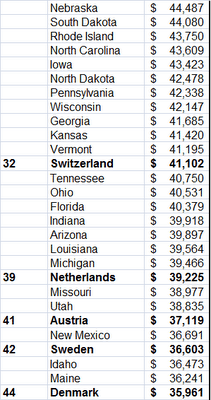

The rich in Europe are poor by American standards. The poor in the USA are middle class by European standards. The European middle class has smaller houses, few cars and few consumers durables that the average poor in the USA.

via Super-Economy: Dynamic America, Poor Europe and Tino Sanandaji
07 May 2014 Leave a comment
in industrial organisation, labour economics, law and economics, liberalism, personnel economics, Public Choice, Richard Epstein
04 May 2014 Leave a comment
in constitutional political economy, development economics, entrepreneurship, liberalism, market efficiency, technological progress Tags: Deirdre McCloskey, industrial revolution, Rise of the Western World, rule of law, The Bourgeois Virtues, The Great Fact
Throughout the history of the world, the average person on earth has been extremely poor: subsisting on the modern equivalent of $3 per day.
This was true until 1800, at which point average wages—and standards of living—began to rise dramatically.
Prof. Deirdre McCloskey explains how this tremendous increase in wealth came about.
In the past 30 years alone, the number of people in the world living on less than $3 per day has been halved.
The cause of the economic growth we have witnessed in the past 200 years may surprise you.
It’s not exploitation, or investment. Innovation—new ideas, new inventions, materials, machinery, organizational structures—has fueled this economic boom.
Prof. McCloskey explains how changes in Holland and England in the 1600s and 1700s opened the door for innovation to take off—starting the growth that continues to benefit us today.
via Why Does 1% of History Have 99% of the Wealth? | Learn Liberty – YouTube.
02 May 2014 Leave a comment
in applied welfare economics, law and economics, liberalism
30 Apr 2014 Leave a comment
in economics, liberalism, Milton Friedman
23 Apr 2014 Leave a comment
in entrepreneurship, environmental economics, environmentalism, liberalism, technological progress Tags: Earth Day, energy conservation
23 Apr 2014 Leave a comment
in applied welfare economics, entrepreneurship, environmental economics, environmentalism, liberalism, market efficiency Tags: Earth Day, Julian Simon, Paul Ehrlich
During the first great Earth Week in 1970 there was panic.
The public’s outlook for the planet was unrelievedly gloomy.
The doom saying environmentalists – of whom the dominant figure was Paul Ehrlich – raised the alarm: The oceans and the Great Lakes were dying; impending great famines would be seen on television starting in 1975; the death rate would quickly increase due to pollution; and rising prices of increasingly-scarce raw materials would lead to a reversal in the past centuries’ progress in the standard of living.
… On average, people throughout the world have been living longer and eating better than ever before.
Fewer people die of famine nowadays than in earlier centuries.
The real prices of food and of every other raw material are lower now than in earlier decades and centuries, indicating a trend of increased natural-resource availability rather than increased scarcity.
The major air and water pollutions in the advanced countries have been lessening rather than worsening.

Via Julian Simon memorial site
23 Apr 2014 1 Comment
in applied welfare economics, law and economics, liberalism, survivor principle Tags: food, natural selection, PEETA, PETA
The web site formally known as People Enjoy Eating Tasty Animals (PEETA) is one of my favourite web sites.
When called PEETA in 1996 or so, this web site was the subject of a pioneering intellectual property court case by PETA.

The web site is a resource for those who enjoy eating meat, wearing fur and leather, hunting, and the fruits of scientific research. More on animal testing later with the help of Penn and Teller.
via People Eating Tasty Animals.
BTW, why are people not allowed to eat tasty animals, but other animals are allowed to eat each other if they can catch them. Should carnivores be required to become vegans? That would be a death sentence for them.
15 Apr 2014 Leave a comment
in entrepreneurship, liberalism, market efficiency Tags: Harry M. Markowitz, modern portfolio theory
Harry M. Markowitz won the Nobel Prize in economics as the father of “modern portfolio theory,” the idea that people shouldn’t put all of their eggs in one basket, but should diversify their investments.

Markowitz split most of his his own retirement investments down the middle, put half in a stock fund and the other half in a conservative, low-interest investment.
Markowitz invested more wisely than some fellow Nobelists who have significant portions of their nest eggs in money market accounts, some of the lowest-returning investment vehicles available.
13 Apr 2014 Leave a comment
in Austrian economics, constitutional political economy, development economics, entrepreneurship, law and economics, liberalism, Public Choice Tags: collapse of communism
the collapse of Communism has taught political economists several things:
first, that economic policy is always nested within a set of institutions—that there are economic/financial, political/legal, and social/cultural issues, which all must be taken into account;
second, that leadership matters throughout the transition process;
and third, that historical contingency can either work in your favour or cut against the successful transition.
And I would add a fourth one: that political power corrupts even the most informed and idealistic of individuals, such that you cannot count on ideological alignment to win the day. You have instead a small window of opportunity in which ideological alignment can be utilized to establish institutions that make it difficult for even bad men to do much harm.
In other words, the goal of our political/legal institutions should not be to ensure that the best and the brightest can govern, but instead that if the worst get in power, they can do little damage. This is the idea of a “robust political economy”.
12 Apr 2014 Leave a comment
in liberalism, politics Tags: useful idiots
The phrase ‘useful idiots’, supposedly Lenin’s, refers to Westerners duped into saying good things about bad regimes.
In political jargon it was used to describe Soviet sympathisers in Western countries and the attitude of the Soviet government towards them.
Useful idiots, in a broader sense, refers to Western journalists, travellers and intellectuals who gave their blessing – often with evangelistic fervour – to tyrannies and tyrants, thereby convincing politicians and public that utopias rather than Belsens thrived.
In part one John Sweeney looks at Stalin’s Western apologists at http://downloads.bbc.co.uk/podcasts/worldservice/docarchive/docarchive_20100804-0905a.mp3
In part two he explores how present day stories of human rights abuses across the world are still rewritten at http://downloads.bbc.co.uk/podcasts/worldservice/docarchive/docarchive_20100811-1059a.mp3

10 Apr 2014 Leave a comment
in Austrian economics, constitutional political economy, F.A. Hayek, liberalism, politics Tags: Hayek, Road to Serfdom, Tullock
Gordon Tullock used Sweden to support his argument that the basic problem with The Road to Serfdom was:
“that it offered predictions which turned out to be false. The steady advance of government in places such as Sweden did not lead to any loss of non-economic freedoms.”
When looking back longingly at the mixed economies of 1950s and 1960s, people often forget who won elections much of the time back then.
The period that managed to combine a large degree of state ownership and control of the UK economy with a free and diverse media and political pluralism was often under Tory rule (1951 to 1964) with the Labor governments (1964-1970) often with a margin of a few seats.
Then there was the Menzies era in Australia with Liberal party rule from 1949 to 1972; and then 1975 to 1983. Much the same in New Zealand. The Left rarely held power in the mid-20th century.
The Christian democrats usually ran both Italy and Germany in coalitions, as I recall, up until the late 1960 or the early 1970s. Gaullist France? The LDP in Japan?
That is where Hayek got it wrong. The left-wing parties were not the face of the future.
Power rotated in Schumpeterian sense. Governments were voted out when they disappointed voters with the replacement not necessarily having very different policies.
The right-wing parties won many western European elections by that well-proven old trick of being slightly to the right of the left-wing parties. Hayek failed to predict this.
Hayek was himself a major critic of detailed predictions:
“We can build up beautiful theories which would explain everything, if we could fit into the blanks of the formulae the specific information; but we never have all the specific information.
Therefore, all we can explain is what I like to call “pattern prediction.”
You can predict what sort of pattern will form itself, but the specific manifestation of it depends on the number of specific data, which you can never completely ascertain. Therefore, in that intermediate field — intermediate between the fields where you can ascertain all the data and the fields where you can substitute probabilities for the data–you are very limited in your predictive capacities.”
“Our capacity of prediction in a scientific sense is very seriously limited. We must put up with this.
We can only understand the principle on which things operate, but these explanations of the principle, as I sometimes call them, do not enable us to make specific predictions on what will happen tomorrow.”
Hayek’s warnings in The Road to Serfdom was against a background where democracy was still young and insecure in Europe and peacetime democratic governments were, up until then, not much bigger than a post office and a military. The big governments of his day were not democratic.
As Popper and Kuhn understood it, bold, risky hypotheses are at the heart of great advances in the sciences and scholarship generally.
06 Apr 2014 Leave a comment
So that the record of history is absolutely crystal clear. That there is no alternative way, so far discovered, of improving the lot of the ordinary people that can hold a candle to the productive activities that are unleashed by a free enterprise system.
Celebrating humanity's flourishing through the spread of capitalism and the rule of law
Celebrating humanity's flourishing through the spread of capitalism and the rule of law
Celebrating humanity's flourishing through the spread of capitalism and the rule of law
Celebrating humanity's flourishing through the spread of capitalism and the rule of law
Celebrating humanity's flourishing through the spread of capitalism and the rule of law
Celebrating humanity's flourishing through the spread of capitalism and the rule of law
Celebrating humanity's flourishing through the spread of capitalism and the rule of law
Celebrating humanity's flourishing through the spread of capitalism and the rule of law
A History of the Alt-Right
Econ Prof at George Mason University, Economic Historian, Québécois
Celebrating humanity's flourishing through the spread of capitalism and the rule of law
Scholarly commentary on law, economics, and more
Beatrice Cherrier's blog
Celebrating humanity's flourishing through the spread of capitalism and the rule of law
Celebrating humanity's flourishing through the spread of capitalism and the rule of law
Celebrating humanity's flourishing through the spread of capitalism and the rule of law
Why Evolution is True is a blog written by Jerry Coyne, centered on evolution and biology but also dealing with diverse topics like politics, culture, and cats.
Celebrating humanity's flourishing through the spread of capitalism and the rule of law
A rural perspective with a blue tint by Ele Ludemann
DPF's Kiwiblog - Fomenting Happy Mischief since 2003
Celebrating humanity's flourishing through the spread of capitalism and the rule of law
The world's most viewed site on global warming and climate change
Tim Harding's writings on rationality, informal logic and skepticism
A window into Doc Freiberger's library
Let's examine hard decisions!
Commentary on monetary policy in the spirit of R. G. Hawtrey
Thoughts on public policy and the media
Celebrating humanity's flourishing through the spread of capitalism and the rule of law
Politics and the economy
A blog (primarily) on Canadian and Commonwealth political history and institutions
Reading between the lines, and underneath the hype.
Economics, and such stuff as dreams are made on
"The British constitution has always been puzzling, and always will be." --Queen Elizabeth II
Celebrating humanity's flourishing through the spread of capitalism and the rule of law
Celebrating humanity's flourishing through the spread of capitalism and the rule of law
WORLD WAR II, MUSIC, HISTORY, HOLOCAUST
Undisciplined scholar, recovering academic
Celebrating humanity's flourishing through the spread of capitalism and the rule of law
Res ipsa loquitur - The thing itself speaks
In Hume’s spirit, I will attempt to serve as an ambassador from my world of economics, and help in “finding topics of conversation fit for the entertainment of rational creatures.”
Researching the House of Commons, 1832-1868
Articles and research from the History of Parliament Trust
Reflections on books and art
Posts on the History of Law, Crime, and Justice
Celebrating humanity's flourishing through the spread of capitalism and the rule of law
Exploring the Monarchs of Europe




Recent Comments