The market is the basis of social peace as well as prosperity

Milton Friedman pointed specifically to the anonymity and impersonal nature of the market as a way that people that would otherwise hate each other if they met on any other basis could instead co-operate, work productively together and become friendly with each other.

“The great virtue of a free market system is that it does not care what colour people are; it does not care what their religion is; it only cares whether they can produce something you want to buy. It is the most effective system we have discovered to enable people who hate one another to deal with one another and help one another.”

Milton Friedman

Benevolence is not enough. The market process ensures that the unpopular and unpleasant also get fed and have jobs. The market is the basis of social peace as well as the only method by which the masses escaped from grinding poverty.

The Economics of Foreign & Military Intervention with Chris Coyne

One of the greatest moments in TV – The Wire – Major Colvins speech: A paper bag for drugs

the best single case made for ending the war on drugs from the greatest TV show of them all. A bit over 3 minutes long.

Years ago, I remember reading a short news note about a Rand study of occupational hazards facing drug gangs in Washington, DC in the 1970s.

In a typical career of a few years, the annual risks were these:

  1. The chances of being caught by the police was 22% – usually 18 months in prison;
  2. the chances of serious injury 7%;
  3. The chances of being murdered by a business associate or market rival was 1.4%;
  4. the pay for street dealers is rather poor and not much better than their next best job opening.

Gave up on the war on drugs right there and then. Death and injury are the main occupational hazards of a drug dealer.

Murder was the leading cause of death of young black Americans.

Another paper pointed out that one reason the death penalty did no work so well was because people spent so long on death row due to appeals that taking them out of the drug trade increased their life expectancy.

The execution rate on death row is about twice the death rate from accidents and violence for all American men, and only slightly greater than the rate of accidental and violent death for all black males aged 15 to 34.

Bad prison conditions—well known, pervasive and immediate—have a more significant deterrent role against crime. Death row is a rather safe place to be?

Video

Three cheers for rude political discourse

There is nothing unusual about ill-mannered political discourse. In the 1980s, a cartoonist went in search of Ronald Reagan’s brain.

A good discussion on political manners is in the Supreme Court judgment on the Larry Flynt, Jerry Falwell case, which included a 200-year history of American political cartoons.

Flynt_falwell

The Court noted that the political cartoon is a weapon of attack, of scorn and ridicule and satire. It is usually as welcome as a bee sting and is always controversial to some and continuously goes beyond the bounds of good taste and conventional manners.

From the viewpoint of history, the Court held that it is clear that our political discourse would have been considerably poorer without them. The Court stated:

Debate on public issues will not be uninhibited if the speaker must run the risk that it will be proved in court that he spoke out of hatred; even if he did speak out of hatred, utterances honestly believed contribute to the free interchange of ideas and the ascertainment of truth.

Shrillness is commonplace in political discourse as is ignorance and ill manners. The Court held that:

The appeal of the political cartoon or caricature is often based on exploitation of unfortunate physical traits or politically embarrassing events – an exploitation often calculated to injure the feelings of the subject of the portrayal.

Everyone has the right to speak and all adults can vote, including those who disagree with you and even fill you with revulsion.

Politics and hatred of your opponents go hand in hand. Politics is a blood sport for driven people.

More than a few hate capitalism and speak in unflattering, even hateful, tones of the successful and other class enemies. Mises explained the youthful allure of socialism:

It promises a Paradise on earth, a Land of Heart’s Desire full of happiness and enjoyment, and—sweeter still to the losers in life’s game—humiliation of all who are stronger and better than the multitude…

Liberalism and capitalism address themselves to the cool, well-balanced mind. They proceed by strict logic, eliminating any appeal to the emotions.

Socialism, on the contrary, works on the emotions, tries to violate logical considerations by rousing a sense of personal interest and to stifle the voice of reason by awakening primitive instincts.

Every day spent pondering on the rudeness of your opponents is a day not spent showing the middle ground that the opposing viewpoint is wrong.

You play into their hands by taking your eyes off the prize. Back to that former union boss Ronald Reagan:

American politics is littered with, as George Will added eloquently, the bleached bones of those who under-estimated Ronald Reagan.

Renegade liberals and the withering away of the proletariat

George Orwell, in his proposed preface of Animal Farm, wrote of the “renegade liberal”. Renegade liberals glorify socialist experiments and disdain middle-class life despite their own pleasant circumstances.

Renegade liberals search the globe for outlaw states and revolutionary movements to support, who, of course, would ship their local versions of these renegade liberals straight to the camps as soon as they won power. Iran, Castro and Hugo Chávez are their latest rebels without a clue.

The revolutionary excesses of the new socialist or Anti-American regimes are excused as the misadventures of ‘liberals in a hurry’, who understandably lost patience with the slow pace of democratic reform. It is all in the name of liberating the proletariat from their misery or throwing off the dead hand of colonial rule.

How is the immiseration of the proletariat going these days?

  • The immiseration of the proletariat is the central prediction of Marxism, the driver of class conflict, and this growing misery and poverty is what will finally push workers to wage a revolution against the capitalists.
  • It is a bit hard to argue that workers are poorer today than in 1848 when the Communist Manifesto was written. The central Marxist prediction is falsified by history.

I agree with G.A. Cohen when he argues that there is no group in advanced industrial societies united by:

  1. being the producers on which society depends;
  2. being exploited;
  3. being, in conjunction with their families, the majority of society; and
  4. being in dire need.

To avoid the inconvenient truth of modern affluence and the move of so many of the proletariat into the middle class, renegade liberals search endlessly for under-developed countries so they can blame their poverty on capitalism.

When they visit them in solidarity, these renegade liberals should read the visa stamp: ‘people’s republic’ or ‘socialist republic’ is so frequently on it. It is still mandatory for all political parties in India to be committed to socialism.

fidel.JPG

Nearly all of Asia (where much of the world’s population lives) has undergone rapid and sustained economic and social progress because they became market economies, starting with the Asian Tigers and recently in previously socialist India and communist China. Latin America adopted the inward economic polices of the mid-20th century that renegade liberals praise so much and they became development disasters.

As the world embraced free market policies in the late 20th century, living standards rose sharply; life expectancy, education and democracy improved and absolute poverty declined. Xavier Sala-I-Martin and Maxim Pinkovskiy (2010) found that between 1970 and 2006, poverty fell by 86% in South Asia, 73% in Latin America, 39% in the Middle East and 20% in Africa. The percentage of people living on less than $1 a day (in PPP-adjusted 2000 dollars) fell from 26.8% in 1970 to 5.4% in 2006.

To go further, P.T. Bauer disputed the lack of development in British colonies. Bauer argued that much of British colonial Africa was transformed in the colonial period.

Peter Bauer

Before British rule, there were no rubber trees in Malaya, no cocoa trees in West Africa, no tea in India:

“…Much of British colonial Africa was transformed during the colonial period. In the Gold Coast there were about 3000 children at school in the early 1900s, whereas in the mid-1950s there were over half a million. In the early 1890s there were in the Gold Coast no railways or roads, but only a few jungle paths…

Before colonialism, Sub-Saharan Africa was a subsistence economy, because of colonialism it became a monetized economy.

Before colonialism, the absence of public security made investment impossible.

After it, investment flowed. So too was scientific agriculture introduced by colonial administrations, or by “foreign private organizations and persons under the comparative security of colonial rule, and usually in the face of formidable obstacles…

In British West Africa public security and health improved out of all recognition… peaceful travel became possible; slavery and slave trading and famine were practically eliminated, and the incidence of the worst diseases reduced..” (P.T. Bauer)

Some colonial powers were better than others. After 500 years of Portuguese rule in East Timor, in 1975, there was one road – to the governor’s house – and the phone number of the Australian consulate was 7! Portugal itself may have not been much better at that time too. Colonial masters are like parents. You must choose them well.

Trade is a powerful force for peace in the Ukraine

Russian TV is starting to spin a Putin back-down in the Ukraine. Channel surfing, I came cross a Russian TV story alluding to Russians that the revenues from the Russian gas pipelines across the Ukraine to the EU are a major lifeline of the Russian economy.

The mere threat of repeated sabotage of these gas pipelines to Western Europe are an easy way to hurt Russia if it overplays its hand. That was the round-about topic of the TV story.

Trade was a powerful force for peace and is a defence against war, as the great Manchester liberal Richard Cobden championed in mid-19th century.

Both Russia and China have much more to lose and much less to gain from war because of their extensive trade links with their neighbours and their former Cold War rivals, including with each other. China’s extensive trade and investment links with Taiwan are the best guarantee of peace between them.

As Joseph Schumpeter observed, when free trade prevails, “no class” gains from forcible expansion: “foreign raw materials and food stuffs are as accessible to each nation as though they were in its own territory”. Patrick McDonald recently called free trade the invisible hand of peace.

Should we fight for the Ukraine?

Murray Rothbard, in the context of the 1980 Afghan war, quoted Canon Sydney Smith – a great classical liberal in early 19th century England who wrote to his warmongering Prime Minister, thus:

“For God’s sake, do not drag me into another war!

I am worn down, and worn out, with crusading and defending Europe, and protecting mankind; I must think a little of myself.

I am sorry for the Spaniards – I am sorry for the Greeks – I deplore the fate of the Jews; the people of the Sandwich Islands are groaning under the most detestable tyranny; Baghdad is oppressed, I do not like the present state of the Delta; Tibet is not comfortable. Am I to fight for all these people?

The world is bursting with sin and sorrow. Am I to be champion of the Decalogue, and to be eternally raising fleets and armies to make all men good and happy?

We have just done saving Europe, and I am afraid the consequence will be, that we shall cut each other’s throats. No war, dear Lady Grey! – No eloquence; but apathy, selfishness, common sense, arithmetic!”

Living in the 70s – the BBC documentary Electric Dreams

I grew up in the 70s. But were they the ‘good old days’?

A BBC television documentary placed two parents and four children in their home with only the amenities available during each of the previous three decades (1970s, 1980s and 1990s) and recording their responses to technological change.

The programme follows the family’s adaption and reaction to being thrown back in time to a more technologically sparse period and how their pastimes and attitudes change in response to both landing in the early 1970s and coming up-to-date.

The episodes revealed the huge transformation that technological change has wrought on British family life over the past 40 years. The children have to cope when they swapped Facebook for black-and-white telly and vinyl records.

33⅓ LP vinyl record album

It was goodbye to their three game consoles, three DVD players, five mobile phones, six televisions and seven computers, not to mention their dishwasher, two washing machines and tumble dryer. The teenager had to do a pre-dawn paper boy run.

Filming occurred over the winter of 2009, which was particularly cold and snowy for England, a fact which figured into the story when the family had to endure cold nights early in the project. The lack of central heating was simulated for the 70s episode.

How much would you pay to go back to the 1970s or whenever you define as the good old days?

A way to grasp the conceptual difficulties of measuring changes in living standards and life expectancies across the decades is to step into Brad De Long’s time machine.

In this thought experiment, De Long asks how much you would want in additional income to agree to go back in time to a specific year. De Long was an economic historian examining the differences in American living standards since 1990.

De Long would have refused to go at all to 1900 unless he could at least have taken mid-20th century modern medicine with him. Otherwise, it would have meant dying from a childhood phenomena. I would have probably died from appendicitis if I was a teenager in 1900. Instead, I spent 10 days in hospital in the 1970s.

The economics of the Dallas Buyers Club

Deciding if a new drug is safe is a serious issue. Separate to this is whether the drug is better than existing drugs.

In 1962, an amended law gave the FDA authority to judge if a new drug produced the results for which it had been developed. Formerly, the FDA monitored only drug safety. It previously had only sixty days to decide this. Drug trials can now take up to 10 years.

Who cares if a safe drug works or not? If a new drug does not work or is no better than the existing drugs on the market, the investors in the development of the new drug bear the (unrecoverable) development costs. Capitalism is a profit AND loss system. Losses are a signal that you should try something else.

Sam Peltzman showed in a famous paper in 1973 that these 1962 amendments reduced the introduction of effective new drugs in the USA from an average of forty-three annually in the decade before the 1962 amendments to sixteen annually in the ten years afterwards. No increase in drug safety was identified.

Drugs became available years after they were on the market outside the USA. To quote David Friedman:

“In 1981… the FDA published a press release confessing to mass murder. That was not, of course, the way in which the release was worded; it was simply an announcement that the FDA had approved the use of timolol, a ß-blocker, to prevent recurrences of heart attacks.

At the time timolol was approved, ß-blockers had been widely used outside the U.S. for over ten years.

It was estimated that the use of timolol would save from seven thousand to ten thousand lives a year in the U.S. So the FDA, by forbidding the use of ß-blockers before 1981, was responsible for something close to a hundred thousand unnecessary deaths.”

AZT double-blind trials collapsed in the mid-1980s in the USA because participants sold the drug in the black market.

If memory serves right, Australian drug regulators planned to duplicate these double-blind trials in Australia before approving the drug. Last time I checked, the physiology of Australians was the same as any other human being. What did they plan to find that justified the delay in approving AZT?

The duplicate double-blind AZT trials in Australia were abandoned not because they were mad and evil, but because again the participants sold the drug in the black market. That was to be expected too so the duplicate double-blind AZT trials in Australia in the 1980s were a double evil.

Free Speech for Me – But Not for Thee

Nat Hentoff wrote a nice book in 1992; Free Speech for Me–But Not for Thee: How the American Left and Right Relentlessly Censor Each Other. It was about those from the right and the left who would suppress the rights of individuals to voice opposing viewpoints.

Hentoff bio.jpg

Hentoff deals with traditional censors–religious fundamentalists and political right-wingers–but does not neglect the new ones, e.g. feminists who tried to prevent a pro-life women’s group from participating in Yale University’s Women’s Center.

Hentoff discusses everything from college campuses preventing non-politically correct subjects from being discussed to censorship he faced while writing his columns. Then there were hate-speech ordinances, speech codes on campus, flag-burning amendments to the Constitution, and feminist-Moral Majority coalitions to ban pornography.

A group of librarians in New York suggested that the following label be put on particular books in school libraries, as needed: “WARNING: It has been determined that these materials are sex-stereotyped and may limit your sense of freedom and choice”.

He especially criticizes “civil libertarians” who use the First Amendment as protection of things they like and then ignore it when trying to ban what they hate (racist writing, sexual harassment, etc.). Voltaire would be turning in his grave.

Rather than set up left-wing straw men to knock down, Hentoff details stories of how the Left censors, while acknowledging that the Right censors. Since conservatives admit their intentions, they are not as dangerous as the duplicitous people on the Left.

Free speech has been on balance an ally of those seeking change. Change in any complex system ultimately depends on the ability of outsiders to challenge accepted views and reigning institutions. Without a strong guarantee of freedom of speech, there is no effective right to challenge the status quo.

British Columbia has an extremely broad hate speech law that prohibits the publication of any statement that “indicates” discrimination or is “likely” to expose a person or group or class of persons to hatred or contempt.

Professor Sunera Thobani of the University of British Columbia faced a hate crimes investigation after she delivered a vicious diatribe against American foreign policy. Thobani, a Marxist feminist and multiculturalist activist, remarked that Americans are “bloodthirsty, vengeful and calling for blood”.

The Canadian hate-crimes law was created to protect minority groups from hate speech. But in this case, it was invoked to protect Americans. Priceless.

Meddlesome preferences or ban smoking, but keep your hands of my dope

I was having a conversation in the pub about social control of private behaviours that harmed no one else.

James Buchanan captures the essence of this mind-set with his phrase “meddlesome preferences”, whereby:

 “the elitist, who somehow thinks that his or her own preferences are ‘superior to,’ ‘better than, ‘ or ‘more correct’ than those of other[s], tries to control the behaviour of everyone else, while holding fast to his or her own liberty to do as he or she pleases.”

Much of the culture war over political correctness is about resentment that the other side has had a chance to enact into law their meddlesome preferences when they were last in government.

From “Politics and Meddlesome Preferences”, in volume 13 of the Collected Works of James Buchanan:

Consider the following politically orchestrated regulations:

  1. Prohibition on private leaf burning.
  2. Prohibition of the possession of handguns.
  3. Prohibition of the sale or use of alcoholic beverages.
  4. Prohibition of smoking in public places or places of business.
  5. Prohibition on driving or riding in an automobile without fastening seat belts.
  6. Prohibition on driving or riding on a motorcycle without wearing crash helmets.

It seems quite possible that at least in some political jurisdictions, a majority of voters might be found to support at some time or another in the past each and every one of the six activities above.

In a democracy, politicians respond to the electorate, and electoral majorities may, in a piecemeal fashion, close off one liberty after another. The political process may well work so as to make each and every person in the relevant community worse off with enactment and enforcement of all of the prohibitions listed than he or she would be if none of the prohibitions were enacted.

To add to Buchanan, the progressive left preaches deference to government – reverence for experts and the need to protect society from itself – and the right of democratic majorities, guided by elite experts, to govern very much as they see fit, as long as they do not interfere with their stash of dope and sexual privacy. Free choice for me, but not for thee!

The conservative Right has its own taboos and plenty of meddlesome preferences but is stout in the defence of religious freedom (for Christians and Jews at least).

The powers of government should be limited to the power you would give to those crazies and busy-bodies to the Left or Right of you when they next get their turn in power, as always will happen in 3, 6 or 9 years’ time or so.

Director’s Law of public expenditure and the survival of the modern welfare state

Sam Peltzman pointed out that most of modern public spending is supported by the median voter –  the ‘swinging’ voter. Governments at the start of the 20th century were a post office and a military. At the end of the 20th century, governments are a post office, a larger military and a very large welfare state.

Studies starting from Peltzman in 1980 showed that governments grew in line with the growth in the size and homogeneity of the middle class that was organised and politically articulate enough to implement a version of Director’s Law. George Stigler published an article on this law because Aaron Director published next to nothing for reasons no one understands. Director founded law and economics through teaching at the University of Chicago law school.

Director’s Law of public expenditure is that public expenditure is used primary for the benefit of the middle class, and is financed with taxes which are borne in considerable part by the poor and the rich.

Based on the size of its population and its aggregate wealth, the middle class will always be the dominant voting bloc in a modern democracy. Growth in the size of governments across the developed world took off in the mid-20th century as the middle class blossomed. Peltzman maintained that:

“the leveling of income differences across a large part of the population … has in fact been a major source of the growth of government in the developed world over the last fifty years” because the leveling created “a broadening of the political base that stood to gain from redistribution generally and thus provided a fertile source of political support for expansion of specific programs. At the same time, these groups became more able to perceive and articulate that interest … [and] this simultaneous growth of ‘ability’ served to catalyze politically the spreading economic interest in redistribution.”

After the 1970s economic stagnation, the taxed, regulated and subsidised groups had an increasing incentive to converge on new, lower cost modes of income redistribution.

  • Economic reforms ensued, led by parties on the left and right, with some members of existing political and special interest groupings benefiting from joining new coalitions.
  • More efficient taxes, more efficient spending, more efficient regulation and a more efficient state sector reduced the burden on the taxed groups.
  • Most of the subsidised groups benefited as well because their needs were met in ways that provoked less political opposition from the taxpaying groups.

Sweden, Norway and Denmark could be examples of Gary Becker’s idea that political systems converge on the more efficient modes of both regulation and income redistribution as their deadweight losses grew in the 1970s and 1980s and after. Unlike some of their brethren abroad, more of the Nordic Left and, more importantly, the Nordic median voter were cognizant of the power of incentives and to not killing the goose that laid the golden egg. Taxes on income from capital are low in Scandinavia.

The rising deadweight losses of taxes, transfers and regulation all limit the political value of inefficient redistributive policies. Tax and regulatory policies that are found to significantly cut the total wealth available for redistribution by governments are avoided relative to the germane counter-factual, which are other even costlier modes of redistribution.

An improvement in the efficiency of either taxes or spending reduces political pressure from taxed and regulated groups for suppressing the growth of government and thereby increases total tax revenue and spending because there is less political opposition. Efficient taxes lead to higher taxes.

Improvements in the efficiency of taxes, regulation and in spending reduce political pressure from the taxed and regulated groups in society. This suppressed the growth of government and thus increased or prevented cuts to both total tax revenue and spending since 1980. Economic regulation lessened after 1980 and there were privatisations, but social and environmental regulation grew unabated.

The post-1980 reforms of Thatcher, Reagan, Clinton, Hawke and Keating, Lange and Douglas and others saved the modern welfare state for the middle class. Most income transfer programmes in modern welfare states disproportionately benefit older people. With an aging society, that trend can only continue.

That is why these reforming policies survived political competition, election after election. The political parties on the left and right that delivered efficient increments and streamlined the size of government were elected, and in turn, got thrown out from time to time because they became tired and flabby.

Robert Nozick’s framework for utopias

Robert Nozick’s framework for utopias has the following features:

  • The main problem in any utopian project is people are different, and their preferences for an ideal community also differ;
  • Utopia will consist of many different and divergent communities in which people lead different kinds of lives under different institutions;
  • People in these utopias are free to leave;  and
  • If they do not enjoy any of the utopian worlds currently available, they can create the world they would prefer to live in.

Nozick’s framework tries to open up as many options as possible for as many people as possible, with people free to leave for what they think is a better place.

Robert_nozick

Utopias are many federal systems with a right to emigrate to other states or countries. Is people and their talents, education and capital being free to leave really part of a progressive Left utopia?

Freedom has many difficulties, and democracy is not perfect.

But we have never had to put a wall up to keep our people in, to prevent them from leaving us!

JFK – ‘Ich bin ein Berliner’ Speech

Any utopia must have exit, voice and loyalty. That has been the case as the world embraced free market policies and democracy since 1980. A major step towards utopias was the collapse of communism and the rejection of big government.

Exit, competition from abroad, and new entry are the cornerstones of utopias.

The progressive Left talks of a single utopia with a great sense of community but also with a certain disdain for tax exiles.

The libertarian Right talks of utopias where people lead lives under different institutions they can vote in and out or reject and just migrate to somewhere better. Everyone can live their lives in accordance with their own preferences. Welfare state utopias are free to compete with Hong Kong style utopias. Good luck.

What did Robert Fogel and John Rawls learn from getting chickenpox and pneumonia as a child?

Robert Fogel was a Nobel Prize winning economist. His first career was as a full-time communist party organiser in the late 1940s and early 1950s.

John Rawls was much more famous as a political philosopher who developed the difference principle.

John Rawls.jpg

Rawls suggested that behind a view of ignorance concerning where we would end up in life and in terms of luck and talents, we would all agree that social and economic inequalities must satisfy two conditions:

(a) they are to be attached to positions and offices open to all under conditions of fair equality of opportunity; and

(b) they are to be to the greatest benefit of the least advantaged members of society.

Rawls was attuned to the importance of incentives in a just and prosperous society. If unequal incomes are allowed, this might turn out to be to the advantage of everyone because everyone could be wealthier than in a more equal society. Rawls excluded envy from considerations behind the veil of ignorance.

Robert Fogel had an interesting life that contrasts with that of John Rawls:

  • Rawls was sick as a small child with diphtheria and then pneumonia.
  • In each case, a brother caught the disease from him and died.
  • Rawls spent his life wrestling with the arbitrary nature of good fortune and bad luck.

Robert Fogel contracted chickenpox as a small boy in 1932.

The city health department quarantined his family’s apartment within 2 hours for the next few weeks. His father was out of the house at the time so he could leave groceries at the door but not enter.

In the early 1950s, Fogel’s son contracted chickenpox:

  • He contacted the family doctor full of fear based on his own childhood.
  • The doctor was calm and routinely said it was a mild year for chickenpox.
  • His son was back in school within a few days.

Fogel made a second career studying the economics of physiology and how much healthier and long-lived people have become because of the industrial revolution.

Rawls made no similar contribution to remedying the blights of his childhood, explaining what institutions made them a relic of recent 20th century history.

Innovation and entrepreneurship produced major improvements in overall well-being, with disproportionate advances for the poor. No egalitarian theory of society can deliver on the promise to level differences in income and wealth without seriously compromising overall levels of social welfare, and in particular of the poor.

Rawls was a profound thinker and open to different interpretations. It is hard to disagree with his ideas of equal liberty, equal opportunity, and such inequalities that are to everyone’s advantage!? Robert Nozick had to box real clever to get passed Rawls. That topic is for another post about the rags to riches story of J. K. Rowling.

An Austrian school economist visits Tacloban

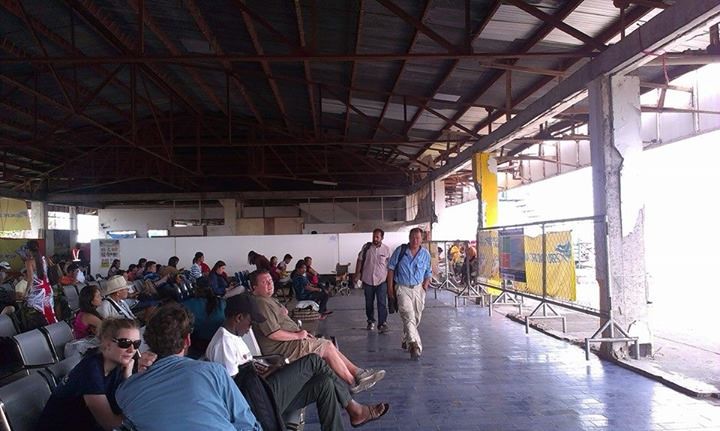
When we landed at Tacloban airport just before New Year’s Day, the devastation from Typhoon Haiyan (Yolanda to the locals) was everywhere. Most of the walls of the airport were missing but the supporting beams survived and there was a make-shift roof. We drove for an hour before the damage was no more than lost roofs.Image

At the airport, there were no barriers between the departure area and the tarmac.

Image

A little known use of those lost walls was stopping the jet engines blasting into the waiting lounge. No photo because I was too busy running.

The Tacloban airport is named after an uncle of Imelda Marcos. The city mayor is her nephew; you may have seen him on CNN. Other relatives of Imelda on the island of Leyte have been congressmen, provincial governors or town mayors in a dynasty that rotates between offices because of term limits.

The café next to the airport where I had breakfast when I was last in Tacloban in January 2012 was washed away, sadly along with its owner.

I remember reading the local newspapers in that café in January 2012. A feature story was about the private armies employed by local politicians. These private armies could be 40 strong. Cronyism and a lack of a rule of law could explain why Leyte is among the poorest islands in the Philippines.

All the surrounding restaurants were wiped out. But the food vendors are back at the airport – the entrepreneurial spirit is very resilient! Tacloban airport was one of the few places where I could get diet coke in all of Leyte.

Image

The only upside of the typhoon was Imelda’s large sea-side walled compound was washed away. There is a god: a vengeful god!?

We dropped in on a friend on the way to my parents-in-law. He had lost power. He said that straight after the typhoon, entrepreneurs were going door to door selling bottled water.

By the time we had arrived, everyone on the island of Leyte had received five-weekly rations of five kilos of rice and other essentials from the town hall. My mother-in-law had no need for this ration so she gave it to less well-off neighbours. Her town was not damaged much at all by the typhoon. They are on the other side of the mountain from Tacloban.

My in-laws living on an island further north of Leyte lost their roof and a wall. Terrifying.

Local merchants must find it hard to rebuild their businesses when everyone is getting food for free from the town hall many weeks after the disaster. This includes areas that suffered little damage.

The consular travel warning for all of Leyte was very ‘high risk’ – one below ‘avoid all travel’. Advised to be self-sufficient and be on guard for bandits, etc.

The owners of a very nice 5-room chalet at the other end of Leyte where my sister-in-law and her family stayed were most unimpressed by the over-inclusive consular travel warnings.There were many cancellations so their business was just ticking over rather than in a profit. Little wonder that the girl behind the makeshift car rental desk in the arrivals lounge at Tacloban airport did not seem to get much business when we arrived.

Previous Older Entries Next Newer Entries

Coordination Problem

Celebrating humanity's flourishing through the spread of capitalism and the rule of law

Libertarian Land

Celebrating humanity's flourishing through the spread of capitalism and the rule of law

Arin’s Substack

Celebrating humanity's flourishing through the spread of capitalism and the rule of law

David Andolfatto

Celebrating humanity's flourishing through the spread of capitalism and the rule of law

Monetary Non-Neutrality

Celebrating humanity's flourishing through the spread of capitalism and the rule of law

Reason Magazine

Celebrating humanity's flourishing through the spread of capitalism and the rule of law

Coyote Blog

Celebrating humanity's flourishing through the spread of capitalism and the rule of law

Thoughts from the North

Celebrating humanity's flourishing through the spread of capitalism and the rule of law

Fardels Bear

A History of the Alt-Right

Vincent Geloso

Econ Prof at George Mason University, Economic Historian, Québécois

Bassett, Brash & Hide

Celebrating humanity's flourishing through the spread of capitalism and the rule of law

Truth on the Market

Scholarly commentary on law, economics, and more

The Undercover Historian

Beatrice Cherrier's blog

Matua Kahurangi

Celebrating humanity's flourishing through the spread of capitalism and the rule of law

Temple of Sociology

Celebrating humanity's flourishing through the spread of capitalism and the rule of law

Velvet Glove, Iron Fist

Celebrating humanity's flourishing through the spread of capitalism and the rule of law

Why Evolution Is True

Why Evolution is True is a blog written by Jerry Coyne, centered on evolution and biology but also dealing with diverse topics like politics, culture, and cats.

NoTricksZone

Celebrating humanity's flourishing through the spread of capitalism and the rule of law

Homepaddock

A rural perspective with a blue tint by Ele Ludemann

Kiwiblog

DPF's Kiwiblog - Fomenting Happy Mischief since 2003

The Dangerous Economist

Celebrating humanity's flourishing through the spread of capitalism and the rule of law

Watts Up With That?

The world's most viewed site on global warming and climate change

The Logical Place

Tim Harding's writings on rationality, informal logic and skepticism

Doc's Books

A window into Doc Freiberger's library

The Risk-Monger

Let's examine hard decisions!

Uneasy Money

Commentary on monetary policy in the spirit of R. G. Hawtrey

Barrie Saunders

Thoughts on public policy and the media

Liberty Scott

Celebrating humanity's flourishing through the spread of capitalism and the rule of law

Point of Order

Politics and the economy

James Bowden's Blog

A blog (primarily) on Canadian and Commonwealth political history and institutions

Science Matters

Reading between the lines, and underneath the hype.

Peter Winsley

Economics, and such stuff as dreams are made on

A Venerable Puzzle

"The British constitution has always been puzzling, and always will be." --Queen Elizabeth II

The Antiplanner

Celebrating humanity's flourishing through the spread of capitalism and the rule of law

Bet On It

Celebrating humanity's flourishing through the spread of capitalism and the rule of law

History of Sorts

WORLD WAR II, MUSIC, HISTORY, HOLOCAUST

Roger Pielke Jr.

Undisciplined scholar, recovering academic

Offsetting Behaviour

Celebrating humanity's flourishing through the spread of capitalism and the rule of law

JONATHAN TURLEY

Res ipsa loquitur - The thing itself speaks

Conversable Economist

In Hume’s spirit, I will attempt to serve as an ambassador from my world of economics, and help in “finding topics of conversation fit for the entertainment of rational creatures.”

The Victorian Commons

Researching the House of Commons, 1832-1868

The History of Parliament

Articles and research from the History of Parliament Trust

Books & Boots

Reflections on books and art

Legal History Miscellany

Posts on the History of Law, Crime, and Justice

Sex, Drugs and Economics

Celebrating humanity's flourishing through the spread of capitalism and the rule of law

European Royal History

Exploring the Monarchs of Europe