The Economics of Elysium
16 Nov 2014 Leave a comment
in applied price theory, development economics, F.A. Hayek, growth disasters, growth miracles, income redistribution, law and economics, Marxist economics, movies, property rights, Public Choice, rentseeking Tags: Cuba, Elysium
What if We’re Looking at Inequality the Wrong Way? – NYTimes.com
16 Nov 2014 Leave a comment
in applied welfare economics, entrepreneurship, human capital, labour economics, labour supply, liberalism, Marxist economics, occupational choice, politics - USA, poverty and inequality, public economics, Rawls and Nozick, technological progress Tags: Piketty, poverty and inequality


The Twitter Left is replacing the Left over Left
14 Nov 2014 Leave a comment
in comparative institutional analysis, liberalism, Marxist economics, politics, politics - Australia, politics - New Zealand, politics - USA, technological progress Tags: Leftover Left, Twitter left
State owned enterprises continue to be a bad investment for the NZ taxpayer
12 Nov 2014 2 Comments
in industrial organisation, Marxist economics, politics - New Zealand, public economics Tags: privatisation, state owned enterprises
In a Briefing to the Incoming Minister just released, the Treasury said that in 2013, total shareholder return from state owned enterprises to the taxpayer was just 3 per cent. This is a little bit better than leaving the money in the bank.

Note: KiwiRail is excluded because of significant changes in its valuation methodologies over the past few years, including the significant write down in its asset values in 2012. . Total shareholder return for 2012 has been restated to include Solid Energy.
KiwiRail lost $248 million in 2013, after a $174.4 million loss a year earlier. Solid Energy lost $182 million last year last year. This $182m loss follows a $335.4m loss in the June 2013 year and a $40m loss the year before that.

25 years ago today in East Berlin
05 Nov 2014 Leave a comment
in Marxist economics, politics, Public Choice Tags: collapse of communism, Fall the Berlin war

Not too long ago, the left promoted the pointlessness of minimum wage – Whale Oil Beef Hooked
29 Oct 2014 Leave a comment
in applied price theory, applied welfare economics, economics of regulation, labour economics, Marxist economics, minimum wage Tags: minimum wage
How on earth did this guy get to become French Minister of Finance? Shades of Roger Douglas?
28 Oct 2014 Leave a comment


The Top 1% of income earners in NZ are lazy – the Occupy Movement have nothing to protest about – updated
25 Oct 2014 Leave a comment
in applied welfare economics, income redistribution, Marxist economics, politics - New Zealand, rentseeking Tags: lost decades, occupy movement, poverty and inequality, prosperity and depression, top 1%
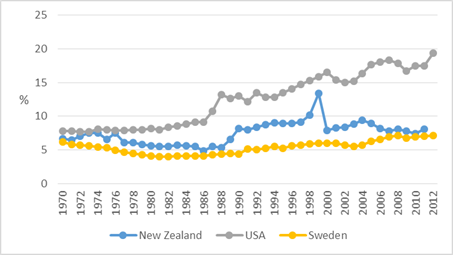
The NZ top 1% share has been steady at 8-9% since the mid-1990s. The top 1%’s share rose strongly in the USA in recent decades, from 13% in the mid-1980s to 19% in 2012.
Figure 1: Top 1% income shares, USA, New Zealand and Sweden, 1970-2012
Source: The World Top Income Database at http://topincomes.g-mond.parisschoolofeconomics.eu/#Database
The top 1% in New Zealand is so lazy that Sweden is overtaking it – See figure 1.
The Occupy crowd blame everything from the global financial crisis to a bad environment on growing inequality and the top 1%. Such an argument has no foundation in fact in New Zealand.
Income inequality as measured by the Gini coefficient has not risen much in New Zealand for 20 years – See figure 2. How can the poor be getting getting poorer, ground under by the yoke of capitalism, if the rich are not getting richer. The occupy movement should apply for unemployment benefits and seek career guidance.
Figure 2: Gini coefficient New Zealand 1980-2015
![clip_image002[7]](https://utopiayouarestandinginit.com/wp-content/uploads/2014/10/clip_image00271.png "clip_image002[7]")
Source: Bryan Perry, Household incomes in New Zealand: Trends in indicators of inequality and hardship 1982 to 2013. Ministry of Social Development (July 2014).
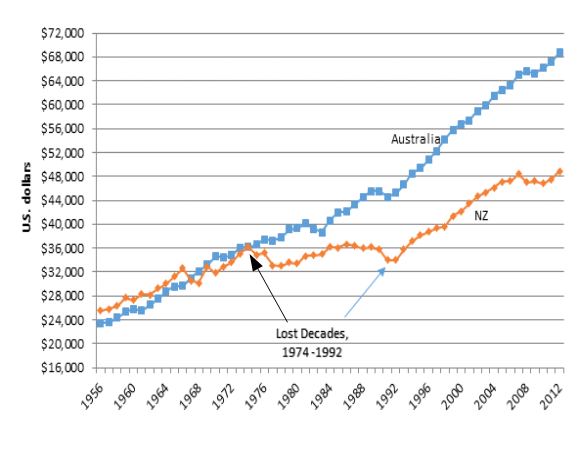
The last major increase in income inequality in New Zealand was in the late 1980s and early 1990s and that was followed by a long economic boom – See figure 3 .
Figure 3: Real GDP per New Zealander and Australian aged 15-64, converted to 2013 price level with updated 2005 EKS purchasing power parities, 1956-2012
Source: Computed from OECD Stat Extract and The Conference Board, Total Database, January 2014, http://www.conference-board.org/economics .
This long boom was after two decades of next to no economic growth in the 1970s and 1980s in New Zealand – see figure 3 . This depression between 1974 and 1992 was New Zealand’s lost decades.
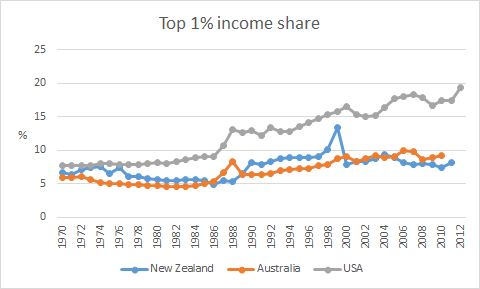
Figure 4 shows that both the lost decades of economic growth in New Zealand and the emergence of the trans-Tasman income gap the seemed to somewhat coincide with the top 1% of earners in Australia increasing their share of income from 6% to 10% of total incomes while the New Zealand top 1% sat on their hands. They are such lazy devils.
Figure 4: Top 1% income shares, USA, New Zealand and Australia, 1970-2012
Source: The World Top Income Database at http://topincomes.g-mond.parisschoolofeconomics.eu/#Database


Recent Comments