Celebrating humanity's flourishing through the spread of capitalism and the rule of law
16 Jun 2016 Leave a comment
in economics, F.A. Hayek, Milton Friedman Tags: capitalism and freedom
05 Jun 2016 Leave a comment
in applied price theory, applied welfare economics, comparative institutional analysis, constitutional political economy, development economics, economic history, economics, economics of regulation, entrepreneurship, growth disasters, growth miracles, income redistribution, industrial organisation, labour economics, macroeconomics, Milton Friedman, minimum wage, occupational choice, politics - USA, Public Choice, public economics Tags: 2016 presidential election, Leftover Left
28 May 2016 Leave a comment
in business cycles, F.A. Hayek, history of economic thought, macroeconomics, Milton Friedman, monetarism, monetary economics Tags: Keynesian macroeconomics
24 May 2016 1 Comment
in macroeconomics, Milton Friedman, monetarism, monetary economics Tags: American Civil War, inflation
16 May 2016 Leave a comment
in liberalism, Milton Friedman Tags: neoliberalism, offsetting behaviour, social insurance, The fatal conceit, The pretense to knowledge, welfare state
11 May 2016 Leave a comment
in Milton Friedman Tags: vanity number plates
20 Apr 2016 Leave a comment
in economics, Milton Friedman Tags: negative income tax, universal basic income
11 Mar 2016 Leave a comment
in history of economic thought, macroeconomics, Milton Friedman, monetary economics Tags: monetary rules, rules versus discretion
Peter Lyons teaches Economics at St Peter’s College in Epsom and has written several economics texts.
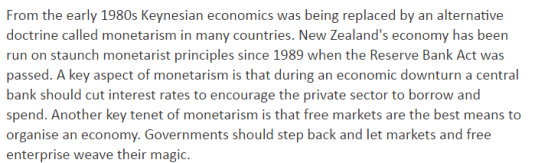
Source: Peter Lyons: Free market doctrine’s bubble about to burst – Economy – NZ Herald News.
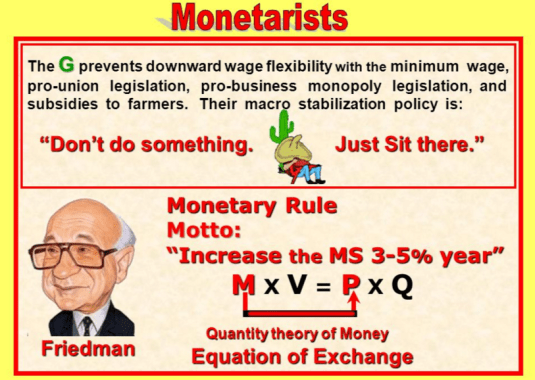
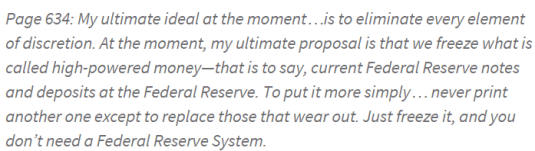
Source: Milton Friedman (1984).
12 Dec 2015 Leave a comment
in comparative institutional analysis, constitutional political economy, economics of bureaucracy, Milton Friedman, Public Choice Tags: grass is greener fallacy, public choice error, The fatal conceit, The pretense to knowledge, unintended consequences
18 Nov 2015 Leave a comment
in applied price theory, Austrian economics, entrepreneurship, human capital, industrial organisation, labour economics, labour supply, Milton Friedman, minimum wage, occupational choice, poverty and inequality, survivor principle, unions Tags: market process, The meaning of competition
09 Nov 2015 Leave a comment
in applied price theory, applied welfare economics, labour economics, labour supply, Milton Friedman, unemployment, unions Tags: union membership, union power, union wage premium
03 Nov 2015 Leave a comment
in applied price theory, applied welfare economics, economic history, entrepreneurship, industrial organisation, labour economics, labour supply, Milton Friedman, poverty and inequality, Public Choice, rentseeking, unions Tags: Canada, entrepreneurial alertness, France, Italy, top 1%, union power, union wage premium
The French ruling class is as lazy as their transnational co-conspirators down under. French union membership is in serious decline albeit from a low base. An opportunity lost for the French ruling class. It has not lifted a finger to extract additional labour surplus from the downtrodden French proletariat now stripped of their only line of collective defence against capitalist exploitation.
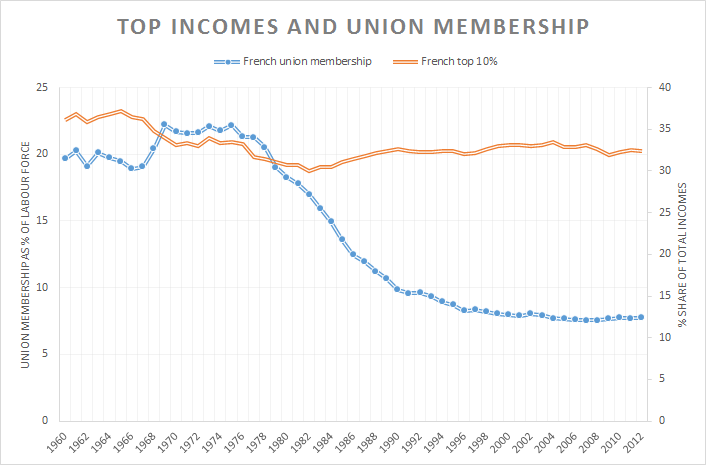
Source: OECD Stat and Top Incomes Database.
The top 10% and top 1% in France are no better off than two generations ago despite the decline of French unions. The French Left must be most disappointed. No kicking in the rotten door of the permanent revolution anytime soon after the immiserised French proletariat rises up because it has nothing to lose but its chains. The 21st century version of the Marxist call to the barricades would be a proletariat stirred to revolution with nothing to lose but their suburban home, motorcar, IPad and air points

Source: OECD Stat and Top Incomes Database.
The Italian ruling class has had little success in bringing Italian unions down. The top 10% in Italy is earning no more now than back when the Red Brigades were gunning for them.
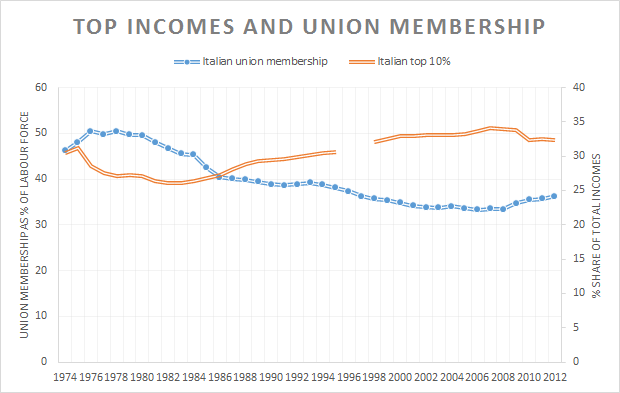
Source: OECD Stat and Top Incomes Database.
The top 1% in Italy is doing a little bit better than when the Red Brigade was gunning for them, but not much more. Unions don’t figure in explaining that small rise in Italian top 1% incomes over the last 40 years. Italian unions are pretty much a strong as they were 40 years ago in membership. Italian employment protection laws are pretty much as strong as they used to be too.

Source: OECD Stat and Top Incomes Database.
The Canadian ruling classes even more incompetent than their transnational co-conspirators over in Italy. There appears to have been next to no decline in union membership in Canada. The Canadian top 10% is not earning any more than back in the 60s.
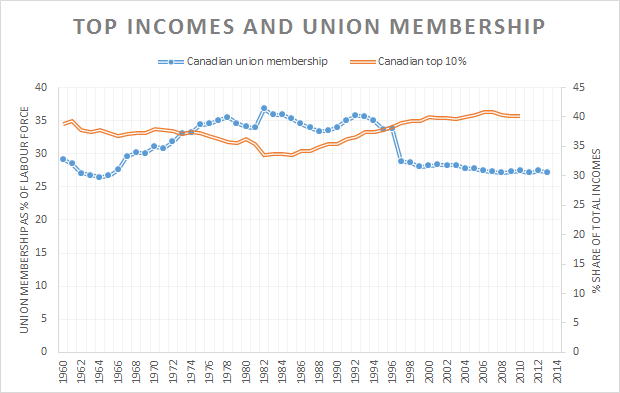
Source: OECD Stat and Top Incomes Database.
The Canadian top 1% is doing a little bit better than 25 years ago also but not off the back of unions which are almost as strong as in the past. The Canadian Left will have to look for a different hypothesis than the ravages of the top 1%.

Source: OECD Stat and Top Incomes Database.
All in all, the Economic Policy Institute simply got lucky with a spurious correlation between top incomes and union membership in the USA.
25 Oct 2015 Leave a comment
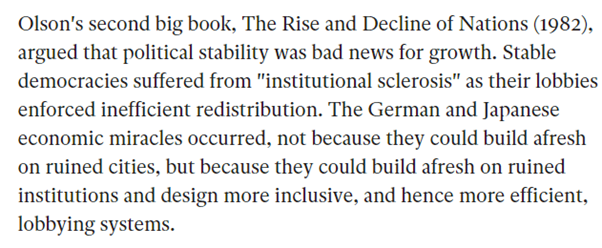
in comparative institutional analysis, constitutional political economy, development economics, economic history, economics of bureaucracy, income redistribution, Marxist economics, Milton Friedman, Public Choice, rentseeking, technological progress Tags: expressive voting, interest groups, Leftover Left, logic of collective action, Mancur Olson, Naomi Klein, pressure groups, rational ignorance, rational irrationality, rise and decline of nations, Twitter left

Source: quoted by Naomi Klein in “The Shock Doctrine”.
LA premiere tonight @NaomiAKlein @avilewis @mrdannyglover in person Q&A 7.30pm sundancecinemas.com http://t.co/wRkPFbnUHu—
Changes Everything (@thischanges) October 16, 2015
1. There will be no countries that attain symmetrical organization of all groups with a common interest and thereby attain optimal outcomes through comprehensive bargaining.
2. Stable societies with unchanged boundaries tend to accumulate more collusions and organizations for collective action over time.
3. Members of “small” groups have disproportionate organizational power for collective action, and this disproportion diminishes but does not disappear over time in stable societies.
4. On balance, special-interest organizations and collusions reduce efficiency and aggregate income in the societies in which they operate and make political life more divisive.
5. Encompassing organizations have some incentive to make the society in which they operate more prosperous, and an incentive to redistribute income to their members with as little excess burden as possible, and to cease such redistribution unless the amount redistributed is substantial in relation to the social cost of the redistribution.
6. Distributional coalitions make decisions more slowly than the individuals and firms of which they are comprised, tend to have crowded agendas and bargaining tables, and more often fix prices than quantities.
7. Distributional coalitions slow down a society’s capacity to adopt new technologies and to reallocate resources in response to changing conditions, and thereby to reduce the rate of economic growth.
8. Distributional coalitions, once big enough to succeed, are exclusive, and seek to limit the diversity of incomes and values of their membership.
9. The accumulation of distributional coalitions increases the complexity of regulation, the role of government, and the complexity of understandings, and changes the direction of social evolution.
Source: Obituary: Professor Mancur Olson | Obituaries | News | The Independent
Celebrating humanity's flourishing through the spread of capitalism and the rule of law
Celebrating humanity's flourishing through the spread of capitalism and the rule of law
Celebrating humanity's flourishing through the spread of capitalism and the rule of law
Celebrating humanity's flourishing through the spread of capitalism and the rule of law
Celebrating humanity's flourishing through the spread of capitalism and the rule of law
Celebrating humanity's flourishing through the spread of capitalism and the rule of law
Celebrating humanity's flourishing through the spread of capitalism and the rule of law
A History of the Alt-Right
Econ Prof at George Mason University, Economic Historian, Québécois
Celebrating humanity's flourishing through the spread of capitalism and the rule of law
Scholarly commentary on law, economics, and more
Beatrice Cherrier's blog
Celebrating humanity's flourishing through the spread of capitalism and the rule of law
Celebrating humanity's flourishing through the spread of capitalism and the rule of law
Celebrating humanity's flourishing through the spread of capitalism and the rule of law
Why Evolution is True is a blog written by Jerry Coyne, centered on evolution and biology but also dealing with diverse topics like politics, culture, and cats.
Celebrating humanity's flourishing through the spread of capitalism and the rule of law
A rural perspective with a blue tint by Ele Ludemann
DPF's Kiwiblog - Fomenting Happy Mischief since 2003
Celebrating humanity's flourishing through the spread of capitalism and the rule of law
The world's most viewed site on global warming and climate change
Tim Harding's writings on rationality, informal logic and skepticism
A window into Doc Freiberger's library
Let's examine hard decisions!
Commentary on monetary policy in the spirit of R. G. Hawtrey
Thoughts on public policy and the media
Celebrating humanity's flourishing through the spread of capitalism and the rule of law
Politics and the economy
A blog (primarily) on Canadian and Commonwealth political history and institutions
Reading between the lines, and underneath the hype.
Economics, and such stuff as dreams are made on
"The British constitution has always been puzzling, and always will be." --Queen Elizabeth II
Celebrating humanity's flourishing through the spread of capitalism and the rule of law
Celebrating humanity's flourishing through the spread of capitalism and the rule of law
WORLD WAR II, MUSIC, HISTORY, HOLOCAUST
Undisciplined scholar, recovering academic
Celebrating humanity's flourishing through the spread of capitalism and the rule of law
Res ipsa loquitur - The thing itself speaks
In Hume’s spirit, I will attempt to serve as an ambassador from my world of economics, and help in “finding topics of conversation fit for the entertainment of rational creatures.”
Researching the House of Commons, 1832-1868
Articles and research from the History of Parliament Trust
Reflections on books and art
Posts on the History of Law, Crime, and Justice
Celebrating humanity's flourishing through the spread of capitalism and the rule of law
Exploring the Monarchs of Europe
Cutting edge science you can dice with


Recent Comments