Peak hour traffic congestion is inevitable and efficient

In 1962, Anthony Downs put forward the fundamental law of peak hour congestion on urban commuter expressways: peak-hour traffic congestion rises to meet maximum capacity. Larger bus and train networks and more cycle-ways are never the solution. Just as more highways leads to more congestion because more people drive to work, with fewer people driving to work if they fit enough to ride on the new cycle-ways, other people will start driving to work, instead of taking public transport (Downs 2005).

Downs’ law of peak hour congestion or “triple convergence” means that road will be as congested as before after any new investment in capacity because fewer people are taking public transport or postponing their trips to outside the peak hour times. More commercial driving in peak hours by trucks and delivery vans is an obvious response to more road capacity (Downs 2004). Increases in road capacity do not reduce congestion because of a triple convergence of new users from buses, trains and off-peak.

If an expressway’s capacity were doubled overnight, the next day’s traffic would flow rapidly because the same number of drivers would have twice the road space. Word will soon spread that this highway is less congested. Drivers who used that road before and after the peak hour to avoid congestion will shift into the peak hours. Other drivers using alternative routes will shift to this more convenient expressway. Bus and train passengers will start driving on the upgraded road in the peak periods. In a short time, this triple convergence of bus, train and car users onto the improved or new road in the peak hours will make that road as congested as it was before its expansion. Duranton and Turner (2011) found that vehicle kilometers travelled increases proportionately to increase road space for interstate highways and slightly less rapidly for other roads. The increased vehicle miles travelled is a mix of more driving by current residents, more commercial traffic and some migration from other types of roads.

Increases in bus or train capacity had the same triple convergence effect at peak times as new roads. Duranton and Turner (2011) found that increased provision of public transport does not relieve road congestion. The road space freed up by the motorists who switched to the additional buses or trains is filled by other motorists and commercial transport who previously planned to travel outside of the peak hours. Downs considers that peak-hour congestion is inherent to how modern societies operate:

…congestion exists because societies organize economies so most people will work during the same hours each day. This makes interaction among firms and agencies possible, thereby increasing society’s productivity, and raising overall efficiency. But it also requires most workers and students to travel to and from their places of activity at the same times. This overloads ground transportation systems during the morning and evening peaks, and often longer.

No large metropolitan areas have enough infrastructure to transport everyone who wants to move during peak hours simultaneously; nor do they have enough resources to build it. Hence some travelers must wait until others have moved. That waiting constitutes traffic congestion. (Downs 2006).

Road capacity expansions and extensions to bus and train networks do not reduce congestion. The added space means the extra traffic can be handled with still tolerable congestion. Judiciously selected road investments are still value for money because the additional road space allows more commuters to travel by the fastest, most convenient, most flexible method of urban travel, which is in a car.

Political activists hold more extreme positions than the average voter for their party

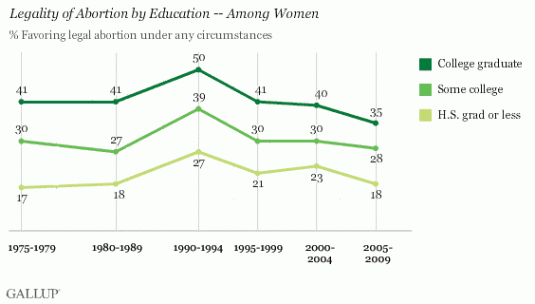
Political activists in any political party have such different opinions to the average supporter for that party is it is often advised that they not go door-knocking. The chart above for 2017 and below for 1994 compares the politically engaged with the views of the median Democrat and Republican.


Political activists who go doorknocking are more likely to put a voter off because of their interest in issues that simply do not interest the average voter for their party, much less the swinging voter.

This gap between the average party activist and average supporter of that party at the ballot box also explains why too many political activists explain political defeat in terms of the voters being wrong.

But is a living wage policy still worth a try?

https://twitter.com/EconBizFin/status/626687442834300928

Demands for massive pay rises for the low-paid are not just confined to New Zealand. The US debate is worth reviewing because their living wage advocates are so upfront about the job losses.

US living wage activists such as Fight for $15 want to double their federal minimum wage from $7.25 per hour to $15 per hour. California, New York, San Francisco and Seattle are among the states and cities increasing their local minimum wages, currently of up to $12, to $15 by 2021 or 2022.

Some such as Arindrajit Dube say that these very large wage increases by cities and states in their federal system are experiments “worth running and monitoring” (Lane 2016). As Dube said recently:

“… 30 to 40 percent of the California workforce will get a raise … This will be a big experiment. It’s far outside of our evidence base…

If you’re risk-averse, this would not be the scale at which to try things. On the other hand, if you think that wages are really low and they’ve been low for a really long time and we can afford to take some risks, doing things at this scale will get us more evidence” (Lee 2016).

Noah Smith (2016) concluded that the empirical literature on minimum wages suggests that a 10% minimum wage increase would reduce employment by about 2% so doubling the federal minimum wage would see the employment of young people go down by one-fifth. Smith (2016) said this is a “small but real effect — a $15 federal minimum wage might throw a million kids out of work”.

Should activists use minimum wage breadwinners for policy experiments? Noah Smith (2016) considers balancing the one million unemployed teenagers against the wage gains for adults as “necessary for a decision”.

Smith suggests that the large minimum wage increases in some US states and cities will tell us how big this welfare trade-off between jobs and wage rises is:

We don’t really know what happens when you raise the minimum wage to $15 — but soon, we will know. We will be able to see whether employment rates fall in L.A., Seattle, and San Francisco. We will be able to see whether people who can’t get work migrate from these cities to cities with lower minimum wages.

We will be able to see if employment growth suddenly slows after the enactment of the policy. In other words, federalism will do its job, by allowing cities to act as policy laboratories for the rest of the country (Smith 2015).

“Big experiments” involving large minimum wage increases to “provide clear evidence” to quote Dube’s words (Scheiber and Lovett 2016) are wrongheaded as Robert Lucas has explained:

I want to understand the connection between in the money supply and economic depressions. One way to demonstrate that I understand this connection–I think the only really convincing way–would be for me to engineer a depression in the United States by manipulating the U.S. money supply.

I think I know how to do this, though I’m not absolutely sure, but a real virtue of the democratic system is that we do not look kindly on people who want to use our lives as a laboratory. So I will try to make my depression somewhere else (Lucas 1988).

Leading reasons for economic theory, empirical research and the study of economic history are to warn the present against repeating past errors and not try experiments that are folly (Rosen 1993). There is too much group think and not enough courage of your vocation (see Dylan Matthew’s tweet below).

https://twitter.com/dylanmatt/status/720786520509165568

Australian-born economist Justin Wolfers is frank about the wishful thinking in the US debate:

But if you are interested in what level to set the minimum wage, the existing literature is nearly hopeless. Plausible reforms lie far outside the bounds of historical experience.

We don’t have useful estimates of the extent to which employment effects vary with the minimum wage. Since policymakers tend to implement short-run fixes, we know a lot about the effects of temporary reforms, but very little about the consequences of lasting reform (Wolfers 2016).

Most of the empirical studies are of the jobs lost over the next few years. When estimates have a 10 to 15-year horizon with time enough for entry, exit and technological adaptation and automation, a “long-run disemployment effect that is five times larger than the short-run effect” is in evidence (Aaronson, French, Sorkin 2016; Aaronson, French, Sorkin and To forthcoming; Sorkin 2015).

More on down and out in America

Source: Five Myths About Welfare and Child Poverty | The Heritage Foundation.

Living Space: Europeans Versus Poor Americans

Source: Understanding Poverty in the United States: Surprising Facts About America’s Poor | The Heritage Foundation

Feeling of powerlessness and voicelessness was a much better predictor of Trump support than age, race, college attainment, income, attitudes towards Muslims, illegal immigrants, or Hispanic identity

Source: Who Are Donald Trump’s Supporters? – The Atlantic.

Investing in roads is the only sustainable solution to commuting dilemmas

Better value for money for the taxpayer from road investments is vital because few New Zealanders (barely 4.5%) commute to work via public transport – see figure 1. Public transport simply does not make the grade for the great majority of New Zealanders as a way of carrying out their daily lives. The policy question therefore is providing the necessary roads in a more cost-effective manner than now.

Figure 1: Modes of travel to work, New Zealand, 2013 Census

Source: Statistics New Zealand, 2013 Census.

A small minority of New Zealand adults commute by bus or train even in the big cities. Figure 2 shows that even in Auckland, for those that left home for work, only 8.3% commute via public transport. In Wellington, 14.1% commute to work from home via public transport – see figure 3.

Figure 2: Modes of travel to work, Auckland, 2013 Census

Source: Statistics New Zealand, 2013 Census

Figure 3: Modes of travel to work, Wellington, 2013 Census

Source: Statistics New Zealand, 2013 Census.

The condescension of the politically correct

Has @WJRosenbergCTU shown @jacindaardern’s first lie in office?

Ardern said there had been market failures in New Zealand such as … most people’s incomes not keeping up with inflation…


Source: Economist Bill Rosenberg details how low and middle-income wages have been hollowed out as higher earners experienced greater growth while those below them had to work more hours each week | interest.co.nz.

Only Nixon could go to China, only @PhilTwyford could reform the RMA?

Right-wing politicians can sometimes implement policies that left-wing politicians cannot, and vice versa under Cowen and Sutter’s only Nixon can go to China theorem:

The point is that politicians with a previous record of opposing a policy shift are often the only ones who can bring it about, because their policy support provides a credible signal of policy quality to the relevant interest groups who would otherwise oppose the policy.

Contemporary wisdom has it that only Nixon could go to China and make a deal because his decades of fierce anti-Communist stance gave him credibility with fellow conservatives and shielded him from any domestic attack.

Cowen and Sutter say that a policy could depend on information – on which policies or values everyone could potentially agree, or on which agreement is impossible.

Politicians, who value both re-election and policy outcomes, realise the nature of the issue better through inside and secret information and superior analytical skills (or access to those skills), whereas voters do not have access to such information base or skills.

Only a right-wing president can credibly signal the desirability of a left-wing course of action. A left-wing president’s rapprochement with China would be dismissed as a dovish sell-out. Nixon must be going to China because that is the best possible policy choice and he would never do so otherwise giving his previous record of firm anti-Communism.

Left-wing parties adopt right-wing policies because they are good ideas that will get them re-elected. Bob Hawke, Tony Blair, and Bill Clinton were centre-left economic reformers who can credibly signal the desirability of their economic reforms because of the brand name capital they invested in distributional concerns and protecting the poor.

The same goes for reforming the Resource Management Act (RMA) in New Zealand. Only a left-wing government can implement major reforms such as abolishing the Auckland urban limit and other restrictions on land supply. Deregulation is normally a right-wing policy.

When a left-wing policy undertake reform of land use regulation, things must be so bad on the housing affordability front that they accept that the reforms must be done despite their natural reluctance to deregulate anything on ideological grounds.

Up until past the 2014 New Zealand election, the Labour Party undertook scare tactics on land use regulation reform as a way winning votes from environmentally leaning voters.

Housing affordability situation is now so bad, with a whole generation locked out of housing, that even the ideological opponents of deregulation accept that restrictions on the housing supply are a bad idea.

Naturally the Greens continue to have their head in the sand. That is the big difference between them and the Labour Party. The Greens are policy dilettantes. The Labour Party is made up of people who believe in making difficult choices and the need for trade-offs.

Why Bernie Sanders’ Medicare for All is a Bad Idea

Trump studies!

https://twitter.com/JonHaidt/status/920251868504379392

Brexit will lower company tax rates everywhere

Brexit will turn the British Isles into one great big offshore tax haven. The post-referendum plans for a 15% company tax rate (and the Australian plans for a 25% company tax rate) will put pressure on New Zealand to follow suit.

A common argument against a much lower company tax in New Zealand is the clipping of the ticket argument. A lower company tax rate in New Zealand is said to mean no more than the higher after-tax dividends are taxed at a higher tax rate in the home country of the foreign investor. Less company tax is paid in New Zealand but more tax is paid back home for no net gain to the investor.

The 12 ½% Irish company tax rate attracted investment

The strongest evidence against this is the Irish were relentlessly bullied by the rest of the European Union over its 12 ½% company tax. The other EU finance ministers rightly feared a loss of investment to Ireland. This 12.5% rate applied initially to exports, then manufacturing and then trading profits. The fiscal bounty of the Celtic Tiger years allowed the Irish to finesse these complaints based on EU laws about fiscal discrimination by phasing their 32% general company tax rate down to 12 ½ %.

Our Minister of Finance certainly would not welcome the plans (Senate permitting) for a 25% company tax rate in Australia by 2026. Rather than rubbing his hands in anticipation of more tax revenues on dividends repatriated from New Zealand subsidiaries in Australia, Mr. English will worry about loss of domestic and offshore investment to a more competitive neighbouring tax jurisdiction.

Source: OECD Stat.

The first big country low company tax rate

The British already have the lowest company tax of any major economy with the 20% company tax rate that started on 1 April 2016 (see graphic). This rate will fall to 19% on 1 April 2017, and 17% on 1 April 2020. Brexit will take that rate down to 15% at a date to be determined.

No Minister of Finance welcomes the prospect of a leading world economy and Europe’s key financial centre having by far the 2nd lowest company tax rate of any developed economy by 2020. They will worry about lost investment rather than expect a higher local tax take.

High company tax rates lower wages

Too many people mistakenly believe that company taxes are paid by shareholders through lower dividends. With capital highly mobile across borders, countries with high company tax rates attract less investment because of the lower after-tax returns relative to competing destinations.

This capital flight means lower wages in high company tax jurisdictions because their workers have less capital to work with. A lower company tax means higher wages because of more investment.

Even the USA is under pressure

The US got away with a very much above average company tax rate (38%) because its economy is so large relative to the rest of the world but it too is under pressure from footloose capital and corporate inversions. The US company tax system is so full of holes that if all tax loopholes were closed, its federal company tax rate could be cut from 35% to 9% with no net loss of revenue.

Leading US tax economist Laurence Kotlikoff estimated that this tax reform would increase wages by 8%, output by 6%, and the amount of capital invested by 17%. Australian Treasury modelling found that a 10-percentage point cut in their company tax rate would increase wages by 1.4% to 3%.

The race is on

The British company tax rate is now well below anywhere else bar one. That will force other countries, other big economies, to reconsider their position. New Zealand should not be left behind in harvesting the large wage increases that flow from a much lower company tax rate.

.@sarahinthesen8 @SenatorMRoberts and beneficiaries living better than kings of 200 years ago; dumb and dumber alert

You probably enjoy a better life than John D. Rockefeller did 100 years ago. Rockefeller lived in a big draughty house with lots of servants. Cars were primitive as was medicine. No refrigerators, washing machines or other domestic appliances we take for granted. Running water, much less safe tap water were brand new inventions at best. He lived a long life. The odds of getting to the age of 15 when he was born were probably better than 50%.

People forget how horrible the good old days before the Industrial Revolution really were.

The great increase in life expectancy of all classes of people should never be underrated.

Peaceful protesters should always plead guilty

By pleading not guilty to maritime safety charges from his offshore drilling protest, does Russel Norman think that his vote counts for more than mine on environmental policy? He is mounting a greater good defence. Does his views count for more than mine on what is the greater good?

We resolve our differences about what is the greater good on offshore drilling, on environmental policy, on any policy by normal democratic means. That is, by trying to persuade each other and elections. We just had an election which gave us a rich taste of the political views of New Zealanders.

By openly breaking the law non-violently, accepting arrest and pleading guilty, that act of peaceful defiance implores the majority to reconsider their position. Through their passion, their sacrifice, their willingness to risk a conviction on their record, protestors are pleading from the bottom of their heart with the majority to think again and contemplate the possibility that they may be wrong.

Central to political protests is the notion is by making a lot of noise and showing your passionate disagreement, your fellow voters will respect that passion and hear you out. Instead, Greenpeace is trying to impose its conception of the greater good by harassment and court room manoeuvring rather than by their side of the argument winning at the ballot box or on the floor of Parliament.

Greenpeace deserves the respect of taking them at their word; that they want to stop offshore drilling by their protesting alone making it too difficult to continue. They are not saying we are staging a publicity stunt that respects maritime safety laws to implore voters to think again.

Protests should not be attempts to impose views on others. Civil disobedience contributes to the democratic exchange of ideas by forcing the dominant opinion to defend their views. A willingness to accept a conviction is proof that the protest is a passionate, selfless attempt to persuade voters to join their side.

Protests should never be a means of coercing or frightening others in a democracy into conforming to your wishes. Greenpeace expects others to obey the laws for which it successfully lobbied. Why does Greenpeace think they can break laws that others secured through normal democratic means?

Some find democracy frustrating because they cannot win at the ballot box even under proportional representation. Environmentalists such as Greenpeace must be the last to complain so. Greenpeace activists and environmentally conscious voters were spoiled for choice at the most recent election.

Two parties were competing principally for their vote. The older of the two spent the last four weeks of the campaign desperately rebranding itself as principally an environmental party. The new party was an environmental party that was also at peace with the market economy. The two major parties were also campaigning strongly on many policies that might win over environment minded voters.

The great virtue of a democracy is it readily enables the people, over time, to be persuaded that what they took for granted is not so and change the law accordingly. Noisy protesters from across the political spectrum stage publicity stunts to catch the public’s eye in the hope of doing this.

What is holding up legislating in many areas is not that minorities are powerless and individuals are voiceless. It is exactly the opposite. By banding together, passionate minorities can resist the tyranny of the majority. They can trade off their support in other areas in return for policy concessions most dear to them. A small group of concerned and thoughtful citizens can band together and change things by mounting single issue campaigns that influence who wins. An MMP democracy is about building winning coalitions made up of a great many different policy agendas and several parties.

If you want to reform the world, Greenpeace should do what we ordinary folk must do: change our vote, write to an MP, protest, donate to or join a political party, or run for parliament. Sometimes you win, sometimes you lose, but you had your chance at the ballot box every 3 years so you must live with the peace of a fair defeat. By pleading guilty, protesters show that they are trying to win the majority over with their deep-felt passion for which they will willingly pay the price for in court.

Previous Older Entries Next Newer Entries

Fardels Bear

A History of the Alt-Right

Vincent Geloso

Econ Prof at George Mason University, Economic Historian, Québécois

Bassett, Brash & Hide

Celebrating humanity's flourishing through the spread of capitalism and the rule of law

Truth on the Market

Scholarly commentary on law, economics, and more

The Undercover Historian

Beatrice Cherrier's blog

Matua Kahurangi

Celebrating humanity's flourishing through the spread of capitalism and the rule of law

Temple of Sociology

Celebrating humanity's flourishing through the spread of capitalism and the rule of law

Velvet Glove, Iron Fist

Celebrating humanity's flourishing through the spread of capitalism and the rule of law

Why Evolution Is True

Why Evolution is True is a blog written by Jerry Coyne, centered on evolution and biology but also dealing with diverse topics like politics, culture, and cats.

Down to Earth Kiwi

Celebrating humanity's flourishing through the spread of capitalism and the rule of law

NoTricksZone

Celebrating humanity's flourishing through the spread of capitalism and the rule of law

Homepaddock

A rural perspective with a blue tint by Ele Ludemann

Kiwiblog

DPF's Kiwiblog - Fomenting Happy Mischief since 2003

The Dangerous Economist

Celebrating humanity's flourishing through the spread of capitalism and the rule of law

Watts Up With That?

The world's most viewed site on global warming and climate change

The Logical Place

Tim Harding's writings on rationality, informal logic and skepticism

Doc's Books

A window into Doc Freiberger's library

The Risk-Monger

Let's examine hard decisions!

Uneasy Money

Commentary on monetary policy in the spirit of R. G. Hawtrey

Barrie Saunders

Thoughts on public policy and the media

Liberty Scott

Celebrating humanity's flourishing through the spread of capitalism and the rule of law

Point of Order

Politics and the economy

James Bowden's Blog

A blog (primarily) on Canadian and Commonwealth political history and institutions

Science Matters

Reading between the lines, and underneath the hype.

Peter Winsley

Economics, and such stuff as dreams are made on

A Venerable Puzzle

"The British constitution has always been puzzling, and always will be." --Queen Elizabeth II

The Antiplanner

Celebrating humanity's flourishing through the spread of capitalism and the rule of law

Bet On It

Celebrating humanity's flourishing through the spread of capitalism and the rule of law

History of Sorts

WORLD WAR II, MUSIC, HISTORY, HOLOCAUST

Roger Pielke Jr.

Undisciplined scholar, recovering academic

Offsetting Behaviour

Celebrating humanity's flourishing through the spread of capitalism and the rule of law

JONATHAN TURLEY

Res ipsa loquitur - The thing itself speaks

Conversable Economist

In Hume’s spirit, I will attempt to serve as an ambassador from my world of economics, and help in “finding topics of conversation fit for the entertainment of rational creatures.”

The Victorian Commons

Researching the House of Commons, 1832-1868

The History of Parliament

Articles and research from the History of Parliament Trust

Books & Boots

Reflections on books and art

Legal History Miscellany

Posts on the History of Law, Crime, and Justice

Sex, Drugs and Economics

Celebrating humanity's flourishing through the spread of capitalism and the rule of law

European Royal History

Exploring the Monarchs of Europe

Tallbloke's Talkshop

Cutting edge science you can dice with

Marginal REVOLUTION

Small Steps Toward A Much Better World

NOT A LOT OF PEOPLE KNOW THAT

“We do not believe any group of men adequate enough or wise enough to operate without scrutiny or without criticism. We know that the only way to avoid error is to detect it, that the only way to detect it is to be free to inquire. We know that in secrecy error undetected will flourish and subvert”. - J Robert Oppenheimer.

STOP THESE THINGS

The truth about the great wind power fraud - we're not here to debate the wind industry, we're here to destroy it.

Lindsay Mitchell

Celebrating humanity's flourishing through the spread of capitalism and the rule of law

Alt-M

Celebrating humanity's flourishing through the spread of capitalism and the rule of law