Decaying democratic discourse.https://t.co/Wmye5R6RW8
— Justin Wolfers (@JustinWolfers) July 28, 2016

Film review: All the Presidents Men (1976)
28 Jul 2016 2 Comments
in movies, politics - USA Tags: Watergate scandal
This movie was on late-night TV. I have not seen it before so I thought I give it a look.
There are a number of big films from that era that I missed because I was too young when they are first released; later on I always ended up borrowing something else at the video shop. It helps to be an American political junkie because you understand much better who are number of the people are.
The reviews of the time describe it as spellbinding. For me, I found it rather chaotic where these two junior reporters splashing around in the dark, often relying on the fact that they knew someone who is the boyfriend or girlfriend of somebody junior in the organisation they are interested in. How a journalist of 9 months experience acquired Deep Throat as their source is not explained well. If it was, it was quick and I missed it.
The film starts with a simple report of the arrest of 5 burglars who broke into the Democratic National party headquarters in early 1972.
For all the CIA training of those involved, they never heard of hiding in plain sight. They immediately attracted suspicion because of the big end of town lawyers representing some burglars including one who gave his occupation as a retired CIA officer. The 5 burglars should have accepted court-appointed lawyers especially as their lawyers turned up despite their not making any phone calls to ask for an independent lawyer.
There is a tremendous amount of grunt work in the film. Countless cold phone calls and even going to the Library of Congress to check every book the White House asked for by going through thousands and thousands of paper request cards manually themselves.
Carl Bernstein (Dustin Hoffman) was highly competitive and a little more experienced than his partner Bob Woodward (Robert Redford), who was very ambitious and a dog for details.
The film is complicated with the step-by-step way in which they linked the burglars back to high people in the White House by the time in which the Republican bench and nominated Nixon. Most of the time they simply ask questions of people who answered even though they had no reason to do so.
Late in the movie one of the editors expressed scepticism about the whole conspirac theory because he could not work out why the Republicans would do it.
George McGovern, who was a far left candidate, was self-destructing before their eyes around the time of the burglary. 1/3rd of Democrats could not bring themselves to vote for him; Nixon won by a landslide. I believe it is on tape that Nixon first found out about the burglary, he asked who was the arsehole who authorise that.
@metiria house prices won’t drop 40% by raising taxes, banning foreigners
27 Jul 2016 Leave a comment
in applied price theory, economics of regulation, politics - New Zealand, urban economics Tags: housing affordability, land supply, New Zealand Greens, RMA, zoning
Just increase the supply of land. Extending the capital gains tax and banning foreigners from buying land will do no good. An average house price 10 times the average income in Auckland is not a demand-side problem.

Source: Is Your Town Building Enough Housing? – Trulia’s Blog.
There are plenty of examples of US cities with different land supply restrictions but common national surges in demand for housing such as prior to the GFC. Cities with liberal land supply experienced only small increases in house prices.

Source: Regionally, Housing Rebound Depends on Jobs, Local Supply Tightness – The Long-Awaited Housing Recovery – 2013 Annual Report – Dallas Fed from Federal Housing Finance Agency; Bureau of Economic Analysis; “The Geographic Determinants of Housing Supply,” by Albert Saiz, Quarterly Journal of Economics, vol. 125, no. 3, 2010, pp. 1253–96.
The Greens should follow ACT and the Labour Party in calling for the abolition of the Auckland urban limit and changes in council finances so they can fund the necessary infrastructure quickly.
Gary Johnson and William Weld on Hillary, Trump, and Why You Should Vote Libertarian
27 Jul 2016 Leave a comment
in libertarianism, politics - USA Tags: 2016 presidential election
A far right populist contradicts the median voter theorem
25 Jul 2016 Leave a comment
in constitutional political economy, politics - USA, Public Choice Tags: British politics, left-wing populism, Leftover Left, median voter theorem, right-wing popularism, Twitter left
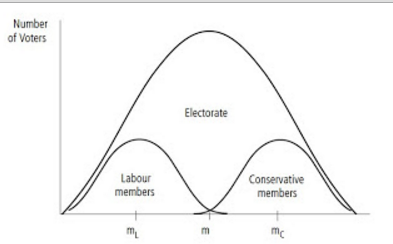
Hanson, Trump, UKIP, Alternative for Germany, Marine Le Pen, and the anti-immigration but pro-welfare state populist parties in northern Europe are all smeared by the media as far right parties but also are described as right-wing populists. Media bias is still constrained by the median voter theorem.
You cannot be on the far right but win lots of votes because the extremes of the political spectrum account for few votes. What do you think left-wingers stay within the Labour Party despite wanting its leader to be tried for war crimes.
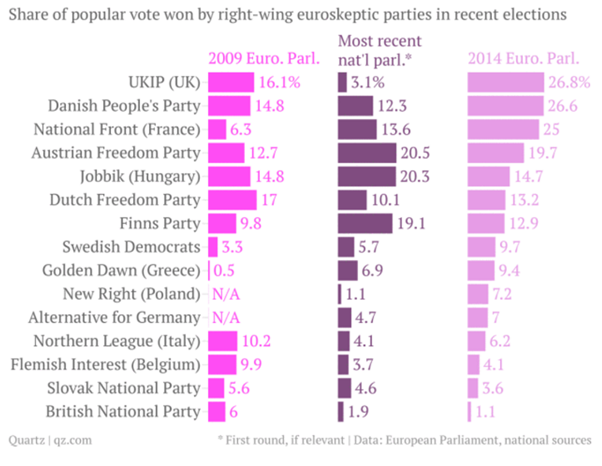
Even in proportional representation systems, few far right and far left party set up on their own two feet and survive because of thresholds to win seats. There are Communist parties in European parliaments but their representation is small except for the Bundestag.
You cannot get into the 2nd round of the French presidential election, come 2nd in 40 British Labour Party seats, win the safest Labour Party seats in Queensland, and be attacked from Ted Cruz from the right and still be a far right winger.
All right-wing populist parties combine that heady brew of nationalism,opposition to immigration and free trade, and staunch support of the welfare state. Not surprisingly, something like 40% of their votes come from the traditional labour parties and social democratic parties.
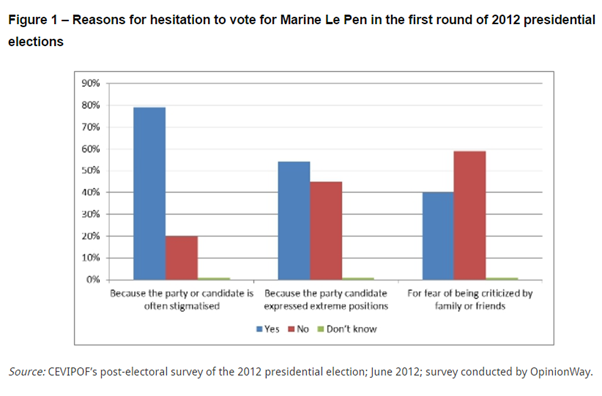
Countering their appeal to the electorate cannot start with saying that anyone who votes for them is weird because the secret ballot allow secret malice.
The left is surprisingly bad at playing catch-up in identity politics. As one UKIP supporter said, I am a white working class Englishmen not on the benefit so Labour does not speak for me.
An inquiry established by Labour’s former policy chief, Jon Cruddas, MP found that Labour needs to
“stop patronising socially conservative Ukip voters and recognise the ways in which Ukip appeals to former Labour voters”, the report says, adding: “Labour is becoming a toxic brand. It is perceived by voters as a party that supports an ‘open door’ approach to immigration, lacks credibility on the economy, and is a ‘soft touch’ on welfare spending.”
At present, the report argues, Labour is “largely a party of progressive, social liberals who value principles such as equality, sustainability, and social justice.
It is losing connection with large parts of the voter population who are either pragmatists in their voting habits or social conservatives who value family, work, fairness and their country.” It adds: “Labour is becoming dangerously out of touch with the electorate and … unwilling to acknowledge this growing estrangement.”
Gary Johnson on Bill Maher
24 Jul 2016 Leave a comment
in politics - USA Tags: 2016 presidential election
A nuclear free New Zealand delayed the end of the Cold War
24 Jul 2016 Leave a comment
in defence economics, politics - New Zealand, war and peace Tags: Cold War, game theory, George Orwell, nuclear free New Zealand, peace movements, war against terror
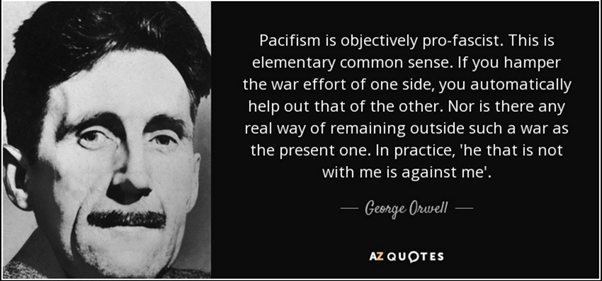
If the dilettantes at the end of the known world accomplished anything at all by declaring New Zealand nuclear free after 1984, anything at all, it was to prolong the Cold War, embolden Communist Russia and increase the chance of a nuclear exchange. As George Orwell said in 1941
Pacifism is objectively pro-Fascist. This is elementary common sense. If you hamper the war effort of one side you automatically help that of the other. Nor is there any real way of remaining outside such a war as the present one. In practice, ‘he that is not with me is against me’.
The idea that you can somehow remain aloof from and superior to the struggle, while living on food which British sailors have to risk their lives to bring you, is a bourgeois illusion bred of money and security.
Mr Savage remarks that ‘according to this type of reasoning, a German or Japanese pacifist would be “objectively pro-British”.’ But of course he would be! That is why pacifist activities are not permitted in those countries (in both of them the penalty is, or can be, beheading) while both the Germans and the Japanese do all they can to encourage the spread of pacifism in British and American territories. The Germans even run a spurious ‘freedom’ station which serves out pacifist propaganda indistinguishable from that of the P.P.U. They would stimulate pacifism in Russia as well if they could, but in that case they have tougher babies to deal with.
In so far as it takes effect at all, pacifist propaganda can only be effective against those countries where a certain amount of freedom of speech is still permitted; in other words it is helpful to totalitarianism.
There is a strong peace movement in the 1930s that undermined rearmament at every point. Indeed, the then leader of the British Labour Party met with Hitler one afternoon with the aim of persuading him to become a Christian pacifist. He failed.
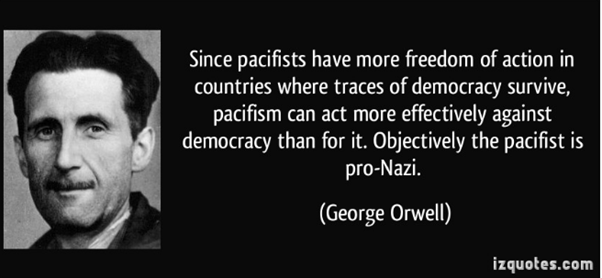
The slaughterhouse of World War I would certainly rest on the memory but Hitler gave them no choice but to rearm yet some on the Left would not accept this reality. The purpose of British foreign policy in the 1930s was to buy time to rearmament before the inevitable clash.
The pro-fascism of the peace movement continues to this day. To quote Michael Walzer
so many leftists rushed to the defense of civil liberties while refusing to acknowledge that the country faced real dangers–as if there was no need at all to balance security and freedom.
Maybe the right balance will emerge spontaneously from the clash of right-wing authoritarianism and left-wing absolutism, but it would be better practice for the left to figure out the right balance for itself, on its own; the effort would suggest a responsible politics and a real desire to exercise power, some day.
But what really marks the left, or a large part of it, is the bitterness that comes with abandoning any such desire. The alienation is radical.
How else can one understand the unwillingness of people who, after all, live here, and whose children and grandchildren live here, to join in a serious debate about how to protect the country against future terrorist attacks? There is a pathology in this unwillingness, and it has already done us great damage.
With one exception, democracies do not go to war with other democracies. There are plenty of undemocratic countries out there with dictators willing to have it go if they see weakness.
That is before you consider the suspicion that the Communist dictatorships had of other countries. In Tom Schelling’s view, many wars including World War 1 were the products of mutual alarm and unpredictable tests of will.
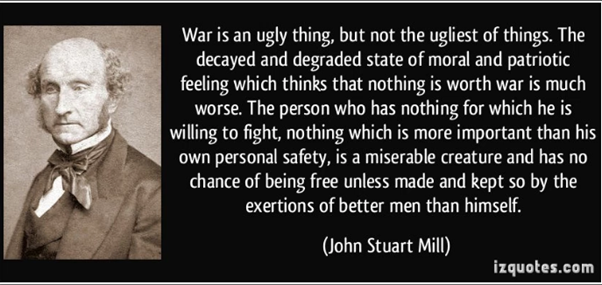
Robert Aumann argued well that the way to peace is like bargaining in a medieval bazaar. Never look too keen, and bargain long and hard. Aumann argues that:
If you are ready for war, you will not need to fight. If you cry ‘peace, peace,’ you will end up fighting… What brings war is that you signal weakness and concessions.
A nuclear free New Zealand signalled weakness and a willingness to make concessions. The peace movements across all democracies had the same effect.
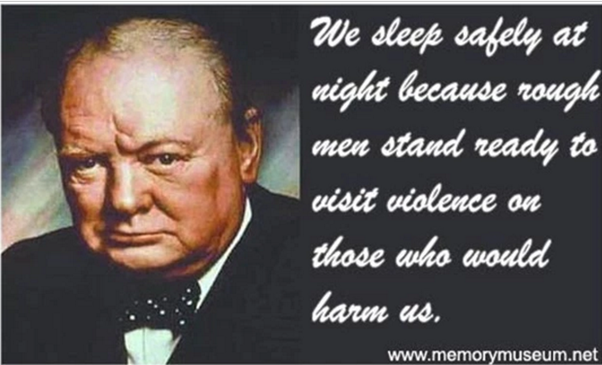
Disarmament increases the chances of war. Aumann gave the example of the Cold War of how their stockpiles of nuclear weapons and fleets of bombers prevented a hot war from starting:
In the long years of the cold war between the US and the Soviet Union, what prevented “hot” war was that bombers carrying nuclear weapons were in the air 24 hours a day, 365 days a year? Disarming would have led to war.
Peace activists are utterly clueless about what is discussed at peace talks. The ability to negotiate a credible peaceful settlement between sovereign states depends on:
- the divisibility of the outcome of the dispute,
- the effectiveness of the fortifications and counterattacks with which an attacker would expect to have to contend, and
- on the permanence of the outcome of a potential war.
Central to any peace talks is that any peace agreement is credible – it will hold and not will not be quickly broken:
A state would think that another state’s promise not to start a war is credible only if the other state would be better off by keeping its promise not to start a war than by breaking its promise.
Peace talks occur only when there something to bargain about. As James Fearon explained, there must be
a set of negotiated settlements that both sides prefer to fighting
That need for a bargaining range is the fundamental flaw of peace activists. When they call for peace talks, peace activists never explain what will be discussed in a world where everybody is not like them terms of good intentions.
What are the possible negotiated settlements that each both side will prefer to continue fighting? Diplomacy is about one side having some control over something the other side wants and this other side have something you want to exchange. In a war, the attacker thinks he can get what it wants to fighting for it.
If peace activists truly want peace, rather than victory for the other side, they must prepare for war including fortified borders so that the other side doesn’t dare cross them and start a war. A peace settlement depends upon the ability to divide the contested territory with or without fortified borders to make a settlement credible:
…despite the costs and risks of war, if a dispute is existential, or, more generally, if the whole of a contested territory is sufficiently more valuable than the sum of its parts, then a peaceful settlement is not possible.
A peaceful settlement of a territorial dispute, and especially a settlement that includes an agreement not to fortify the resulting border, also can be impossible if a state thinks, even if over optimistically, that by starting a war it would be able at a small cost to settle the dispute completely in its favour permanently.
Gary Johnson: He’s Also Running | Full Frontal with Samantha Bee
24 Jul 2016 Leave a comment
in constitutional political economy, libertarianism, politics - USA Tags: 2016 presidential election
HT: Lise Rose
Best defence of Employment Contracts Act is a @FairnessNZ graphic
24 Jul 2016 1 Comment
in economic growth, economic history, labour economics, macroeconomics, politics - New Zealand, unions Tags: economic reform, Employment Contracts Act, employment protection laws, employment regulation, Leftover Left, neoliberalism, pessimism bias
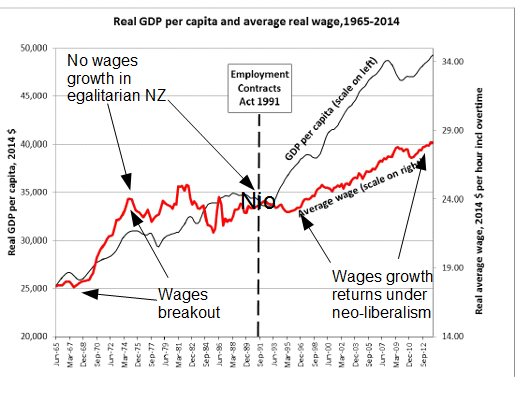
Source: Low Wage Economy | New Zealand Council of Trade Unions – Te Kauae Kaimahi, with extra annotations by this blogger.
#DavidAislabie shares @MaxRashbrooke’s boy’s own view of pre-1984 NZ as an egalitarian paradise
23 Jul 2016 Leave a comment
in economic history, liberalism, politics - New Zealand Tags: Leftover Left, pessimism bias, Twitter left
David Aislabie yesterday in the Wanganui Chronicle went beyond Max Rashbrooke’s boy’s own view of the 1970s New Zealand is an egalitarian paradise. Aislabie said
The post-war New Zealand I grew up in was the envy of the world — an egalitarian paradise and a great place to bring up children.
It is a sad irony that the baby boomers who benefited from the welfare state they inherited from their parents’ generation should be responsible for snatching those benefits away from subsequent generations.
At least last year, Max Rashbrooke was good enough to qualify his pre-economic reform egalitarian paradise to not include women and Maori
New Zealand up until the 1980s was fairly egalitarian, apart from Maori and women, our increasing income gap started in the late 1980s and early 1990s,” says Rashbrooke. “These young club members are the first generation to grow up in a New Zealand really starkly divided by income.
Leaving out a good 60% of the population from the pre-1984 New Zealand egalitarian paradise is a bit of a stretch on any paradise.
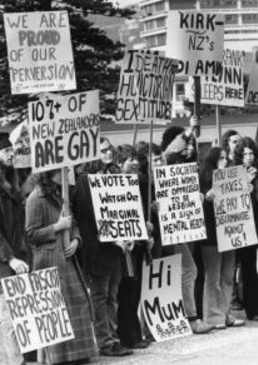 Pre-1984 was no paradise to sing that you were glad to be gay; you could have been thrown in jail and many were.
Yes Prime Minister on a minister of manufacturing @jamespeshaw @julieannegenter
21 Jul 2016 Leave a comment
in comparative institutional analysis, economics, economics of bureaucracy, economics of media and culture, industrial organisation, international economics, politics - New Zealand, Public Choice, rentseeking, survivor principle, television Tags: corporate welfare, industry policy, New Zealand Greens, picking losers, picking winners, Yes Prime Minister
Australians May Elect a Second Libertarian Senator
21 Jul 2016 Leave a comment
in libertarianism, politics - Australia Tags: 2016 Australian federal election
Meet Gabriel Buckley, free market anarchist and rock guitarist.
Source: Australians May Elect a Second Libertarian Senator – Hit & Run : Reason.com
Labor, Jobs, and the Modern Economy | Becker Friedman Institute
20 Jul 2016 Leave a comment
in economics, industrial organisation, Joseph Schumpeter, labour economics, politics - USA, population economics, technological progress Tags: creative destruction
% Australian top incomes from wages, salaries and pensions since 1954
19 Jul 2016 Leave a comment
in economic history, human capital, industrial organisation, labour economics, occupational choice, politics - Australia, poverty and inequality Tags: Australia, CEO pay, superstar wages, superstars, top 1%, top incomes
Australia has had a working rich for a long time now. Australian top income earners are top wage earners. They are athletes, celebrities, business executives and in the professions.
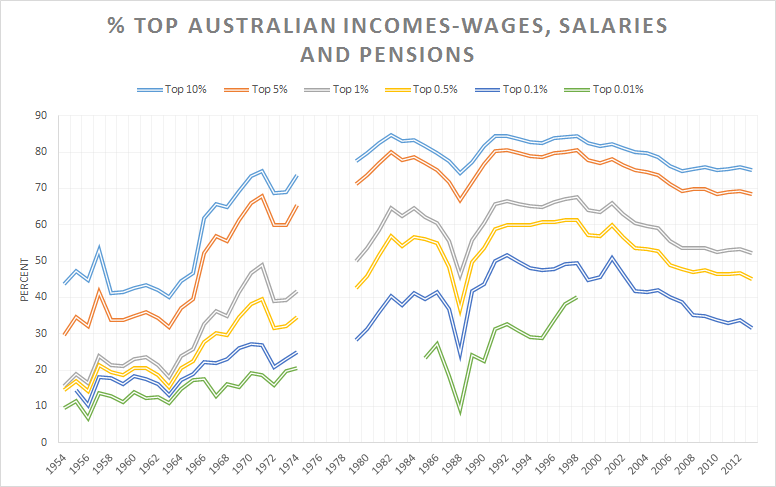
Source: The World Wealth and Income Database.


Recent Comments