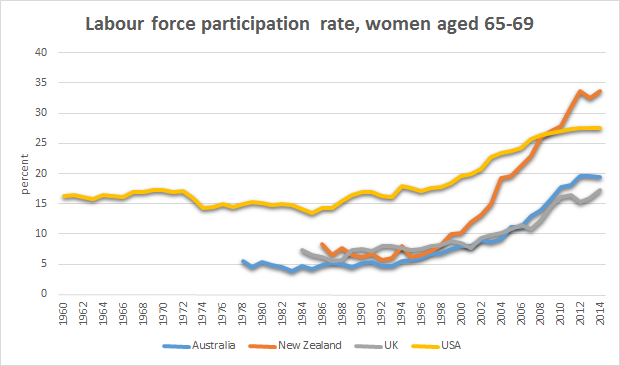
US maternal employment rates by number and age of children

image

Source: Pensions at a Glance 2015 – Statistics – OECD iLibrary.

How big is Medsafe’s invisible graveyard? @PeterDunneMP @annetterongotai

Medsafe replicates in part or in whole the drug approval processes of its overseas counterparts. There is expedited processing for drugs already approved overseas.

Every day in which a drug approval application is sitting on the desk of a bureaucratic at Medsafe is a day in which another New Zealander may die but for that drug.

That delay in access to drugs because of the duplication in approval processes is the invisible graveyard of Medsafe. My Official Information Act requests so far have been unable to access a cost benefit analysis at the Ministry of Health that quantifies the size of that invisible graveyard.

If economists have a bitter drinking song it would be “how many people has the FDA killed today”. Many drugs became available years after they were on the market outside the USA because of drug approval lags at the FDA. The dead are many. To quote David Friedman:

In 1981… the FDA published a press release confessing to mass murder. That was not, of course, the way in which the release was worded; it was simply an announcement that the FDA had approved the use of timolol, a ß-blocker, to prevent recurrences of heart attacks. At the time timolol was approved, ß-blockers had been widely used outside the U.S. for over ten years.

It was estimated that the use of timolol would save from seven thousand to ten thousand lives a year in the U.S. So the FDA, by forbidding the use of ß-blockers before 1981, was responsible for something close to a hundred thousand unnecessary deaths.

The only rational basis for duplicating overseas drug safety approval processes is the honest belief that a New Zealand process can pick up errors. These errors must be so large that they justify the delay. If there are no such errors to pick up in a cost justified manner, the drug approval branch of Medsafe just adds to the invisible graveyard.

The Ministry of Health did advise its Minister of the unilateral recognition model in Singapore. If a drug is registered in two trusted jurisdictions, it is fast tracked. If it is registered in one other trusted jurisdiction, it goes through an expedited process. This process appears to only cut the registration process for a drug from 270 days to 240 days.

The truncated approaches when there is approval of the drug in a trusted jurisdiction usually call for access to evaluation reports and other red tape. What can drug trials in New Zealand
find out that is not already known? Medsafe targets processing applications for the approval of new drugs in New Zealand to be done within 200 days. That’s 200 days too many.

My preferred unilateral recognition process consists of authenticating the drug registration certificate from a trusted overseas jurisdiction. It would be a post-box process. The G7 countries plus Australia should be this list of trusted overseas jurisdiction. There should be automatic recognition in New Zealand of any drug registration in those jurisdictions.

There is no reason to believe that Medsafe will pick up errors of trusted jurisdictions overseas. Medsafe denied New Zealanders access to four drugs approved in comparable regulatory jurisdictions in the last three years. Medsafe rejected two other drugs in the last three years but these drugs were not approved in comparable jurisdictions. Medsafe is not involved in the funding of medicines; this is the responsibility of PHARMAC.

Source: data released 29 October 2015 pursuant to an Official Information Act request to the Ministry of Health.

Medsafe is turning down not even a handful of drugs were approved overseas jurisdictions in the past three years. Was that worth the wait? Was that worth a larger invisible graveyard?

The net benefits of the entire drug approval framework over the past three years in New Zealand is riding out on rejecting for approval half a dozen drugs, four of which are approved as safe in other comparable jurisdictions. 

The size of the invisible graveyard has been quantified in the USA. The Prescription Drug User Fee Acts (PDUFA) reduced the drug approval time lag by 10 months:

Converting these economic gains into equivalent health benefits, we find that the more rapid access of drugs on the market enabled by PDUFA saved the equivalent of 140,000 to 310,000 life years.

A few drugs were approved that were later withdrawn. Their unfortunate consequences must always be weighed against the drugs that got to the market faster, saving lives, relieving pain and curing illnesses. That trade-off must be faced up to openly rather than as it is now left in the invisible graveyard.

The Taylor rule and the Fed’s interest rate policies compared

Old age poverty rates in the G7, Australia, New Zealand and Korea

image

Source: Old-age income poverty – Pensions at a Glance 2015 – OECD iLibrary.

In Wellington CBD, average value of commercial building is almost halved with a red or yellow sticker

Within the Wellington CBD, the average value of a commercial building is almost halved if it receives a legally binding earthquake-prone declaration. Discounts on specific buildings will vary around this average level, reflecting a number of factors such as costs of remediation and the nature of existing rental agreements.

Source: Before a Fall: Impacts of Earthquake Regulation and Building Codes on the Commercial Building Market | Motu

Labour productivity growth in the New Zealand retail services confounds Baumol’s cost disease

The gap between black and white students appears as early as kindergarten and grows with time

Young people supported the Vietnam War as much as older folk

@jacindaardern the role of drug addiction in poverty and unemployment

Jacinda Adern does have a point that the Prime Minister overplayed the role of drug dependency in child poverty, but he is not completely off the mark. A whole bunch of self-destructive behaviours play a role in family poverty.

Source: Minister of Social Development Cabinet Paper on Pre-employment Drug Testing Requirements.

Too many children have irresponsible parents. Caplan along with Charles Murray point out that a number of pathologies are particularly prevalent among poor:

  1. alcoholism: Alcohol costs money, interferes with your ability to work, and leads to expensive reckless behaviour.
  2. drug addiction: Like alcohol, but more expensive, and likely to eventually lead to legal troubles you’re too poor to buy your way out of.
  3. single parenthood: Raising a child takes a lot of effort and a lot of money.  One poor person rarely has enough resources to comfortably provide this combination of effort and money.
  4. unprotected sex: Unprotected sex quickly leads to single parenthood.  See above.
  5. dropping out of high school: High school drop-outs earn much lower wages than graduates.  Kids from rich families may be able to afford this sacrifice, but kids from poor families can’t.
  6. being single: Getting married lets couples avoid a lot of wasteful duplication of household expenses.  These savings may not mean much to the rich, but they make a huge difference for the poor.
  7. non-remunerative crime: Drunk driving and bar fights don’t pay.  In fact, they have high expected medical and legal expenses.  The rich might be able to afford these costs.  The poor can’t.

Caplan is disputing that healthy adults who are poor are victims. That is central to the poverty is not a choice movement: the poor are victims.

The New Zealand experience with work testing of beneficiaries for drugs is most of them quickly stopped using dope. Many jobs have tests for drug-taking.

Why do ‪@fightfor15 @LivingWageNZ @LivingWageUK aim so low?

Why @JohnKeyPM is tourism minister – tourism as a % of GDP across the OECD

John Key is both Prime Minister and Minister for Tourism. Previously the portfolio was held by a junior minister. I am not sure if that was a good idea. Government departments tend to be gravestones of industries.

The New Zealand tourism industry grew on its own to be the 4th largest relatively speaking in the world without the guiding hand of a Minister of Tourism. Maybe it should have stayed that way.

Source: OECD Tourism Trends and Policies 2014 – OECD.

The rapidly approaching demographic crisis in New Zealand

Choices that lead to poverty @GarethMorgannz @povertymonitor

The best evidence that poverty can be a choice is the success of the 1996 US welfare reforms and other carrot and stick approaches to poverty reduction. Poverty in the USA dropped dramatically in the mid-1990s after being stable for decades.

The stick is the most important part of poverty reduction programs that have succeeded. The poverty is not a choice movement deny to themselves the most successful child poverty reduction tool of modern times.

The success of the 1996 US federal welfare reforms were not discussed in an experts report on solutions to child poverty published a few years ago by the Children’s Commissioner. It should have been.

After decades of no progress against child poverty, five-year time limits on federal welfare assistance along with mandatory work requirements encouraged a large number of single mothers to find work. Many of these single mothers who joined the workforce in the USA were high school dropouts with small children.

Child poverty fell dramatically among minorities after the 1996 US federal welfare reforms. Everybody was surprised by the massive increases in the employment of single mothers and the reductions in child poverty. Nobody expected young mothers with small children to have so much control over their destiny.

That ability of single mothers to find a job as a condition of welfare benefits after the 1996 US federal welfare reform contradicts the belief that poverty is not a choice.

Child poverty is concentrated among single mothers and in particular single mothers on a welfare benefit. The subsequent declines in welfare participation rates and gains in employment were largest among the single mothers previously thought to be most disadvantaged: young (ages 18-29), mothers with children aged under seven, high school drop-outs, and black and Hispanic mothers.

When welfare benefits are linked to work requirements, the 1996 US federal welfare reforms showed that a surprisingly large number of single mothers can find and keep a job. Employment are never married mothers increased by 50% after these US reforms; employment of single mothers with less than a high school education increased by two-thirds; employment of single mothers aged of 18 to 24 approximately doubled.

Brian Caplan has been among those to link self-destructive behaviours to many of those in poverty. He argues there are a number of reasonable steps that healthy adults can take to avoid poverty for them and their children:

  1. Work full-time, even if the best job you can get isn’t fun.
  2. Spend your money on food and shelter before getting cigarettes and cable TV.
  3. Use contraception if you can’t afford a child.

Caplan specifically includes among the undeserving poor the children of poor or irresponsible parents.

Caplan along with Charles Murray point out that a number of pathologies are particularly prevalent among poor:

  1. alcoholism: Alcohol costs money, interferes with your ability to work, and leads to expensive reckless behaviour.
  2. drug addiction: Like alcohol, but more expensive, and likely to eventually lead to legal troubles you’re too poor to buy your way out of.
  3. single parenthood: Raising a child takes a lot of effort and a lot of money.  One poor person rarely has enough resources to comfortably provide this combination of effort and money.  
  4. unprotected sex: Unprotected sex quickly leads to single parenthood.  See above.
  5. dropping out of high school: High school drop-outs earn much lower wages than graduates.  Kids from rich families may be able to afford this sacrifice, but kids from poor families can’t.
  6. being single: Getting married lets couples avoid a lot of wasteful duplication of household expenses.  These savings may not mean much to the rich, but they make a huge difference for the poor.
  7. non-remunerative crime: Drunk driving and bar fights don’t pay.  In fact, they have high expected medical and legal expenses.  The rich might be able to afford these costs.  The poor can’t.

Caplan is disputing that healthy adults who are poor are victims. That is central to the poverty is not a choice movement: the poor are victims. Many are not, especially the healthy adults.

Policy debates about how to reduce poverty must break out of poverty is not a choice mentality because as Caplan says:

Being poor is a reason to save money, work hard, and control your impulses.

The choices people can make to avoid poverty are finish high school, seek a full-time job, delay children until you marry, and avoid crime. Working against this is as women’s labour market opportunities improved, their interest in low-status men has declined. As Charles Murray explains, working class males have become less industrious:

In 2003-5, men who were not employed spent less time on job search, education, and training, and doing useful things around the house than they had in 1985. They spent less time on civic and religious activities. They didn’t even spend their leisure time on active pastimes such as exercise, sports, hobbies, or reading…

How did they spend that extra leisure time? Sleeping and watching television.  The increase in television viewing was especially large – from 27.7 hours per week in 1985 to 36.7 hours in 2003-5…

The demand to date and marry such men has declined because raising children as a solo mission has become more viable for mothers.

Saying poverty is not a choice undermines important messages about help but hassle that must be woven into the heart of the incentive structures of social insurance and the welfare state.

Statistical illusions about U.S. poverty @JulieAnneGenter @povertymonitor

More evidence of the success of the 1996 US federal welfare reforms

Previous Older Entries Next Newer Entries

Thoughts from the North

Celebrating humanity's flourishing through the spread of capitalism and the rule of law

Fardels Bear

A History of the Alt-Right

Vincent Geloso

Econ Prof at George Mason University, Economic Historian, Québécois

Bassett, Brash & Hide

Celebrating humanity's flourishing through the spread of capitalism and the rule of law

Truth on the Market

Scholarly commentary on law, economics, and more

The Undercover Historian

Beatrice Cherrier's blog

Matua Kahurangi

Celebrating humanity's flourishing through the spread of capitalism and the rule of law

Temple of Sociology

Celebrating humanity's flourishing through the spread of capitalism and the rule of law

Velvet Glove, Iron Fist

Celebrating humanity's flourishing through the spread of capitalism and the rule of law

Why Evolution Is True

Why Evolution is True is a blog written by Jerry Coyne, centered on evolution and biology but also dealing with diverse topics like politics, culture, and cats.

NoTricksZone

Celebrating humanity's flourishing through the spread of capitalism and the rule of law

Homepaddock

A rural perspective with a blue tint by Ele Ludemann

Kiwiblog

DPF's Kiwiblog - Fomenting Happy Mischief since 2003

The Dangerous Economist

Celebrating humanity's flourishing through the spread of capitalism and the rule of law

Watts Up With That?

The world's most viewed site on global warming and climate change

The Logical Place

Tim Harding's writings on rationality, informal logic and skepticism

Doc's Books

A window into Doc Freiberger's library

The Risk-Monger

Let's examine hard decisions!

Uneasy Money

Commentary on monetary policy in the spirit of R. G. Hawtrey

Barrie Saunders

Thoughts on public policy and the media

Liberty Scott

Celebrating humanity's flourishing through the spread of capitalism and the rule of law

Point of Order

Politics and the economy

James Bowden's Blog

A blog (primarily) on Canadian and Commonwealth political history and institutions

Science Matters

Reading between the lines, and underneath the hype.

Peter Winsley

Economics, and such stuff as dreams are made on

A Venerable Puzzle

"The British constitution has always been puzzling, and always will be." --Queen Elizabeth II

The Antiplanner

Celebrating humanity's flourishing through the spread of capitalism and the rule of law

Bet On It

Celebrating humanity's flourishing through the spread of capitalism and the rule of law

History of Sorts

WORLD WAR II, MUSIC, HISTORY, HOLOCAUST

Roger Pielke Jr.

Undisciplined scholar, recovering academic

Offsetting Behaviour

Celebrating humanity's flourishing through the spread of capitalism and the rule of law

JONATHAN TURLEY

Res ipsa loquitur - The thing itself speaks

Conversable Economist

In Hume’s spirit, I will attempt to serve as an ambassador from my world of economics, and help in “finding topics of conversation fit for the entertainment of rational creatures.”
The Victorian Commons

Researching the House of Commons, 1832-1868

The History of Parliament

Articles and research from the History of Parliament Trust

Books & Boots

Reflections on books and art

Legal History Miscellany

Posts on the History of Law, Crime, and Justice

Sex, Drugs and Economics

Celebrating humanity's flourishing through the spread of capitalism and the rule of law

European Royal History

Exploring the Monarchs of Europe

Tallbloke's Talkshop

Cutting edge science you can dice with

Marginal REVOLUTION

Small Steps Toward A Much Better World

NOT A LOT OF PEOPLE KNOW THAT

“We do not believe any group of men adequate enough or wise enough to operate without scrutiny or without criticism. We know that the only way to avoid error is to detect it, that the only way to detect it is to be free to inquire. We know that in secrecy error undetected will flourish and subvert”. - J Robert Oppenheimer.

STOP THESE THINGS

The truth about the great wind power fraud - we're not here to debate the wind industry, we're here to destroy it.

Lindsay Mitchell

Celebrating humanity's flourishing through the spread of capitalism and the rule of law

Alt-M

Celebrating humanity's flourishing through the spread of capitalism and the rule of law