
The left-wing tax dilemma
06 Feb 2016 Leave a comment
in politics - USA, public economics Tags: 2016 presidential election, entrepreneurial alertness, growth of government, size of government, taxation and entrepreneurship, taxation and investment, taxation and labour supply
Female labour force participation rate, workers aged 60 to 64, USA, UK, Australia and New Zealand since 1960
06 Feb 2016 Leave a comment
in economic history, labour economics, labour supply, politics - New Zealand, public economics Tags: ageing society, labour demographics, old-age pension, older workers, social insurance, welfare state
The increase in the eligibility age from the age of 60 to the age of 65 for the old age pension in New Zealand clearly sparked an explosion in female labour force participation between these ages.
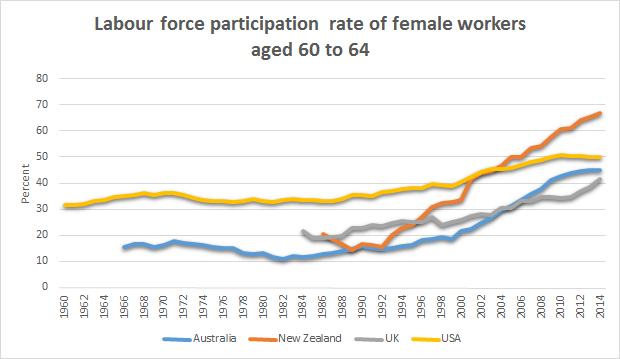
Data extracted on 05 Feb 2016 04:49 UTC (GMT) from OECD.Stat.
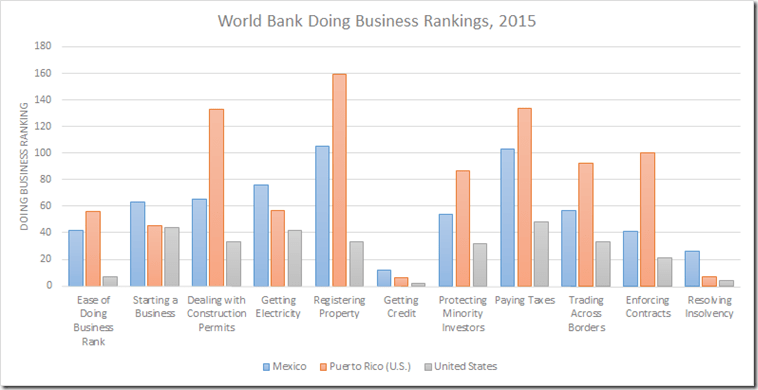
Trading across the Mexican, Puerto Rican and US borders – World Bank Doing Business rankings, 2015
05 Feb 2016 Leave a comment
in international economics, politics - USA

Source: World Bank Doing Business database 2015.
Much more than a high minimum wage – Puerto Rican, Mexican and U.S. Doing Business rankings 2015
05 Feb 2016 Leave a comment
in economics of religion, entrepreneurship, industrial organisation, law and economics, politics - USA, property rights Tags: doing business, Mexico, Puerto Rico
Having a high minimum wage is the least of the problems that the US territory of Porto Rico has when you consider reasons from its recent sovereign default. It owes about US$70 billion. It is a terrible place to do do business – worse than Mexico! Mexicans find it easier to export to the USA!
US, Danish, British, Canadian, Australian and New Zealand tax and social security burden net of cash benefits as a % of labour costs, one-earner married couple with two children since 2000
05 Feb 2016 Leave a comment
in labour economics, labour supply, politics - Australia, politics - New Zealand, politics - USA, public economics Tags: 2016 presidential election, British election, Canada, Denmark, family tax credit, in work tax credit, taxation and labour supply
For some reason the Labour government in New Zealand in the mid-2000s could not bring itself to admit it was introducing a huge tax cut for families. To avoid admitting it ever gave a tax cut, that Labour government called the huge family tax credit introduced in 2004 and 2005 Working for Families.
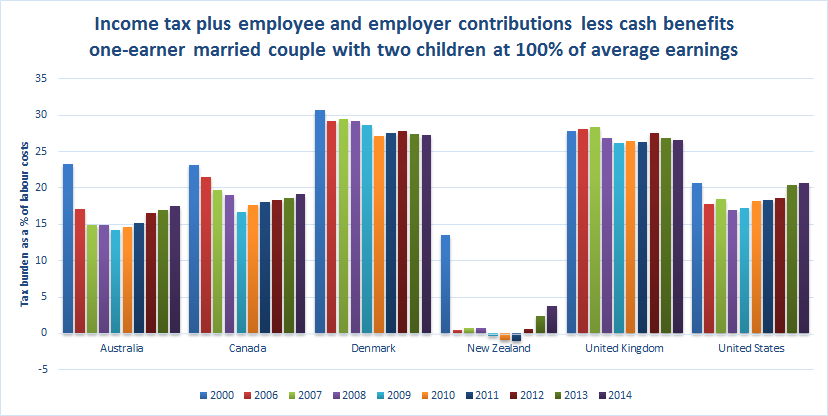
Source: Taxing Wages 2015 – OECD 2015
The above data does not include the effects of GST and VAT.
@BernieSanders MRI rationing – US v. Single-payer UK, Canada and Denmark
05 Feb 2016 Leave a comment
in health economics, politics - USA Tags: 2016 presidential election, British economy, Canada, Denmark, health insurance, medical rationing, NHS, single-payer, social insurance, universal health insurance
Single payer health insurance systems may have their advantages but one of which is not ready access to an MRI scan in the UK, Denmark or Canada.
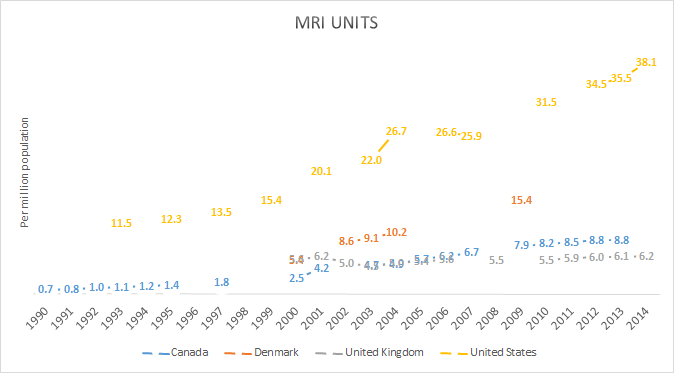
Source: OECD Health Statistics.
Remember that those aged over 65 in the USA are covered by Medicare; the poor and welfare beneficiaries are covered by Medicaid; and children of the working poor are covered by CHIPS.
I am told that dogs to get an MRI scan in Canada far quicker than humans. This is because dog owners can pay for the MRI scan. Private health insurance is unlawful in 9 of the 10 Canadian provinces.
There is considerable medical tourism from Canada to the USA, including by politicians who passionately support the single-payer system.
Labour force participation rates of US, UK, Australian and New Zealand male workers aged 65 to 69 since 1960
05 Feb 2016 Leave a comment
in economic history, labour economics, labour supply, politics - New Zealand, public economics
Up until the early 1990s, New Zealand had a universal old age pension that was paid from the age of 60. There was no means test or assets test. The eligibility age for this old age pension was increased to age 65 over the course of the 1990s and early 2000s. It obviously showed up in the labour supply of workers aged 66 and over in New Zealand after the change in the eligibility age.
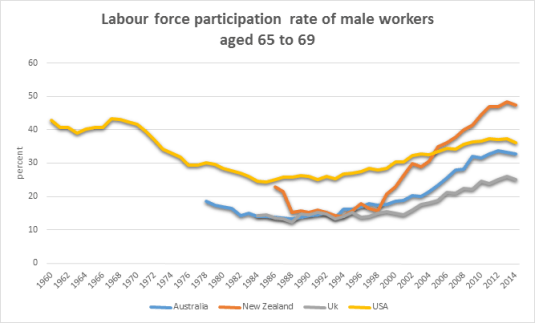
Data extracted on 05 Feb 2016 04:49 UTC (GMT) from OECD.Stat.
Labour force participation rates of US, UK, Australian and New Zealand workers aged 60 to 64 since 1960
05 Feb 2016 Leave a comment
in applied price theory, economic history, labour economics, labour supply, politics - New Zealand, public economics
Up until the early 1990s, New Zealand had a universal old age pension that was paid from the age of 60. There was no means test or assets test. The eligibility age for this old age pension was increased to age 65 over the course of the 1990s and early 2000s. It obviously showed up in the labour supply of workers aged 60 to 64 in New Zealand both before and after the change in the eligibility age.

Data extracted on 05 Feb 2016 04:49 UTC (GMT) from OECD.Stat.
#Employment rate for workers aged 60-64
05 Feb 2016 Leave a comment
in labour economics, labour supply, politics - New Zealand, poverty and inequality, public economics
@Greens @sarahinthesen8’s solution to boat people drowning
05 Feb 2016 1 Comment
in applied welfare economics, politics - Australia

Source: Another way for refugees | Australian Greens.
Arriving by boat in Australia does not increase the size of the refugee quota. It just changes who gets to the head of the queue and how many died trying to get to the head of the queue.
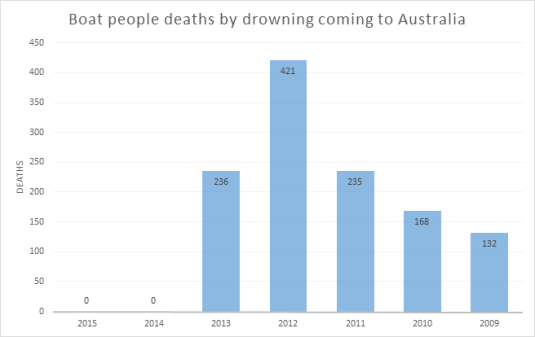
Source: Kiwiblog.
There is nothing compassionate about rewarding people for risking their lives. The chances of dying while attempting to come to Australia by boat are about 2%.
The recent experience in Europe confirms that just letting large numbers of refugees come to your country hardens the attitude of the majority of voters in that country to admitting refugees in general, much less more than their current quota.
1st and 2nd generation immigrants as percentage of the population
05 Feb 2016 Leave a comment
in labour economics, labour supply, politics - Australia, politics - New Zealand, politics - USA Tags: economics of immigration
@billshortenMP Why @TurnbullMalcolm will back Kevin Rudd for UN Secretary General
05 Feb 2016 1 Comment
in economics of bureaucracy, International law, politics - Australia, Public Choice

What a splendid opportunity! In an Australian election year, Kevin Rudd will be back in the Australian news, frequently front page.
This re-emergence of Kevin747 will remind Australian voters of how dysfunctional he was and how dysfunctional the last Labour government was.
Most of the reporting of Kevin Rudd in the Australian media be about how that control freak and social cripple will bring his dysfunctionality to United Nations and international relations generally.
Bill Shorten must hate the idea. The last thing he wants as an unpopular opposition leader is for the last Labour Prime Minister, who he stabbed in the back as prime minister first time round, to be back in the news.

Mark Latham uses to say that the only reason Kevin Rudd was popular with the Australian people was that never met him.
#TPPANoWay sovereignty objections apply equally to @ILO conventions
04 Feb 2016 Leave a comment
in constitutional political economy, economics of regulation, international economic law, international economics, International law, labour economics, law and economics, politics - New Zealand, unions Tags: employment law, employment protection, employment regulation, ILO, labour market regulation, social clauses, TPPA
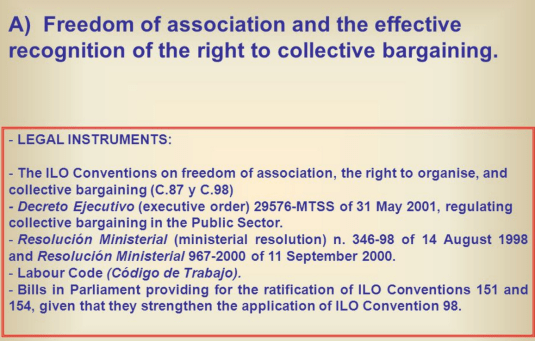
New Zealand has signed and ratified dozens of International Labour Organisation Conventions dating back to 1921. They all fetter the sovereignty of New Zealand. As a member of the ILO, New Zealand is required to report on its application of ILO Conventions.
That limitation on the sovereignty of New Zealand is no more and no less than in an international trade agreement. New Zealand can renounce an international trade agreement and has renounced nine International Labour Organisation conventions.
Jane Kelsey makes the following points about the legal implications of the Trans-Pacific Partnership agreement:
The 30 chapter Trans-Pacific Partnership Agreement (TPPA) constrains domestic law and policy at central government level, and in places by local government and SOEs, in diverse areas beyond traditional aspects of international trade.
…The TPP provides cumulative opportunities for foreign states and corporations to influence domestic decisions which may be burdensome and intrusive.
The exact same objections apply to the ILO conventions. The union movement does not hesitate to argue that the democratic process in New Zealand should be overridden because the proposal at hand purportedly conflicts with an ILO convention.
For example, when the government was choosing to deregulate collective bargaining, the sovereignty of Parliament was questioned because of an ILO convention. Helen Kelly, CTU President said:
in Parliament on 4 June, the Minister was asked if he agreed with advice from officials that the ability for employers to opt out of multi-employer bargaining may breach our obligations under ILO Convention 98 on the right to organise and collective bargaining.
…There is no point attending such an important UN ILO conference at the time your Government is being advised it is breaching its undertakings to that very organisation…
The CTU President also referred to the regulatory impact statement prepared for that collective bargaining legislation:
The paper also points out that these changes open NZ up to international examination by the International Labour Organisation (ILO) for non-compliance with Convention 98 – on the Right to Organise and Collectively Bargain, which New Zealand has signed up to.
Helen Kelly says “at least four of the proposals are deemed to be inconsistent with our international obligations, and two of them are classified as uncertain. Why the Government wants law changes that damage our international obligations is unclear.”
Council of Trade Unions submissions to minimum wage reviews have at least a dozen references to ILO conventions and the requirement to honour their provisions.
Posner and Goldsmith rightly argue that international law is a product of states pursuing their interests on the international stage. It does not induce states to comply contrary to their interests. The possibilities for what it can achieve are limited.
Government sign-up to various international agreements depending on their political priorities. You cannot complain that governments that you did not vote do what government you voted for also did, which was sign up to international agreements that suited their political agendas. The solution is to work harder to win the next general election.
As for opposing trade agreements on sovereignty grounds, it is rank hypocrisy for the union movement to do so given the number of times it cites international labour agreements when it suits them and seeks their inclusion in trade agreements to raise labour costs in developing countries.
@TransportBlog forgets the car ownership data it published
04 Feb 2016 Leave a comment
in economic history, politics - New Zealand, transport economics, urban economics
Transport Blog was making much of some data about how a lot of people used public transport and New Zealand in the 1950s:
Take Auckland as an example. According to Paul Mees [Transport for Suburbia, p. 21], in 1954 Auckland’s public transport network “accounted for 58 per cent of trips by motorized modes, private transport only 42 per cent. When walking and cycling, which were not surveyed, are taken into account, it is likely that fewer than a third of daily trips were by car.”
… public spending to enable car travel did not respond to existing demand – it was intended to shape future demand. (And in doing so, change the shape of the city).
…
“roads first” transport policies seem less like an exercise in meeting demands, and more of a component of a large social engineering programme.
Transport Blog forgot previous data it dugout on trends in car ownership per capita in New Zealand since 1925. There is an explosive growth in car ownership from the 1950s onwards with the post-war economic boom. The roadbuilding that followed responded to this growing wealth of the New Zealand people rather than the other way round.
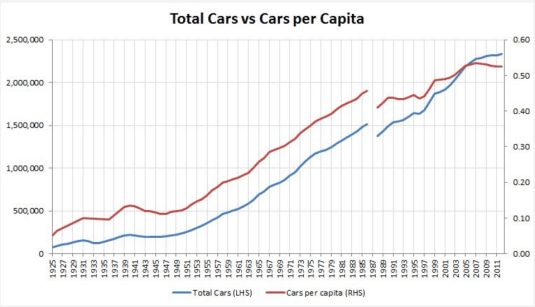
Source: The Infernal Combustion Engine « transportblog.co.nz.
People like owing and driving cars. Transport Blog begrudgingly admits in its post today that cars have some advantages.
Young people save up to buy a car not because they are duped by the enemies of public transport, they save because a car is a good way to get around.
Privately owned cars are more comfortable, faster, more private, more convenient in trip timing, and more flexible for multiple tasks on one trip than any form of public transit. What cannot be avoided as Anthony Downs explains is:
As household incomes rise around the world, more and more people shift from slower, less expensive modes of movement to privately owned cars and trucks.
Downs argues that it is time to settle down and accept what cities are:
…peak-hour traffic congestion is inescapable in large modern metropolitan areas the world over. Business firms want most people on the job during the same hours so that workers can interact efficiently. Many firms also want to locate in low-density establishments scattered across the landscape.
Households want a range of choices of where to live and work, and most want to live in low-density settlements that are separate from poorer households, use private vehicles for most travel and be able to carry out multiple errands on a single trip.


Recent Comments