Why is the US equilibrium unemployment rate so stable as compared to Canada and the UK?

The equilibrium unemployment rate in the USA has been dead flat at a little under 6% as far back as the OECD Economic Outlook November 2015 can estimate. The Canadian and British equilibrium unemployment rates have gone up and down to the point of near doubling at times. Institutions cannot be so stable in the USA and so unstable Canada and Britain in terms of the incentives to post vacancies, for search for work in the same in different industries and occupations and revise asking wages. We’re talking about a 35 year stretch macroeconomic and labour market policy in the USA.

Source: OECD Economic Outlook November 2015 Data extracted on 10 Nov 2015 07:07 UTC (GMT) from OECD.Stat.

Furthermore, there is a large literature in the early 1970s and late 1990s arguing that the US equilibrium unemployment rate dropped as low as 4%.

Source: Robert Shimer, Why is the U.S. Unemployment Rate So Much Lower? (1999).

More correctly, for the early 1970s literature, the equilibrium unemployment rate had risen to 4% after being at an equilibrium rate of about 3%. Something doesn’t add up.

Source: Robert Shimer, Why is the U.S. Unemployment Rate So Much Lower? (1999).

This estimate of an unchanging US equilibrium unemployment rate doesn’t add up even more when you consider the discussions after the Great Recession about how the extensions to unemployment insurance from a time limit of 26 weeks to 99 weeks would increase the equilibrium unemployment rate. Something really doesn’t add up for the US equilibrium unemployment rate to be so stable and the British and Canadian equilibrium unemployment rates to be so volatile.

Source: Robert Barro: The Folly of Subsidizing Unemployment – WSJ.

New Zealand gender wage gap for full-time workers and for part-time workers, 2015

The unadjusted gender wage gap is regarded as a reliable measure of sex discrimination in these day, apparently, because the adjusted wage gap is too small to maintain the rage. In the data below, the gender wage gap is in favour of women. That is an unreliable unadjusted gender wage because many part-time male workers are teenagers. Many part-time female workers are professionals.

image

Source: Statistics New Zealand, New Zealand Income Survey, June quarter 2015

The Berlin Wall fell today 1989

@NZGreens is the gender pay gap 6.6%, 11.8% or 14%?

Source: Statistics New Zealand: New Zealand Income Survey.

Source: Gender pay gap | Ministry for Women.

The unadjusted gender pay gap has been in a long-term decline for generations. The unadjusted gender wage gap in 2015 is 11.8% as shown in the above chart and in the second New Zealand Green’s Facebook link above but not first of their Facebook links above where it is claimed to be 14%.

To sex-up their numbers, the Labour Party and Greens used the gap between the average wages of men and women. This was rather than the median wage to make their gender wage gap comparisons despite the pious commitment of the Greens to use median wage in their gender wage gap calculations in the recent past.

The unadjusted gender pay gap has all but disappeared at the bottom of the labour market as the chart below shows. The gender wage gap remains stubbornly high at the high end of the wage market at 20% because of compensating differentials. Professional women are balancing families and careers in choosing the occupations that best suits each individual woman.

Source: OECD Employment Database.

Unions – not the cause of our 40 hour workweek

I am not responsible for the ads on my blog

Image

When did buying your own home become a good investment in Australia?

When I left university, all my mates were in a fever pitch about buying a house because it was such a good investment. They didn’t mention that housing had been a dog of investment for the previous 10 years. Housing was a good investment for a couple years around the time of this feverish home buying by my friends as the chart below shows. I didn’t buy a house because I could rent houses that were far nicer and more convenient to work and that any I could buy in Canberra. That pretty much applies to today.

Source and notes: Dallas Fed International Housing Database July 2015 – The author acknowledge use of the dataset described in Mack and Martínez-García (2011); real housing prices are nominal housing prices deflated by a personal consumption deflator.

Through all the 1990s as the chart above shows in retrospect, I was too polite to inquire of friends about their house prices in case they had no equity in their own house after the bank took its slice. For all of the 1990s, investing in a house was a dog of an investment in Australia if the above chart is a reasonable national summary of what is a medium-sized country. Things then hit a fever pitch at the end of the 1990s with house prices doubling and then some across Australia.

When did buying your own home become an investment in New Zealand?

Buying a house became an investment in New Zealand coincidently with the passing of the Resource Management Act and all the restrictions on land supply it empowered. Prior to then buy a house was a good idea except if you want to make money because real housing prices in 1993 were the same as in the mid-70s.

Source and notes: Dallas Fed International Housing Database July 2015 – The author acknowledge use of the dataset described in Mack and Martínez-García (2011); real housing prices are nominal housing prices deflated by a personal consumption deflator.

Housing prices rose by 50% in the first few years after the passage of the Resource Management Act. Housing prices doubled again in the last five years of the last Labour Government in New Zealand. With the economic recovery, housing prices increased again by 30% in the last four years or so.

The housing prices charted in deflated above are nationwide figures originally from nationwide nominal data published by the Reserve Bank of New Zealand and Quotable Value. They do not show the even faster growth in housing prices in, example, Auckland, Wellington and Christchurch and stagnant housing prices in declining regions, cities and towns of New Zealand.

Did @MaxRashbrooke make his case for wealth and inheritance taxes?

Veteran left-wing grumbler Max Rashbrooke yesterday argued for a wealth tax and inheritance taxes in New Zealand because of a widening wealth gap. He wants to tax inheritances of more than a mere $200,000 over your lifetime!

Yeah, I mean, we really are an international outlier in the sense that we don’t really tax wealth in any form. We don’t tax capital gains except now in very limited circumstances. We don’t tax inheritances. We don’t tax gifts. We don’t tax wealth in general, and this is a complicated area. In a lot of countries inheritance taxes are falling out of fashion. They get called death taxes and that kind of thing. But in response to that, what a lot of people are talking about are things like kind of a lifetime capital receipts tax. So rather than taxing the giver, you tax the recipient, and you say, ‘Look, over your lifetime, you can inherit, say, $200,000 tax free,’ so that your parents can pass on a bit to you.

That means an inheritance tax on the family home given current house prices in Auckland and Wellington and small families. I can’t see the Labour Party or even the Greens following him in on that one if they want to win office ever again.

Did Rashbrooke make a case for a widening wealth gap by looking at a 2004 survey of income and wealth?

Currently, the most recent publicly available information on wealth inequality in New Zealand comes from the 2004 round of the Survey of Family, Income and Employment, known as Sofie… Because wealthy people often refuse to take part in surveys such as Sofie, such data tends to underestimate how much of the pie is owned by the wealthiest people and overstate the share of everyone else. But it is still the best data we have.

Rashbrooke used this 2004 survey to draw a number of conclusions about the distribution of wealth in New Zealand:

The wealthiest tenth of individuals (including that wealthiest one per cent) had 52 per cent of all assets. In contrast, the poorest half of the country had just five per cent of all wealth. Some 190,000 people had negative net worth (more debts than assets), owing $4.7 billion between them.

Did Rashbrooke make his case that there is 52% of all assets in New Zealand are held by the wealthiest 10%? He did not because his definition wealth is too incomplete. Because of that, his focus on inheritance taxes and wealth taxes as solutions are equally poorly made. Any definition of wealth including that by Rashbrooke that doesn’t include human capital or acknowledge the limitations of not including human capital isn’t worth serious attention in public policy circles.

Source: Gary Becker, ‘Give Us Your Skilled Masses’ (2005).

Rashbrooke ignores 70% of the capital, the wealth in any economy. Gary Becker’s estimate that human capital is 70% of all capital in the US economy travels well to New Zealand as shown in the chart below.

Source: Lˆe Thi. Vˆan Tr`ınh, Estimating the monetary value of the stock of human capital for New Zealand, University of Canterbury PhD thesis (September 2006), Table 4.8: Human and physical capital stocks.

Over 70% of all capital in New Zealand is human capital. That cannot be ignored in any discussion of a widening wealth gap or in a case for inheritance and wealth taxes.

Dollar value estimates were available to Rashbrooke of human and physical capital of the same vintage as his wealth data from an excellent New Zealand PhD thesis by Lˆe Thi. Vˆan Tr`ınh. Her estimates of the aggregate dollar value of New Zealand physical and human capital are charted below. These estimates show that physical capital doubled between 1981 and 2001 but New Zealand human capital quadrupled.

Source: Lˆe Thi. Vˆan Tr`ınh, Estimating the monetary value of the stock of human capital for New Zealand, University of Canterbury PhD thesis (September 2006), Table 4.8: Human and physical capital stocks.

The rich are clearly not getting richer and the poor getting poorer and some people have no wealth at all. Human capital is the dominant form of capital in New Zealand and is growing rapidly. Any discussion of wealth does not include estimates of human capital or acknowledge the limitations of not having those estimates, which are easily available, should not be considered in public policy debates on inequality.


Source: Lˆe Thi. Vˆan Tr`ınh, Estimating the monetary value of the stock of human capital for New Zealand, University of Canterbury PhD thesis (September 2006).

The only group in New Zealand that doesn’t have more human capital in 2001 than in 1981 were the unskilled as the chart above shows. This was because their numbers dropped by one-third as a share of the working age population.

Source: Lˆe Thi. Vˆan Tr`ınh, Estimating the monetary value of the stock of human capital for New Zealand, University of Canterbury PhD thesis (September 2006), table 3.1.

I don’t think a solution to skills gaps is to increases taxes on those who investing in human capital. But that is the logic of Rashbrooke. When someone gets ahead, drag them back down rather than lift everybody up.

The reason for the lack of growth in the dollar value of unskilled human capital is the massive increase in investment in higher education in New Zealand. More New Zealanders go to university, Polytech or other diploma education. Working class New Zealanders are taking the advice of that unrepentant Stalinist but brilliant screenwriter Dalton Trumbo.

What is most disappointing is the unrepentant lack of gender analysis in the writings of Max Rashbrooke on inequality and wealth. Without a gender analysis, no discussion of wealth and inequality in New Zealand has any meaning.

Few labour market statistics have any meaning unless broken down by gender. Whenever you don’t see statistics with a gender breakdown, the first question for any sort of credible audience is “Gender analysis! Gender analysis! Where is your gender analysis?”

Max Rashbrooke inadvertently illustrated the meaningless of statistics that don’t have a gender analysis when griping recently about poverty and inequality in New Zealand as compared to the good old days before the economic reforms of the 1980s.

To paint pre-1984 New Zealand, pre-neoliberal New Zealand as an egalitarian paradise, Rashbrooke had to ignore two thirds of the population. He brushed over the inequalities they suffered in the heavily regulated, heavily taxed economy so looked upon with dewy eyes by the left of politics:

“New Zealand up until the 1980s was fairly egalitarian, apart from Maori and women, our increasing income gap started in the late 1980s and early 1990s,” says Rashbrooke. “These young club members are the first generation to grow up in a New Zealand really starkly divided by income”.

Racism and patriarchy can sit comfortably with a fairly egalitarian society if you are to believe a leading spokesman of the Left. I disagree as would John Rawls with this boy’s own view of trends in New Zealand inequality. Boy’s own because trends in gender inequality are not discussed. No weight is given to the closing of the gender pay gap, a massive increase in female employment and women out-numbering male university new graduates for well over a decade.

Perry (2014) reviews the poverty and inequality data in New Zealand every year for the Ministry of Social Development. He concluded that:

Overall, there is no evidence of any sustained rise or fall in inequality in the last two decades. The level of household disposable income inequality in New Zealand is a little above the OECD median. The share of total income received by the top 1% of individuals is at the low end of the OECD rankings.

As there is no evidence of any sustained rise or fall on inequality New Zealand for the last 20 years, the case for inheritance and wealth taxes simply doesn’t get out of the box.

Source: OECD Employment Database.

That case for inheritance and wealth taxes by Max Rashbrooke doesn’t deserve to get into the box to go under starter’s orders if that analysis doesn’t include an analysis of human capital and a gender analysis. For example, male human capital increased by 31% in New Zealand between 1981 and 2001. Over the same period, female human capital increased by 112%. This not insignificant achievement in gender empowerment by capitalism and freedom bears celebration in any discussion of inequality.

Source: Lˆe Thi. Vˆan Tr`ınh, Estimating the monetary value of the stock of human capital for New Zealand, University of Canterbury PhD thesis (September 2006).

The only group of women for whom the gender pay gap has not all but disappeared over the last 30 years are the top 10% of women. This is the very group that Max Rashbrooke wants to tax heavily to prevent them accumulating and inheriting wealth.

The reason for those taxes on wealth and inheritances on successful women in the professions and business is growth in inequality but there is little to no evidence of that in New Zealand for at least 20 years.

The case of wealth and inheritance taxes as a way of coping with inequality is just not keeping up with recent trends in superstar wealth. New Zealand top 1% is lazy when compared to their more entrepreneurial American brothers.

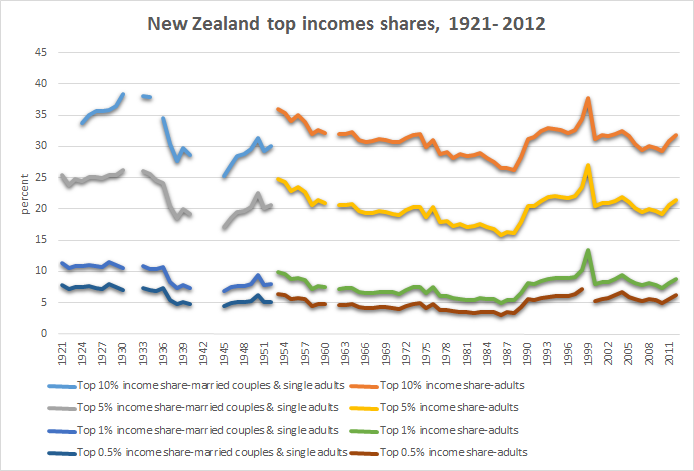
Source: The World Top Incomes Database.

Our local top 1% earns the same share of total income as 30 years ago or even 60 years ago. Any growth in wealth gaps in New Zealand isn’t showing up in top incomes shares.

Source: The World Top Incomes Database.

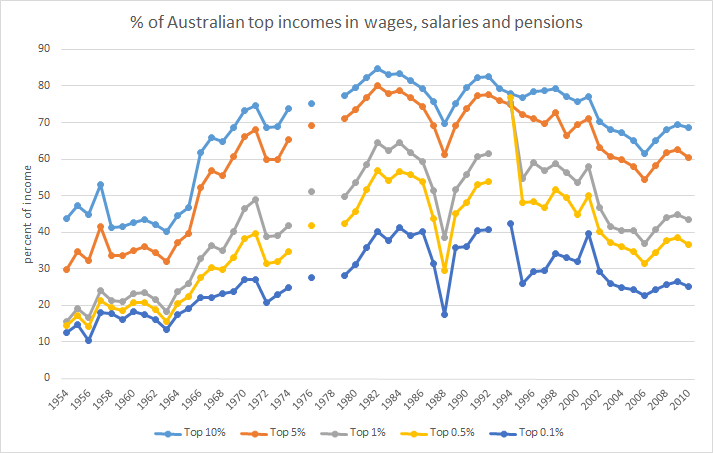
As for overseas, Piketty and Saez (2003) concluded that a substantial fraction of the rise in top incomes was due to surging top wage incomes. These world-renowned social economists concluded that top executives (the ‘working rich‘) replaced top capital owners (the ‘rentiers’) at the top of the income hierarchy in the USA and Canada. The largest portion of the top incomes comes from earning wages. Top wage earners work for their living founding, building and/or directing successful businesses.

@PhilTwyford fantastic @nzlabour policy breakthrough on housing affordability

Labour yesterday announced an excellent policy on housing affordability. The reforms proposed by Labour stress increasing the supply of land and improvements to local government finances surrounding infrastructure investments for new housing:

Labour will free up density and height controls to allow more medium density housing and reform the use of urban growth boundaries so they don’t drive up section costs. This will curb land bankers and speculators.

Labour has struck at the heart of two major constraints on urban land supply New Zealand: restrictions on density and height of new developments, and much more importantly, the use of urban growth boundaries to drive up land prices. These proposed regulatory reforms could not be more welcome.

The other shoe of Labour’s housing affordability reform proposals is improving the incentives for local councils to support new housing developments:

The other new element is changing the way we fund infrastructure for new developments. Currently those costs are either subsidised by the ratepayer or passed by the developer onto the price tag of a new home. That makes houses much more expensive. It also means they are paid off through mortgages at expensive bank interest rates.

Our new policy will see infrastructure funded by local government bonds, paid off over the lifetime of the asset through a targeted rate on the properties in the new development. This will substantially reduce the cost of new housing.

The reforms proposed by Labour to local government financing will reduce the financial burden on existing ratepayers of the local government funded infrastructure necessary to support new land developments.

Source and notes: International House Price Database – Dallas Fed June 2015; nominal housing prices for each country is deflated by the personal consumption deflator for that country.

These Labour Party reforms are fantastic because the main party on the left-wing of New Zealand politics has faced up to restricted land supply as a key reason behind housing unaffordability. I wonder what the New Zealand Greens will think of these major new reforms.

Of course, nothing is perfect in the art of policy development. New Zealand Labour continue to want government to build 100,000 affordable houses and scapegoat foreigners for high housing prices.

A few more sensible economic and fiscal policy announcements such as those today by the New Zealand Labour Party and it will start looking like a credible alternative government.


Has Obama ‘elected more Republicans than any human being in history’?

https://twitter.com/TheFix/status/662367703257206784

Increase in real New Zealand household incomes since 1982 – before and after housing costs

It is those below median household income that are suffering more from rising housing costs in New Zealand since 1982. Those on low incomes in particular have suffered the most.

image

Source: Bryan Perry, Household Incomes in New Zealand: trends in indicators of inequality and hardship 1982 to 2014 – Ministry of Social Development, Wellington (August 2015), Tables D3 and D4.

The data for the lowest decile is somewhat unreliable because there are so many implausibly low and zero incomes in that decile.

$1/2 billion in customs duties still collected in New Zealand!

In the course of feuding with strangers on Twitter about how much tariff revenue is still collected in New Zealand, I discovered that the revenue from customs duties are less than I recall but more than most think. These customs duties are distinct from any GST collected at the border by New Zealand Customs.

Source: Tax Outturn Data — The Treasury – New Zealand.

Source: Import Tariff Levels After 2015 Cabinet Submission by Minister of Commerce.

There is a God! @AlboMP and @tanya_plibersek could lose their seats to Greens at the next election

Source: Do it | Catallaxy Files.

Similar karma here. The deputy leader of the New Zealand Labour Party wins his seat because the Greens do not fight for it. The co-leader of the Greens happens to contest that seat. The Greens win or almost win the party vote in that electorate for several elections now.

@CloserTogether @FairnessNZ nail case for neoliberalism @chrishipkins @Maori_Party

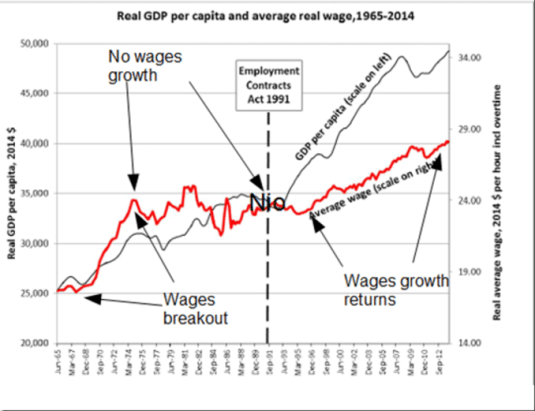
The Council of Trade Unions and Closer Together Whakatata Mai charted similar statistics to show that everything has gone to hell in a hand basket since neoliberalism seized power in New Zealand in 1984 and in particular after the passing of the Employment Contracts Act in 1991.

image

Source: Income Gap | New Zealand Council of Trade Unions – Te Kauae Kaimahi.

The passage of the Employment Contracts Act greatly reduced union power and union membership and with it wages growth in New Zealand, according to what is left of the New Zealand union movement.

image

Source: Income Gap | New Zealand Council of Trade Unions – Te Kauae Kaimahi.

Unfortunately, both charts of the same statistics show the exact opposite to what was intended by The Council of Trade Unions and Closer Together Whakatata Mai.

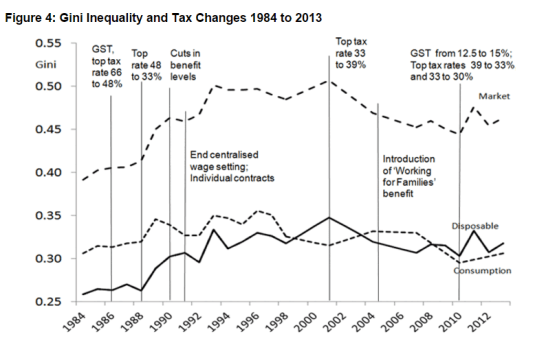
Even the most casual inspection of the data charted above and reproduced below with some annotations shows that real wages growth returned to New Zealand in the early 1990s after 20 years of real wage stagnation.

image

Source: Income Gap | New Zealand Council of Trade Unions – Te Kauae Kaimahi.

The reforms of the 1980s stopped what was a long-term decline in average real wages. The reforms of the early 1990s including the passing of the Employment Contracts Act was followed by the resumption of sustained growth in average real wages with little interruption since.

Closer Together Whakatata Mai has even stumbled onto the great improvements in household incomes across all ethnicities since the early 1990s.

The increase in percentage terms of Maori and Pasifika real household income is much larger than for Pakeha. As Bryan Perry (2015, p. 67) explains when commenting on the very table D6 sourced by Closer Together Whakatata Mai:

From a longer-term perspective, all groups showed a strong rise from the low point in the mid 1990s through to 2010. In real terms, overall median household income rose 47% from 1994 to 2010: for Maori, the rise was even stronger at 68%, and for Pacific, 77%. These findings for longer- term trends are robust, even though some year on year changes may be less certain. For 2004 to 2010, the respective growth figures were 21%, 31% and 14%.

image

Source: Bryan Perry, Household Incomes in New Zealand: trends in indicators of inequality and hardship 1982 to 2014 – Ministry of Social Development, Wellington (August 2015), Table D6.

As Closer Together Whakatata Mai  documented, incomes increased in real terms by 14% for the bottom and 19% for the middle.

Perry noted that in the lowest decile had too many implausible incomes including many on zero income so he was wary of relying on it. I have therefore charted the second, median and top decile before and after housing costs below. All three deciles charted showed substantial improvements  in incomes both before  and after housing costs.

image

Source: Bryan Perry, Household Incomes in New Zealand: trends in indicators of inequality and hardship 1982 to 2014 – Ministry of Social Development, Wellington (August 2015).

Naturally, measuring changes in living standards over long periods of time is fraught with under-estimation. There are new goods to be accounted for and product upgrades too.

Previous Older Entries Next Newer Entries

Thoughts from the North

Celebrating humanity's flourishing through the spread of capitalism and the rule of law

Fardels Bear

A History of the Alt-Right

Vincent Geloso

Econ Prof at George Mason University, Economic Historian, Québécois

Bassett, Brash & Hide

Celebrating humanity's flourishing through the spread of capitalism and the rule of law

Truth on the Market

Scholarly commentary on law, economics, and more

The Undercover Historian

Beatrice Cherrier's blog

Matua Kahurangi

Celebrating humanity's flourishing through the spread of capitalism and the rule of law

Temple of Sociology

Celebrating humanity's flourishing through the spread of capitalism and the rule of law

Velvet Glove, Iron Fist

Celebrating humanity's flourishing through the spread of capitalism and the rule of law

Why Evolution Is True

Why Evolution is True is a blog written by Jerry Coyne, centered on evolution and biology but also dealing with diverse topics like politics, culture, and cats.

NoTricksZone

Celebrating humanity's flourishing through the spread of capitalism and the rule of law

Homepaddock

A rural perspective with a blue tint by Ele Ludemann

Kiwiblog

DPF's Kiwiblog - Fomenting Happy Mischief since 2003

The Dangerous Economist

Celebrating humanity's flourishing through the spread of capitalism and the rule of law

Watts Up With That?

The world's most viewed site on global warming and climate change

The Logical Place

Tim Harding's writings on rationality, informal logic and skepticism

Doc's Books

A window into Doc Freiberger's library

The Risk-Monger

Let's examine hard decisions!

Uneasy Money

Commentary on monetary policy in the spirit of R. G. Hawtrey

Barrie Saunders

Thoughts on public policy and the media

Liberty Scott

Celebrating humanity's flourishing through the spread of capitalism and the rule of law

Point of Order

Politics and the economy

James Bowden's Blog

A blog (primarily) on Canadian and Commonwealth political history and institutions

Science Matters

Reading between the lines, and underneath the hype.

Peter Winsley

Economics, and such stuff as dreams are made on

A Venerable Puzzle

"The British constitution has always been puzzling, and always will be." --Queen Elizabeth II

The Antiplanner

Celebrating humanity's flourishing through the spread of capitalism and the rule of law

Bet On It

Celebrating humanity's flourishing through the spread of capitalism and the rule of law

History of Sorts

WORLD WAR II, MUSIC, HISTORY, HOLOCAUST

Roger Pielke Jr.

Undisciplined scholar, recovering academic

Offsetting Behaviour

Celebrating humanity's flourishing through the spread of capitalism and the rule of law

JONATHAN TURLEY

Res ipsa loquitur - The thing itself speaks

Conversable Economist

In Hume’s spirit, I will attempt to serve as an ambassador from my world of economics, and help in “finding topics of conversation fit for the entertainment of rational creatures.”

The Victorian Commons

Researching the House of Commons, 1832-1868

The History of Parliament

Articles and research from the History of Parliament Trust

Books & Boots

Reflections on books and art

Legal History Miscellany

Posts on the History of Law, Crime, and Justice

Sex, Drugs and Economics

Celebrating humanity's flourishing through the spread of capitalism and the rule of law

European Royal History

Exploring the Monarchs of Europe

Tallbloke's Talkshop

Cutting edge science you can dice with

Marginal REVOLUTION

Small Steps Toward A Much Better World

NOT A LOT OF PEOPLE KNOW THAT

“We do not believe any group of men adequate enough or wise enough to operate without scrutiny or without criticism. We know that the only way to avoid error is to detect it, that the only way to detect it is to be free to inquire. We know that in secrecy error undetected will flourish and subvert”. - J Robert Oppenheimer.

STOP THESE THINGS

The truth about the great wind power fraud - we're not here to debate the wind industry, we're here to destroy it.

Lindsay Mitchell

Celebrating humanity's flourishing through the spread of capitalism and the rule of law

Alt-M

Celebrating humanity's flourishing through the spread of capitalism and the rule of law