— EPI Chart Bot (@epichartbot) December 26, 2015
More evidence from the @economicpolicy institute of the great success of the 1996 US federal welfare reforms
17 Jan 2016 Leave a comment
in economic history, gender, labour economics, labour supply, politics - USA, welfare reform Tags: child poverty, family poverty, single mothers, single parents, US welfare reforms
The prediction market speaks on the Republican presidential primaries
16 Jan 2016 Leave a comment
in financial economics, politics - USA, Public Choice Tags: 2016 presidential election, prediction markets
The pros and cons of America’s primary electoral system
16 Jan 2016 Leave a comment
in constitutional political economy, politics - USA
Reagan began seeking a rapprochement with the Kremlin 15 months before Gorbachev took office, this Day 1984
16 Jan 2016 Leave a comment
in politics - USA, war and peace Tags: Cold War, game theory, mutually assured destruction, nuclear deterrence, nuclear war, Ronald Reagan
Reagan spoke of common concerns, the mutual desire for peace and the urgent need to address “dangerous misunderstandings” between Moscow and Washington.
NZ, Oz & US real housing price index, January 1975 – September 2015 @philtwyford @JulieAnneGenter
14 Jan 2016 Leave a comment
in economic history, economics of regulation, politics - Australia, politics - New Zealand, politics - USA, urban economics
Notice that New Zealand housing prices were pretty flat until the passage of the Resource Management Act in 1993.

@garethmorgannz are the poor are just like everyone else except that they have less money?
14 Jan 2016 Leave a comment
in applied welfare economics, economics of education, politics - New Zealand, politics - USA, poverty and inequality, welfare reform
There is a large literature on what money can buy in terms of improved child outcomes. Central to the left-wing view is the poorer are just like everyone else but they have less money. Susan Mayer, a proud registered Democrat all her life, kick-started the literature challenging this with her book in 1997.

More money does help the children of poor families but the effect is considerably less–and more complicated–than is generally thought because as Mayer says ‘once children’s basic material needs are met, characteristics of their parents become more important to how they turn out than anything additional money can buy.
Doubling the income of poor families would lift most children above the poverty line, it would have virtually no effect on their test scores and only a slight effect on social behaviour. Among her findings, which have largely survive the test of time, are:
- Higher parental income has little impact on reading and mathematics test scores.
- Higher income increases the number of years that children attend school by only one-fifth of a year.
- Higher income does not reduce the amount of time sons are idle as young adults.
- Higher income reduces the probability of daughters growing up to be single mothers by 8 to 20 percent.
Mayer found that as parents have more money to spend, they usually spend the extra money on food, especially food eaten in restaurants; larger homes; and on more automobiles. As a result, children are likely to be better housed and better fed, but not necessarily better educated or better prepared for high-income jobs. Mayer said that her findings do not endorse massive cuts in welfare:
My results do not show that we can cut income support programs with impunity…Indeed, they suggest that income support programs have been relatively successful in maintaining the material living standard of many poor children.
Mayer found that non-monetary factors play a bigger role than previously thought in determining how children overcome disadvantage as she explains. Parent-child interactions appear to be important for children’s success, but the study shows little evidence that a parent’s income has a large influence on parenting practices.
Mayer said that if money alone were responsible for overcoming such problems as unwed pregnancy, low educational achievement and male idleness, states with higher welfare benefits could expect to see reductions in these problems. In reality
once we control all relevant state characteristics, the apparent effect of increasing Aid to Families with Dependent Children benefits is very small.
Social economics has been here before. In the 1960s, the Coleman Report rather than finding that investing in schools improved child outcomes found that most variation between child outcomes depended on family backgrounds. When we talking about schools not matter in too much we are talking about average bad schools and average good school not American inner-city schools into war zones.
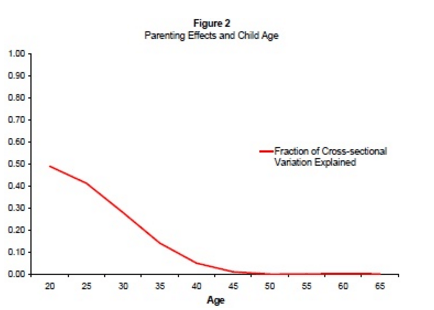
Source: Savings, Genes, and Fade-Out, Bryan Caplan | EconLog | Library of Economics and Liberty.
Behavioural genetics has been a bit of a blow to those that think greater parental investment can raise child outcomes as Bryan Caplan has explained:
Economists like Nobel laureate Gary Becker have been studying the family for decades. Like most modern parents, economists usually take it for granted that “parental investment” has large, lasting effects on adult outcomes.
And yet adoption and twin researchers find surprisingly little evidence for this this assumption(link is external)! With a few notable exceptions, the measured effect of upbringing on adult outcomes is small to zero. Adoptees barely resemble their adopting families, identical twins are much more similar than fraternal twins, and identical twins raised apart are often as similar as identical twins raised together. Almost all traits run in families, but the overarching reason is heredity.
Caplan notes that while it is extremely difficult for parental investments to change the adult outcomes of his children, it is well within his power to give his children a happy childhood.
Trigger warning: American political junkies – the cost of presidential campaigns since Lincoln
14 Jan 2016 Leave a comment
in economic history, politics - USA, Public Choice
The man most responsible for money in American politics is President Obama. He refused public funding in the 2008 presidential election of $84 million. This is because he could raise 10 times that online. Senator McCain accepted public funding because his fundraising prospects were so poor for the general election.
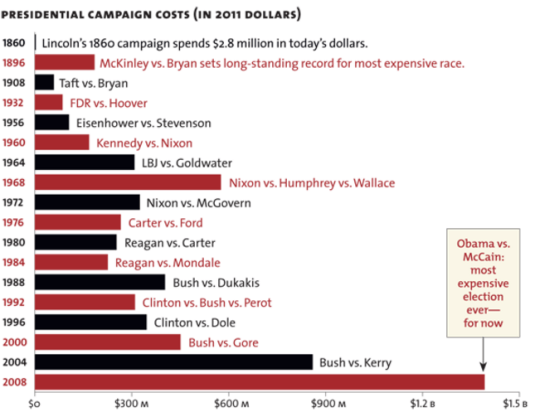
Source: The Crazy Cost of Becoming President, From Lincoln to Obama | Mother Jones
Here’s how Scandinavian countries pay for their spending
14 Jan 2016 Leave a comment
in economic history, politics - Australia, politics - New Zealand, politics - USA, public economics Tags: growth of government, Norway, size of government, Sweden
40% of New Zealanders aged 65 to 69 still work
13 Jan 2016 1 Comment
in labour economics, labour supply, politics - New Zealand, politics - USA
1996 US welfare reforms & single mother employment rates @garethmorgannz @geoffsimmonz
13 Jan 2016 Leave a comment
in gender, labour economics, labour supply, politics - New Zealand, politics - USA, poverty and inequality, welfare reform Tags: 1996 US welfare reforms, female labour force participation, maternal labour force participation, single mothers, single parents, social insurance, welfare state
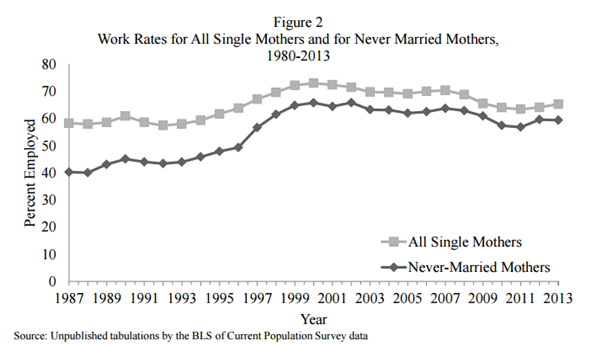
Source: Ron Haskins (2015).
@TBillTheProf shows that SF #livingwage sends hiring standards through the roof
13 Jan 2016 Leave a comment
in applied price theory, labour economics, minimum wage, personnel economics, politics - USA Tags: living wage
Recent field research in San Francisco and North Carolina restaurants found that after San Francisco living wage increase, managers were pickier about whom they hire, because they want workers to be worth the higher cost. The San Francisco minimum wage is now $12.25, and all employers are required to offer paid sick days and contribute to their employees’ health insurance.

Source: How worker-friendly laws changed life as a server in San Francisco restaurants – The Washington Post.
The study is useful because of instead of studying the myths and realities about how a higher minimum wage somehow motivates workers to be more productive and offset part or all of its cost to employers, the study investigates how the minimum wage, a living wage, affects hiring standards.
Employers of low skilled, low-wage workers look for workers who are friendly and reliable. As the study concedes, you can teach people the skills they need as long as they are friendly and reliable.

In San Francisco, recruits not only have to be friendly and reliable, they are expected to have experience. The living wage shuts out inexperienced and new workers, which promotes social exclusion.
Minimum wage workers in San Francisco are noticeably older and better educated than those in North Carolina and recruited after more intensive sorting and screening against the hiring standards for the vacancy:
Rather than viewing servers as essentially interchangeable labourers who can be quickly and easily trained if they possess a modicum of personal hygiene and a friendly personality, employers in San Francisco exhibited a clear description of what a professional server was and the explicit and implicit skills required.
The study did not enquire into what happened to applicants who failed to meet the higher hiring standard induced by the living wage increase. As is standard with the champions of the living wage, they do not want to talk about those excluded by the living wage rise.
Poverty Rates by Mothers’ Marital Status, 1987 to 2013
13 Jan 2016 Leave a comment
in applied welfare economics, economic history, labour economics, labour supply, politics - USA, poverty and inequality, welfare reform Tags: child poverty, family poverty, single mothers, single parents, social insurance, welfare state
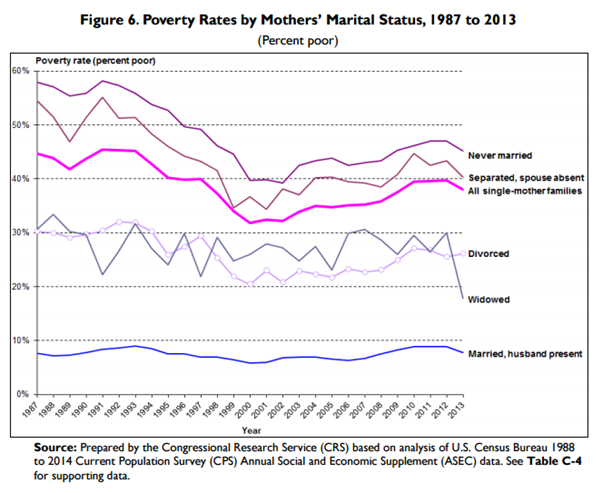
Source: Congressional Research Service.https://www.fas.org/sgp/crs/misc/R41917.pdf
A curious @povertymonitor based child poverty infographic
12 Jan 2016 2 Comments
in applied welfare economics, politics - New Zealand, poverty and inequality



@povertymonitor confirms success of neoliberalism in restoring real wages growth
12 Jan 2016 Leave a comment
in applied welfare economics, economic history, politics - New Zealand, poverty and inequality
After two lost decades from 1974 where there was real wage stagnation and next to no real GDP growth, following the Mother of All Budgets in 1991 under Ruth Richardson and the passage of the Employment Contracts Act in the same year, real wages growth returned after a hiatus of 20 years. These 20 years of real wage stagnation were the good old days if the Leftover Left is to be believed.

Source: Child Poverty Monitor: 2015 Technical Report, figure 39.
@stevenljoyce misses the point on R&D and economic growth
12 Jan 2016 Leave a comment
in economic growth, macroeconomics, politics - New Zealand
With 99% of global R&D undertaken overseas, Steven Joyce, the Minister for Economic Development, simply missed the point in an op-ed today as to what was important in raising New Zealand’s economic growth potential. As a technology follower, the issue is New Zealand’s ability to import and absorb the latest technological innovations from overseas. The extent of local

Source: Steven Joyce: A chance for a land of milk and money – Politics – NZ Herald News.
Different national abilities to absorb technology innovations that were developed by the countries at the global frontier such as the USA will result in different national growth rates for countries that are technological followers (Acemoglu et al. 2006; Aghion and Howitt 2005, 2006; Howitt 2008). As a technological follower nation such as New Zealand approaches the global technological frontier, the types of institutions required for successful technology absorption changes markedly.
The world growth rate is driven by discoveries in the technologically leaders such as the USA, Japan, Germany, UK and France (Barro and Sala-i-Martin 1999). The richest OECD member countries are rich because they use almost all of the available global pool of useful technological knowledge. Their further growth is limited to growth in the global pool of technological knowledge (Parente 2001).
Technological followers such as Australia, Canada, and New Zealand converge toward the global technological leaders because copying is cheaper than innovation over some range. The cost of imitation is estimated to be 40 to 90 per cent of the cost of an innovation (Barro and Sala-i-Martin 1999). This ability of economic development latecomers to grow rapidly by importing and copying frontier technologies is the ‘advantage of backwardness’ (Gerschenkron 1952).
Appropriate institutions and distance from the global technology frontier
The kind of institutions and economic policies that are appropriate to sustain convergence and technology transfer evolve and become more demanding as a country approaches the global technological frontier (Acemoglu et al. 2006; Aghion and Howitt 2005, 2006). The key point from the discussion of endogenous growth theory that is to follow is that institutions that favour the implementation of imported technologies may not necessary favour innovation (Aghion and Howitt 2005, 2006).
The political, tax and regulatory institutions that favour the more ready-made implementation of more standardised imported technologies do not necessarily favour the growing demand for the domestic innovations in New Zealand as the global technological frontier nears. There is a growing demand for more highly skilled workers to master and adapt the leading-edge technologies to the distinctive circumstances of each New Zealand workplace.
 By innovation, I do not mean the lab coats model of R&D where boffins invent new products. By innovation, I mean workplace innovation where New Zealand workers master the latest technologies so they can squeeze every drop out of these new and upgraded products and adapt them to New Zealand markets.
Innovation is much more than the R&D that leads to design blueprints for new or upgraded products and production process. Technology transfer is much more than the unpacking of imported new equipment and production processes, the reading of the associated blueprints and operating manuals and some training when the latest imported technology is more complex and less established.
Technologies can be ranked in the level of human capital required in workers. Some technologies are routine in operation and implementation. Others can be much more complex and require local innovations in how the technology is operated and the workers need to be highly educated, well-trained and able to follow quickly the latest technological developments (Nelson and Phillips 1966).
Innovation is getting harder
As technology progresses, each new and upgraded product is a smaller and smaller increment and what came before. Innovation is haunted by fishing-out effects. The easier innovations are discovered first with more and more R&D and adaptation efforts required for further successes. With technological knowledge ever accumulating, and a greater complexity of new innovations, each new generation of innovators and workers that used new technologies face an increasing educational and research burden.
R&D efforts, human capital investments and on-the-job learning must be spread more and more thinly over a greater number of different sectors, products and production processes. Product proliferation requires a society to make ever-increasing investments in R&D, in human capital and in on-the-job learning to innovate and adopt and adapt new technologies at the same pace as before.
The trend rate of productivity growth did not accelerate over the 20th century despite a massive rise in investments in human capital and R&D because of the rising cost of discovering and adapting new technological knowledge. The number of both R&D workers and highly educated workers increased many-fold over the 20th century in New Zealand and other OECD member countries including the global industrial leaders such as the USA, Japan and major EU member states.
Trend productivity growth did not accelerate because innovation is simply getting harder. As modern technology advances, each new technology is more complex and the number of products and production processes proliferate exponentially.
Technology absorption is getting harder
In implementation models of technology diffusion, the imported technology is very much ready-made and proven rather than a recent innovation. Implementation it is more of an issue for developing countries where they lack many technologies. They are introducing proven technologies that spread widely in developed countries decades previous. It is really about unpacking the box and plugging it in.
Far from the frontier, the technology gap is so large so that growth in productivity from each innovation on the relatively old predecessors is large. As a laggard moves closer to the global technological frontier, the impact of each successive technology import will decline. The newer technology is a smaller and smaller upgrade on what it replaces (Aghion and Howitt 2005, 2006, 2009).
Close to the global technological frontier, there is less room for copying and easy adoption of well-established technologies. Many of the latest technologies are small upgrades on the previous product. Skill and entrepreneurial endeavour is needed to harvest all of the latest available quality improvement.

As technology followers such as New Zealand approach the global technological frontier, the institutions appropriate for continued productivity growth change. As a country moves closer to the global technological frontier, the impact of each successive technology import will decline. The latest imported technology is usually a smaller and smaller upgrade on before. A more skilled workforce and greater entrepreneurship is needed to squeeze out all of the available productivity and product quality gains from the latest imported technologies. This is in contrast to Mr. Joyce’s lab coats model where boffins spend R&D handouts from him.
As a country nears the global technological frontier, the impact of each successive technology imports is smaller. The newest imported technology is a smaller and smaller upgrade on what it replaced. A more skilled and experienced workforce is needed to meet the challenge to squeeze out all of the available productivity and product quality gains from the latest technologies (Ha and Howitt 2007).
The initial incarnations of new production technologies and new products are often expensive and bug-infested. Skilled and seasoned operators are needed to oversee their introduction and testing. Later versions of new products and processes are far more reliable and much cheaper to run. There are gradual improvements in quality of the product and in the way in which and the scale on which the product is produced and maintained. As a new technology becomes more established, there is less demand in the adopting firms for more skilled labour and an increased demand for less skilled labour (Greenwood 1999).
A leading reason behind the one to two decade or longer delay in any new technology moving from use by 10 per cent of an industry to 90 per cent use are the complexities of mastering new technologies. Jovanovic and Lach (1997) found a 15-year lag to go from 10 per cent to 90 per cent use for the 21 innovations they reviewed. Even for transformational technologies ranging from electricity to the Internet, a host of secondary innovations had to be invented, adopted and mastered over several decades before the most was made on their potential.
Access to technologies depends upon having a suitably prepared workforce. The costs of technology absorption and imitation are lower the more abundant is human capital in the technology importing country (Nelson and Phelps 1966; Benhabib and Spiegel 2005). A high proportion of skilled workers in the labour force are an inviting market to develop technologies to compliment those skills (Acemoglu 2002, 2003).
Many technologies developed by the industrial leaders are designed to make best use of the skills that are in good supply in the workforces of these countries. These skills are less abundant in follower countries. Some of the tasks performed by skilled workers in the industrial leaders will be carried out by less skilled workers when they use the same technology in a follower country. Since the technology is designed for use by skilled workers, productivity will be lower in countries with less of the required human capital. This mismatch between skills and technology can lead to sizable differences in total factor productivity and output per worker (Acemoglu and Zilibotti 2001).
Why did the EU stop catching-up?
The end of the EU’s productivity convergence with the USA from the late 1980s has been partly attributed to not making the shift from technology implementation enhancing institutions to innovation enhancing institutions (Aghion and Howitt 2005, 2006). Different types of policies or institutions appear to be growth-enhancing at different stages of development.
The institutions of the EU member states may have become inappropriate to its increasing proximity to the global technological frontier. Many of the EU member states had caught up with USA in capital-labour ratios and labour productivity. The institutions of the EU were the appropriate growth-enhancing institutions during this prior period of catch-up with the USA. The EU then reached the world technology frontier by the 1990s and this exhausts capital accumulation and technological imitation as sources of growth for technology laggards. By the 1990s, Europe needed to develop institutions that promoted innovation.
The EU had to switch over to innovation enhancing institutions but it did not successfully make this move. This switch required regulatory and tax reforms and more national investment in R&D and higher education. The EU falls short on these new institutional requirements because it lags the USA by 25 to 50 per cent in R&D and higher education spending relative to GDP and in the educational attainment of the respective workforces (Aghion 2006). The institutions of the EU were appropriate to facilitating catch-up but not to the encouraging of innovation.
The end by 1990 of the EU’s productivity convergence on the USA has been partly attributed to not making the policy shift from technology implementation enhancing institutions to innovation enhancing institutions. EU members invested far less than the USA in R&D and tertiary education had more rigid labour and product markets, had less entry and exit of firms, and much higher taxes.
Implementation-based and innovation-based policy regimes
The intensity and mix of innovation and imitation in a country will depend on institutions, policies and the composition of human capital in ways that vary with a country’s distance to global technological frontier (Aghion and Howitt 2005, 2006, 2009). Imitation of the technological leaders may be enhanced by long-term investments in large existing firms.
Innovation depends more on skill adequacy and is enhanced by institutions which screen out managers and allow shareholders to dismiss those who underperform. Innovation often requires initiative, risk-taking, the selection of good projects and talents, and the weeding out of those that are not to be profitable (Aghion and Howitt 2005, 2006).
The political, tax and regulatory institutions that favour the more ready-made implementation of more standardised imported technologies do not necessarily favour the growing demand for the domestic innovations in New Zealand as the global technological frontier nears. There is a growing demand for more highly skilled workers to master and adapt the leading-edge technologies to the distinctive circumstances of each New Zealand workplace to stay ahead in rapidly changing competitive environments and meet the changing needs of customers.
Productivity growth is not manna from heaven. Every increase in productivity and in product quality and variety are the sum of many inventions that must be first discovered by prospective innovators building on past ideas and developed, tested, adopted and adapted by profit-minded entrepreneurs and workers. Investments in R&D, in human capital and in on-the job learning and in the entrepreneurial judgments about risking investments in the new technologies that all underpin further growth in productivity are all influenced by public policies.
Far from the global technological frontier, the policy regime and institutional background of a technological follower can promote implementation based growth with established firms and an emphasis on a good primary and secondary education of workers.
Closer to the global technological frontier, capital accumulation and technological imitation will have been exhausted as the main sources of growth (Aghion and Howitt 2005, 2006). A country must turn to innovation, which is the ability for firms and highly skilled workers to move rapidly into new technologies and products and improve production processes. This calls for different skill levels and entrepreneurial approaches to implementation (Aghion and Howitt 2005, 2006). Tertiary education will became much more of a priority closer to the frontier.
As a country moves closer to the global frontier, its technological capabilities must change from just implementing imported technologies to modern R&D. Modern R&D draws heavily on scientific knowledge and methods, and requires higher skill levels (Aghion and Howitt 2005, 2006, 2009). The implementation of the more sophisticated imported technologies requires a more skilled work-force.
Modern R&D uses resources, including skill labour, to generate new knowledge about technological possibilities and these endeavours use scientific principles and methods to build on previous knowledge (Aghion and Howitt 2005, 2006; Ha and Howitt 2007). Invention and the lab-coat vision of R&D is a small part of modern innovation. Only a small fraction of R&D expenditures even in the USA is actually spent on invention and basic research. Most R&D is about the development and the adaptation of ideas for practical uses in the workplace and elsewhere (Jovanovic 1997; Greenwood and Jovanovic 2001). The majority of spending on schooling, on-the-job training and learning by doing, 10-15 per cent of GDP or more, is about informing students of their menu of technological options and preparing them to adapt these options to a great variety of both known and yet to be discovered uses (Jovanovic 1997; Greenwood and Jovanovic 2001).
Institutions that foster technology absorption
Productivity growth in New Zealand is principally about making the most of technology transfer by absorbing and adapting overseas invented technologies. The nature of technology absorption changes as a country approaches the global technological frontier. New Zealand can no longer rely on its workforce and entrepreneurs implementing of more straight-forward new product designs and new production process invented in the research sectors and workplaces of the global leaders to keep local productivity growing at two per cent per year.
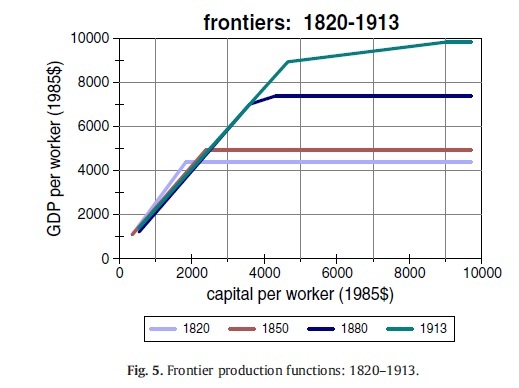
As an economy approaches the world technology frontier, there must be a switch from an implementation-based regime to an innovation-based policy regime with younger firms, fewer incumbents, better educated workers and more entry and exit. These newer and younger firms will be the standard bearers of the latest technologies. The threat of more new entry will induce incumbent firms to innovate more to parlay this growing threat of displacement be new entrants.
The local workforce must up-skill if the more leading edge technologies are to be understood and adapted. These technologies are designed to be used by more educated workers able to meet the challenges of operating complex technologies. The leading-edge technologies are more productive if paired with more highly skilled workers. Many secondary innovations and local adaptations are needed before the new technology can be fully mastered. These local technological adaptations are more complex and costly than for the prior technologies.
Close to the global technological frontier, firms and workers must be able and skilled enough to move rapidly into new activities and the latest technologies and be able to quickly improve and refine production processes and product designs. More and more of productivity growth will come from a rapid expansion of a locally based class of educated people who spend their careers exchanging ideas, solving work-related problems and generating new knowledge. Large productivity gains can be lost if there is a mismatch between technologies and the skills of the workers that operate it (Acemoglu and Aghion 2001).
Many legal and economic institutions must change. Changes are required to competition and entry policies, the funding to higher education, and the design of macroeconomic and tax policies that encourage investment, domestic savings and investment in human capital (Aghion and Howitt 2005, 2006, 2009). For example, more investments in higher education speeds transfer of the most complex frontier technologies.
The composition of human capital is important as the global technology frontier approaches. More and more university graduates are required to adapt the latest technologies successfully. This is partly because skilled labour is used intensively in the R&D process needed for the technology transfers.
It is also because the benefits from the diffusion of more complex technologies from the global leaders are faster where there are skilled local workers able to adapt these technologies and to use them most productively in-country. An effective education system will have a positive effect on long-run growth by increasing the efficiency of innovation technologies and investments, both of which are highly skill intensive, and by reducing the cost of skill labour, which in turn increases the profits that accrue to successful innovators and rapid technology adaptors.
Schumpeterian endogenous growth theory
The Minister of Economic Development is simply missed the second generation of endogenous growth theory and in particular Schumpeterian growth theory:
This new theory is explicit about who gains from technological progress, who loses, how the gains and losses depend on social arrangements, and how such arrangements affect society’s willingness and ability to create and cope with technological change.
The more demanding institutional requirements on countries that are closing in on the global technology frontier can make reform a prerequisite to continued current growth rather than higher trend growth. Entrepreneurial rewards drive invention and innovation and the import and adaptation of new technologies.
Innovation and adaptation becomes more complex as technology advances. Larger and longer investments are required in human capital to overcome the rising burden of knowledge to learn enough to continue innovating and adapting at the current pace. This made reforms to the adequacy of the rewards for entrepreneurship and human capital of increased importance in recent decades.
Lower company tax and less labour market regulation are the biggest contributions that government can make to raising the growth potential of the New Zealand economy. Instead, Stephen Joyce focuses on giving more and more handouts to boffins rent seeking boffins. The real innovators, the real entrepreneurs in the New Zealand economy responsible for importing and adapting the latest technologies from overseas must therefore carry an extra burden, a higher company tax, because of the success for rent seeking by boffins.


Recent Comments