Teachers are well-paid in #NewZealand
05 Oct 2015 Leave a comment
in economics of education, politics - Australia, politics - New Zealand, politics - USA Tags: economics of teaching, teachers pay, teachers tenure
@JosephEStiglitz talks sense on flaws of the #TPPA @ItsOurFutureNZ @greencatherine @RusselNorman
04 Oct 2015 1 Comment
in economics of regulation, international economic law, politics - New Zealand, politics - USA, rentseeking Tags: drug lags, free trade agreements, Leftover Left, preferential trading agreements, TPPA, Trade Blocs
Joe Stiglitz occasionally gets it right such as this week when he spoke about the downside of the Trans-Pacific Partnership Agreement. As he said:
The reality is that this is an agreement to manage its members’ trade and investment relations – and to do so on behalf of each country’s most powerful business lobbies.
Make no mistake: It is evident from the main outstanding issues, over which negotiators are still haggling, that the TPP is not about “free” trade.
Because of all the haggling over the trade-offs where you do something stupid in return for the other side doing something sensible in terms of liberalisation or something equally stupid in additional regulation, the gains in the agreement can be quite small. Again as Joe Stiglitz explains:
New Zealand has threatened to walk away from the agreement over the way Canada and the US manage trade in dairy products. Australia is not happy with how the US and Mexico manage trade in sugar.
And the US is not happy with how Japan manages trade in rice. These industries are backed by significant voting blocs in their respective countries. And they represent just the tip of the iceberg in terms of how the TPP would advance an agenda that actually runs counter to free trade.
The case for intellectual property rights over drugs is complicated but no one seems to be suggesting that patents should be lengthened.
Far more can be gained in terms of drug availability through regulatory reforms that streamline the drug safety approval process which is currently costing many people their lives.
Barriers to entry – costs ($s) of bringing new drugs to the market have risen manyfold #econ3 http://t.co/MFHTFhTLrj—
Geoff Riley (@tutor2u_econ) November 30, 2014
Sam Peltzman showed in a famous paper in 1973 that the 1962 amendments to US Federal drug approval laws reduced the introduction of effective new drugs in the USA from an average of forty-three annually in the decade before the 1962 amendments to sixteen annually in the ten years afterwards. No increase in drug safety was identified.
The most bizarre part of drug approval processes is they go beyond the checking whether the new drug is safe. What is even more bizarre in New Zealand is the New Zealand drug safety agency duplicates safety processes already performed overseas. This is instead of automatically approving any drug or medical device approved in the USA, UK, Canada or Australia.
Drug safety regulators in the USA also check to see if the drug works – that the drug has its predicted effects. Drug safety is a health policy concern but whether the investors developed a useful drug is something between them and those interested in buying it. Drugs became available years after they were on the market outside the USA because of drug lags at the FDA. To quote David Friedman:
In 1981… the FDA published a press release confessing to mass murder. That was not, of course, the way in which the release was worded; it was simply an announcement that the FDA had approved the use of timolol, a ß-blocker, to prevent recurrences of heart attacks.
At the time timolol was approved, ß-blockers had been widely used outside the U.S. for over ten years. It was estimated that the use of timolol would save from seven thousand to ten thousand lives a year in the U.S.
So the FDA, by forbidding the use of ß-blockers before 1981, was responsible for something close to a hundred thousand unnecessary deaths.
It is a pity that the far left movement ranted against the TPP focused on conspiratorial theories about investor state dispute settlement rather than the risks of this trade deal to the cost of drugs to the health sector. Only late in the game did the far left start talking about drug availability and the costs of drugs to the health budget of the government if patent lives were extended under the TPPA.
@amplifyonly @TaurangaTPPA @actionstation @ActivistsNZ @Keyweekat @endarken #ExposeTPP @gregfullmoon http://t.co/JyG5wQ2MX7—
ItsOurFuture (@ItsOurFutureNZ) July 22, 2015
A campaign against the TPPA on the basis of its impact on drug availability because of longer patent terms running up against the limited budgets of pharmaceutical purchasing agencies would have appealed across the entire political spectrum. As Joe Stiglitz explains:
The TPP would manage trade in pharmaceuticals through a variety of seemingly arcane rule changes on issues such as “patent linkage,” “data exclusivity,” and “biologics.”
The upshot is that pharmaceutical companies would effectively be allowed to extend – sometimes almost indefinitely – their monopolies on patented medicines, keep cheaper generics off the market, and block “biosimilar” competitors from introducing new medicines for years. That is how the TPP will manage trade for the pharmaceutical industry if the US gets its way.
The health sector can only so much to buy drugs. If drug patents last longer, there is less money to go around because the generics become available later than otherwise.

Homicide rates for young American women by race since 1980
04 Oct 2015 Leave a comment
in economic history, economics of crime, gender, politics - USA
The crack cocaine epidemic in the USA in the late 1980s also appeared to lead to a spike in murders of young Black and Latina women.
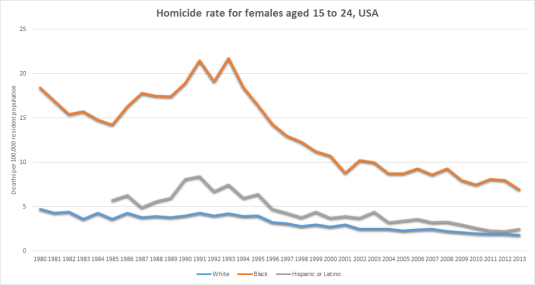
Source: Centres for Disease Control and Prevention.
No data was available on Asian female homicides aged 15 to 24. There is no data on Latino homicide rates prior to 1985.
Homicide rates for young American males since 1980
04 Oct 2015 Leave a comment
in economic history, economics of crime, economics of regulation, law and economics, politics - USA
The explosion in the murder rate in the USA during the crack cocaine epidemic appears to mainly be confined to young black Americans and to a lesser extent Latino youth.

Source: Centres for Disease Control and Prevention.
Warren Brookbanks’ lecture “Three strikes, five years on” in New Zealand
03 Oct 2015 Leave a comment
in applied price theory, economics of crime, health economics, Jan van Ours, politics - New Zealand, politics - USA Tags: 3-strikes, addiction, crime and punishment, criminal deterrence, economics of personality traits
Warren Brookbanks’ inaugural Greg King Memorial lecture earlier in the week was on “Three strikes, five years on”. Brookbanks is a law lecturer at Auckland Law School who specialises in mental illness.
Blackstone’s ratio and three strikes
The essence of his position was the same as he had when the bill was before Parliament. His reservations were a law designed to give lengthy prison terms to the worst of the worst violent offenders would catch in the net some lower-level offenders.
Brookbanks’ objection is a variation of Blackstone’s ratio. Just as the legal system is premised on let 10 guilty go free rather than one innocent be convicted, to what extent does the criminal justice system weigh the risk of occasionally punishing an offender who is convicted of violent or sexual offences who is not one of the worst of the worst.
Brookebanks’ objections are the classic perfect justice as the enemy of adequate justice. It is doubtful that low-level offenders will be caught up in the three strikes regime simply because anyone who repeatedly commits a serious violent or sexual offence, an offence carrying a sentence of seven years or more, is the worst of the worst. They are repeat violent or sexual offenders designed to be caught by the legislation.
All of the 41 offences included in the three strikes legislation in New Zealand of violent or sexual offences carrying a maximum prison sentence of seven years or more. On the first strike you were warned of the consequences of further offending. On the second strike you receive the same sentence as usual but are not eligible for parole. On the third strike there is a mandatory maximum sentence for the offence concerned. There is also a mandatory life without parole sentence for murder if it is a second strike. Slightly over 90% of all first strike warnings are for assault, robbery or sexual offences.
Three strikes is about the incapacitation of repeat violent offenders
In the Q&A session after the lecture I put my principal objection to his lecture:
- Brookebanks did not address the main rationale for three strikes legislation both abroad and in New Zealand;
- The rationale for three strikes was not criminal deterrence, which was the exclusive focus of his lecture;
- The rationale for three strikes both originally in California and elsewhere is incapacitation of serious violent offenders; and
- If you lock up serious violent offenders you reduce the crime rate simply threw the fact that these serious violent offenders off the streets.
Obviously the Californian legislation got off to a false start when it threw away the key on pathetic men who stole pizzas and videotapes as their third strikes. That law was drafted through a citizen initiated referenda rather than the more circumspect process of the state legislature. But there is a lesson there. If parliaments do not act on violent crime, the people will vote in people who are less temperate.
The primary purpose of three strikes legislation and other repeat offender legislation is the incapacitation of repeat serious offenders as Justice Rehnquist explained long ago:
The purpose of a recidivist statute such as that involved here is not to simplify the task of prosecutors, judges, or juries. Its primary goals are to deter repeat offenders and, at some point in the life of one who repeatedly commits criminal offenses serious enough to be punished as felonies, to segregate that person from the rest of society for an extended period of time.
This segregation and its duration are based not merely on that person’s most recent offense but also on the propensities he has demonstrated over a period of time during which he has been convicted of and sentenced for other crimes…. Like the line dividing felony theft from petty larceny, the point at which a recidivist will be deemed to have demonstrated the necessary propensities and the amount of time that the recidivist will be isolated from society are matters largely within the discretion of the punishing jurisdiction.
The purpose of repeat offender laws is to put behind bars people have shown a propensity to commit violent serious crimes frequently. By putting them behind bars for a long time, there are fewer crimes by the simple fact that those hardened violent criminals locked up on their third strike are not in the position to offend against the general public.
The rational for recidivist laws is different from say harsh laws against drug trafficking which is a more opportunistic, business motivated crime. If the current drug traffickers are put behind bars for an extended time, there is usually a good supply of other criminals willing to take their place because of the lucrative rewards.
In the case of serious violent offenders, their crimes of violence and depravity are something to do with personality traits that dispose them towards harming others because they like doing so. The hope behind three strikes laws is that these dangerous people are in limited supply because of the genetic and psychopathic origins of their offending.

There are not that many other petty criminals willing to step into their shoes to commit the same violent offences because these other petty criminals simply do not have the necessary traits in their personalities that dispose them toward such cruelty and abominations. There is not a good supply of petty criminals to take the place of intractable often psychopathic violent offenders covered by three strikes laws.
That was the fundamental flaw are the recent lecture by Brookebanks on the three strikes law in New Zealand. He did not address the incapacitation of criminal psychopaths of various ilks.
That said, it would be good if three strikes delivered on criminal deterrence because it is cheaper than incapacitation. Better that the hardened criminal be deterred in the first instance rather than a third strike be committed and he is locked away for a long time as a way of stopping further crimes. Deterrence is great, but I am happy to live with incapacitation as the main benefit of three strikes.
What is the evidence on three strikes?
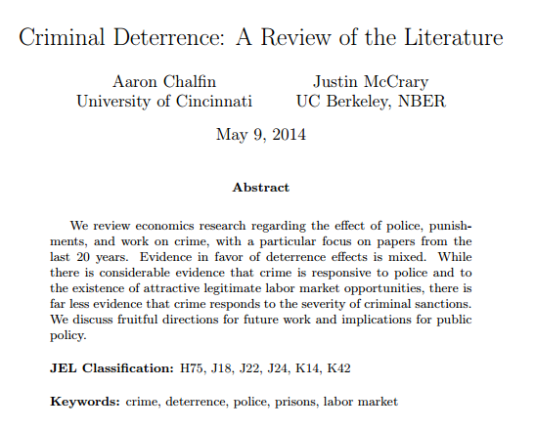
There have been a range of studies of sentencing enhancements to see if they deliver on incapacitation and criminal deterrence. As Levitt explains:
Becker’s well-known economic model of crime is based on deterrence: potential criminals alter their behaviour in response to changing incentives.
Empirically, however, it is often difficult to distinguish between deterrence (which is a behavioural response) and incapacitation (in which reductions in crime are attributable solely to criminals being unable to commit crimes because they are locked up). Virtually all of the empirical work that purportedly supports the economic model of crime is equally consistent with incapacitation.
Levitt and Kessler exploited a unique feature of sentence enhancements to isolate deterrence. Proposition 8 in California selectively instituted sentence enhancements for some crimes. If deterrence works, the incidence of these crimes should drop straightaway. If it is only incapacitation that works, crime will not drop until after the base sentence expires and these would-be criminals are kept locked up for longer and therefore not able to commit crimes but for their sentence enhancement. They found an immediate, sharp decline in eligible crimes relative to those that are unaffected by the sentencing enhancement law in Proposition 8 suggesting the importance of deterrence.
There is good evidence to suggest that criminals do not enjoy the prison experience. Levitt investigated this through the impact on prison overcrowding litigation on criminal deterrence. These Civil Liberties union lawsuits reduced state prison populations, but they were otherwise unrelated to crime rates. One reason for this is the cases often take a decade or more to resolve.
In the three years after a final decision was handed down by the courts in those cases, prison populations fell by 14.3 percent compared to the population of the nation as a whole, whereas violent and property crime rates increased 10.2 percent and 5.5 percent respectively… A one-prisoner reduction is associated with an increase of fifteen Index I crimes per year.
Helland and Tabarrok looked at post-sentencing crimes of criminals who were convicted of a strikeable offense with those who were tried for a strikeable offense but convicted of a non-strikeable offense. They found that California’s three-strike legislation significantly reduces felony arrest rates among the class of criminals with two strikes by 17–20 percent. This is a clever strategy because it is based on the assumption that many of the criminals convicted of a non-strike offence but charged with a strikeable offence were not convicted because of a lack of good evidence of their guilt rather than sheer innocence. Helland and Tabarrok found that
California’s three-strike legislation significantly reduces felony arrest rates among the class of criminals with two strikes by 17–20 percent.
Brookbanks’ preferred a 2012 study that showed that three strikes had no impact on criminal offending in California:
Declining crime rates in California and nationwide reflect declines in alcohol consumption, not tough-on-crime policies such as three-strikes laws… Three-strikes has had nothing whatsoever to do with the drop in violent crime.
The paper makes a very definitive conclusion despite ignoring most of the economic literature up until 2012 bar Shepherd (2002). The paper also had a cartoon version of the economic model of crime as perfectly informed rational calculators instead of the proper one as explained by David Friedman.
The economic analysis of crime starts with one simple assumption: Criminals are rational. A mugger is a mugger for the same reason I am a professor-because that profession makes him better off, by his own standards, than any other alternative available to him. Here, as elsewhere in economics, the assumption of rationality does not imply that muggers (or economics professors) calculate the costs and benefits of available alternatives to seventeen decimal places-merely that they tend to choose the one that best achieves their objectives.
If muggers are rational, we do not have to make mugging impossible in order to prevent it, merely unprofitable. If the benefits of a profession decrease or its costs increase, fewer people will enter it-whether the profession is plumbing or burglary. If little old ladies start carrying pistols in their purses, so that one mugging in ten puts the mugger in the hospital or the morgue, the number of muggers will decrease drastically-not because they have all been shot but because most will have switched to safer ways of making a living. If mugging becomes sufficiently unprofitable, nobody will do it.
Criminals respond to incentives in the same way as the rest of us with the same degree of success. Everyone agrees with that as long as you put them on a turf where they have to show their true colours.
Do hardened lifers respond to incentives?
One of the arguments against life without parole put up by those who are soft on crime is criminals sentenced to life without parole will be difficult to manage in the prison system because they have no hope of release. That is unless they have the incentive in the form of a prospective release at some time in their life, they will misbehave. That precisely is the economic model of crime. Crime is an occupational choice most attractive of those with fewer opportunities in legitimate occupations.
The role of empirical findings in criminal justice policy
The first article in my honours econometrics methodology course was the just published Edward Leamer’s Let’s Take The Con Out Of Econometrics. He used the death penalty debate to illustrate the fragile nature of empirical findings. Leamer showed that the death penalty could be shown to greatly reduce or greatly increase murder rates depending on how you did your econometric modelling and what prior beliefs you bought to the table. I remembered what Leamer said through my entire career.

The main task of econometrics is to measure proven relationships rather than to establish whether they exist at all as Bryan Caplan explains:
Being An Intelligent Consumer of Econometrics
-
Economic Significance vs. Statistical Significance
- For most of the class, we’ve checked for statistical significance – i.e., whether the results were likely to occur purely by chance.
- But it is at least as important to know if the results are economically significant – i.e., are they big?
- If you have a lot of data, almost everything will be statistically significant, but still may not be economically significant.
- If you have little data, little will be statistically significant, but it may still be economically significant.
- For most of the class, we’ve checked for statistical significance – i.e., whether the results were likely to occur purely by chance.
-
Econometrics One Tool of Empirical Research
- Econometrics is only one tool of econometric research.
- More important: economic history. Econometrics may help you understand economic history better, but statistics are not a good substitute for knowing the historical facts.
- Knowing history helps you to distinguish correlation and causation.
- Econometrics is only one tool of econometric research.
-
Data-Mining
- A lot of statistical work is produced by “data-miners” who torture the facts until they confess. So whenever you see statistical results, ask yourself:
- What data was used?
- Does the data actually capture what it is supposed to measure?
- How many alternate specifications were tried? Of these, how many were shown?
- Does the study confuse causation with correlation?
- A lot of statistical work is produced by “data-miners” who torture the facts until they confess. So whenever you see statistical results, ask yourself:
-
Economic Theory and Econometrics
- Sometimes, you use econometrics to test economic theories.
- However, when an economic theory is fundamental, you can reverse this: use the theory to test whether the econometrics works well.
- Example: I am convinced by all of my personal experience and historical study that demand curves slope down. If a study claims that the minimum wage increases employment, it just makes me think that econometrics is unreliable. (How come no one checks to see if the demand for asparagus is negatively sloped?)
- While some will call this dogmatic, I don’t think that it is. Econometrics is itself a sort of theory that merits testing and must be double-checked against other sources of knowledge.
- Sometimes, you use econometrics to test economic theories.
Do not just ride out on the latest empirical study which suits your prior beliefs. Say what those prior beliefs are and base them on well proven understandings of human behaviour. Incentives matter even to criminals.
Does addiction and mental illness dull responses to incentives
Brookbanks is correct that criminals have addictions and mental illness and this contributes to their offending. I found the chapter in Tullock and McKenzie’s book on token economies in mental hospitals to be most enlightening in regard to addictions and mental illness clouding judgement.
The tokens in a token economy were spending money at the hospital canteen and trips to town and other privileges. They were earned by keeping you and your area clean and helping out with chores at the mental asylum.
The first token economies were for chronic, treatment-resistant psychotic inpatients. In 1977, a major study, still considered a landmark, successfully showed the superiority of a token economy compared to the standard treatments of these type of psychotic inpatients.
Experiments which would now be unethical showed that the occupational choices and labour supply of certified lunatics responded to incentives in the normal, predictable way. For example, tokens were withdrawn for helping clean halls and common areas. The changes in occupational choice and reductions in labour supply was immediate and as predicted by standard economics.
Some patients would steal the tokens for other patients, so the tokens were individually marked. The thefts almost stopped. Crime must pay even for criminally insane inpatients. Kagel reported that:
The results have not varied with any identifiable trait or characteristic of the subjects of the token economy – age, IQ, educational level, length of hospitalization, or type of diagnosis.
Most people age out of addiction to drugs or to alcohol. By age 35, half of patients with active alcoholism or addiction diagnoses during their teens and 20s no longer take drugs or drink:
The average cocaine addiction lasts four years, the average marijuana addiction lasts six years, and the average alcohol addiction is resolved within 15 years. Heroin addictions tend to last as long as alcoholism, but prescription opioid problems, on average, last five years. In these large samples, which are drawn from the general population, only a quarter of people who recover have ever sought assistance in doing so (including via 12-step programs). This actually makes addictions the psychiatric disorder with the highest odds of recovery.
Studies of demand elasticity normally find that consumption of hard drugs is quite sensitive to price. Addicts respond to incentives, in particular, to price rises by cutting back on their drug taking.
At the beginning of this century, the Dutch government controlled the opium market in the Dutch East Indies–nowadays Indonesia–for several decades. This state monopoly was called the opiumregie. Using information gathered during the opiumregie, this paper estimates price elasticities of opium consumption. It appears that short-term price elasticities of opium use are about -0.7. Long-term price elasticities are about -1.0.
Compliance by the Fed with the Taylor rule
03 Oct 2015 Leave a comment
in business cycles, macroeconomics, monetarism, monetary economics, politics - USA Tags: central banks, economics of central banking, monetary policy, rules and discretion, Taylor rule, The Fed
Yellen vs. Congress: The Fed's independence is under attack despite economic rebound bloom.bg/1HM9c0A http://t.co/NQ6548yGJK—
Bloomberg VisualData (@BBGVisualData) August 10, 2015
MFAT’s Hawaian Mansion
03 Oct 2015 Leave a comment
in economics of bureaucracy, politics - New Zealand, Public Choice Tags: government waste, Taxpayers'Union
For some reason NZ has a Consul General in Hawaii. Their main job appears to be working with Palau, Micronesia and the Marshall Islands, so I wonder why they are not located on one of those island…
Source: MFAT’s Hawaii Mansion | Kiwiblog
New Zealand labour force projections by age and sex
03 Oct 2015 Leave a comment
in labour economics, labour supply, politics - New Zealand
The common theme in New Zealand labour force projections is the number of plus age 65 workers is to increase for next to nothing a mere 10 years ago, barely 65,000 plus 65 workers in all, to knock on the door of the number to population aged 15 to 24 in a mere 15 years from now.

Source: NZ.Stat.
Prime age male workers will continue to be the most predominant male worker but there will be many more +65 male workers. The retirement of baby boomer male workers is the reason why mature age working population is static for some time.

Source: NZ.Stat.
The working age female population aged 45 to 64 has already overtaken the 25 to 44 female working age population. The number of female workers aged 65 and over is also exploding.

Source: NZ.Stat.
Most labour force projections are based on the premise that we are all going to work to we drop. That is not unreasonable assumption given healthy ageing and the great number of service jobs that are available which are not physically taxing.
All population projections scenarios are for the 50th percentile projection.
The IMF’s Causes and Consequences of Income Inequality: A Global Perspective
02 Oct 2015 2 Comments
in entrepreneurship, human capital, industrial organisation, labour supply, occupational choice, politics - USA, poverty and inequality Tags: entrepreneurial alertness, superstar wages, superstars, top 0.01%, top 0.1%, top 1%, working rich
The IMF has joined the OECD in arguing there is an important connection between inequality and who gains from economic growth.
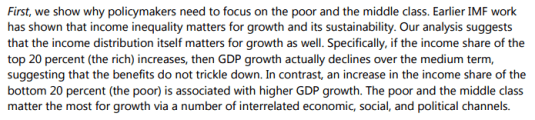
To reach the conclusion that the income distribution matters, the IMF had to tie its master the exact same weak moorings that the OECD did. Specifically the ability of the lower middle class to finance investments in school and higher education.
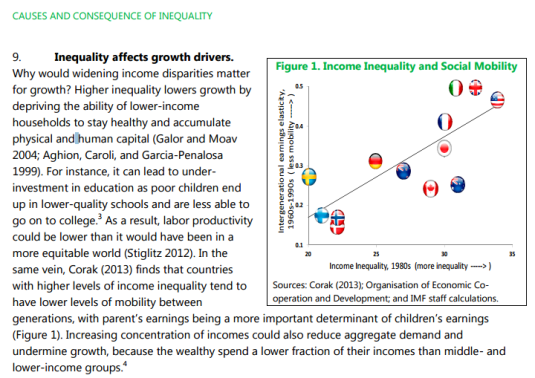
The IMF has articulated a specific hypothesis that can be confronted with facts and logic.
Many critics of inequality are extremely vague about what exactly is the process that grinds the proletariat down. The withering away of the proletariat in the 20th century has been discussed elsewhere on this blog.
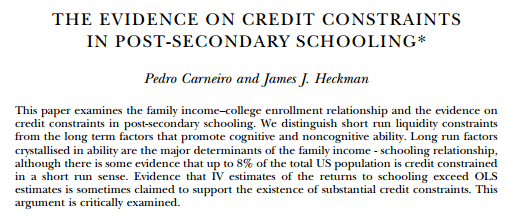
The impact of low income on the ability to accumulate physical and human capital sounds like an interesting question. Not surprisingly, the top labour economists have looked into it.
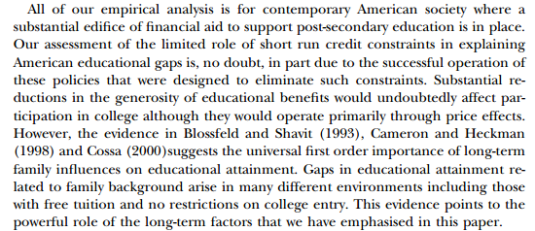
Short-term factors such as the ability to borrow to fund higher education has been found to be seriously wanting. Only a small percentage of people are in any way constrained from going on to higher education because of the lack of money. This is not surprising in any society with student loans freely available at low or zero rates without any need to post collateral.
Wow. I mean, WOW. College completion figures over time by income quartile. bit.ly/16Bb1jh http://t.co/y0MVyiDCEZ—
Richard V. Reeves (@RichardvReeves) February 04, 2015
The notion that the rich are just replicating the good fortunes of their parents has also fallen on hard times despite the persistence of the OECD and the IMF in championing this old Marxist fantasy.
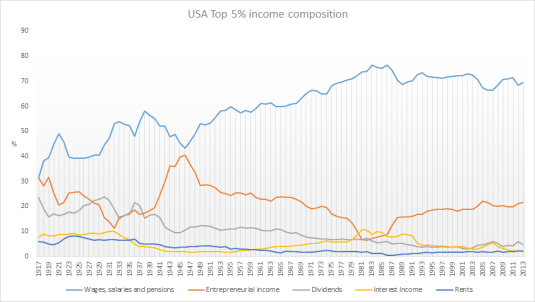
Source: The World Top Incomes Database.
If you look at the income composition of the top 5% of the USA, for example, it is a disappointing story for the IMF and the OECD. Today’s rich are working rich with the majority of their income from wages and salaries and much of the rest from entrepreneurial income. There is no passive rich earning incomes from their inherited investments and grinding the proletariat down.
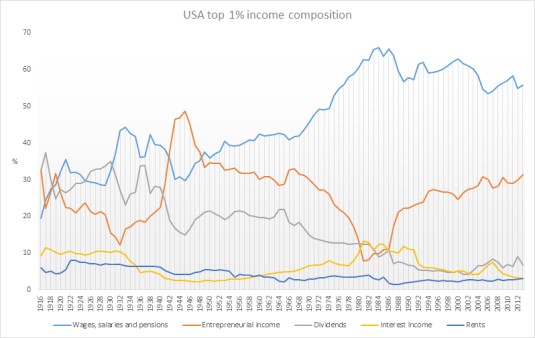
Source: The World Top Incomes Database.
It is the same story with the top 1%. They are working rich with the majority of their incomes paid in wages and salaries and running a business. They are top executives, managers and leading professionals that go to work every day.
Who are today’s supermanagers and why are they so wealthy? equitablegrowth.org/research/today… http://t.co/Ts2OkOUk5g—
Equitable Growth (@equitablegrowth) December 03, 2014
The IMF was simply wrong to claim that at least half the income of the top 1% in the USA was not labour income.
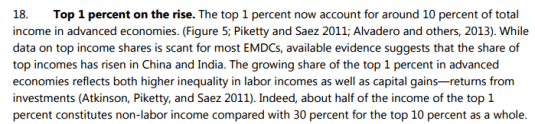
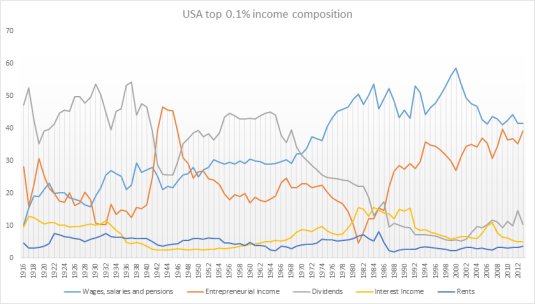
Before 1940, most of the income of the top 0.1% of income earners in the USA was income from investments. By the end of the 20th century, the top 0.1% were earning their incomes as wages and salaries, business incomes and capital gains. Very little of that income of the top 0.1% was in the form of passive income from capital. The top 0.1% of the USA are now working rich – entrepreneurs.
Source: The World Top Incomes Database.
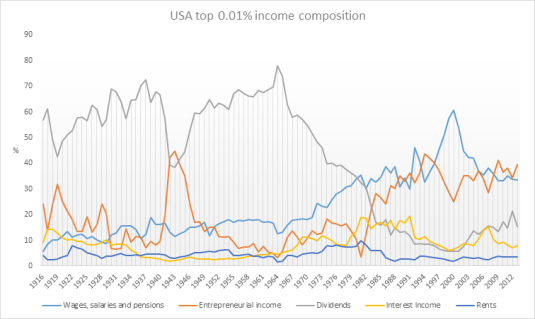
In the good old days of high taxes, the top 0.01% did earn the great majority of their income from passive investment.
Only under the scourge of neoliberalism starting in the 1970s and then massive tax cuts in the Reagan Revolution did the top 0.01% join the working rich. Even the super super-rich have to work for their money these days.
Source: The World Top Incomes Database.
The IMF and before it the OECD were batting from a weak position when they argued that human capital investments of ordinary families is held up by inequality. Student loans to pay for subsidised tuition fees and living expenses solve that problem long ago.
How many of the richest Americans inherited their fortune? Find out. buff.ly/1DNM3g2 http://t.co/QlarE5yAdT—
HumanProgress.org (@humanprogress) August 14, 2015
It was simply wrong of the IMF to claim that the top 5%, 1% and 0.1% of for example the USA are living off the rest of society. In the USA, is usually put forward as the worst-case, the rich and super-rich are working rich making their fortunes by building and running businesses. In The Evolution of Top Incomes: A Historical and International Perspective (NBER Working Paper No. 11955), Thomas Piketty and Emmanuel Saez concluded that:
While top income shares have remained fairly stable in Continental European countries or Japan over the past three decades, they have increased enormously in the United States and other English speaking countries. This rise in top income shares is not due to the revival of top capital incomes, but rather to the very large increases in top wages (especially top executive compensation). As a consequence, top executives (the “working rich”) have replaced top capital owners at the top of the income hierarchy over the course of the twentieth century…
Steven Kaplan and Joshua Rauh make a number of basic points backed up by detailed evidence about top CEO pay:
- While top CEO pay has increased, so has the pay of private company executives and hedge fund and private equity investors;
- ICT advances increase the pay of many – of professional athletes (technology increases their marginal product by allowing them to reach more consumers), Wall Street investors (technology allows them to acquire information and trade large amounts more easily), CEOs and technology entrepreneurs in the Forbes 400; and
- Technology allows top executives and financiers to manage larger organizations and asset pools – a loosening of social norms and a lack of independent control of CEO pacesetting does not explain similar increases in pay for private companies– technology explains it.
The report SuperEntrepreneurs shows that:
- SuperEntrepreneurs founded half the largest new firms created since the end of the Second World War
- There is a strong correlation between high rates of SuperEntrepreneurship in a country and low tax rates
- a low regulatory burden and high rates of philanthropy both correlate strongly with high rates of SuperEntrepreneurship
- Active government and supranational programmes to encourage entrepreneurship – such as the EU’s Lisbon Strategy – have largely failed.
- Yet governments can encourage entrepreneurialism by lowering taxes (particularly capital gains taxes which have a particularly high impact on entrepreneurialism while raising relatively insignificant revenues); by reducing regulations; and by vigorously enforcing property rights.
- High rates of self-employment and innovative entrepreneurship are both important for the economy.
- Yet policy makers should recognise that they are not synonymous and should not assume policies which encourage self-employment necessarily promote entrepreneurship.
John Rawls is often put forward by political progressives as the starting point for political philosophy. Rawls pointed out that behind the veil of ignorance, people will agree to inequality as long as it is to everyone’s advantage. Rawls was attuned to the importance of incentives in a just and prosperous society. If unequal incomes are allowed, this might turn out to be to the advantage of everyone.
Steven Kaplan and Joshua Rauh’s “It’s the Market: The Broad-Based Rise in the Return to Top Talent”, Journal of Economic Perspectives (2013) found that:
- Rising inequality is due to technical changes that allow highly talented individuals or “superstars” to manage or perform on a much larger scale.
- These superstars can now apply their talents to greater pools of resources and reach larger numbers of people and markets at home and abroad. They thus became more productive, and higher paid.
- Those in the Forbes 400 richest are less likely to have inherited their wealth or have grown up wealthy.
- Today’s rich are working rich who accessed education in their youth and then applied their natural talents and acquired skills to the most scalable industries such as ICT, finance, entertainment, sport and mass retailing.
- The U.S. evidence on income and wealth shares for the top 1% is most consistent with a “superstar” explanation. This evidence is less consistent with the gains in earnings of the top 1% coming from greater managerial power over the determination of their own pay in the corporate world, or changes in social norms about what managers could earn.
Today’s super-rich are highly productive because they produce new and better products and services that people want and are willing to pay for. These rewards for entrepreneurship and hard work guide people of different talents and skills into the occupations and industries where their talents are valued the most. The efficient allocation of talent and income maximising occupational choices were important to Rawls’ framework.
The IMF and World Bank should look for policies that remove barriers to riches. Instead, the IMF and OECD are giving support to those who want to tax and regulate the super-rich that drive much of the innovation, entrepreneurship and creative destruction in modern economies.
Poverty traps in America
02 Oct 2015 Leave a comment
in applied welfare economics, behavioural economics, labour economics, labour supply, politics - USA, poverty and inequality, public economics, welfare reform Tags: poverty traps, taxation and labour supply, welfare state
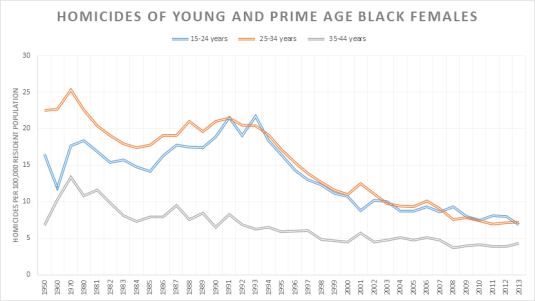
Homicide rates of young and prime age black females in the USA since 1950
02 Oct 2015 Leave a comment
in economic history, economics of crime, politics - USA
Source: Centres for Disease Control and Prevention.
Homicide rates of young and prime age black males since 1950
02 Oct 2015 Leave a comment
in economic history, economics of crime, politics - USA

Source: Centres for Disease Control and Prevention.
Peak Trump?
02 Oct 2015 Leave a comment
Donald Trump's drop in the polls related to a drop in media coverage. (cc @TheFix). washingtonpost.com/blogs/monkey-c… http://t.co/5uQMyJ1Lhj—
The Monkey Cage (@monkeycageblog) September 29, 2015
@NZGreens @JulieAnneGenter are right! Government cars should go electric!
01 Oct 2015 Leave a comment
in constitutional political economy, economics of bureaucracy, politics - New Zealand, transport economics
Ministerial cars going electric is a great idea. The range limitations and range anxiety inherent to electric cars would mean ministers will find it much more difficult to do their jobs and therefore will have less time each day to mess up the economy and regulate unnecessarily.

One of the most productive things I ever saw the Green MPs do in Wellington was taking the bus to and from work.
I could not be happier when I saw Green coleaders Russel Norman and Metiria Turei waiting at a bus stop. They are just waiting, they will not working with a colleague, they were not working on their phones. They were just standing there doing nothing. That was the most productive moments of their times in parliament.

Every second a Green MP spends waiting for a bus and travelling on a bus and arranging to fit in with bus timetables is one second less spent making New Zealand a poorer country and deterring investment from coming to New Zealand through their high tax and heavy regulation policies.
Why 41% of Americans wanted a fence on their northern border
01 Oct 2015 Leave a comment
in economics of crime, economics of media and culture, law and economics, politics - USA Tags: Canada, economics of immigration, Justin Bieber
@justinbieber #MUGSHOT http://t.co/ZuYwmdipIy—
Miami Beach Police (@MiamiBeachPD) January 23, 2014


Recent Comments