In our spring poll 51% of Dems said #TPP would be a good thing compared w/ 43% of Reps http://t.co/qhNsjnXHPj pic.twitter.com/kCyoI5UiNJ
— Richard Wike (@RichardWike) October 7, 2015
#TPA more popular among democrats
09 Oct 2015 Leave a comment
in income redistribution, international economics, politics - New Zealand, politics - USA, Public Choice, public economics, rentseeking Tags: TPA, voter demographics
What will it take to finish the Last Mile in ending extreme poverty
09 Oct 2015 Leave a comment
in development economics, economic history, growth disasters, growth miracles, politics - Australia, politics - New Zealand, politics - USA, poverty and inequality Tags: capitalism and freedom, The Great Escape, The Great Fact
What will it take to finish the “Last Mile” in ending extreme #poverty? brook.gs/1LiFT8E http://t.co/YxSZ36VCSW—
Brookings (@BrookingsInst) October 07, 2015
@jamespshaw @nzlabour @actparty inflow of asylum seekers into Australia and New Zealand since 1987
08 Oct 2015 Leave a comment
in International law, politics - Australia, politics - New Zealand, war and peace Tags: asylum seekers, Australia, economics of migration, refugees
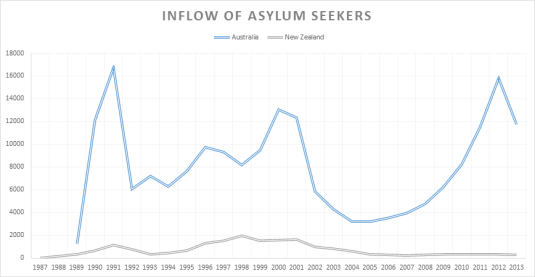
Data extracted on 08 Oct 2015 09:06 UTC (GMT) from OECD.Stat; Dataset: International Migration Database.
@NZNationalParty @nzlabour @NZGreens inflow of asylum seekers into #UK #Canada, #Australia and #NewZealand since 1980
08 Oct 2015 Leave a comment
in economic history, Economics of international refugee law, International law, politics - Australia, politics - New Zealand, population economics Tags: Australia, British politics, economics of migration, refugees
New Zealand’s intake of asylum seekers has been embarrassingly low. The left-wing parties in New Zealand should be ashamed of themselves given the way they wear their international consciences on their sleeves about New Zealand being above it all morally, nuclear free, and can lecture the rest about war, peace and compassion from on high.

Data extracted on 08 Oct 2015 09:06 UTC (GMT) from OECD.Stat; Dataset: International Migration Database.
The UK absorbed an immense number of asylum seekers in the 1990 as did Canada. The data stops in 2013.
Why did the Democrats become the favourites of the rich?
08 Oct 2015 Leave a comment
in economic history, politics - USA, Public Choice
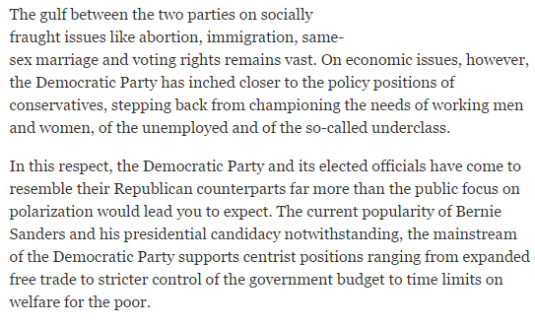
Thomas Edsall is one of the smartest op-ed writers at the New York Times. His latest op-ed is about how well-to-do people are contributing to and voting for the Democrats as much as the poor these days. The Democratic Party now holds the majority of the most affluent congressional districts in America.
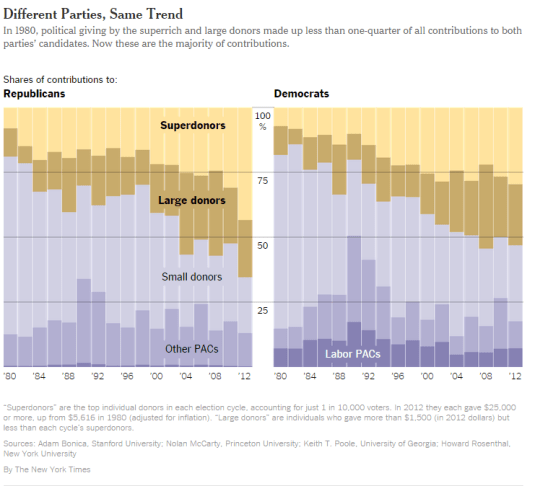
Source: How Did the Democrats Become Favorites of the Rich? – The New York Times.
The median income of Republican districts is slightly less than that of Democratic Party congressional districts. The Republicans are no longer the party of the well-off albeit by a whisker on average. Both the Democrats and the Republicans are doing their best as predicted by the Directors’ Law. They service the swinging voter who is a middle-class voter.
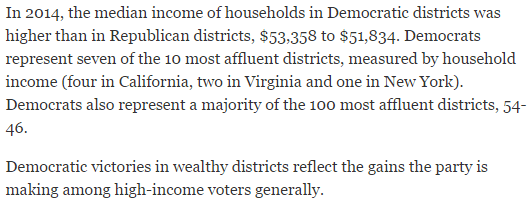
Source: How Did the Democrats Become Favorites of the Rich? – The New York Times.
I first noticed this trend in in the best TV soapy of 2008. In the 2008 presidential primaries campaign, Hillary Clinton just talked all the time about the struggles of the middle class and will again in her 2016 campaign. Obama was no different.
A key reason for the withering away of the proletariat in Democratic Party campaign rhetoric is too many of the swinging voters are not in the working class and there are many more many members of the middle classes. One consequence of the withering away of the proletariat is parties that claim to represent the working class are representing a shrinking electorate. They must adapt or face permanent opposition.
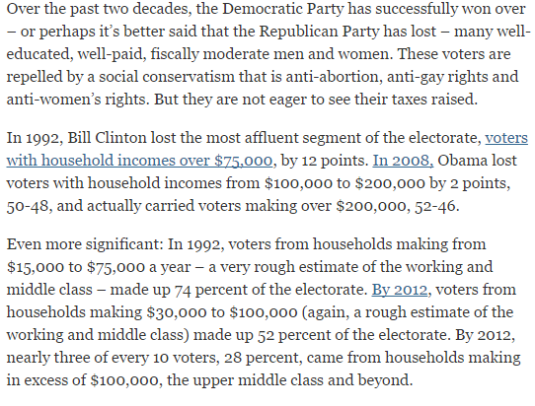
Source: The Problem With Middle-Class Populism – The New York Times.
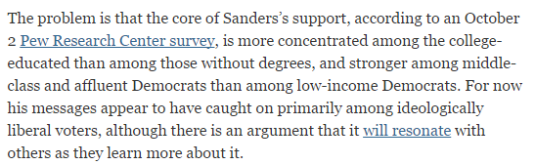
The Democrats do well among the college educated voters. Obama won this over Romney in 2012 by 10 percentage points. This may explain why the Democrats are slightly conflicting: they must win the working class vote as well as the college educated vote to win. The risk for the Democratic party of basing its support in the middle-class is this middle-class is fiscally conservative and rather unwilling to pay for any large-scale redistribution of wealth because it will come out of their very own pockets.
One reason that the Democratic Party and many parties on the centre-left moved into the politics of identity is that allows them to better target their policies towards people who might switch their vote to them all this at the expense of the welfare of the working class. By targeting race, gender, sexual orientation and ethnicity, the policies of the Democratic Party moved away from promoting the general welfare towards servicing their specific voting constituencies. The social liberalism of the Democratic Parties is part of this servicing of their constituencies.
Source: How Did the Democrats Become Favorites of the Rich? – The New York Times.
Do not get your hopes up with Bernie Sanders. He too is the favourite of the middle class and college students – expressive voters all. The working class and minorities do not actually have much time for him. Bernie Sanders has terrible polling among black Democratic voters and about 90% of blacks vote Democrat.
Source: How Did the Democrats Become Favorites of the Rich? – The New York Times
There is certainly a lot of straight median voter theorem in the Democratic Party being co-opted by the middle-class but there is more than that. There is the issue of smart political communication in the era of The Great Enrichment. Andrew Cherlin showed some insight into both the basics of political communication about identity and expressive politics when he observed that:
Politicians may prefer to call working-class families by the class position they aspire to rather than the one they hold.

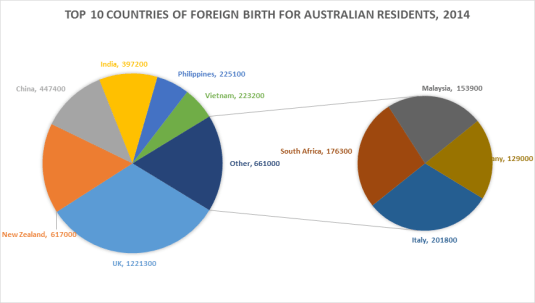
Top 10 countries of foreign birth for Australian residents
07 Oct 2015 Leave a comment
in politics - Australia, politics - New Zealand, population economics
Creative destruction in car prices
07 Oct 2015 Leave a comment
in applied welfare economics, economic history, entrepreneurship, politics - USA, technological progress, transport economics Tags: creative destruction
CHART: Since 1995 the CPI for new vehicles has been flat, while the CPI (and wages) increased 60%. What a bargain! http://t.co/DOdlQn8pcK—
Mark J. Perry (@Mark_J_Perry) July 01, 2015
Jane Kelsey oppose handcuffs on the democratic choices of future governments! Does she opposes labour and environmental standards in trade agreements too?
06 Oct 2015 Leave a comment
in development economics, international economic law, international economics, International law, politics - New Zealand, politics - USA Tags: colonialism, GATT, Leftover Left, preferential trading agreements, TPA, TPPA
What's in the #TPP? Robust enforceable environmental protections. Get the facts ustr.gov/tpp #LeadOnTrade http://t.co/hzapJwGaCa—
USTR (@USTradeRep) October 05, 2015What's in the #TPP? Protections for American workers. Get the facts: ustr.gov/tpp #MadeInAmerica http://t.co/VPeV70zaPT—
USTR (@USTradeRep) October 05, 2015https://twitter.com/JimRose69872629/status/651230008875220992
One of my policy essays for my Masters of Public Policy Degree in Japan was on the social clauses of the GATT. I described the labour and environmental clauses is a new form of colonialism.
My classmates were government officials from all around Asia, more than 20 countries. As they spoke English as a second language, they were pleased to learn of a new way of describing social clauses in trade agreements in English.
A Filipino friend had a blunter way of referring to social clauses in trade agreements: “the whites are back, telling us what to do”.
Environmentalists are praising wildlife measures in the Trans-Pacific Partnership trade deal nyti.ms/1hlu7hS http://t.co/ZLYarL9QE7—
The New York Times (@nytimes) October 05, 2015

Jane Kelsey in a television interview said she opposes the reductions in sovereignty in trade agreements that result from investor-state dispute settlement (ISDS) provisions because they limit the democratic choices of future governments.
If so, she must oppose environmental and labour standards in trade agreements and, more importantly, binding the hands of future governments with climate treaties. All international treaties are about restrictions on sovereignty.
Environmental and labour clauses in trade agreements and climate treaties all limit the powers of governments to legislate on environmental and employment law in accordance with the will of the people as expressed in the most recent election and change of government. Power to the people.
https://twitter.com/rorymccourt/status/625540621457960960
Jane Kelsey would do better focusing on those parts of the TPPA deal that lowers the net value of the deal such as those extending the term of patents over the drugs. All international treaties are about trade-offs.
View original post 212 more words
@jamespeshaw nails the #TPPA policy trade-off @NZGreens
06 Oct 2015 1 Comment
in applied price theory, applied welfare economics, comparative institutional analysis, economics of regulation, international economic law, international economics, International law, law and economics, politics - Australia, politics - New Zealand, politics - USA, property rights Tags: conspiracy theories, David Friedman, foreign direct investment, free trade agreements, FTI, international investment law, Leftover Left, New Zealand Greens, preferential trading agreements, TPPA, Twitter left
About 1% more GDP but higher drug prices.

Source: No increased medicine costs under TPPA | Stuff.co.nz
.@MSF: Patients and treatment providers in developing countries the big losers of the #TPP bit.ly/TPPconcludes http://t.co/cbikANleyA—
MSF Access Campaign (@MSF_access) October 05, 2015
The next best arguments James Shaw made were xenophobia about foreign investment in land and some vast conspiracy theory regarding endangered dolphins.
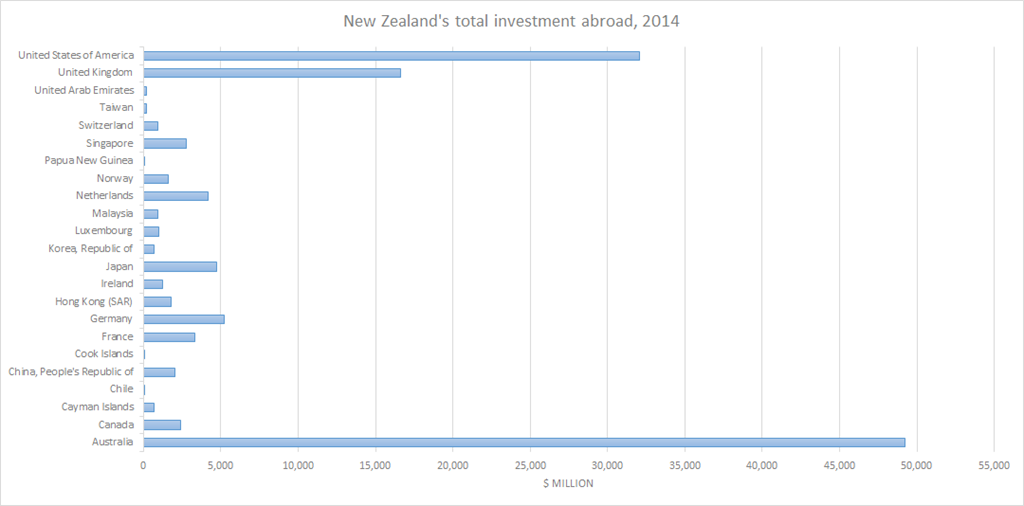
When your next best argument is foreigners are coming to buy up all our land, you are playing from a weak populist hand. About half of million New Zealand born live in other countries.
About 80% of these live in Australia, the great majority as residents rather than as citizens. These New Zealanders living in Australia and elsewhere need protection under international agreements to ensure they are not the victim of populist outbreaks against the sale of land to foreigners.
Source: Statistics New Zealand.
In addition, if a foreigner wants to pay over the odds for my house I am glad to separate a fool from his money.
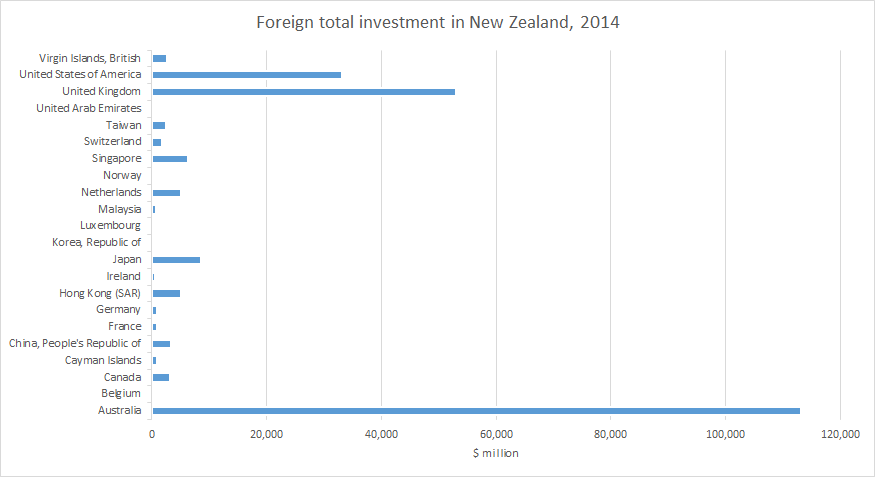
Source: Statistics New Zealand.
New Zealand has a strong interest in protecting the rights of its own expatriates as well as New Zealand foreign investors to buy land in other countries. As David Friedman explains:
Much more commonly, [economic imperialism] is used by Marxists to describe–and attack–foreign investment in “developing” (i.e., poor) nations. The implication of the term is that such investment is only a subtler equivalent of military imperialism–a way by which capitalists in rich and powerful countries control and exploit the inhabitants of poor and weak countries.
There is one interesting feature of such “economic imperialism” that seems to have escaped the notice of most of those who use the term. Developing countries are generally labour rich and capital poor; developed countries are, relatively, capital rich and labour poor. One result is that in developing countries, the return on labour is low and the return on capital is high–wages are low and profits high. That is why they are attractive to foreign investors.
To the extent that foreign investment occurs, it raises the amount of capital in the country, driving wages up and profits down. The effect is exactly analogous to the effect of free migration. If people move from labour-rich countries to labour-poor ones, they drive wages down and rents and profits up in the countries they go to, while having the opposite effect in the countries they come from.
If capital moves from capital-rich countries to capital-poor ones, it drives profits down and wages up in the countries it goes to and has the opposite effect in the countries it comes from. The people who attack “economic imperialism” generally regard themselves as champions of the poor and oppressed.
To the extent that they succeed in preventing foreign investment in poor countries, they are benefiting the capitalists of those countries by holding up profits and injuring the workers by holding down wages. It would be interesting to know how much of the clamour against foreign investment in such countries is due to Marxist ideologues who do not understand this and how much is financed by local capitalists who do.
Homicide rates of prime age adult males in the USA since 1980
05 Oct 2015 Leave a comment
in economic history, economics of crime, politics - USA
In addition to the bump in black males homicide rates for those aged 25 to 34 during the crack cocaine epidemic, there is a bump for white homicide rates for 9/11 for both age brackets for white males. I have no information on why the black adult male homicide rate started to climb again in the early 2000s then fall in the mid-2000s for black males age that 25 to 34.
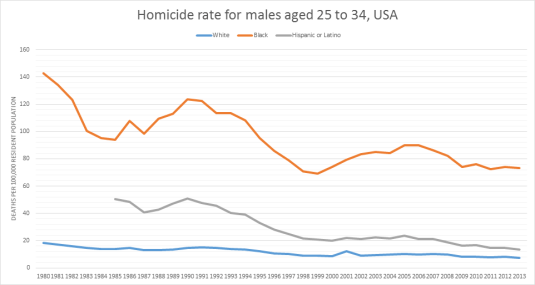
Source: Centres for Disease Control and Prevention.

Source: Centres for Disease Control and Prevention.
@nzlabour @NZGreens @jamespeshaw cannot tell the crims from the injustice in the tough new Australian laws on deporting criminals
05 Oct 2015 Leave a comment
in economics of crime, International law, politics - Australia, politics - New Zealand
Australia is introduced tough new deportation laws for noncitizens of bad character that sweep up New Zealanders who may have lived in Australia since childhood.
The new laws provide for automatic deportation of noncitizen criminals. The Immigration Minister used to decide if a criminal who was not an Australian resident was to be deported. Deportations are now automatic, although there are some exemptions and the opportunity for the Minister to intervene in special cases.
Anyone sentenced to more than a year in prison, or for a child-sex related offence automatically loses their visa and is detained to await deportation. This can include cumulative sentences over decades. Anyone spends a total of more one year in a prison is not a petty offender.
If you are a guest in another country, that is not a citizen, you do not go around messing up the place and making a nuisance of yourself. Sooner or later your host will lose patience and send you on your way.

There are injustices in these deportation laws because of a quirk of the New Zealand citizenship law. Some New Zealanders living in Australia cannot pass on their New Zealand citizenship to their children through decent. You cannot become an Australian citizen simply by being born there.
The injustice therefore is some of these New Zealanders who are Samoans whose children spend most of their lives in Australia will be deported back to Samoa because they have Samoan citizenship. They have neither New Zealand nor Australian citizenship.
It is one thing for a criminal to be deported from Australia to New Zealand – both are developed countries. It is another to be deported to a backward Pacific island.
If the New Zealand Labor Party and the New Zealand Greens would take time out for standing up for New Zealand criminals at home and abroad, they might be able to plead with greater success for a deal for these children of New Zealanders who find themselves in a quirky citizenship status. For these children of New Zealanders, their deportation is unusually harsh because they end up back in Samoa, not New Zealand.
dodgy @OECD paper on inequality & growth doing the Twitter Left rounds again
05 Oct 2015 1 Comment
in economic growth, economic history, economics of education, human capital, politics - New Zealand, politics - USA, population economics, poverty and inequality Tags: economics of personality traits, economics of schools, education premium, endogenous growth theory, IMF, James Heckman, Leftover Left, OECD, student loans, top 1%, Twitter left
Rick Noack did a great job in the Washington Post today to concisely summarise the hypothesis behind the OECD’s claim that inequality holds back growth. In the case of New Zealand 15 ½ percentage points of economic growth was lost due to rising equality since the late 1980s.
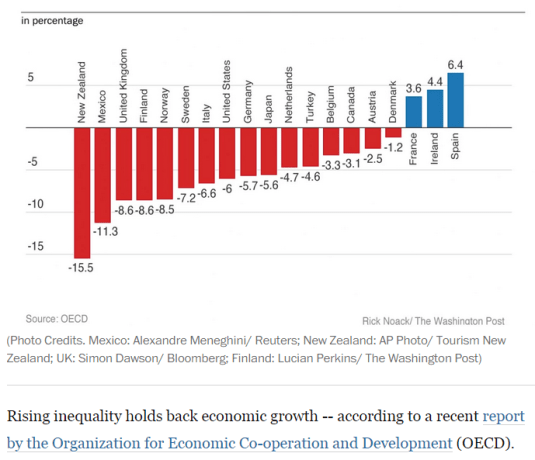
Source: How inequality made these Western countries poorer – The Washington Post.
According to the OECD, it is all about the ability to lower middle class and working class families to finance the human capital investments of their children. The OECD theory of inequality and lower growth is there is a financing constraint because of inequality that reduces economic growth because of less human capital accumulation by lower income families.
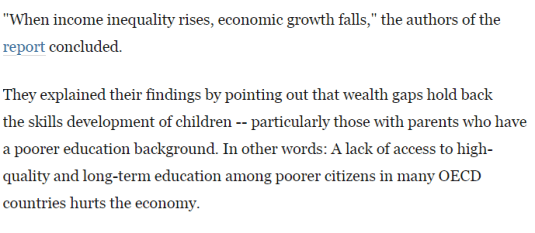
Source: How inequality made these Western countries poorer – The Washington Post.
In an age of interest-free student loans or cheap student loans everywhere for several decades now at least, the OECD is nonetheless hanging its head on the notion that not enough has been done to ensure there is enough graduates from the lower middle class and working class families making it to university. Taylor also has the same problem as me with the OECD’s human capital and inequality nexus:
There are a few common patterns in economic growth. All high-income countries have near-universal K-12 public education to build up human capital, along with encouragement of higher education. All high-income countries have economies where most jobs are interrelated with private and public capital investment, thus leading to higher productivity and wages. All high-income economies are relatively open to foreign trade.
In addition, high-growth economies are societies that are willing to allow and even encourage a reasonable amount of disruption to existing patterns of jobs, consumption, and ownership. After all, economic growth means change.
One of the findings of the Coleman report in the 1960s, which is been pretty much backed up since then such as by top labour economists such as James Heckman, is family background is the key to skills development in children, not the quality of their schools or their access to finance for higher education.

Schools work with what families present to them in terms of innate ability, and personality traits such as to pay attention and work. There is not much difference between an average bad public school and an average good public school when it comes to getting on in life. Going to really bad public school is different from just going to an average bad public school in terms of the chaos imposes on a child’s education and upbringing. What matters is the home environment rather than the ability to access good schools and families of ordinary means to finance higher education for their teenagers.
Most of the skill gaps that are present at the age of 18 – skill gaps which substantially explain gaps in adult earnings and employment in all groups – are also present at the age of five (Cunha and Heckman 2007). There is much evidence to show that disadvantaged children have lower levels of soft skills (non-cognitive skills): motivation, persistence, self-discipline, the ability to work with others, the ability to defer gratification and plan ahead, etc. (Heckman 2008). Most of the skills that are acquired at school build on these soft skills that are moulded and reinforced within the family.
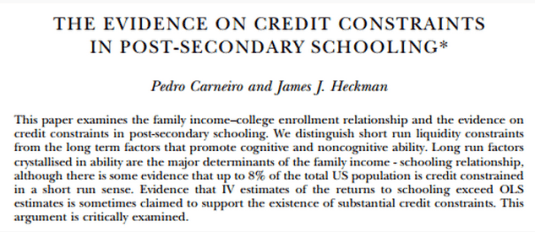
In 2002, with Pedro Carneiro, James Heckman showed that lack of access to credit is not a major constraint on the ability of young Americans to attend college. Short-term factors such as the ability to borrow to fund higher education has been found to be seriously wanting as an explanation for who and who does not go on to higher education.
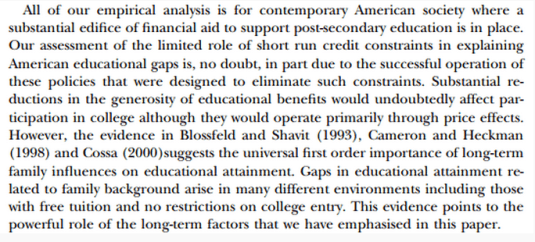
Only a small percentage of young people are in any way constrained from going on to higher education because of the lack of money. This is not surprising in any society with student loans freely available at low or zero rates without any need to post collateral. Heavily subsidised tuition fees and cheap student loans have been around for several generations.

Source: James Heckman.
The biggest problem with the OECD hypothesis linking a lack of skill development within lower income and working class families is it is such an easy problem to solve for the ambitious politician of either the left or the right by throwing money at the problem. Schooling until the age of 16 has been free for a century and universities have been virtually free for at least two generations. Lack of access to a good education does not cut it as the explanation for large disparities in growth rates.

The OECD and more recently the IMF have placed a lot of weight in access to human capital as a driver of inequality because human capital accumulation is hypothesised to be a major driver of economic growth.
The evidence that human capital is a key contributor to higher economic growth is weakening rather than strengthening. If human capital accumulation is not a major driver of productivity growth and productivity disparities, the inequality and growth hypothesis of the OECD and the IMF based on access to finance for human capital accumulation does not get out of the gate. Moreover, as Aghion said:
Economists and others have proposed many channels through which education may affect growth–not merely the private returns to individuals’ greater human capital but also a variety of externalities.
For highly developed countries, the most frequently discussed externality is education investments’ fostering technological innovation, thereby making capital and labour more productive, generating income growth. Despite the enormous interest in the relationship between education and growth, the evidence is fragile at best.
The trend rate of productivity growth did not accelerate over the 20th century despite a massive rise in investments in human capital and R&D because of the rising cost of discovering and adapting new technological knowledge. The number of both R&D workers and highly educated workers increased many-fold over the 20th century in New Zealand and other OECD member countries including the global industrial leaders such as the USA, Japan and major EU member states.
Cross-country differences in total factor productivity are due to differences in the technologies that are actually used by a country and the degree in the efficiency with which these technologies are used. Differences in total factor productivity, rather than differences in the amount of human capital or physical capital per worker explain the majority of cross-country differences in per capita real incomes (Lucas 1990; Caselli 2005; Prescott 1998; Hall and Jones 1999; Jones and Romer 2010).
Differences in the skills of the individual worker or in the total stock of human capital of all workers in a country cannot explain cross national differences in value added per worker at the industry level.
- The USA competes with Japan for productivity leadership in many manufacturing industries.
- The Japanese services sector productivity can be as little as a one-third of that of the USA.
- Japanese labour productivity is almost twice Germany’s in producing automobiles and is better that Germany by a large margin for many other manufactured goods.
- The USA is uniformly more productive in services sector labour productivity. For example, British, French and German telecom workers were 38 to 56 per cent as productive as their American counter-parts.
The USA, Japan, France, the UK and Germany all have relatively well-educated, experienced and tested labour forces. For example, the 1993 McKinsey’s study inquired into the education and skills levels of Japanese and German steel workers. Comparably skilled German steel workers were half as productive as their Japanese counterparts (Prescott and Parente 2000, 2005).
The ability to finance human capital accumulation and go to good schools is a weak theory of inequality. Human capital accumulation itself is a weak theory of growth unless linked to sophisticated theories of the institutions fostering innovation and technology absorption which it now is.
To be fair, I will not point out that this period of rising inequality since 1980s so damned by the OECD and the Twitter Left in the Washington Post today coincided with the return of real wages growth in New Zealand after 20 years of wage stagnation. That would be kicking the Twitter Left when they are down. I was a sneak in a graph instead.
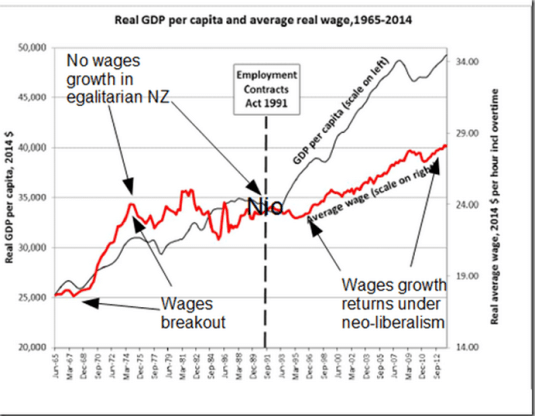
Data source: New Zealand Council of Trade Unions.
I will leave it for your own imagination to think of what happened to female labour force participation, the gender wage gap and female participation in higher education since the late 1980s and the onset of this horrific inequality which was mainly for men.
The failure of the Twitter Left to undertake a gender analysis of any labour force or income statistic they use is a major analytical shortcoming. Hardly any labour force statistics make any sense unless broken down by male and female outcomes.


Recent Comments