US and UK Real Housing Price Index, 1975 – 2015
13 Sep 2015 Leave a comment
in economic history, economics of regulation, politics - USA, urban economics Tags: British economy, British politics, housing affordability, housing prices, land supply, land use planning, NIMBYs, zoning

Source: International House Price Database – Dallas Fed
Note: The house price index series is an index constructed with nominal house price data. The real house price index is an index calculated by deflating the nominal house price series with a country’s personal consumption expenditure deflator.
Much higher house prices and the political sustainability of a return of inflation
13 Sep 2015 1 Comment
in business cycles, economic history, global financial crisis (GFC), inflation targeting, macroeconomics, monetary economics, politics - New Zealand, urban economics Tags: expressive voting, housing affordability, inflation rates, median voter theorem, mortgage belt, mortgage rates, rational ignorance, rational rationality
Mortgage interest rates were last in the double digits in the late 1980s and early 1990s. Since then, housing prices have exploded in New Zealand and barely paused for the recession in the wake of the Global Financial Crisis.
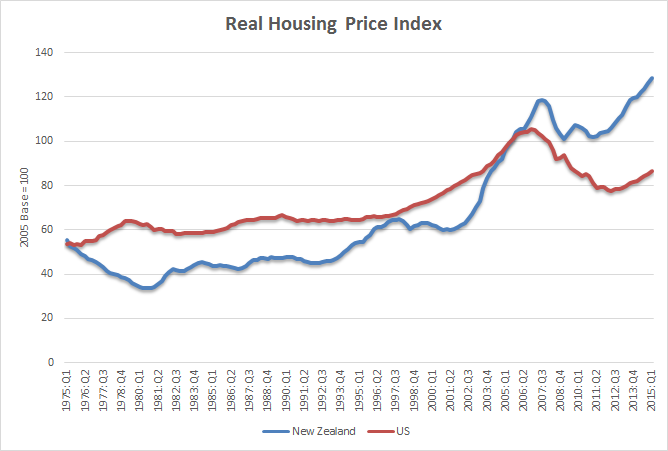
Source: International House Price Database – Dallas Fed; Housing prices deflated by personal consumption expenditure deflator.
With house prices and mortgages several times what they used to be, the ability for any household income to absorb the sudden return of high mortgage interest rates because of a return of even moderate CPI inflation and double-digit mortgage rates is well-nigh impossible, politically.

Source: Reserve Bank of New Zealand Mortgage rates and Bryan Perry, Household Incomes in New Zealand: trends in indicators of inequality and hardship 1982 to 2014 – Ministry of Social Development, Wellington (August 2015) Table C.5.
The chart above shows that the number of 25 to 44-year-olds in New Zealand who have more than 30% of their income going to housing expenses has doubled since 1988 to nearly a third of all households. The number of 45 to 64-year-olds who pay more than 30% of their income in housing expenses has quadrupled to 20%. That is a lot of voters who would be offended by mismanagement of monetary policy.
None of these households would have much left over to absorb an increasing mortgage interest rates. That is very different political arithmetic too the last time both mortgage rates and CPI inflation were in double digits, which was more than 20 years ago. Not many New Zealanders under the age of 40 or 45 have an adult memory of high inflation and high mortgage rates.
What do #McDonalds & @GreenpeaceNZ no longer have in common? @NZGreens @RusselNorman
12 Sep 2015 Leave a comment
in economics of regulation, environmental economics, environmentalism, global warming, health economics, politics - New Zealand Tags: anti-science left eye global warming, climate alarmism, GMOs, Greenpeace, Leftover Left, New Zealand Greens, Russell Norman, The Great Escape, The Great Fact, Twitter left
Like McDonalds, Greenpeace globally is a brand. I read the papers every day in detail but are utterly clueless as to who its leaders are. That is a deliberate branding decision so people cannot conflate the inevitably dodgy and far left backgrounds of its leaders and activist support base with self appointed environmental do-gooders brand.

That is no longer so in New Zealand where a middle-age political junkie retiring as co-leader of the New Zealand Greens will now be their CEO in New Zealand.
.@RusselNorman to lead @GreenpeaceNZ bit.ly/1K08JJj http://t.co/M4QNmeGQjr—
Greenpeace NZ (@GreenpeaceNZ) September 10, 2015
If Russell Norman wants to do his job properly, you should never give an interview, never appear in public.
Incoming @GreenpeaceNZ leader @RusselNorman says Greenpeace critical for humanity's future stuff.co.nz/national/polit… http://t.co/XqpxYjYmf4—
Greenpeace NZ (@GreenpeaceNZ) September 12, 2015
What is worse is the carrying on by the Greens about the retirement of Russell Norman to lead the Greenpeace in New Zealand.
If they wanted to maintain the political effectiveness of Greenpeace, they should have made a short press release congratulating him on his retirement and wishing him well in his new job and saying little more. The Greens should stop carrying on as though you have taken over Greenpeace New Zealand.
I do not wish Greenpeace well with its anti-growth, anti-science, anti-human agenda, so I hope this was a mistake and I hope I am not interrupting them in making that mistake.
An opportunity lost – to expel #WesternAustralia from the rest of Australia and seal the border
11 Sep 2015 Leave a comment
in comparative institutional analysis, constitutional political economy, economic history, politics - USA, Public Choice, rentseeking Tags: Australia, economics of borders, economics of succession, Scotland, self-determination, succession movements, Western Australia
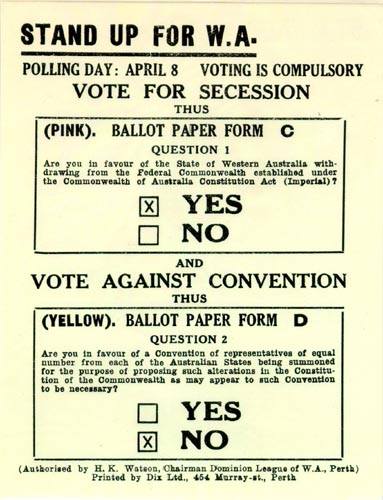
Western Australian secessionists, in common with Scottish nationalists, really do like to dictate the terms of their succession which always includes an open border and a generous financial settlement regarding division of federal government debts.
How arrogant. Why should parting be sweet? If you do not want us, why should we want you. If you want to find your own destiny, you can find it good and hard.
How Senator Bilyk’s Dad found paradise in Australia @Catbilyk
11 Sep 2015 Leave a comment
in economic history, politics - Australia, war and peace Tags: Australia, economics of migration, Poland, Russia, Ukraine, World War II
An old Uni mate’s dad was rounded up by the Nazis in the Polish Ukraine in 1941 and carted off as a slave in factories in Germany. He survived the war. He ended up in a refugee camp. He met and married a Dutch lass.
He did not want to go back to the Ukraine because that part of the Ukraine was now Russian under Stalin. That part of the Ukraine was Polish before the war.
Soviet post-war expansion resulted in border changes, the creation of a Communist Bloc & the start of the Cold War. http://t.co/0Os3EPp6Th—
History Facts 247 (@historyfacts247) August 17, 2015
Australia was the first country to accept them as refugees. He raised a family in Tasmania, working in a factory to support them.
I knew one of his two sons who became economists both at the University of Tasmania and in Canberra. One of his daughter’s was elected to the Australian Senate in the 2007 general election.
After such a rough start in life, my old mate’s dad must regard Australia as paradise for him, his wife and their family.
@radleybalko @thecounted How did the 169 unarmed people killed by police in 2015 die? @Mark_J_Perry updated
11 Sep 2015 2 Comments
in economics of crime, law and economics, politics - USA Tags: body cameras, crime and punishment, criminal deterrence, law and economics of evidence, law and order, Leftover Left, police, police shootings, presumption of innocence, William Blackstone
The Guardian is so anti-police that they included in their interactive database a drunk that drove into a police car and some poor bastard run over by the police cruiser searching for him at night.
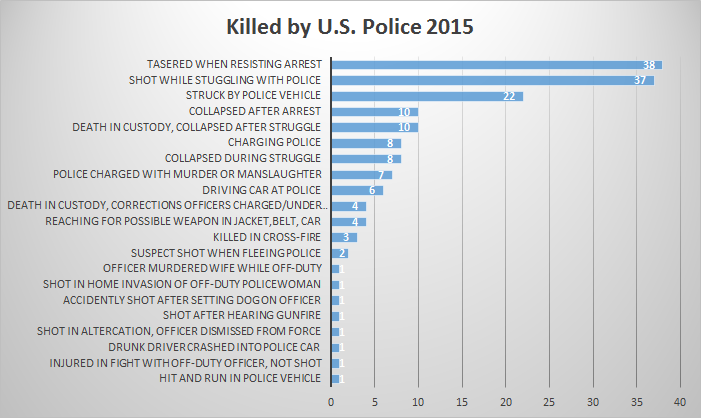
Another handy hint for an unarmed suspect is do not flee police by stealing a police cruiser with the officer dragging behind you. He may well shoot you. Police will certainly shoot an unarmed suspect if they flee arrest in a police cruiser, kidnapping the two children who happened to be in the back – their parents expect no less.

Most of the police killings of the unarmed in circumstances where better evidence would resolve doubts.

The Guardian would do a lot better by arguing that all Tasers should have cameras on them, all police cruisers should have cameras in them, and all police officers should have cameras on their lapels. These cameras are excellent for collecting evidence against criminals. There should also be plenty of cameras in police stations.

The first randomized controlled trial of police body cameras in the USA showed that cameras sharply reduce the use of force by police and the number of citizen complaints. In Seattle, the police department has set up its own YouTube channel, broadcasting a stream of blurred images to protect privacy.
Update: I recoded charging police and reaching for a possible weapon on your person or in a car into separate categories
$100 million for the few that cycle to work in #Wellington @dpfdpf @NZGreens
10 Sep 2015 Leave a comment
in politics - New Zealand, population economics, transport economics Tags: expressive voting, Leftover Left, urban transport
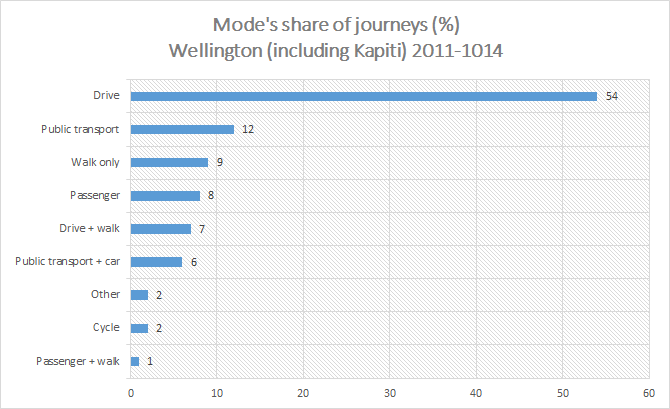
Source: Statistics New Zealand, New Zealand Travel Survey.
How did the 19 unarmed people killed by police since 1 August 2015 die? @radleybalko @thecounted
10 Sep 2015 Leave a comment
in economics of crime, law and economics, politics - USA Tags: crime and punishment, deaths in custody, expressive voting, law and order, Leftover Left, police, police shootings
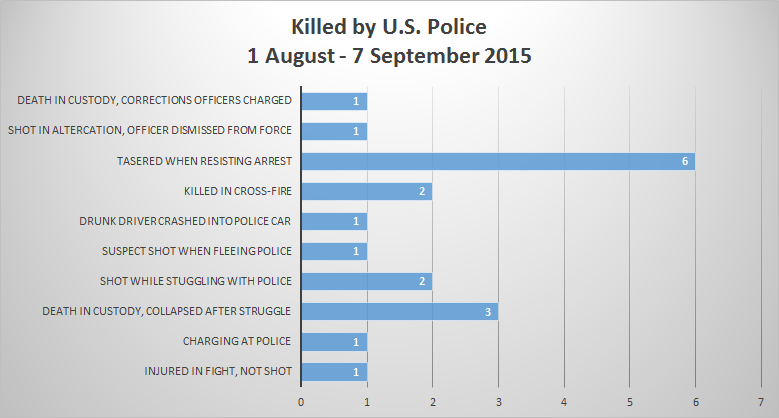
In coding the data from The Guardian interactive website, I included all 19 people they classified as unarmed and killed by police including
- a death in custody involving corrections officers,
- a drunk driver drove into the police car while turning left, and
- an off duty police officer getting into a fatal fight with a neighbour.
Unarmed people should not charge at armed police, struggle for their guns, or refuse to comply when threatened with a Taser, especially if poor of health or have a weak heart.
In the only two cases of police malfeasance – three corrections officer beating a prisoner to death or a trigger-happy police officer – charges have been laid or the officer dismissed pending further investigation. The man shot while fleeing police was a murder suspect.
War on Police? Or one of the safest years in law enforcement since 1887? @Mark_J_Perry goo.gl/qNQ2lO http://t.co/2zPjZmG2fQ—
AEIdeas Blog (@AEIdeas) September 09, 2015
Presidential election turnout by race
09 Sep 2015 Leave a comment
in constitutional political economy, politics - USA, Public Choice, rentseeking Tags: 2016 presidential election, civil rights, Democratic Party, racial discrimination, southern States, voting rights

Creative destruction in desktops
09 Sep 2015 Leave a comment
in economic history, entrepreneurship, politics - USA, technological progress Tags: creative destruction, PCs
GRAPHIC: Why your middle-class salary is better than you might think
washingtonpost.com/blogs/wonkblog… http://t.co/vvRCo0PNel—
Mark J. Perry (@Mark_J_Perry) June 15, 2015



Recent Comments