Trigger Warning: This Tweet might make you uncomfortable.
theatlantic.com/magazine/archi… http://t.co/7kyG6kGSZo—
Mark J. Perry (@Mark_J_Perry) August 11, 2015
Union density rates in USA, UK, Australia and New Zealand since 1960
13 Aug 2015 Leave a comment
in labour economics, politics - Australia, politics - New Zealand, politics - USA, unions Tags: Australia, British economy, union membership, union power, union wage premium
Unions have been in a long-term decline in Australia, New Zealand, the UK and the USA for as far back as survey and administrative data can be collected. There is a bit of a hump in union membership in the mid-1970s in New Zealand, Australia and the UK but that was about it.
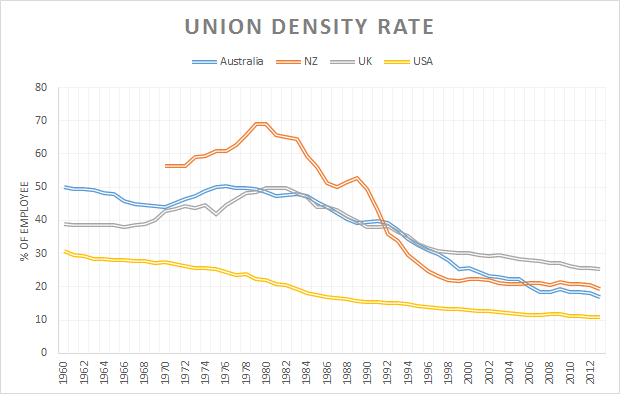
Source: Source: OECD and J.Visser, ICTWSS database (Institutional Characteristics of Trade Unions, Wage Setting, State Intervention and Social Pacts, 1960-2010), version 3.0 (http://www.uva-aias.net/).
@metiria @NZGreens child poverty is driven by housing unaffordability – by Green opposition to RMA reform
13 Aug 2015 1 Comment
in applied welfare economics, economic history, economics of regulation, labour economics, politics - New Zealand, poverty and inequality, urban economics Tags: antimarket bias, child poverty, expressive voting, family poverty, green rent seeking, housing affordability, land use planning, Leftover Left, New Zealand Greens, NIMBYs, rational ignorance, rational irrationality, RMA, zoning
#moreinclusivenz @povertymonitor Killer graphs & #infographics by NZ Children's Commissioner. Shameful content, NZ http://t.co/mG987C5kh0—
Isabella Cawthorn (@fixiebelle) July 26, 2015
Nothing much has happening to child poverty before housing costs in New Zealand since the early 1980s. It is after housing costs poverty that is crucifying the children in New Zealand.
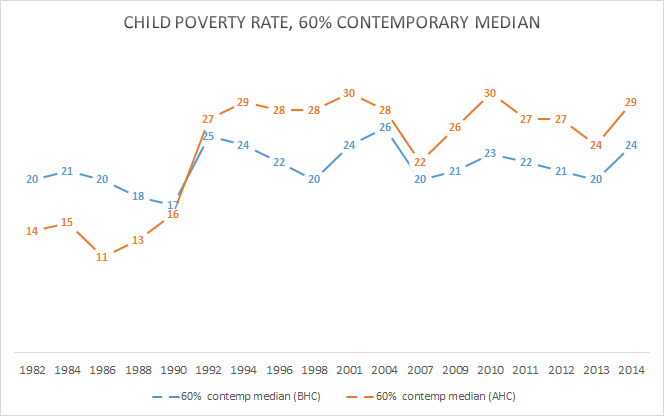
Source: Bryan Perry, Household Incomes in New Zealand: trends in indicators of inequality and hardship 1982 to 2014 – Ministry of Social Development, Wellington (August 2015), Table F6 and table F7.
An economy that is not working for all of us, is simply not working. http://t.co/zZu0LOy7ED—
Green Party NZ (@NZGreens) August 13, 2015
From HES 2013 to HES 2014 median household income rose 5% in real terms (5% above the CPI inflation rate)…
On the AHC moving line measures, child poverty rates in HES 2014 are around the same as their peak after the GFC. A good amount of the rise from HES 2013 to HES 2014 is due to the large rise in the BHC median, as noted above, rather than a change in the numbers in low income per se.
The parties that oppose measures to increase the supply of land and reduce the cost of housing through reform of the Resource Management Act and its many restraints on the supply of land are the New Zealand Labour Party and New Zealand Greens.
Children's views on poverty #childpovertynz occ.org.nz/assets/Uploads… http://t.co/wZHJ19QcpN—
Child Poverty NZ (@povertymonitor) September 08, 2015
Has NZ child poverty doubled as @MaxRashbrooke said?
13 Aug 2015 Leave a comment
in applied welfare economics, economic history, politics - New Zealand Tags: child poverty, family poverty, Leftover Left
An economy that is not working for all of us, is simply not working. http://t.co/zZu0LOy7ED—
Green Party NZ (@NZGreens) August 13, 2015https://twitter.com/JimRose69872629/status/631634249737605120
https://twitter.com/JimRose69872629/status/631635425271001088

Lindsay Mitchell put me onto a quote by veteran grumbler Max Rashbrooke that the child poverty rate doubled in New Zealand:
In a system where income goes disproportionately to the already well-off, ordinary workers are missing out on the rewards of their efforts, to the tune of billions of dollars a year. Welfare benefits, cut by a quarter in 1991 and increased just 8 per cent in the last budget, are far too low to meet people’s basic needs.
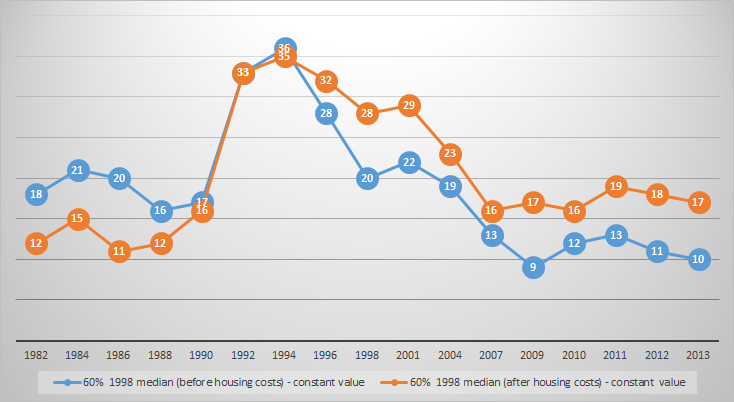
The result is a doubling of child poverty and the return of childhood diseases unknown in most developed countries – a national embarrassment, as one researcher described it.
Poverty, income and inequality data is collected in loving detail by Brian Perry every year for the Ministry of Social Development.
Figure 1: % child poverty in New Zealand (before and after housing costs), 60% 1998 median constant value, 1982 – 2013
Source:
View original post 509 more words
@radleybalko @thecounted 156 killed by police 1 July-11 August. How did they die?
13 Aug 2015 2 Comments
in economics of crime, law and economics, politics - USA Tags: common law, crime and punishment, criminal deterrence, law enforcement, police


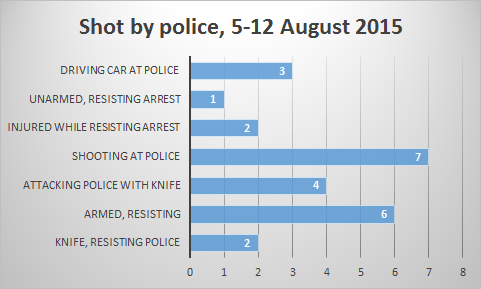
@radleybalko @thecounted 25 killed by police 5-12 August. How did they die? @PoliticalLine
12 Aug 2015 Leave a comment
in economics of crime, law and economics, politics - USA Tags: common law, crime and punishment, criminal deterrence, law enforcement, police
Creative destruction in family spending in the USA
12 Aug 2015 Leave a comment
in applied welfare economics, economic history, politics - USA Tags: creative destruction, living standards
https://twitter.com/VisualEcon/status/508957190129188864/photo/1
Family spending across a different income groups bit.ly/195NbKb http://t.co/mSbc0DRICY—
Catherine Mulbrandon (@VisualEcon) September 01, 2014
Australia announces its futile carbon emissions target
12 Aug 2015 Leave a comment
in applied price theory, applied welfare economics, environmental economics, global warming, politics - Australia, politics - New Zealand, politics - USA, Public Choice, rentseeking Tags: Australia, China, climate alarmism, climate change treaties, free-riders, game theory, global warming, international free riders, international public goods, public goods

Trump has lost 9-points since debate. Rubio, Fiorina and Carson surge.
12 Aug 2015 Leave a comment
in politics - USA, Public Choice Tags: 2016 presidential election, opinion polls, voted demographics
My tip is a President Rubio and Vice President Fiorina or vice a versa.
A look at how @realDonaldTrump is running his unconventional campaign: on.wsj.com/1P5iV49 http://t.co/qXZ6VuGMUW—
Nick Timiraos (@NickTimiraos) August 12, 2015
Zimbabwe Quietly Re-Opens Lion Hunts After Outcry Over The Killing of “Cecil the Lion”
12 Aug 2015 Leave a comment
The anti-hunting choir has a lot to answer for. #auspol http://t.co/2FGgC11VZp—
David Leyonhjelm (@DavidLeyonhjelm) August 17, 2015

 Zimbabwe has its ban on lion, leopard and elephant hunting that it imposed after the illegal killing of the beloved “Cecil the Lion” by Minnesota Dentist Walter Palmer. Hunting companies were told that they could start to line up wealthy trophy hunters again for bag the big game. In the meantime, conservationists have come forward to defend trophy hunting as a needed source of revenue for these parks.
View original post 165 more words
Liberal voting cities markets have higher income inequality and worse affordability
12 Aug 2015 Leave a comment
in politics - New Zealand, politics - USA, Public Choice, rentseeking, urban economics Tags: Director's Law, expressive boating, green rent seeking, housing affordability, land supply, land use planning, Left-wing hypocrisy, NIMBYs, rational ignorance, rational irrationality, zoning
All homeowners have an incentive to stop new housing because if developers build too many homes, prices fall, and housing is many families’ main asset. But in cities with many Democrats and Green Party members, environmental concerns might also be a factor. The movement might be too eager to preserve the past.

via Why Middle-Class Americans Can’t Afford to Live in Liberal Cities – The Atlantic.
Net favourability is the name of the presidential primaries game
11 Aug 2015 Leave a comment
in politics - USA, Public Choice Tags: 2016 presidential election, expressive voting, rational rationality, rationally parents
Twenty-three percent of GOP voters had a favourable opinion of Trump in a May Washington Post-ABC News poll, while 65 percent viewed him negatively. Eleven percent of Republicans felt strongly favourably toward Trump; 43 percent felt strongly negatively.

via Boy, was I wrong about Donald Trump. Here’s why. – The Washington Post.
America still has lots of small banks– Is that still a good idea?
11 Aug 2015 Leave a comment
in law and economics, macroeconomics, monetary economics, politics - USA Tags: bank panics, bank runs, free banking, unit banking
Small banks continue to decline as large banks grow larger mercatus.org/publication/sm… http://t.co/Jr9eeV58IC—
Mercatus Center (@mercatus) July 27, 2015


Recent Comments