https://twitter.com/oldpicsarchive/status/630710778065252352
DMZ in 1953
11 Aug 2015 Leave a comment
in economic history, politics - USA, war and peace Tags: Korean war
New Zealand unemployment incidence by duration since 1986
10 Aug 2015 Leave a comment
in business cycles, human capital, job search and matching, labour economics, labour supply, macroeconomics, politics - New Zealand, unemployment Tags: equilibrium unemployment rate, hysteresis, long-term unemployment, natural unemployment rate, unemployment duration, unemployment rates
There has been bit of a wild ride in long-term unemployment in New Zealand. Long-term unemployment – longer than one year – ranging from just over 8% of unemployment in 1986 to nearly 40% in 1992 then down to 5% in 2008. Clearly the duration of unemployment in New Zealand is highly sensitive to the business cycle unlike the case in the USA or UK.
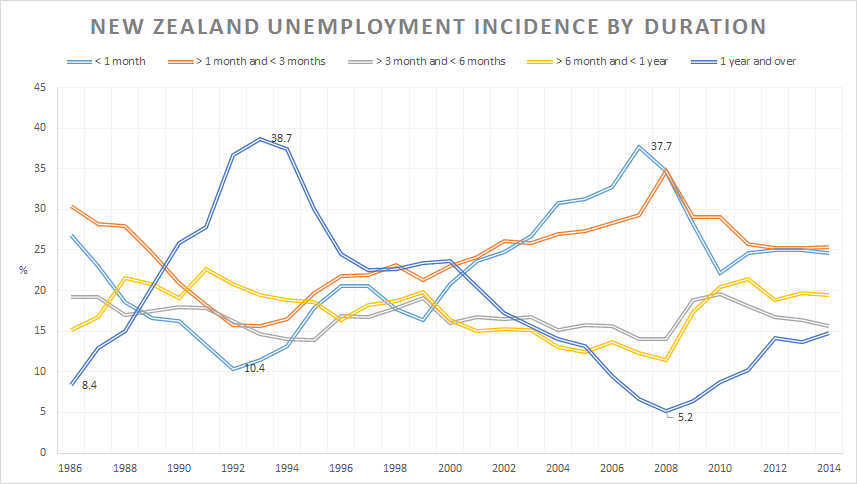
Source: OECD StatExtract.
This sensitivity of long-term unemployment to the business cycle does not bode well for the hypothesis of hysteresis where human capital depreciates the longer a jobseeker is out of employment. For this hypothesis to hold, there must be some enduring aspect of long-term unemployment rather than just going up and down with the business cycle rather noticeably.

The rival hypothesis to hysteresis is the long-term unemployed tend to be those who have a lot of trouble getting employment, which is why they end up been unemployed for a long time. Again in New Zealand, these less employable jobseekers appear to be able to find jobs quite easily when the labour market is good.
Hysteresis in practice, Delong-Summers Variety @delong @LHSummers http://t.co/urqxQBi6NE—
Roger E. A. Farmer (@farmerrf) July 23, 2015
The Rules of Campaign Cash
10 Aug 2015 Leave a comment
in politics - USA, Public Choice Tags: 2016 presidential election, campaign finance regulation
How money is raised by candidates, parties and groups that want to influence the election bloom.bg/1IONJaR http://t.co/f3CI6x9ooc—
Bloomberg Politics (@bpolitics) August 09, 2015
Analysing environmental benefits from driving electric vehicles
09 Aug 2015 Leave a comment
in applied welfare economics, energy economics, environmental economics, global warming, politics - USA, Public Choice, rentseeking Tags: coal power, electric cars, green rent seeking, hydroelectric power, nuclear energy, nuclear power, offsetting behaviour, The fatal conceit, The pretense to knowledge, unintended consequences
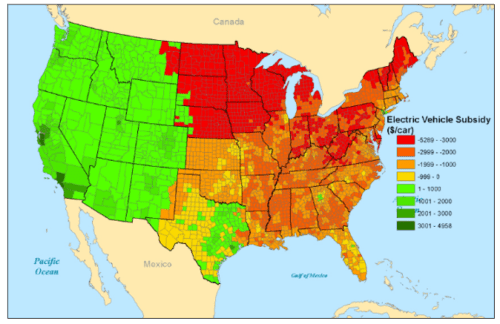
- The benefit is large and positive in many places in the west because the western electricity grid is relatively clean – primarily a mix of hydro, nuclear, and natural gas.
- The benefit is large and negative in many places in the east because the eastern electricity grid primarily relies more heavily on coal and natural gas.
via Economist’s View.
Which Nation Has the Worst Dependency Ratio?
09 Aug 2015 1 Comment
in economic history, politics - USA, public economics Tags: ageing society, demographic crisis, dependency ratio, social insurance
Past, present, and future of the welfare state… http://t.co/1gcGree4o1—
Austrian EconoCenter (@AustrianCenter) June 22, 2015

For both policy reasons and narcissism, I wish the most popular item ever posted on International Liberty was Mitchell’s Golden Rule.
But that guide to sensible fiscal policy isn’t even in the top 70.
 Instead, my most-read post is a set of cartoons showing how the welfare state inevitably metastasizes as more and more people are lured into the wagon of government dependency.
I suspect these cartoons are popular because they succinctly capture and express a concern that is instinctively felt by many people.
But instinct isn’t the same as evidence.
So I’ve shared various estimates of America’s growing dependency problem, though I’ve also warned that these numbers don’t necessarily tell the full story.
Given my dissatisfaction with the current estimates, I was very interested to see a new attempt to measure the degree to which nations are undermined by ever-expanding redistribution. Writing for the Mises Institute and…
View original post 590 more words
The taxes paid by the rich, middle-class and the poorer in the USA
09 Aug 2015 Leave a comment
in politics - USA, public economics Tags: creative destruction, entrepreneurial alertness, envy, taxation and entrepreneurship, taxation and investment, taxation and the labour supply, top 1%
Average Income Before & After Federal Taxes from "An Illustrated Guide to Income" bit.ly/1j9ymXF #inequality http://t.co/eabwDATSlU—
Catherine Mulbrandon (@VisualEcon) April 28, 2014
@NZGreens and co. must face an inconvenient truth about global poverty
09 Aug 2015 Leave a comment
in development economics, energy economics, environmental economics, global warming, growth disasters, growth miracles, politics - New Zealand Tags: expressive voting, extreme poverty, global poverty, rational irrationality, The Great Escape, The Great Fact
This time it is different: unemployment incidence by duration, USA, 1968 – 2014
08 Aug 2015 1 Comment
in budget deficits, great recession, job search and matching, labour economics, labour supply, macroeconomics, politics - USA, unemployment, welfare reform Tags: natural unemployment rate, taxation and labour supply, unemployment duration, unemployment insurance, unemployment rates, welfare state
The Great Recession was the first recession in the USA in a good 40 to 50 years where the composition of employment changed by much. Even the big recession at the beginning of the 1980s did not do much to the composition of unemployment by duration in the USA.
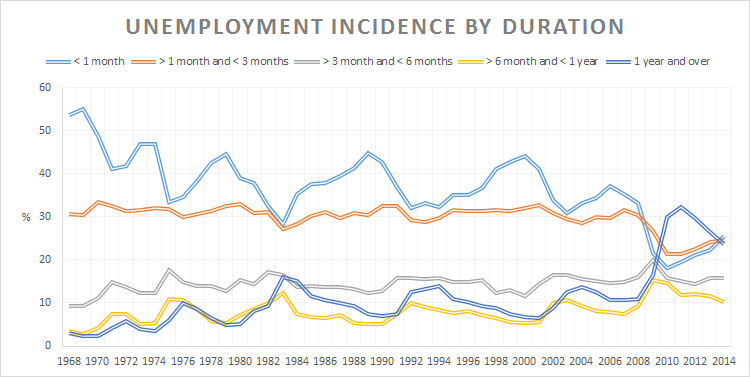
Source: OECD StatExtract.
Those unemployed for more than a year moved from barely double digits even in a bad recession prior to 2008 to coming on one-third of all unemployed. Likewise, those unemployed for less than a month halved from 40% to 20%. Something changed in the US labour market with the Great Recession and the long extensions of unemployment insurance from 26 weeks to 52 weeks and then 99 weeks.
Trump would also do well in the Democratic Party primaries
07 Aug 2015 Leave a comment
in constitutional political economy, politics - USA, Public Choice, rentseeking Tags: 2016 presidential election, expressive voting, traditional working class


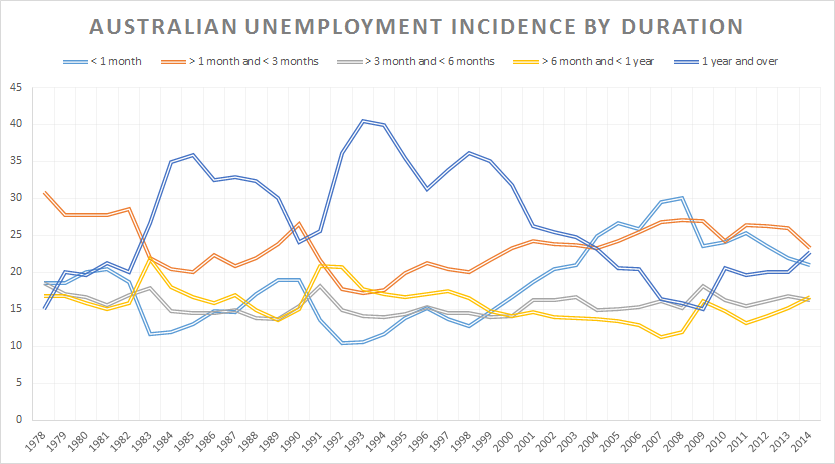
Australian unemployment incidence by duration since 1978
07 Aug 2015 Leave a comment
in economic history, global financial crisis (GFC), job search and matching, labour economics, labour supply, macroeconomics, politics - New Zealand, unemployment Tags: Australia, equilibrium unemployment rate, natural unemployment rate, unemployment duration
As with New Zealand, Australian long-term unemployment seems to go up and down quite a lot with recessions such as those in the early 1980s and early 1990s but not after the global financial crisis.
Source: OECD StatExtract.
The impact of welfare states on life expectancy
07 Aug 2015 Leave a comment
in applied welfare economics, fiscal policy, labour economics, politics - Australia, politics - New Zealand, politics - USA, poverty and inequality, welfare reform Tags: Denmark, Finland, life expectancies, Norway, Sweden, welfare state
New from @iealondon: Scandinavian success is not due to high taxes and welfare spending. iea.org.uk/in-the-media/p… http://t.co/QVH566KNtV—
IEA (@iealondon) July 07, 2015
The Progressive Mind
06 Aug 2015 Leave a comment
in liberalism, Marxist economics, politics - Australia, politics - New Zealand, politics - USA, Public Choice Tags: antiforeign bias, antimarket bias, expressive voting, Left-wing hypocrisy, Leftover Left, makework bias, meddlesome preferences, nanny state, political correctness, rational irrationality, Twitter left
@DN_Debatt_betyg @LibyAlonso Vem vaktar väktarna? Vem tillser att experter är fria från bias? Vem nudgar, nudgarna? http://t.co/T01Va6UYOV—
Old Whig (@aClassicLiberal) July 26, 2015
Cannabis is pretty harmless by comparison
06 Aug 2015 Leave a comment
in economics of regulation, health economics, politics - Australia, politics - New Zealand, politics - USA Tags: alcohol regulation, economics of prohibition, marijuana decriminalisation, medical marijuana decriminalisation
US deaths (2013)
Tobacco 437k
Alcohol 29k
Opoids 16k
Heroin 8k
Cocaine 5k
Marijuana 0vox.com/2014/5/19/5727… http://t.co/o8yMDf7oE0—
Conrad Hackett (@conradhackett) August 04, 2015
Two charts on Trump and a more important one on Herman Cain
06 Aug 2015 3 Comments
in economic history, politics - USA, Public Choice Tags: 2012 presidential election, 2016 presidential election


via Why is Trump surging? Blame the media. – The Washington Post.
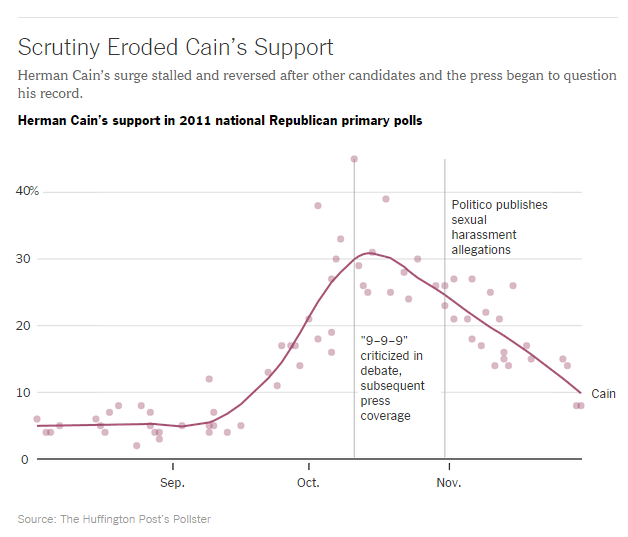
via Donald Trump and the Press: Why Coverage Matters – The New York Times.


Recent Comments