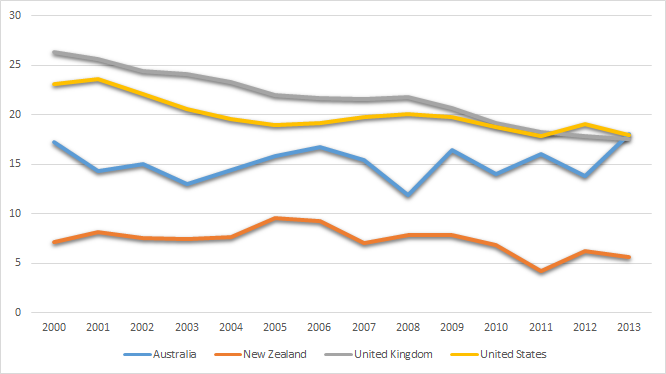
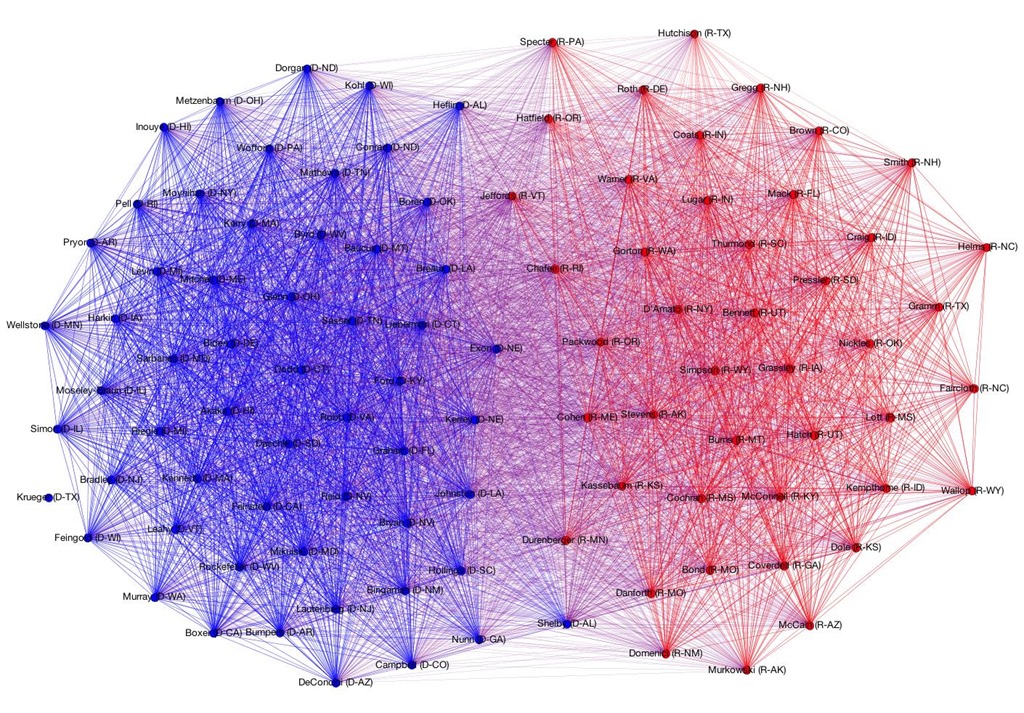
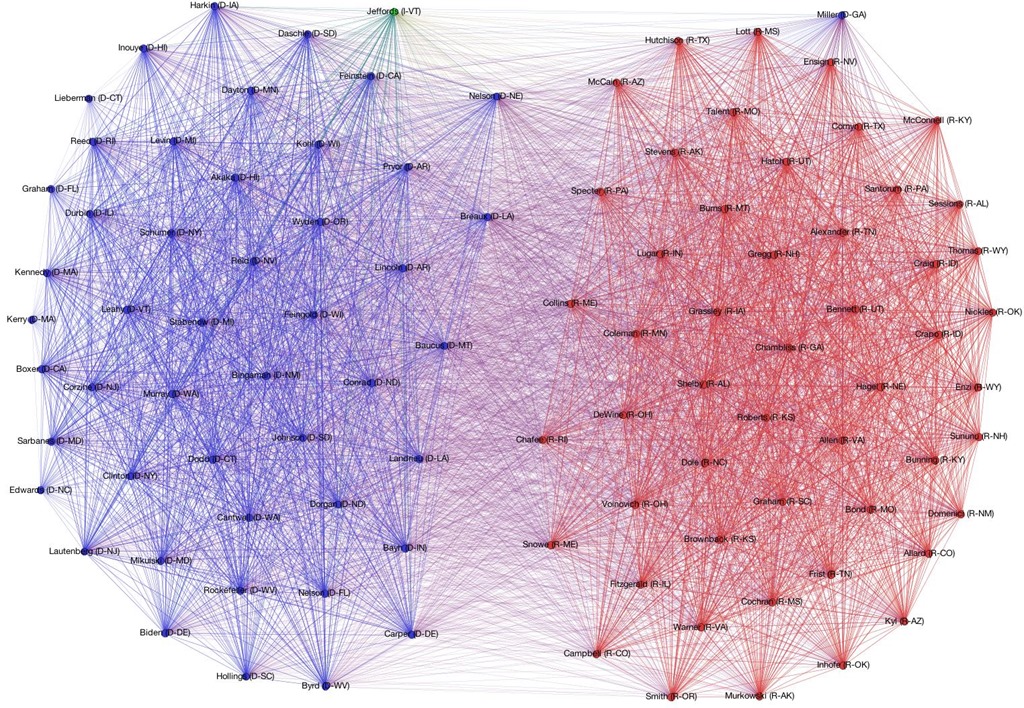
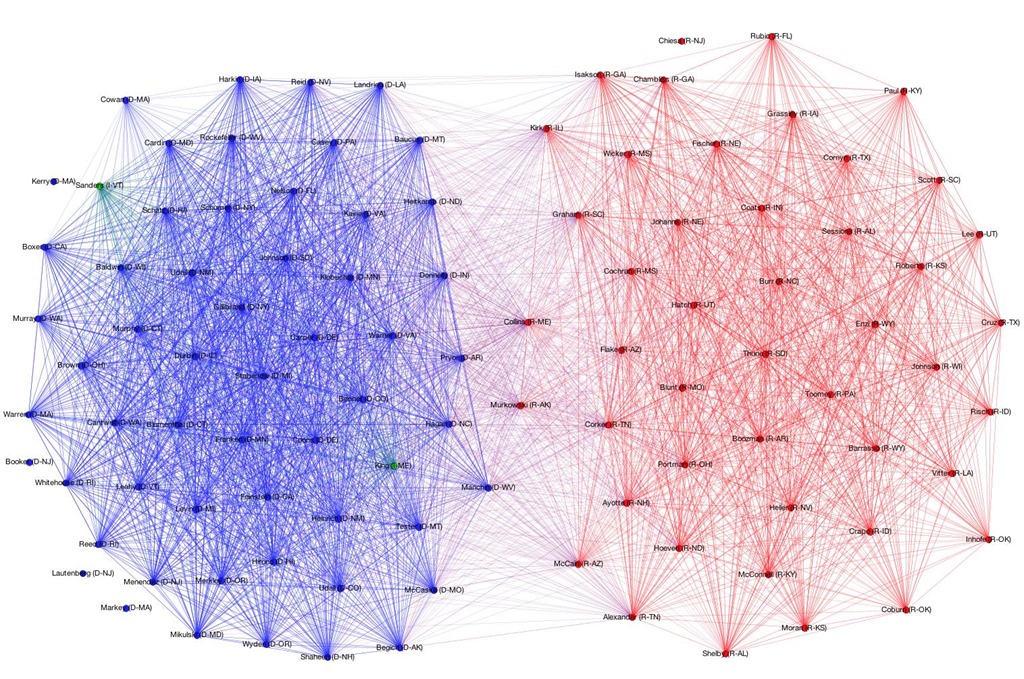
Why the pipeline of GOP female politicians is dry: Too few are highly conservative. nyti.ms/1Fp4JNW http://t.co/kst4so4kyH—
The Upshot (@UpshotNYT) June 01, 2015
The surprising divergences in the congressional gender gap by party
04 Jun 2015 Leave a comment
in politics - USA, population economics, Public Choice Tags: gender gap
Unions have been on the way out for a long time
03 Jun 2015 Leave a comment
in economic history, labour economics, politics - Australia, politics - New Zealand, politics - USA, unions Tags: the withering away of the proletariat, union power, union wage premium
The economics of low wages: When what comes down doesn’t go up econ.st/1zlP1G0 http://t.co/AujgeDIAUX—
The Economist (@EconEconomics) May 02, 2015
Obama and Reagan are about equal in the presidential popularity stakes
02 Jun 2015 Leave a comment
in politics - USA Tags: obama, Reagan
Highest approval rating
HW Bush 89%
W Bush 86
Carter 75
Clinton 71
Nixon 68
Reagan 68
Obama 64
pewresearch.org/fact-tank/2015… http://t.co/sIyy3nCyGO—
Conrad Hackett (@conradhackett) May 30, 2015
How often the 2016 candidates agreed (and disagreed) in their Senate votes, charted
02 Jun 2015 Leave a comment
How often the 2016 candidates agreed (and disagreed) in their Senate votes, charted. wpo.st/T5dJ0 http://t.co/CBLtRllny1—
Chris Cillizza (@TheFix) June 01, 2015
Creative destruction in television prices in New Zealand
01 Jun 2015 1 Comment
in economics of media and culture, entrepreneurship, politics - New Zealand, technological progress Tags: creative destruction, good old days
How Qatar is the odd man out in World Cup hosting
01 Jun 2015 Leave a comment
Six ways in which Qatar doesn't make a lot of sense as a World Cup host 53eig.ht/1BpVlrH #FIFA http://t.co/0N87zTO07x—
(@FiveThirtyEight) May 30, 2015
Average tax rates versus tax revenue as a percentage of the GDP
31 May 2015 Leave a comment
in economic history, politics - USA, public economics, taxation Tags: average tax rates, growth of government, size of government
Is Canada diverging from Australia in labour productivity to become like New Zealand?
31 May 2015 1 Comment
in economic growth, economic history, macroeconomics, politics - Australia, politics - New Zealand Tags: Australia, Canada, economic geography, endogenous growth theory, lost decades
Figure 1 shows that Canada has been diverging from Australia in real GDP per working age person since the mid-1990s particularly since the global financial crisis.
Figure 1: Real GDP per New Zealander, Canadian and Australian aged 15-64, converted to 2013 price level with updated 2005 EKS purchasing power parities, 1956-2013
Source: Computed from OECD StatExtract and The Conference Board, Total Database, January 2014, http://www.conference-board.org/economics
In common with New Zealand, Figure 2 shows that Canadian productivity has been in a pretty much along declines is about 1974, rarely catching up with any lost ground. Figure 1 shows that Canada used to be richer than Australia but is now poorer than Australia. Figure 2 is real GDP growth data detrended by the growth rate of the USA in the 20th century. A flat line in figure 2 is annual real GDP growth at 1.9%; a rising line is growth above 1.9%; a falling line is annual growth below 1.9% a year.
Figure 2: Real GDP per New Zealander, Canadian and Australian aged 15-64, converted to 2013 price level with updated 2005 EKS purchasing power parities, 1.9 per cent detrended, 1956-2013
Source: Computed from OECD StatExtract and The Conference Board, Total Database, January 2014, http://www.conference-board.org/economics
Figure 2 shows that Canadian productivity has been below trend for perhaps 30 years. There has been the occasional recovery but followed by a further decline. If Canadian labour productivity had grown at the same rate as the USA since 1974, labour productivity in Canada is something like 18% better.
Australia, as shown in figure 2, has neither caught up nor falling behind the USA in labour productivity for the entire post-war period since 1956. Canada has been falling behind its neighbour most markedly since the mid-1970s.
- Canada fell 10 percentage points further behind the USA in relative labour productivity between the mid-1970s and the mid-1990s.
- Canada stopped falling further behind the USA after 1995 to 2005 but, in common with New Zealand, Canadian labour productivity did not rebound to recover the prior lost ground.
The proximate causes of the Canadian productivity gap with the USA have a familiar echo to New Zealand ears. Relative to the USA, Rao et al. (2006) and Sharp (2003) attributed the gap to less capital per worker, an innovation gap as shown by lower R&D expenditure, a smaller and less dynamic high technology sector, less developed human capital at the top end of the labour market, and more limited scale and scope economies.
These factors have been put forward, at one time or another, as the proximate causes of the New Zealand productivity gap with the USA. Identifying the barriers to higher Canadian productivity may offer fresh insights into removing similar productivity barriers in New Zealand.
Canada, New Zealand and Australia should be catching-up with the USA in productivity per capita because copying the global leader is cheaper than innovation. Canada, New Zealand and Australia all have the basics to do this: a market economy, the rule of law and openness to foreign technology and international trade.
Instead of asking why New Zealand is not catching-up with Australian productivity, further study of the lack of productivity catch-up of Australia and Canada with the USA may uncover subtle barriers to productivity growth with similarities in New Zealand.
The productivity decline in Canada is of interest in New Zealand because Canada certainly cannot blame remoteness because it borders the USA. Canada cannot blame lack of size because it is noticeably larger than Australia and certainly New Zealand.
The futility of minimum wage increases as a poverty reduction strategy
31 May 2015 Leave a comment
in labour economics, labour supply, politics - USA, welfare reform Tags: family tax credits, poverty traps, welfare reform, welfare state
Many unions have exemptions from local minimum wage laws they helped pass
31 May 2015 Leave a comment
in income redistribution, labour economics, minimum wage, politics - USA, Public Choice, rentseeking, unions Tags: bootleggers and baptists, cartels, rent seeking, union power, union wage premium
What is the trend growth rate of the USA?
31 May 2015 Leave a comment
in business cycles, economic growth, economic history, great depression, great recession, macroeconomics, politics - USA Tags: prosperity and depression
The British electorate is almost as right-wing as New Zealand’s
30 May 2015 Leave a comment
People in Britain who bothered to vote: on the whole, as @NickCohen4 points out, fairly Right-wing http://t.co/BFYRBVnray—
Michael Deacon (@MichaelPDeacon) May 30, 2015
The Green vote can only head south under James Shaw or why he must win Wellington Central
30 May 2015 Leave a comment
in politics - New Zealand, Public Choice Tags: expressive voting, James Shaw, New Zealand Greens, New Zealand Labour Party, rational ignorance, rational irrationality, swinging voter, tactical voting, vote parking
The New Zealand Greens have elected a new male co-leader. James Shaw is a first term MP who is supposed to consolidate and build the green vote from 10%. At the last election, the Greens were targeting a 15% party vote. Their vote fell from 11.1% to 10.7%.
I doubt that he can do it because much of the improvement of the Green vote since the 2005 election has been an expense of the Labour Party.
The Green vote was pretty sickly at 5-7% when the Labour Party was popular in government between 1999 and 2005. In the 2005 election, the Greens failed to reach the 5% party vote threshold necessary to win seats in Parliament on election night. It was only saved by absentee and postal votes that pushed its party vote up to 5.3%.
Maybe 30% of the Green vote, perhaps more, is made up of disgruntled Labour Party voters awaiting the call home. These disgruntled Labour voters will vote for the Labour Party again when it is fit for government.
Once there is a Labour–Green government in New Zealand, the Green vote faces the recurring theme that green parties lose a substantial part of their vote whenever they get into government such as happened federally in Australia and in Tasmania.
If the Greens go into government with about 7% of the party vote in the 2017 or 2020 New Zealand general elections, the Greens face the real prospect of of being voted out of Parliament completely in the 2023 New Zealand general election if their vote drops below 5%.
James Shaw happened to run for the Wellington Central electorate in the 2014 general election. He did not ask for the electorate vote in that election. Only the party vote.
Wellington Central has one of the highest green party votes in New Zealand. The Green party vote is 2000 more than Labour’s party vote in Wellington Central although the National Party won the party vote with 14,000 party votes.
Given the fact that the Greens may dropped below 5% by 2020, James Shaw would be wise to try to win Wellington Central in 2017 as a safety margin. If a party wins electorate seat under MMP, their party vote counts towards winning list MPs even if they win less than 5% of the party vote.
To add a twist to the tail, the deputy leader of the Labour Party, Grant Robertson, is the sitting member for Wellington Central with a margin of 8000 votes. If the current leader of the opposition fails at his job, Grant Robertson is his natural replacement.
There’s not much room at the top of the Labour Party list for defeated electoral seat candidates because of the last election Labour’s party vote was so low that it was only eligible for five list MPs. The last of these was the current leader of the opposition prove wasn’t even elected on election night but got back into Parliament on postal and absentee votes.
To complicate Grant Robinson’s golden parachute even further, the Labour Party has a policy that 50% of its caucus should be female by 2017 and the party list should be drawn up with that gender quota in mind. Grant Robertson may be a victim of this policy if he does not win Wellington Central.
More than a few careers hinge on the election of James Shaw as male co-leader of the Greens including the very survival of his party. It would be a tight race, but James Shaw could win Wellington Central.
.


Recent Comments