
Strong public support for school choice in the USA
18 Feb 2015 Leave a comment
in economics of education, politics - New Zealand, politics - USA Tags: charter schools, School choice
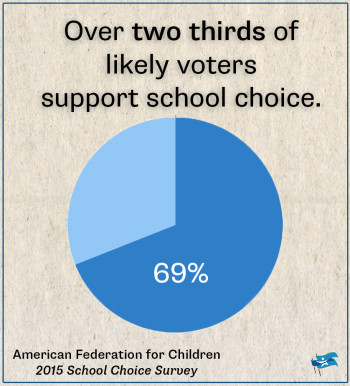
HT: Stephen Franks


Cigarette smuggling in the United States on a state-by-state basis
18 Feb 2015 Leave a comment
in applied price theory, applied welfare economics, economics of crime, law and economics, macroeconomics, politics - Australia, politics - New Zealand, public economics, taxation Tags: smuggling, tax avoidance, tobacco regulation, tobacco taxation

Who benefits from a minimum wage increase in the USA
17 Feb 2015 Leave a comment
in applied welfare economics, labour economics, minimum wage, politics - New Zealand, politics - USA Tags: poverty and inequality
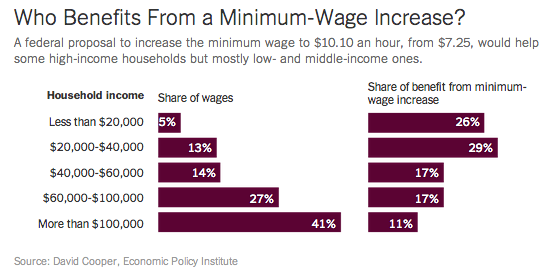
HT David_Boaz’s Tweet – https://twitter.com/David_Boaz/status/477910953548197888?s=09

Ricardian equivalence alert: Millennials and the funding of their retirements
17 Feb 2015 5 Comments

Abolish by-elections in the New Zealand Parliament
16 Feb 2015 Leave a comment
in constitutional political economy, politics - New Zealand
When an electorate seat becomes vacant in the New Zealand House of Representatives, there is a by-election. When there is a list seat vacancy, the vacancies are filled by the next person on the party list.

In Parliament of 120, and with mixed member proportional representation (MMP), virtually all New Zealand elections are close and have coalition governments. Through defections, since the introduction of MMP in 1996, two governments have lost their majority on the floor of the house and had to work for every vote or had to form into a new coalition in the middle of the Parliamentary term.
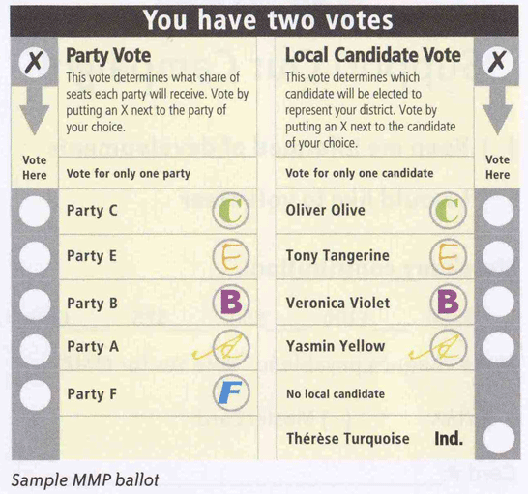
The major parties – the Labour Party and the National Party – have never won a majority in their own right. The National Party has 60 out of 121 seats in the current House of Representatives. That’s the closest anyone has got to governing in their own right. The Labour Party is never won more than 50 seats in the New Zealand Parliament since introduction of MMP.
There is a by-election shortly. It’s in a safe National Party seat. If the current casual vacancy and by-election was in a marginal seat, it’s possible that a by-election could upset the result of the recent General Election and distort the proportionality of Parliament.
The whole point of proportional representation is the parties win seats in Parliament equal to their party vote.
The solution to this constitutional risk is to abolish by-elections. In the Australian Senate, vacancies are filled by nominee of the same party from which the departing senator came from.
Casual vacancies in the House of Representatives for electorate seats could be filled by the next person on the party list or by a nominee of the registered political party from which the departing MP was elected in the General Election. That second option would allow the electorate seat to be filled by a party member who lives in the local area rather than the next member of the party list who could come from anywhere in the New Zealand.
A firm with no employees is not a firm
16 Feb 2015 Leave a comment
in econometerics, politics - USA, theory of the firm Tags: Armen Alchian, Eugene Fama, Harold Demsetz, Ronald Coase, Yoram Barzel
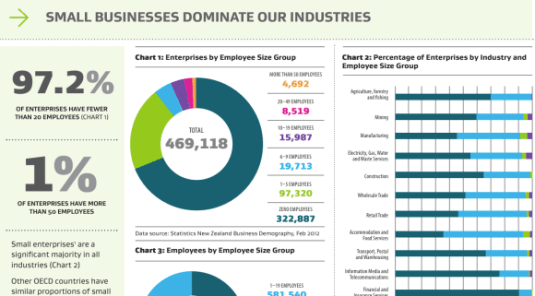
Business demographic statistics in New Zealand include companies with zero employees and calls them a firm.

Source: Statistics New Zealand.
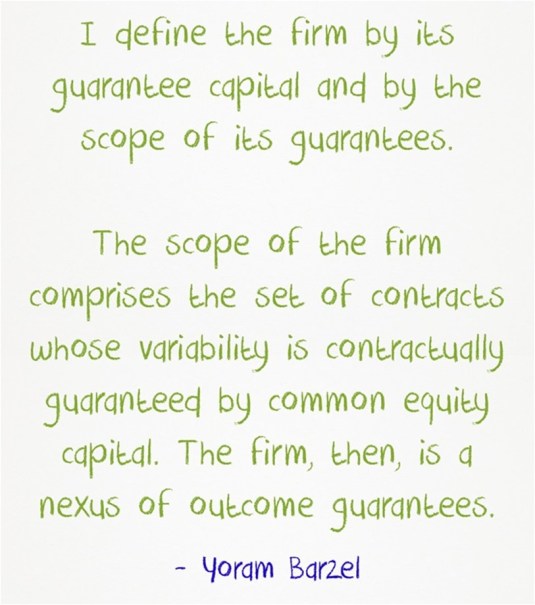
Every definition of a firm that I have seen refers to a firm as a relationship between employers, employees and others. There is team production or some sort of nexus of contracts or dependent assets, something social.
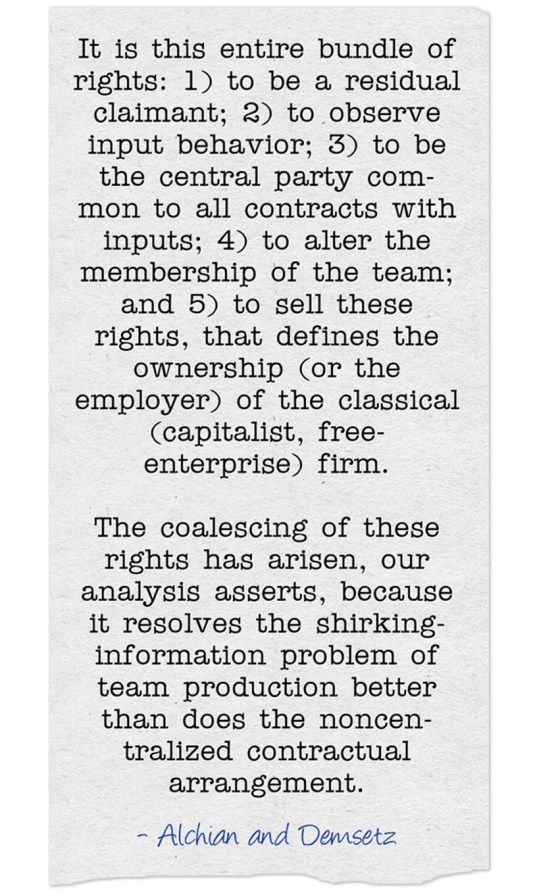
The notion is that transactions that normally take place in the market are taken out of the market and take place within the firm. Most profoundly, as Ronald Coase explained in 1937 in his seminal work The Nature of the Firm is what needs to be explained is the existence of the firm, with its
distinguishing mark … [of] the supersession of the price mechanism.
If there’s only one person in the firm, there is no one to transact with within the firm that the parties would normally have otherwise done in the market at arm’s length. There is no suppression of the price system, because all the dealings of the one person firm is with others. There are no transactions outside of the price system. As Barzel and Kochin explain when contrasting Ronald Coase’s theory of the firm with that of Alchian and Demsetz:
Even though they offer an alternative to Coase’s theory of the firm, their firm, nevertheless, is fundamentally a transaction cost phenomenon – it arises in response to the costs associated with measuring and policing various inputs and outputs.
Doug Allen, along with Eugene Fama, argue that all economic organisations are designed to maximise the gains from trade net of transaction costs. Other forms of organisation, forms of organisation that do not maximise the gains from trade net of transaction costs as well would not survive in market competition.
Transaction costs are defined by Allen as the costs of establishing and maintaining property rights. Yoram Barzel defines (economic) property rights (in this paper, p. 394) as:
… an individual’s net valuation, in expected terms, of the ability to directly consume the services of the asset, or to consume it indirectly through exchange. A key word is ability: The definition is concerned not with what people are legally entitled to do but with what they believe they can do.
A property right, according to Alchian (1965, 1987) and Cheung (1969), is essentially the ability to enjoy a piece of property, but this ability to benefit from an asset or commodity, either directly, or indirectly through market exchange, is seldom unhindered. Eugene Fama observed that:
The striking insight of Alchian and Demsetz (1972) and Jensen and Meckling (1976) is in viewing the firm as a set of contracts among factors of production. In effect, the firm is viewed as a team whose members act from self-interest but realize that their destinies depend to some extent on the survival of the team in its competition with other teams.
If the firm consists only of the owner, there is no internal constraints on the establishment and maintenance of property rights because no one else is in the firm to cause any conflict. There is no nexus of contracts between different suppliers of production inputs whose destinies depend on the ability of them as a team to survive in competition with other teams.
Whatever constraints might arise about the ability of the owner to actually exercise property rights, none of these constraints arise internally to the firm because of the presence of employees or partners.

If there are no employees, if the firm only consist of the owner, the purpose of the firm, which is to make the incentives of workers compatible with those of owners is lost.
Firms, to be a firm, must have employees. If not employees, there must be at least more than one party involved, such as in a partnership.
Firms exist because it is cheaper to organize inputs within a firm than buy and sell in many different markets. This buying and selling requires a continual negotiation, renegotiation, enforcement and monitoring of contracts at arm’s length with independent suppliers of inputs. Barzel stressed this enforcement of property rights in an unpublished paper:
I hypothesize that the firm is organized for the express purpose of creating rights that are more economically enforced by non-state rather than by state means.
Many of these firms with zero employees in the New Zealand business demographic statistics, a classification that accounts for over 60% of all firms in New Zealand, are shelf companies or property investment companies.
There is no measuring and policing of inputs and outputs in a firm that has no employees and only an owner. These entities are not firms. They meet none of the criteria for a firm in the economics of industrial organisation.
This failure to distinguish between a firm and other forms of organisation leads the Minister of Economic Development to say unfortunate things such as:
97 per cent of enterprises in New Zealand are small businesses and have fewer than 20 employees.
Two thirds of that 97% of enterprises has no employees. Any discussion that pretends to know that there are too many or too few small and large firms in New Zealand should not be confused with other forms of organisation of capital that have nothing to do with the topic at hand, which is usually workplace productivity and entrepreneurial competence.
Many of these zero employee firms are not even economic organisations. They are legal mechanisms for exercising legal property rights. Including these property rights in business demographic statistics on business organisations is confusing.
Was Moynihan Right?
16 Feb 2015 Leave a comment


Anti-science Left alert: the Greens on GMOs and vaccines
15 Feb 2015 Leave a comment
in health economics, politics - New Zealand, politics - USA Tags: anti-GMO movement, Anti-Science left, anti-vaccination movement, GMOs, green hypocrisy, Green Left, Greens
Join the calls of NZ MPs to ban Dihydrogen Monoxide (DHMO)
15 Feb 2015 Leave a comment
in health economics, politics - New Zealand Tags: DHMO, science awareness

In 2001, a staff member in New Zealand Green MP Sue Kedgley’s office responded to a request for support saying she would be “absolutely supportive of the campaign to ban this toxic substance”.
Otago Labour Party MP Jacqui Dean wrote to New Zealand’s Associate Health Minister Jim Anderton in 2007 asking if the Expert Advisory Committee on Drugs had a view on banning DHMO.
Ask your local MP now to join the global movement to ban DHMO.


Recent Comments