Those subservient press barons

Both political parties used television licensing and the threat of cable TV to manipulate Murdoch, Packer and the other press barons. They were victims of Fred McChesney’s concept of rent extraction:

  • Rent extraction is the politician’s pastime of threatening harmful legislation to extract political support and contributions from well-heeled private institutions.
  • Payments to politicians are often made not for political favours, but to avoid political disfavour, that is, as part of a system of political extortion or rent extraction.

Rent extraction is money for nothing – money paid in exchange for politicians’ inaction.

The politician is paid, not for rent creation, but for withholding legislative and regulatory action that would destroy existing private rents.

McChesney establishes the conditions under which of rent creation or extraction will occur. The relative attractiveness of the two strategies depends on the elasticities of demand and supply.

  • If demand is relatively inelastic, rent creation will occur; and
  • If supply is relatively inelastic, rent extraction will occur.

The existence of an organization or a large established firm lowers transaction costs for the politicians negotiating and collecting donations and support, making rent expropriation threats easier.

It is hard to extort rents from those with little in the way of organisation. A cost of being an established lobbying organisation or a large firm with high fixed costs is a greater potential for rent extraction.

The print and electronic media are ripe for rent extraction because of their immobile assets and heavy regulation.

Investors in heavily regulated capital intensive industries such as the mass media, digital and print, do not bite the hand the feeds them.

Little wonder that the media barons were honoured supplicants to whomever is in power in Canberra. They are soon Labor’s business mates whenever Labor was in power.

Threatening to allow cable TV was the big stick in every Australian government’s hand until the 1990s to extract support or at least subservience from the media.

Rupert Murdoch has unashamedly backed political winners, only to dump them when he was convinced that they were washed up or that his newspapers might be left stranded on the losing side of politics.

Murdoch’s see-sawing political stances are entirely pragmatic. He has always been prepared to back winners just before they win, and to shift allegiances on non-ideological grounds.

The Internet Arguing Checklist for Right-Wingers

  1. Say something offensive.
  2. Pretend statistics support your offensive statement.
  3. Claim liberal bias in the media.
  4. Claim there’s a liberal agenda.
  5. Offer up a conspiracy theory.
  6. Call your opponent stupid.
  7. Gloat about your accomplishments.
  8. Offer easily disqualified opinions.
  9. Create derogatory nicknames for opponents.
  10. Say science proves your point.
  11. Say science is limited when it conflicts with your point.
  12. When all else fails, Communism!

via Pox Vopoli: The Internet Arguing Checklist for Right-Wingers.

The Internet Arguing Checklist for Left-Wingers

  1. Skim until Offended
  2. Disqualify that Opinion
  3. Attack, Attack, Attack
  4. Disregard Inconvenient facts
  5. Make Shit Up
  6. Resort to Moral Equivalency
  7. Concern Trolling
  8. When all else fails, Racism!

arguemnetuj1.jpg Internet Argument image by AzarIwa

via The Internet Arguing Checklist | Monster Hunter Nation.

First they came…

Why I am not reviewing Thomas Piketty’s Capital in the Twenty-First Century – updated again

It’s 700 pages long and goes on about Marx. Some people were watching the other channel when the Berlin Wall fell.

thomas-piketty-economist-will-hutton

My 1 o’clock lecture at ANU in 1990 was next to a room rented out ironically from 12 to 1 to the Campus Trots and then to the Campus Christians for an hour of prayer to another saviour.

The Twitter summary of Piketty is this:

Karl Marx wasn’t wrong, just early. Pretty much. Sorry, capitalism. #inequalityforevah

The only Marxist I bother with is Jon Elster. He is a leading proponent of Analytical Marxism and one of the last polymaths. Brian Barry once wrote that to review one of Elster’s books one:

would either have to have taken off several years to master the many fields which fall within Elster’s purview or would be a consortium of at least twenty carefully-chosen experts.

All of Elster’s books and writings are worth reading, including

  • Ulysses and the Sirens (1979);
  • Sour Grapes: Studies in the Subversion of Rationality (1983);
  • Making Sense of Marx (1985); and
  • An Introduction to Karl Marx (1986).

As Jon Elster noted:

Marxian economics is, with a few exceptions, intellectually dead

and Marx’s labour theory of value is:

useless at best, harmful and misleading at its not infrequent worst.

To go on with my non-review, I will quote Tyler Cowen:

The crude seven-word version of Piketty’s argument is “rates of return on capital won’t diminish.”

Piketty’s reasons why rates of return on capital won’t diminish are fairly specific and restricted to only a small share of capital.

.. In any case this is pure speculation and Piketty’s entire argument depends upon it.

… Piketty converts the entrepreneur into the rentier.

To the extent capital reaps high returns, it is by assuming risk…

Yet the concept of risk hardly plays a role in the major arguments of this book.

Once you introduce risk, the long-run fate of capital returns again becomes far from certain.

In fact the entire book ought to be about risk but instead we get the rentier…

Overall, the main argument is based on two (false) claims.

First, that capital returns will be high and non-diminishing, relative to other factors.

Second, that this can happen without significant increases in real wages.

Piketty’s advocacy of a top marginal income tax rate of 80% and a an international treaty for a wealth tax are wildly impractical and destructive of economic growth and entrepreneurship. His advocacy of 60% marginal tax rates on incomes above $200,000 strike at the heart of the professional and managerial occupations that are the backbone of day-to-day capitalism. Piketty’s wealth tax would tax the homes and the retirement savings of the ordinary middle class:

  • wealth below 200,000 euros be taxed at a rate of 0.1 percent,
  • wealth between 200,000 and one million euros at 0.5 percent,
  • wealth between one million and five million euros at 1.0 percent, and
  • wealth above five million euros at 2.0 percent.

Piketty’s reason for these high top tax rates is not to bring in more revenue or to redistribute wealth to poor and the downtrodden but simply “to put an end to such incomes.” Harsanyi argues that:

Like many progressives, Piketty doesn’t really believe that most people deserve their wealth anyway, so confiscating it presents no real moral dilemma.

He also argues that we can measure a person’s productivity and the value of a worker (namely, low-skilled labourers) while arguing that other groups of workers (namely, the kind of people he doesn’t admire) are bequeathed undeserved, “arbitrary” salaries. What tangible benefit does a stockbroker or a kulak or an explanatory journalist offer society, after all?

This takes me back to Jon Elster who had this to say on socialism:

Optimism and wishful thinking have been features of socialist thought from its inception.

In Marx, for instance, two main premises appear to be that whatever is desirable is possible, and that whatever is desirable and possible is inevitable.

…It has become clear that classical socialism massively underestimated the importance of economic incentives.

Greg Mankiw is less harsh, but still to the point:

Like President Obama and others on the left, Piketty wants to spread the wealth around.

Another philosophical viewpoint is that it is the government’s job to enforce rules such as contracts and property rights and promote opportunity rather than to achieve a particular distribution of economic outcomes.

No amount of economic history will tell you that John Rawls (and Thomas Piketty) offers a better political philosophy than Robert Nozick (and Milton Friedman).

John Rawls was actually very much alive to the importance of incentives in a just and prosperous society.

Unequal incomes might turn out to be to the advantage of everyone. Work effort and entrepreneurial alertness respond to incentives; incentives channel people into the occupations and jobs where they produce more.

Rawls lent qualified support to the idea of a flat-rate consumption tax because these taxes:

impose a levy according to how much a person takes out of the common store of goods and not according to how much he contributes.

A simple way to have a progressive consumption tax is to exempt all savings from taxation.

With his emphasis on fair distributions of income, Rawls’ initial appeal was to the Left. Left-wing thinkers then started to dislike his acceptance of capitalism and his tolerance of large discrepancies in income and wealth.

It’s impossible to make the workers better off by taxing capital. The optimal rate of tax on income from capital is zero. This is why the Mirrlees Review of the UK taxation system argued for zero taxation of the returns to capital.

Robert Lucas estimated in 1990 that eliminating all taxes on income from capital would increase the U.S. capital stock by about 35% and consumption by 7%.

Hans Fehr, Sabine Jokisch, Ashwin Kambhampati, and Laurence J. Kotlikoff (2014) found that eliminating the corporate income tax completely would raise the U.S. capital stock (machines and buildings) by 23%, output by 8% and the real wages of unskilled and skilled workers each by 12%.

Book reviews serve the same purpose as film reviews. They are filters for our time. Do you agree?

I made a time management decision to not read a long book plenty of others reviewed and some even understood.

As for the growing income inequality, there is a long literature dating back 25-years arguing that skill-biased technological change is increasing the returns to investing in education as Gary Becker blogged in 2011:

Earnings inequality in the United States and many other countries has increased greatly since the late 1970s, due in large measure to globalization and technological progress that raised the productivity of more educated and more skilled individuals.

While the average American college graduate earned about a 40% premium over the average high school graduate in 1980, this premium increased to over 70% in 2000.

The good side of this higher education-based earnings inequality is that it induced more young men, and especially more young women, to go to and finish college.

The bad side is that many sufficiently able children could not take advantage of the greater returns from a college education because their parents did not prepare them to perform well in school, or they went to bad schools, or they lacked the financing to attend college.

As a result, the incomes of high school dropouts and of many high school graduates stagnated while incomes boomed for many persons who graduated college, and even more so for those with post graduate education.

There is nothing new under the sun.

My favourite speech: Vaclav Havel’s address to the US Congress, 21 February 1990

Dear Mr. President, dear Senators and Members of the House, ladies and gentlemen:

My advisers advised me to speak on this important occasion in Czech. I don’t know why. Perhaps they wanted you to enjoy the sweet sounds of my mother tongue.

Vaclav_havel

The last time they arrested me, on October 27 of last year, I didn’t know whether it was for two days or two years.

Exactly one month later, when the rock musician Michael Kocab told me that I would be probably proposed as a presidential candidate, I thought it was one of his usual jokes.

On the 10th of December, 1989, when my actor friend, Jiri Bartoska, in the name of the Civic Forum, nominated me as a candidate for the office of president of the republic, I thought it was out of the question that the parliament we have inherited from the previous regime would elect me.

Nineteen days later, when I was unanimously elected president of my country, I had no idea that, in two months, I would be speaking in front of this famous and powerful assembly and that what I say would be heard by millions of people who have never heard of me and that hundreds of politicians and political scientists would study every word that I say.

When they arrested me on October 27, I was living in a country ruled by the most conservative communist government in Europe, and our society slumbered beneath the pall of a totalitarian system.

Today, less than four months later, I’m speaking to you as the representative of a country that has set out on the road to democracy, a country where there is complete freedom of speech, which is getting ready for free elections and which wants to create a prosperous market economy and its own foreign policy…

The living wage

Why not just increase the family tax credit? That would increase the incomes of poor families without putting their jobs at particular greater risk.

The local calculation of the living wage includes cable TV and an overseas holiday.

Milton Friedman provides some critical truths on the living wage:

Do-Gooders believe passing a law saying nobody shall get less than [a minimum wage] is helping poor people (who need the money).

You’re doing nothing of the kind.

What you’re doing is to ensure that people whose skills do not justify that wage will be unemployed.

Richard Tol: IPCC again

Richard Tol reports that landlocked countries vigorously protested at IPCC meetings that they too would suffer from sea level rise!

Richard S. J. Tol

This was because the international climate negotiations of 2013 in Warsaw concluded that poor countries might be entitled to compensation for the impacts of climate change.

The assessment of the size of those impacts and hence any compensation led to an undignified bidding war among delegations – my country is more vulnerable than yours. Landlocked countries had no intention of missing out.

The IPCC is a typical multilateral meeting process from Tol’s description:

  • Many countries send a single person delegation.
  • Some countries can afford to send many delegates.
  • They work in shifts, exhausting the other delegations with endless discussions about trivia, so that all important decisions are made in the final night with only a few delegations left standing.

Naturally, all inconvenient truths are vetoed, as Tol explains, listing the following omissions and redrafts of the Summary for Policy Makers:

Tol then aptly states his position on it all:

Alarmism feeds polarization.

Climate zealots want to burn heretics of global warming on a stick.

Others only see incompetence and conspiracy in climate research, and nepotism in climate policy.

A polarized debate is not conducive to enlightened policy in an area as complex as climate change – although we only need a carbon tax, and a carbon tax only, that applies to all emissions and gradually and predictably rises over time.

HT: Catallaxyfiles

Is the IPCC Government Approval Process Broken? | Robert Stavins

Robert Stavins, the Co-Coordinating Lead Author of Chapter 13, “International Cooperation:  Agreements and Instruments,” of Working Group III (Mitigation) of the Fifth Assessment Report of the Intergovernmental Panel on Climate Change (IPCC) has written a letter arguing the following:

  • If the IPCC is to continue to survey scholarship on international cooperation in future assessment reports, it should not put country representatives in the uncomfortable and fundamentally untenable position of reviewing text in order to give it their unanimous approval. 
  • In my view, with the current structure and norms, it will be exceptionally difficult, if not impossible, to produce a scientifically sound and complete version of text for the SPM on international cooperation that can survive the country approval process.
  • The general motivations for government revisions – from most (but not all) participating delegations – appeared to be quite clear in the plenary sessions.
  • These motivations were made explicit in the “contact groups,” which met behind closed doors in small groups with the lead authors on particularly challenging sections of the SPM.
  • In these contact groups, government representatives worked to suppress text that might jeopardize their negotiating stances in international negotiations under the United Nations Framework Convention on Climate Change (UNFCCC).
  • Nearly all delegates in the meeting demonstrated the same perspective and approach, namely that any text that was considered inconsistent with their interests and positions in multilateral negotiations was treated as unacceptable.

HT: Catallaxyfiles

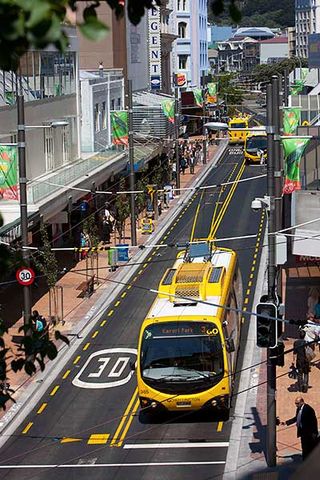
@NZGreens @GreenpeaceNZ The scrapping of the trolley buses is great news – killer green technology alert

The extra costs associated with the wire network and the difficulty of changing the buses’ routes were the main factors in this great decision.

Goldenmile-busroute-lg

Trolley buses cause backlogs when they brake down because they cannot overtake a broken-down bus. The trolley buses just stake-up behind the broken-down bus because they cannot overtake.

I have been trapped on a diesel express bus this way commuting to work many times. Central Wellington grinds to halt when one trolley bus breaks-down.

The 50-year-old power system would need upgrading soon costing “tens of millions of dollars,” and maintaining the 160 kilometres of wires and 15 substations costs $6m a year. The one-off cost of dismantling this network is cheaper than this!

Trolley bases are a killer green technology: drivers have been killed while standing on the road behind the bus reconnected the arms on the top of the bus to the overhead wires. These arms disconnect frequently, and have even hit people on the side of the road.

Wellington is earthquake prone. Having public transport run off a single electric power source connected to overhead wires is fool hardy.

I grew up in a small country town. I have none of the obsessions that big-city folk and the inner-city green voters, in particular, have with buses.

Climate policy targets revisited | Richard Tol

The IPCC’s Fifth Assessment Report estimates lower costs of climate change and higher costs of abatement than the Stern Review. However, current UN negotiations focus on stabilising atmospheric concentrations of greenhouse gases at even lower levels than recommended by Stern.

This column argues that, given realistic estimates of the rate at which people discount the future, the UN’s target is probably too stringent.

Moreover, since real-world climate policy is far from the ideal of a uniform carbon price, the costs of emission reduction are likely to be much higher than the IPCC’s estimates.

PRTP is the preferred rate of time preference used in net present value calculations.

via Climate policy targets revisited | vox.

Rod Croome’s unanticipated revolution

Back in 1986, an old University mate of mine, Rod Croome was very physically brave in his protesting for reforms to the Tasmanian state criminal law.

  • Rod even walked into a Tasmanian police station and confessed to abominations against the order of nature, as the Tasmanian criminal code called it.
  • The Police said they could not prosecute without the other party coming forward as the witness. The abominee did.
  • The Tasmanian Director of Public Prosecutions then declined to prosecute on public interest grounds. His discretion to not prosecute is absolute.

These days, Rod is campaigning for the equal right to marry. All inside one generation!

When Rod walked out of that police station rather disappointed at being a free man, I wonder if he anticipated how much change would happen regarding gay rights in his lifetime, much less in the next 5, 10, and 20-years.

A good explanation of this rapid social change is in Timur Kuran’s “Sparks and Prairie Fires: A Theory of Unanticipated Political Revolutions” and “Now Out of Never: The Element of Surprise in the East European Revolution of 1989“.

Kuran suggests that political revolutions and large shifts in political opinion will catch us by surprise again and again because of people’s readiness to conceal their true political preferences under perceived social pressure:

People who come to dislike their government are apt to hide their desire for change as long as the opposition seems weak.

Because of the preference falsification, a government that appears unshakeable might see its support crumble following a slight surge in the opposition’s apparent size, caused by events insignificant in and of themselves.

Kuran illustrated his bandwagon effect first with the fall of the Russian Czar in 1918. On the morning of the day that the Czar abdicated, he thought it was just another day at the office. But the regiment stationed in St. Petersburg to put down riots had been recently sent to the front. The raw recruits that replaced them melted away in the front of the rioters. The rest is history.

Then there is the Ayatollah Khomeini: two months before the Iranian Revolution, the main concern of his aides was his French visa was expiring; He needed a new country to seek refuge. Just before the Iranian Revolution of 1979, a CIA report characterised the Shah of Iran as an “island of stability.”

clip_image001

Yeltsin came to power after the coup attempt by hard-liners against Gorbachev because a KBG regiment sent to arrest Yeltsin mutinied against the orders of the hard-line coup leaders. Then everyone at the top of the military and security forces saw their main chance and switched sides. All popular revolutions against autocrats are ultimately palace revolutions, as I have argued before.

The loyalties of security forces are crucial in any political revolution. Within the security forces, a key concern is ending-up on the winning side in any show-down. Moving too early, too late or not at all have risks of their own when the time comes after a military coup to reward supporters and punish those that chose the wrong side, or even worse, sat on the side-lines waiting to see who would win.

Kuran argues that everyone has a different revolutionary threshold where they reveal their true beliefs, but even one individual shift to opposition leads to many others to come forward and defy the existing order. Small concessions only emboldens the ground-swell of revolution.

Those ready to oppose social intolerance or who are lukewarm in their intolerance keep their views private until a coincidence of factors gives them the courage to bring their views into the open. They find others share their views and there is a revolutionary bandwagon effect.

Plenty of people have had personal experiences of this in the 1980s and the 1990s when there were rapid changes in social and political attitudes about racism, sexism and gay rights.

A few political entrepreneurs such as Rod Croome had to stand up for what was right, and a surprisingly large number of others will quickly join the side pushing for social change.

clip_image002

In switching sides, these early movers and initial protestors encourage other hidden opponents of the established social and political order to switch. As knowledge of the opposition spreads and grows, the external cost of joining becomes lower.

clip_image003

In Crime Waves, Riots, and Revolutions, Alex Tabarrok makes the important related point that when the courts and police are over-crowded and over-whelmed, proportionately fewer criminals or protestors will be apprehended, convicted, and imprisoned or otherwise socially pressured to conform. This feedback effect from one decision to participate in crime or protest to the decisions of others to break the law or rebel can be highly significant.

Kuran argued that fear changes sides once the revolutionary bandwagon takes hold: genuine supporters of the old political or social older or the traditional social values falsify their publicly professed preferences, pretending that they support the new order.

These are late-switchers. Do not trust them.

These late switchers are opportunists who will as easily switch back or move on to support another coup or a counter-coup or a return to traditional values.

Kuran argued that the reason for the bloody purges among revolution movements after many takeovers is to find and route-out these late-switchers. Many are purged, rightly or wrongly, before they have a chance to betray the current leaders of the revolution or military coup.

There are plenty of Christian and family parties winning upper house seats in Australia and soon in the New Zealand House of Representatives. There are plenty of morally manoeuvrable politicians willing to switch to their side if they have enough votes.

Ministers of course have a whole range of dazzling qualities, including … um … well, including an enviable intellectual suppleness and moral manoeuvrability.

Sir Humphrey, The Death List

Addendum: don’t pretend it was just the old fogeys who were the social reactionaries back then in the 80s.

When a gay men’s club sought affiliation with the Tasmanian University Union’s Societies Council in 1983, a number of clubs spoke against it because they simply didn’t like gays. I was there representing a catholic college students club so I seconded the motion.

When the motion was put to the vote, it was carried on the voices with a lot of people not saying anything or mumbling against it.

The chairman of the meeting, who was a member of the Liberal club, wisely didn’t put the motion to a vote. He declared it carried and moved as quickly as possible to the next item of business in case there was a call for show of hands.

Anti-gay rhetoric was common among young people in the 1980s.

Paul Krugman, Tom Sargent and Me

Paul Krugman seems to be implying that I am the double-secret ring-leader of a vast right-wing conspiracy.

clip_image001

Today in his blog at the New York Times, Krugman said:

…why the sudden attention to Sargent’s 2007 speech?

I think it’s fairly obvious: it’s essentially stealth anti-Keynesian propaganda, cloaked in the form of a widely respected and liked economist uttering what sound like eternal truths.

But they aren’t, and the real goal here is to undermine the case for fighting unemployment in the here and now. There are virtues to that 2007 talk, but right now is no time for 2007 Sargent.

In my reply at his blog, I said that I originally posted the link to Sargent’s speech to make a point that most economic analysis is free of politics because the average economist is a moderate Democrat. Tom Sargent is a life-long Democrat.

To add to my reply at Krugman’s blog, Krugman said earlier in his blog that:

It’s not so much that what Sargent said is wrong, although some of his principles are by no means universally agreed upon, even in normal times.

What’s so striking about Sargent’s points is that it’s hard to think of a worse time to cite them.

And the people citing that old speech clearly have ulterior motives.

I live in New Zealand. Not everything is about U.S. domestic politics.

I rather prophetical said on Marginal Revolution on the 20th that “Too many on social media such as Reddit responded by smearing Sargent as a right-winger and neo-liberal. He is a life-long Democrat.”

My conspiratorial minions span the globe to include initially Newmark’s Door and then Marginal Revolution,  Stephen Williamson, Vox.com, the American Enterprise Institute, Catallaxyfiles and the Business Insider to name but a few. There are other unindicted co-conspirators.

Karl Popper argued that conspiracy theories overlook the pervasive unintended consequences of political and social action; conspiracy theorists assume that all consequences must have been intended by someone.

Krugman agrees that Sargent’s 12-points are not that controversial in themselves. Krugman then plays the man rather than the ball:

“How to discredit an unwelcome report:

… Stage Four: Discredit the person who produced the report. Explain (off the record) that
1. He is harbouring a grudge against the Department.
2. He is a publicity seeker.
3. He is trying to get a Knighthood/Chair/Vice Chancellorship.
4. He used to be a consultant to a multinational.
5. He wants to be a consultant to a multinational.

Sir Humphrey, The Greasy Pole

The case against industry policy in one photo

Industry policy is back in vogue in New Zealand:

  • The National Party-led Government is keen on smart specialisation.
  • The Labour Party wants a Manufacturing Upgrade targeting R&D and innovation.

The case against picking winners is the answer to the question in the picture of the weirdoes below.

One of the people in the photo won a competition on the radio that offered free company photos. That is how Microsoft could afford the photo. That photo became one of the most iconic photos in American business history.

I first saw this photo 12-14 years ago at a presentation, so who first designed the caption is lost in time.

Previous Older Entries Next Newer Entries

Libertarian Land

Celebrating humanity's flourishing through the spread of capitalism and the rule of law

Arin’s Substack

Celebrating humanity's flourishing through the spread of capitalism and the rule of law

David Andolfatto

Celebrating humanity's flourishing through the spread of capitalism and the rule of law

Monetary Non-Neutrality

Celebrating humanity's flourishing through the spread of capitalism and the rule of law

Reason Magazine

Celebrating humanity's flourishing through the spread of capitalism and the rule of law

Coyote Blog

Celebrating humanity's flourishing through the spread of capitalism and the rule of law

Thoughts from the North

Celebrating humanity's flourishing through the spread of capitalism and the rule of law

Fardels Bear

A History of the Alt-Right

Vincent Geloso

Econ Prof at George Mason University, Economic Historian, Québécois

Bassett, Brash & Hide

Celebrating humanity's flourishing through the spread of capitalism and the rule of law

Truth on the Market

Scholarly commentary on law, economics, and more

The Undercover Historian

Beatrice Cherrier's blog

Matua Kahurangi

Celebrating humanity's flourishing through the spread of capitalism and the rule of law

Temple of Sociology

Celebrating humanity's flourishing through the spread of capitalism and the rule of law

Velvet Glove, Iron Fist

Celebrating humanity's flourishing through the spread of capitalism and the rule of law

Why Evolution Is True

Why Evolution is True is a blog written by Jerry Coyne, centered on evolution and biology but also dealing with diverse topics like politics, culture, and cats.

NoTricksZone

Celebrating humanity's flourishing through the spread of capitalism and the rule of law

Homepaddock

A rural perspective with a blue tint by Ele Ludemann

Kiwiblog

DPF's Kiwiblog - Fomenting Happy Mischief since 2003

The Dangerous Economist

Celebrating humanity's flourishing through the spread of capitalism and the rule of law

Watts Up With That?

The world's most viewed site on global warming and climate change

The Logical Place

Tim Harding's writings on rationality, informal logic and skepticism

Doc's Books

A window into Doc Freiberger's library

The Risk-Monger

Let's examine hard decisions!

Uneasy Money

Commentary on monetary policy in the spirit of R. G. Hawtrey

Barrie Saunders

Thoughts on public policy and the media

Liberty Scott

Celebrating humanity's flourishing through the spread of capitalism and the rule of law

Point of Order

Politics and the economy

James Bowden's Blog

A blog (primarily) on Canadian and Commonwealth political history and institutions

Science Matters

Reading between the lines, and underneath the hype.

Peter Winsley

Economics, and such stuff as dreams are made on

A Venerable Puzzle

"The British constitution has always been puzzling, and always will be." --Queen Elizabeth II

The Antiplanner

Celebrating humanity's flourishing through the spread of capitalism and the rule of law

Bet On It

Celebrating humanity's flourishing through the spread of capitalism and the rule of law

History of Sorts

WORLD WAR II, MUSIC, HISTORY, HOLOCAUST

Roger Pielke Jr.

Undisciplined scholar, recovering academic

Offsetting Behaviour

Celebrating humanity's flourishing through the spread of capitalism and the rule of law

JONATHAN TURLEY

Res ipsa loquitur - The thing itself speaks

Conversable Economist

In Hume’s spirit, I will attempt to serve as an ambassador from my world of economics, and help in “finding topics of conversation fit for the entertainment of rational creatures.”

The Victorian Commons

Researching the House of Commons, 1832-1868

The History of Parliament

Articles and research from the History of Parliament Trust

Books & Boots

Reflections on books and art

Legal History Miscellany

Posts on the History of Law, Crime, and Justice

Sex, Drugs and Economics

Celebrating humanity's flourishing through the spread of capitalism and the rule of law

European Royal History

Exploring the Monarchs of Europe

Tallbloke's Talkshop

Cutting edge science you can dice with