The Case for Boring Courts and Very Bored Lawyers

The world would be a better place if law was the most boring occupation about.

Lawyers and the court room make for great TV drama, but if the outcome of most litigation was fairly predictable, we would all be better-off.

Ordinary people would not fear law suits or suing to uphold their rights if the law was simple. With the law clear-cut, every-one knows where they stand. People settle out of court. They do not misbehave in the first place because they know they will be liable and will have to pay.
Richard Epstein contents that

…greater judicial sophistication has not brought forth higher quality judgments, but rather the reverse

…An easy mistake for a modern judge to make is to assume that the tools he or she possesses are capable of being put to good ends, and that it is possible to tell which of the parties in a given case are the ‘good guys’ and which are the ‘bad guys’.

…Most of the cases that a judge sees are aberrations.

Yet it is a great mistake for a judge to assume that the rules a court creates only apply to the aberrational cases.

The legal rules will also govern the mundane cases that remain within the system, to be resolved without litigation.

The judge needs to fear that laying down an ideal rule for this one case in a thousand may unglue the system that works well for the other 999 cases.

We all bargain in the shadow of the courts and the law. Bargaining and the enforcement of contracts and property rights and the resolution of disputes would be a lot cheaper if we knew what would happen if we did not settle and went to court.

As an example of the simple rules he champions, Epstein proposed that the default divorce settlements be 50:50.

Epstein also supports employment at will as the default rule because "you’re fired, I quit" could not be simpler to understand and administer.

Everyone knows where they stand and a free to make more detailed marital or employment agreements if they wish. Many do: contractors and short-term routinely earn a premium over permanent employees with more job security.

The law attracts more than its share of reformers wanting to use the courts and judge-made law for political purposes.

If you want to reform the world, do what we ordinary people have to do: change your vote, write a mail to an MP, protest, donate to or even join a political party, or run for parliament.

Some lawyers think themselves above how ordinary people must resolve their differences in democracies: by trying to persuade each other and elections.

The great strength of democracy is a small group of concerned and thoughtful citizens can band together and change things by running for office and winning elections.

That is how new Australian parties such as the Labor Party, the Country Party, Democratic Labor Party, the Australian Democrats and the Greens changed Australia. One Nation even had its 15 minutes of fame with its 11 MPs. Australian state upper houses even have Christian, family and shooters parties and many independents. A middle-of-the-road Senate independent in South Australia nearly topped the poll.

All of these parties started in a living room full of angry, motivated people.

I agree with Antonin Scalia when he said that the purpose of the law is to slow the impassioned majority down:

Judges are sometimes called upon to be courageous, because they must sometimes stand up to what is generally supreme in a democracy: the popular will.

Their most significant roles, in our system, are to protect the individual criminal defendant against the occasional excesses of that popular will, and to preserve the checks and balances within our constitutional system that are precisely designed to inhibit swift and complete accomplishment of that popular will.

Those are tasks which, properly performed, may earn widespread respect and admiration in the long run, but — almost by definition — never in the particular case.

Democracy is government by checks and balance by putting the parties and branches of government in continual tension with each other – it is not trusting the specific people who are currently in power.

Tyler Cowen on the common mistakes of left-wing economists?

1. Suggesting that money matters in politics far more than the peer-reviewed evidence indicates.

2. Evaluating government spending on a program-by-program basis, rather than viewing the budget as a series of integrated accounts.  Cross check with the phrase “Social Security,” or for use to take many discretionary spending cuts off the table.

3. A reluctance to incorporate sophisticated “public choice” theories into the analysis of favored programs.

4. Sins of omission: there are plenty of bad policies, such as occupational licensing, which fail to come under much attack from the left.  Sometimes this is because the critique would run counter to the narrative of needing more government or needing more regulation.

5. Significantly overestimating the quality of the political economy of an America with more powerful labor unions and underestimating the history of labor unions as racist, corrupt, protectionist, and obstructions to positive change.

6. Overestimating the efficacy of fiscal policy, underestimating the power of monetary policy, and sometimes ignoring or neglecting how the two interact (“the monetary authority moves last”).

7. Citing weak versions of structural unemployment theories and dismissing them with a single sentence or graph, while relying on stronger versions of structural theories in other, non-cyclical contexts.

8. Lack of interest in discussing ethnicity and IQ as relevant for social policy, except in preferred contexts.

9. Overly optimistic views of the fiscal positions of state governments.  Since the states don’t have the same tax-raising powers that the feds do, and since state government spending is favored, there is a tendency to see these fiscal crises as not so severe, or as caused by mere obstructionists who will not raise taxes to the required levels.

10. A willingness to think that one has “done one’s best” in the realm of policy, and to blame subsequent policy failures on Republican implementation, rather than admitting that a policy which cannot be implemented by both political parties is perhaps not a good policy in the first place.

11. Use of a strong moral argument for universal health care coverage, combined with a fairly practical, hard-headed approach to the scope of the mandate, and not realizing the tension between the two.  Failure to indicate where the “bleeding heart” argument actually should stop and at what margins we should (and will) let non-elderly people die, if only stochastically.

12. Implicitly constructing a two-stage moral theory, which first cordons off the sphere of the nation-state (public goods provision, etc.) and then pushing cosmopolitan questions off the agenda in the interests of expanding a social welfare state.  (In fairness, many individuals on the right don’t give cosmopolitan considerations even this much consideration, although right-oriented economists tend to be quite cosmopolitan.)

13. What about countries?  Classical liberals are increasingly facing up to the enduring successes of the Nordic nations.  There is not always a similar reckoning with the successes of Chile and Hong Kong and Singapore; often this is a sin of omission.

14. Reluctance to admit how hard the climate change problem will be to solve, for fear of wrecking any emerging political consensus on taking action.

via Common mistakes of left-wing economists?.

Stephen Franks: Time to call out the earthquake sooks-updated

An over-the-top blog post title spoiled a great round-up by Stephen Franks of the costs and benefits of higher building standards regarding earthquakes:

  • Employees are pressing employers to avoid premises seen as risky even if the earthquake risk is a fraction of the risks faced by employees in their homes, or getting to and from work;
  • Retroactive earthquake strengthening may cost more than the cost of a completely new building (the Canterbury Earthquake Royal Commission mentions up to 120%);
  • Retroactively strengthening buildings outside our highest seismic risk regions is rarely likely to pass any rational cost/benefit test because few if any of them will ever cause an injury.
  • The Martin Jenkins & Associates cost benefit study mentioned by the Canterbury Earthquake Royal Commission showed no  retrospective upgrading policy that could deliver net economic benefit.
  • Rationally, almost all existing weaker buildings should be allowed to end their useful life naturally and be replaced.
  • In high risk Wellington the $60m the Council is looking at spending on the Town Hall would save more lives if spent on dedicated cycle-ways.

via StephenFranks.co.nz » Blog Archive » Time to call out the earthquake sooks.

I remember reading a justifiably bitter op-ed by a woman who survived the bus on which a wall fell on and flattened in the second Canterbury Earthquake in February 2011. Eleven died.

That historic wall was known to be in risk is collapse both before and after the first Canterbury Earthquake in 2010.

The wall could not be demolished because of restrictions under the Historic Places Act.

A relative sat on a council committee in a small country town that was among other things trying to demolish a derelict building. The building was protected by heritage legislation.

Permission was refused to demolish the derelict building even after it caught fire and nearly burnt down the pub next door.

What do Ross Perot and the Tea Party have in common?

Popular uprisings are common in US politics. Of late, there has been the Tea Party, Moveon.org and the anti-Iraq war movement.

Remember Ross Perot? He was a well-mannered, TV friendly version of the Tea Party. Perot won 19% of the presidential vote in 1992, and 8.4% in 1996.

Perot appealed to disaffected voters across the political spectrum who had grown weary of the two-party system. NAFTA played a role in Perot’s support, and Perot voters were relatively moderate on hot button social issues.

Perot siphoned votes nearly equally among Bush and Clinton in 1992, but of the voters who cited Bush’s broken "No New Taxes" pledge as "very important," two thirds voted for Clinton.

Attacking Perot as politically unrefined, arrogant and more than a little unstable did not do any good in 1992. Just made him fight harder and also belittled the concerns of his potential supporters thus turning them even more against the major party candidates.

The worst way to ask for someone’s vote is to belittle what troubles them and insult them personally to round things off.

Combining fiscal conservatism with social moderation was Clinton’s response to the Perot insurgency by the time of the 1996 election; adapt or lose office. Clinton was re-elected easily. This made him the first elected incumbent Democratic president to be re-elected since Roosevelt.

Do empirical studies change minds?

Economics got on just fine before the attack of the econometricians and their data mining and publication bias:

From ‘The Scientific Illusion in Empirical Macroeconomics’, Lawrence H. Summers , The Scandinavian Journal of Economics, Vol. 93, No. 2, Proceedings of a Conference on New Approaches to Empirical Macroeconomics. (June 1991), pp. 129-148.

A baser reason for holding out against the latest empirical is in Most Published Research Findings Are False, John Ioannidis says that:

There is increasing concern that in modern research, false findings may be the majority or even the vast majority of published research claims. However, this should not be surprising. It can be proven that most claimed research findings are false

Ioannidis goes on the say that

  • The truth of a research claim is true may depend on study power and bias, the number of other studies on the same question, and, the ratio of true to no relationships among the relationships probed in each scientific field; and
  • a research finding is less likely to be true when the studies conducted in a field are smaller, when effect sizes are smaller, when there is a greater number and lesser preselection of tested relationships, where there is greater flexibility in designs, definitions, outcomes, and analytical modes; when there is greater financial and other interest and prejudice; and when more teams are involved in a scientific field in chase of statistical significance.

Simulations show that for most study designs and settings, it is more likely for a research claim to be false than true. Ioannidis also says that for many current scientific fields, claimed research findings may often be simply accurate measures of the prevailing bias.

Now let The Guardian finish matters with “False positives: fraud and misconduct are threatening scientific research: High-profile cases and modern technology are putting scientific deceit under the microscope”:

Cases of scientific misconduct tend to hit the headlines precisely because scientists are supposed to occupy a moral high ground when it comes to the search for truth about nature. 

The scientific method developed as a way to weed out human bias. But scientists, like anyone else, can be prone to bias in their bid for a place in the history books. 

Increasing competition for shrinking government budgets for research and the disproportionately large rewards for publishing in the best journals have exacerbated the temptation to fudge results or ignore inconvenient data.

Massaged results can send other researchers down the wrong track, wasting time and money trying to replicate them. Worse, in medicine, it can delay the development of life-saving treatments or prolong the use of therapies that are ineffective or dangerous.

Malpractice comes to light rarely, perhaps because scientific fraud is often easy to perpetrate but hard to uncover.

Obama’s opportunistic record on fighting global warming

Even in the US, where nothing can be done through legislation thanks to Republican delusionists.

The 2008 Republican Party presidential nominee supported cap-and-trade. McCain had a strong legislative record; he introduced a bill with Joe Lieberman to introduce carbon trading in 2003.

McCain has been one of the most outspoken members of Congress on the issue of climate change’ and he “managed to force the first real Senate vote on actually doing something about the largest environmental peril our species has yet faced.

McCain used a Senate parliamentary manoeuvre that forced a floor vote on the climate legislation. The McCain-Lieberman bill lost 43-55.

In 2007 he reintroduced his bill, with bipartisan co-sponsorship. Obama missed the June 2008 vote on McCain’s Climate Security Bill.

In a March 2008 speech, McCain called for a “successor to the Kyoto Treaty” and a cap-and-trade system “that delivers the necessary environmental impact in an economically responsible manner.”

McCain’s climate policy includes several target dates. By 2012, McCain said U.S. emissions should return to 2005 levels. By 2050, he says, the U.S. emissions should be 60 per cent below 1990 levels.

In January 2010, the Pew Research Center asked Americans to rank the importance of twenty-one issues. Climate change came in last.

After winning the fight over health care, another issue for which polling showed weak support, Obama moved on to the safer issue of financial regulatory reform.

There were 5 Republican senators who would have voted for cap and trade in April 2010: Lindsey Graham, Susan Collins, Olympia Snowe, Scott Brown, and George LeMieux. There were 57 Democrat Senators. It takes 60 votes to break a filibuster.

President Obama could have fought harder to get the Bill the House passed through the Senate but he did not.

Blame Obama, no one else. He is supposed to make change happen. He lacked the political skills to build coalitions even within his own party to deliver.

Many others, including McCain softened or reversed positions as voter support waned as the great recession deepened.

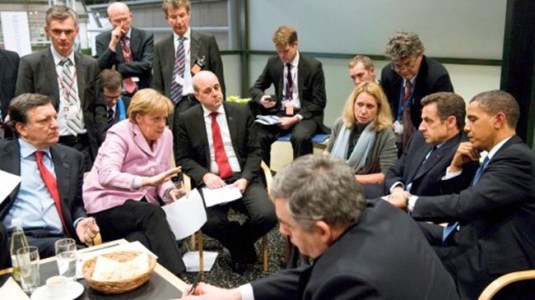
In Copenhagen’s final private negotiations, Obama, Brown, Sarko and Merkel sat down with He Yafei, the Chinese vice-minister of foreign affairs. There is a tape of this meeting at Der Spiegel. HT: The Guardian.

He Yafei was the smartest guy in the room – listen to the tape. Wen Jiabao refused to attend most of the negotiating sessions.

Given the choice of walking out and sitting down with a vice-minister, they chose humiliation. One response of Obama was:

It would be nice to negotiate with somebody who can make political decisions.

Rather than blaming vast right-wing conspiracies, using Google searches for “unemployment” and “global warming”, Kahn and Kotchen found that:

  • Recessions increase concerns about unemployment at the expense of public interest in climate change;
  • The decline in global-warming searches is larger in more Democratic leaning states; and
  • An increase in a state’s unemployment rate decreases in the probability that Americans think global warming is happening, and reduces the certainty of those who think it is.

The middle-of-the-road voters changed their priorities and their political leaders followed them.

It’s the peoples’ will, I am their leader, I must follow them. – Jim Hacker, The Greasy Pole

As Geoff Brennan has argued, CO2 reduction actions will be limited to modest unilateral reductions of a largely token character. There are many expressive voting concerns that politicians must balance to stay in office and the environment is but one of these. Once climate change policies start to actually become costly, expressive voting support for these policies will fall away, and it has.

Tom Sargent’s 12 lessons from economics for public policy

Tom Sargent is a life-long Democrat who is old enough to remember when Democrats were fiscal conservatives.

At a graduation speech at Berkeley, Sargent listed these lessons:

    1. Many things that are desirable are not feasible.
    2. Individuals and communities face trade-offs.
    3. Other people have more information about their abilities, their efforts, and their preferences than you do.
    4. Everyone responds to incentives, including people you want to help. That is why social safety nets don’t always end up working as intended.
    5. There are trade-offs between equality and efficiency.
    6. In an equilibrium of a game or an economy, people are satisfied with their choices. That is why it is difficult for well-meaning outsiders to change things for better or worse.
    7. In the future, you too will respond to incentives. That is why there are some promises that you’d like to make but can’t. No one will believe those promises because they know that later it will not be in your interest to deliver. The lesson here is this: before you make a promise, think about whether you will want to keep it if and when your circumstances change. This is how you earn a reputation.
    8. Governments and voters respond to incentives too. That is why governments sometimes default on loans and other promises that they have made.
    9. It is feasible for one generation to shift costs to subsequent ones. That is what national government debts and the U.S. social security system do (but not the social security system of Singapore).
    10. When a government spends, its citizens eventually pay, either today or tomorrow, either through explicit taxes or implicit ones like inflation.
    11. Most people want other people to pay for public goods and government transfers (especially transfers to themselves).
    12. Because market prices aggregate traders’ information, it is difficult to forecast stock prices and interest rates and exchange rates

So privatisation, deregulation and tax cuts in Australia were mistakes?

The test of a mistake is if you can, you undo it.

The Most Dangerous Landing Page Mistakes & How You Can Fix Them

The classic in Australia is Kim Beazley in the 1998 federal election:

  • He was asked by a journalist that if the GST is a mistake, as he claimed, would he repeal the GST if he won office at some later time.
  • Beazley waffled about you can’t unscramble an egg and so on. He could not admit the truth.

If deregulation was a mistake, campaign for a reintroducing of the two-airline policy, the bank regulation that suppressed competition, high tariffs on cars, electrical goods and clothes, and media regulation that outlawed cable TV. Campaign for a repeal of the GST and for 66% tax rates again on the middle class!

The Left must campaign for a buy back of the Commonwealth Bank, Qantas and Telecom. They will be a good buy. Public ownership is said by them to be as least as efficient as private ownership, and the cost of capital cost for state owned enterprises is allegedly less.

Go for it. It will ensure another 60 years is the wilderness for the Left. The only Left-wing government that held office in Australia since 1949 was the Whitlam Government from 1972 to 1975.

President Obama’s persistent ’77-cent’ claim on the wage gap gets a new Pinocchio rating–updated

http://www.washingtonpost.com/blogs/fact-checker/wp/2014/04/09/president-obamas-persistent-77-cent-claim-on-the-wage-gap-gets-a-new-pinocchio-rating/

The fact checker at the Washington Post said:

Few experts dispute that there is a wage gap, but differences in the life choices of men and women — such as women tending to leave the workforce when they have children — make it difficult to make simple comparisons.

…From a political perspective, the Census Bureau’s 77-cent figure is golden. Unless women stop getting married and having children, and start abandoning careers in childhood education for naval architecture, this huge gap in wages will almost certainly persist. Democrats thus can keep bringing it up every two years.

…There appears to be some sort of wage gap and closing it is certainly a worthy goal. But it’s a bit rich for the president to repeatedly cite this statistic as an “embarrassment.” …The president must begin to acknowledge that “77 cents” does not begin to capture what is actually happening in the work force and society.


In premiere episode of ‘Factual Feminist’ Christina Sommers explains how the gender wage gap is based on bogus statistics

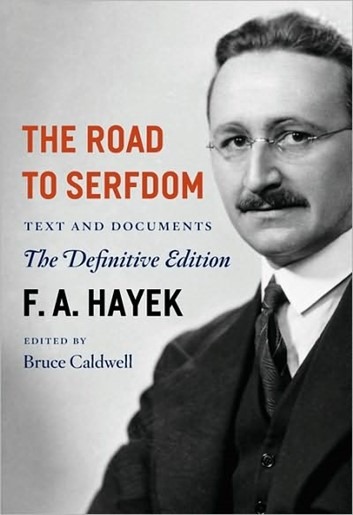
Hayek’s spotty record as a prophet in the Road to Serfdom – part 2: what about the post-colonial Third World?

Gordon Tullock used Sweden to argue that  the problem with The Road to Serfdom was:

“that it offered predictions which turned out to be false. The steady advance of government in places such as Sweden did not lead to any loss of non-economic freedoms.”

But was socialism good for democratic consolidations in the post-colonial third world? Was that not a better hunting ground for Hayek’s fears?

clip_image001

The people and parties, very often with a socialist hew, who won the election after the colonial government left town are not always all that keen to give up the reins of power.

Remember Huntington’s Two Turnover Test: when a nation moves from an emergent to a stable democracy, it must undergo two democratic and peaceful turnovers of ruling parties.

After an emerging democracy’s first turnover, the new administration often reverts to authoritarian rule. Russia under Yeltsin and Putin are examples.

Would Singapore be an example of central planning and state ownership leading to serfdom and a one-party state?

The state controls and owns firms that comprise at least 60% of the GDP through government entities. The vast majority (more than 80%) of Singaporeans live in public housing;

Although initially styling itself an anti-Communist and Social Democratic, the People Action Party (PAP) was expelled from the Socialist International in 1976 because it suppressed dissent and jailed opposition leaders. Hayek would be vindicated?!

The Index of Economic Freedom says that Singapore is a nominally democratic state ruled by the PAP since the country became independent in 1965, and that certain rights, such as freedom of assembly and freedom of speech, remain restricted

The Freedom House 2010 country report notes that Singapore is not an electoral democracy despite elections free of irregularities and mentions that all domestic newspapers, radio stations, and television channels are owned by government-linked companies, which limits free speech. The PAP has used the Government’s extensive powers to place formidable obstacles in the path of political opponents.

Daron Acemoglu has written on the role of institutions on post-colonial development in his why nations fail research agenda.

  • In Africa, Central America, the Caribbean and South Asia, European powers set up extractive states. These institutions did not introduce much protection for private property nor did they provide checks and balances against government expropriation. The explicit goal of the Europeans, in one form or another, was the extraction of resources from these colonies.
  • This colonization strategy contrasts with the institutions that the Europeans set up in colonies in which they settled in large numbers, e.g., the United States, Canada, Australia and New Zealand. In these colonies, life was modelled after that in the home country; the emphasis was on the enforcement of property rights for a broad cross-section of society, especially smallholders, merchants and entrepreneurs.

The same British colonists established different institutions in very different parts of the world:

  • If Europeans settled in a colony, institutions were developed for their own future benefits.
  • If Europeans did not settle in a colony, they set up a highly centralized state apparatus and other similar institutions to oppress the native population and to facilitate the extraction of resources in the short run

Acemoglu has written on Singapore as a stable non-democracy that can persist without significant repression.

Singapore was able through industrialization in the post-colonial period to ease social tensions and thus eliminate the need for democratic consolidation and also the need for repression. China’s ruling elite has the same current goal.

Why has Singapore not democratized? Acemoglu suggests is it is because Singapore is a very equal society. There is no traditional wealthy landed elite and the economy relies on external capital and businesses.

Most people appear to be relatively happy with the status-quo, at least not so unhappy that they want to engage in serious, and potentially costly, collective action to induce a major change in political institutions.

All and all, political economy has come on in leaps and bounds since 1944. Hayek should be judged against the other predictions of his times. Few socialist countries in the post-colonial Third World stayed democratic for long.

BBC World Service – Documentaries – Useful Idiots

The phrase ‘useful idiots’, supposedly Lenin’s, refers to Westerners duped into saying good things about bad regimes.

In political jargon it was used to describe Soviet sympathisers in Western countries and the attitude of the Soviet government towards them.

Useful idiots, in a broader sense, refers to Western journalists, travellers and intellectuals who gave their blessing – often with evangelistic fervour – to tyrannies and tyrants, thereby convincing politicians and public that utopias rather than Belsens thrived.

In part one John Sweeney looks at Stalin’s Western apologists at http://downloads.bbc.co.uk/podcasts/worldservice/docarchive/docarchive_20100804-0905a.mp3

In part two he explores how present day stories of human rights abuses across the world are still rewritten at http://downloads.bbc.co.uk/podcasts/worldservice/docarchive/docarchive_20100811-1059a.mp3


via BBC World Service – Documentaries – Useful Idiots

Steve Jobs and the Twitter Left

We saw the movie Jobs:

  • I could not work out what Steve Jobs actually achieved on his own by the time the film ended in about 2001.
  • Jobs was portrayed as a thoroughly unlikable fellow who was a terrible CEO who deserved to be fired in the mid-1980s.
  • If he had been hit by a bus in 2000, no one would remember him now. I read a biography of Jobs around that time.

By 2012, Jobs had been labelled “Greatest entrepreneur of our time”, “brilliant, visionary, inspiring”, and “the quintessential entrepreneur of our generation” and CEO of the decade.

My estimations of Jobs did go up later when I found out that after resuming control of Apple in 1997, Jobs eliminated all corporate philanthropy programmes. Jobs said he felt that expanding Apple would do more good than giving money to charity. This is a great point by him about the role of economic progress in abolishing poverty. There is no public record of Jobs giving money to charity apart from product RED.


Good to see that having a driven personality can still get you a pass on your membership of the top 0.1% of income earners in the eyes of the Twitter Left or should it be the IPhone Left.

Hayek’s spotty record as a prophet in The Road to Serfdom – Part 1

Gordon Tullock used Sweden to support his argument that the basic problem with The Road to Serfdom was:

“that it offered predictions which turned out to be false. The steady advance of government in places such as Sweden did not lead to any loss of non-economic freedoms.”

Hayek discusses the Road to Serfdom

When looking back longingly at the mixed economies of 1950s and 1960s, people often forget who won elections much of the time back then.

The period that managed to combine a large degree of state ownership and control of the UK economy with a free and diverse media and political pluralism was often under Tory rule (1951 to 1964) with the Labor governments (1964-1970) often with a margin of a few seats.

Then there was the Menzies era in Australia with Liberal party rule from 1949 to 1972; and then 1975 to 1983. Much the same in New Zealand. The Left rarely held power in the mid-20th century.

The Christian democrats usually ran both Italy and Germany in coalitions, as I recall, up until the late 1960 or the early 1970s. Gaullist France? The LDP in Japan?

That is where Hayek got it wrong. The left-wing parties were not the face of the future.

Power rotated in Schumpeterian sense. Governments were voted out when they disappointed voters with the replacement not necessarily having very different policies.

The right-wing parties won many western European elections by that well-proven old trick of being slightly to the right of the left-wing parties. Hayek failed to predict this.

Hayek was himself a major critic of detailed predictions:

“We can build up beautiful theories which would explain everything, if we could fit into the blanks of the formulae the specific information; but we never have all the specific information.

Therefore, all we can explain is what I like to call “pattern prediction.”

You can predict what sort of pattern will form itself, but the specific manifestation of it depends on the number of specific data, which you can never completely ascertain. Therefore, in that intermediate field — intermediate between the fields where you can ascertain all the data and the fields where you can substitute probabilities for the data–you are very limited in your predictive capacities.”

“Our capacity of prediction in a scientific sense is very seriously limited. We must put up with this.

We can only understand the principle on which things operate, but these explanations of the principle, as I sometimes call them, do not enable us to make specific predictions on what will happen tomorrow.”

Hayek’s warnings in The Road to Serfdom was against a background where democracy was still young and insecure in Europe and peacetime democratic governments were, up until then, not much bigger than a post office and a military. The big governments of his day were not democratic.

As Popper and Kuhn understood it, bold, risky hypotheses are at the heart of great advances in the sciences and scholarship generally.

Is the Blogosphere an Infotopia or an Echo Chamber – the Daily Me?

Cass Sunstein made some astute observations in Republic.com 2.0 about how the blogosphere forms into information cocoons and echo chambers. People can avoid the news and opinions they don’t want to hear.

This is not all that surprising. Many do not read the newspaper, or read those newspapers that fuel their initial beliefs. London is famous for its partisan newspapers each pandering to their own slice of the political spectrum.

The standard J.S. Mill view of deliberation is that group discussion is likely to lead to better outcomes, if only because competing views are stated and exchanged.

Sunstein has argued that there are limitless news and information options and, more significantly, there are limitless options for avoiding what you do not want to hear:

  • Those in search of affirmation will find it in abundance on the Internet in those newspapers, blogs, podcasts and other media that reinforce their views.
  • People can filter out opposing or alternative viewpoints to create a "Daily Me."
  • The sense of personal empowerment that consumers gain from filtering out news to create their Daily Me creates an echo chamber effect and accelerates political polarisation.

A common risk of debate is group polarisation. Members of the deliberating group move toward a more extreme position relative to their initial tendencies!

How many blogs are populated by those that denounce those who disagree? This is the role of the mind guard in group-think.

Debate is over-rated as compared to brute experience. Milton Friedman said this in his Nobel price lecture:

Government policy about inflation and unemployment has been at the centre of political controversy. Ideological war has raged over these matters.

Yet the drastic  change that has occurred in economic theory has not been a result of ideological warfare.

It has not resulted from divergent political beliefs or aims.

It has responded almost  entirely to the force of events: brute experience proved far more potent than the  strongest of political or ideological preferences

The market process succeeds because it relies on a bare minimum of knowledge and hardly any deliberation but a lot of learning from experience.

A purpose of voting through secret ballots is both to bring the debate to a close and to clip the wings of those that shout the loudest and longest.

Sunstein in Infotopia wrote about how people use the Internet to spend too much time talking to those that agree with them and not enough time looking to be challenged:

In an age of information overload, it is easy to fall back on our own prejudices and insulate ourselves with comforting opinions that reaffirm our core beliefs. Crowds quickly become mobs.

The justification for the Iraq war, the collapse of Enron, the explosion of the space shuttle Columbia–all of these resulted from decisions made by leaders and groups trapped in "information cocoons," shielded from information at odds with their preconceptions. How can leaders and ordinary people challenge insular decision making and gain access to the sum of human knowledge?

Conspiracy theories had enough momentum of their own before the information cocoons and echo chambers of the blogosphere gained ground.

Must everything be the result of a grand plan? As Karl Popper explains:

…a theory which is widely held but which assumes what I consider the very opposite of the true aim of the social sciences; I call it the "conspiracy theory of society."

It is the view that an explanation of a social phenomenon consists in the discovery of the men or groups who are interested in the occurrence of this phenomenon (sometimes it is a hidden interest which has first to be revealed), and who have planned and conspired to bring it about.

This view of the aims of the social sciences arises, of course, from the mistaken theory that, whatever happens in society – especially happenings such as war, unemployment, poverty, shortages, which people as a rule dislike – is the result of direct design by some powerful individuals and groups.

Cass Sunstein in another book defines a conspiracy theory as:

An effort to explain some event or practice by reference to the machinations of powerful people, who have also managed to conceal their role.

He goes on to argue that millions hold conspiracy theories – that powerful people work together to withhold the truth about some important practice or terrible event.

Conspiracy theories attribute extraordinary powers to political leaders and bureaucracies to plan, to control others, and to maintain secrets. Conspiracy theories overestimate the competence and discretion of these political leaders and bureaucracies, who are assumed to be able to make and carry out sophisticated secret plans, despite ample evidence that most government actions do not remain secret for long.

Conspiracy theories also assume that these nefarious secret plans are easily detected by members of the public without the need for special access to the key information or any investigative resources.

Sunstein also argued that a distinctive feature of conspiracy theories is their self-sealing quality. Conspiracy theorists are not persuaded by an attempt to dispel their theories and look at these attempts as further proof of the conspiracy.

Karl Popper argued that conspiracy theories overlook the pervasive unintended consequences of political and social action; they assume that all consequences must have been intended by someone.

Most people lack direct or personal information about the explanations for terrible events, and they are often tempted to attribute such events to some nefarious actor as a way of coping with an uncertain world. More than a few blogs help them round-up the usual suspects.

Congestion pricing – Swedish style

Sweden had a novel approach to introducing a road congestion charge. The congestion toll is put in place in 2006 for six months and then was lifted for another seven months.

clip_image001

A local referendum was then held on whether to bring the road tolls back or stay with the old traffic congestion. Road traffic passing in and out of the cordon in Stockholm Municipality reduced by between 20-25% during the period of the trial.

Neat.

Previous Older Entries Next Newer Entries

Libertarian Land

Celebrating humanity's flourishing through the spread of capitalism and the rule of law

Arin’s Substack

Celebrating humanity's flourishing through the spread of capitalism and the rule of law

David Andolfatto

Celebrating humanity's flourishing through the spread of capitalism and the rule of law

Monetary Non-Neutrality

Celebrating humanity's flourishing through the spread of capitalism and the rule of law

Reason Magazine

Celebrating humanity's flourishing through the spread of capitalism and the rule of law

Coyote Blog

Celebrating humanity's flourishing through the spread of capitalism and the rule of law

Thoughts from the North

Celebrating humanity's flourishing through the spread of capitalism and the rule of law

Fardels Bear

A History of the Alt-Right

Vincent Geloso

Econ Prof at George Mason University, Economic Historian, Québécois

Bassett, Brash & Hide

Celebrating humanity's flourishing through the spread of capitalism and the rule of law

Truth on the Market

Scholarly commentary on law, economics, and more

The Undercover Historian

Beatrice Cherrier's blog

Matua Kahurangi

Celebrating humanity's flourishing through the spread of capitalism and the rule of law

Temple of Sociology

Celebrating humanity's flourishing through the spread of capitalism and the rule of law

Velvet Glove, Iron Fist

Celebrating humanity's flourishing through the spread of capitalism and the rule of law

Why Evolution Is True

Why Evolution is True is a blog written by Jerry Coyne, centered on evolution and biology but also dealing with diverse topics like politics, culture, and cats.

NoTricksZone

Celebrating humanity's flourishing through the spread of capitalism and the rule of law

Homepaddock

A rural perspective with a blue tint by Ele Ludemann

Kiwiblog

DPF's Kiwiblog - Fomenting Happy Mischief since 2003

The Dangerous Economist

Celebrating humanity's flourishing through the spread of capitalism and the rule of law

Watts Up With That?

The world's most viewed site on global warming and climate change

The Logical Place

Tim Harding's writings on rationality, informal logic and skepticism

Doc's Books

A window into Doc Freiberger's library

The Risk-Monger

Let's examine hard decisions!

Uneasy Money

Commentary on monetary policy in the spirit of R. G. Hawtrey

Barrie Saunders

Thoughts on public policy and the media

Liberty Scott

Celebrating humanity's flourishing through the spread of capitalism and the rule of law

Point of Order

Politics and the economy

James Bowden's Blog

A blog (primarily) on Canadian and Commonwealth political history and institutions

Science Matters

Reading between the lines, and underneath the hype.

Peter Winsley

Economics, and such stuff as dreams are made on

A Venerable Puzzle

"The British constitution has always been puzzling, and always will be." --Queen Elizabeth II

The Antiplanner

Celebrating humanity's flourishing through the spread of capitalism and the rule of law

Bet On It

Celebrating humanity's flourishing through the spread of capitalism and the rule of law

History of Sorts

WORLD WAR II, MUSIC, HISTORY, HOLOCAUST

Roger Pielke Jr.

Undisciplined scholar, recovering academic

Offsetting Behaviour

Celebrating humanity's flourishing through the spread of capitalism and the rule of law

JONATHAN TURLEY

Res ipsa loquitur - The thing itself speaks

Conversable Economist

In Hume’s spirit, I will attempt to serve as an ambassador from my world of economics, and help in “finding topics of conversation fit for the entertainment of rational creatures.”

The Victorian Commons

Researching the House of Commons, 1832-1868

The History of Parliament

Articles and research from the History of Parliament Trust

Books & Boots

Reflections on books and art

Legal History Miscellany

Posts on the History of Law, Crime, and Justice

Sex, Drugs and Economics

Celebrating humanity's flourishing through the spread of capitalism and the rule of law

European Royal History

Exploring the Monarchs of Europe

Tallbloke's Talkshop

Cutting edge science you can dice with