
#GeorgeOrwell on @jeremycorbyn #pacifism and #Paris
14 Nov 2015 Leave a comment
in defence economics, politics - Australia, politics - New Zealand, politics - USA, war and peace Tags: British politics, France, game theory, George Orwell, pacifism, Paris, war on terror
Employment status of sole parents in UK, USA, France, Italy, Australia, Ireland and New Zealand
13 Nov 2015 Leave a comment
in economics of love and marriage, labour supply, politics - Australia, politics - New Zealand, politics - USA Tags: Australia, British economy, France, Ireland, Italy, maternal labour supply, single parents, sole parents, welfare state
Despite supposedly having stingy welfare states, both New Zealand and Australia have a lot of sole parents who do not work at all. There is no separate breakdown of full-time and part-time work status in the USA. About 72% of sole parents in the USA either work full-time or part-time.
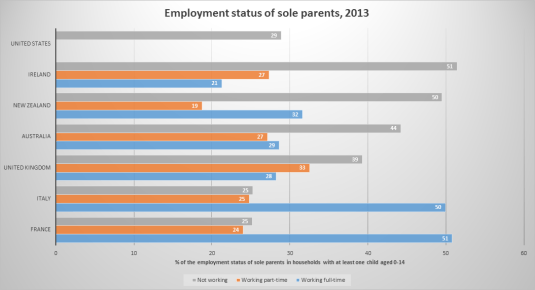
Source: OECD Family Database.
Escaping from Australian immigration detention facilities – what’s the point?
12 Nov 2015 Leave a comment
in applied price theory, economics of crime, politics - Australia
Some poor bugger died shortly after escaping from the Australian immigration detention facility on Christmas Island a few days ago. I wonder where he was intending to escape?
Christmas Island is in the middle of the Indian Ocean and the only way off is by the airport. He had nowhere to run. There would be lucky to be 2000 people living on the small island of Christmas Island so he would stand out very quickly.
Many years ago, a fight broke out one breakfast time between the different nationalities regarding the management of the canteen at the Port Hedland immigration detention facility. They resolved the differences about this largely self-managed canteen where each cooked their own foods by deciding to stage a spontaneous escape.
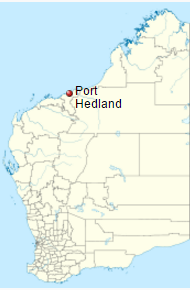 As they marched down the road, free at last, the manager of the facility caught up with them. He asked them where were they going? He said it already telephoned Greyhound buses and told them not to sell them bus tickets. Perth is 1300 km away from Port Hedland. The manager of the facility suggested they all come back to settle things over a cuppa as it was warming up as noon was approaching.
Unions – not the cause of our 40 hour workweek
10 Nov 2015 Leave a comment
in applied price theory, applied welfare economics, economic history, entrepreneurship, health and safety, human capital, industrial organisation, labour economics, labour supply, Marxist economics, minimum wage, politics - Australia, politics - New Zealand, politics - USA, poverty and inequality, unions Tags: The Great Enrichment, union power, union wage premium
When did buying your own home become a good investment in Australia?
09 Nov 2015 Leave a comment
in economic history, politics - Australia, urban economics
When I left university, all my mates were in a fever pitch about buying a house because it was such a good investment. They didn’t mention that housing had been a dog of investment for the previous 10 years. Housing was a good investment for a couple years around the time of this feverish home buying by my friends as the chart below shows. I didn’t buy a house because I could rent houses that were far nicer and more convenient to work and that any I could buy in Canberra. That pretty much applies to today.
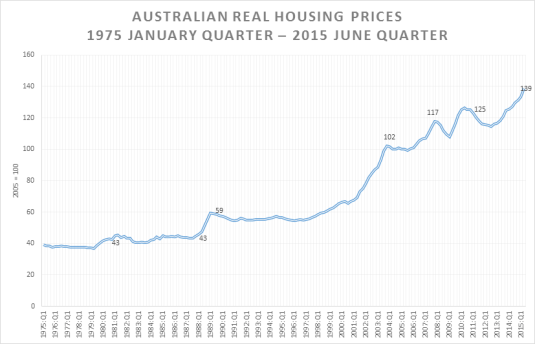
Source and notes: Dallas Fed International Housing Database July 2015 – The author acknowledge use of the dataset described in Mack and Martínez-García (2011); real housing prices are nominal housing prices deflated by a personal consumption deflator.
Through all the 1990s as the chart above shows in retrospect, I was too polite to inquire of friends about their house prices in case they had no equity in their own house after the bank took its slice. For all of the 1990s, investing in a house was a dog of an investment in Australia if the above chart is a reasonable national summary of what is a medium-sized country. Things then hit a fever pitch at the end of the 1990s with house prices doubling and then some across Australia.
There is a God! @AlboMP and @tanya_plibersek could lose their seats to Greens at the next election
06 Nov 2015 Leave a comment
in election campaigns, politics - Australia, politics - New Zealand
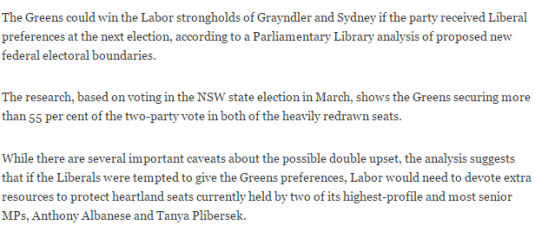
Source: Do it | Catallaxy Files.
Similar karma here. The deputy leader of the New Zealand Labour Party wins his seat because the Greens do not fight for it. The co-leader of the Greens happens to contest that seat. The Greens win or almost win the party vote in that electorate for several elections now.
How the first world war changed the world
04 Nov 2015 Leave a comment
in politics - Australia, politics - New Zealand, politics - USA, war and peace Tags: Armistice Day, World War I
#Dailychart: How the first world war changed the world econ.st/1rvj6tW http://t.co/OldeGaiJEe—
The Economist (@ECONdailycharts) July 28, 2014
@GreenpeaceNZ @RusselNorman Can We Rely on Wind and Solar Energy? @NZGreens
02 Nov 2015 Leave a comment
in energy economics, environmental economics, global warming, politics - Australia, politics - New Zealand, politics - USA Tags: Big Solar, Big Wind, bootleggers and baptists, expressive voting, green rent seeking, rational irrationality, renewable energy, solar power, wind power
@economicpolicy Top incomes and the decline of unions in the US, UK, Australia and New Zealand
02 Nov 2015 4 Comments
in applied welfare economics, labour economics, Marxist economics, politics - Australia, politics - New Zealand, politics - USA, unions Tags: top 1%, union power, union wage premium
The Left in the USA and the UK like to show correlations between top incomes and the decline of union membership.
I thought I would check how this hypothesis travelled to European offshoots such as Australia and New Zealand. For example, in the USA, top income shares have been increasing while union membership has been in decline since 1960.

Source: OECD Stat and Top Incomes Database.

Source: OECD Stat and Top Incomes Database.
In the UK, the relationship between union membership and top incomes is gentler than in the USA.
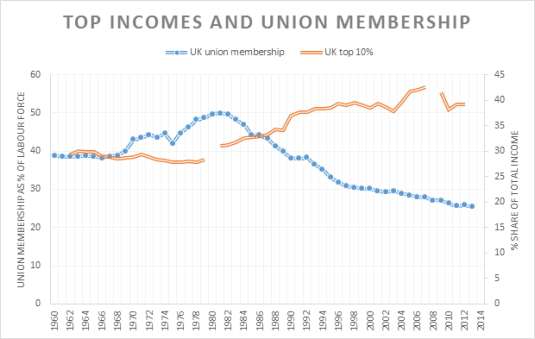
Source: OECD Stat and Top Incomes Database.
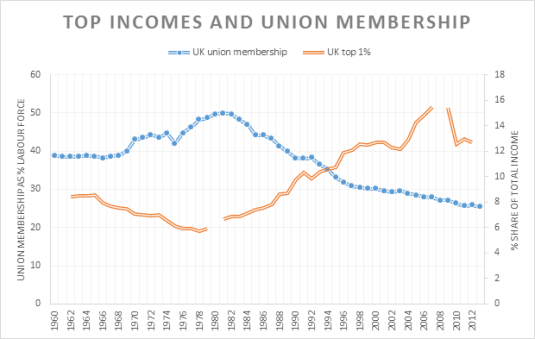
Source: OECD Stat and Top Incomes Database.
Moving down under, the relationship between top incomes and union membership is non-existent in New Zealand.

Source: OECD Stat and Top Incomes Database.

Source: OECD Stat and Top Incomes Database.
The same pretty much goes for Australia in terms of no relationship between top incomes in union membership to extent that this relationship is anything more than a spurious correlation.

Source: OECD Stat and Top Incomes Database.
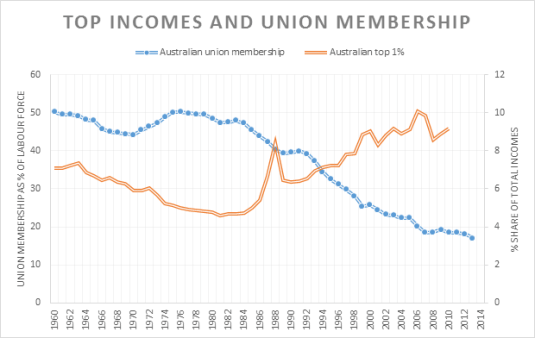
Source: OECD Stat and Top Incomes Database.
Did the New Zealand film industry just eat our lunch? By Jason Potts
01 Nov 2015 Leave a comment
in applied price theory, economics of media and culture, fiscal policy, industrial organisation, job search and matching, labour economics, labour supply, macroeconomics, politics - Australia, politics - New Zealand, Public Choice, rentseeking, survivor principle Tags: film subsidies, Hollywood economics, industry policy, offsetting behaviour, The fatal conceit, The pretense to knowledge, unintended consequences

James Cameron is going to film the next three instalments of the Avatar franchise in New Zealand. He promises to spend at least NZ$500 million, employ thousands of Kiwis, host at least one red-carpet event, include a NZ promotional featurette in the Avatar DVDs, and will personally serve on a bunch of Film NZ committees, and probably even bring scones, all in return for a 25% rebate on any spending he and his team do in the country (up from a 20% baseline to international film-makers) that is being offered by the New Zealand Government.
The implication that many media reports are running with is that this is a loss to the Australian film industry, that we should be fighting angry, and that we should hit back at this brilliantly cunning move by the Kiwi’s by increasing our film industry rebates, which currently are about 16.5% (these include the producer and location offsets, and the post, digital and visual effects offset) to at very least 30%. These rebates cost tax-payers A$204 million in 2012, which hardly even buys you a car industry these days.
So what are the economics of this sort of industry assistance? Is this something we should be doing a whole lot more of? Was the NZ move to up the rebate especially brilliant? First, note that James Cameron has substantial property interests in New Zealand already, so this probably wasn’t as up for grabs as we might think. But if that’s how the New Zealand taxpayers want to spend their money, that’s up to them. The issue is should we follow suit?
The basic economics of this sort of give-away is the concept of a multiplier “”), which is the theory that an initial amount of exogenous spending becomes someone else’s income, which then gets spent again, creating more income, and so on, creating jobs and exports and all sorts of “economic benefits” along the way.
People who believe in the efficacy of Keynesian fiscal stimulus also believe in the existence of (>1) multipliers. Consultancy-based “economic impact” reports do their magic by assuming greater-than-one multipliers (or equivalently, a high marginal propensity to consume coupled with lots of dense sectoral linkages). With a multiplier greater than one, all government spending is magically transformed into “investment in Australian jobs”.
So the real question is: are multipliers actually greater-than-one? That’s an empirical question, and the answer is mostly no. (And if you don’t believe my neoliberal bluster, the progressive stylings of Ben Eltham over at Crikey more or less make the same point.)
But to get this you have to do the economics properly, and not just count the positive multipliers, but also account for the loss of investment in other sectors that didn’t take place because it was artificially re-directed into the film sector, which no commissioned impact study ever does.
This is why economists have a very low opinion of economic impact studies, which are to economics what astrology is to physics.
What does make for a good domestic film industry then? Look again at New Zealand, and look beyond the great Weta Studios in Wellington, for Australia and Canada both have world-class production studios and post-production facilities. Look beyond New Zealand’s natural scenery, for Vancouver is an easy match for New Zealand and Australia pretty much defines spectacular.
No, the simple comparison is that New Zealand is about 20% cheaper than Australia and 30% cheaper than Canada. New Zealand has lower taxes, easy employment conditions and relatively light regulations (particularly around insurance and health and safety). It’s just easier to get things done there.
If Australia really wants to boost its film industry, it might look more closely at labour market restrictions (including minimum wages) and regulatory burden and worry less about picking taxpayer pockets and bribing foreigners.
This article was originally published on The Conversation in December 2013. Read the original article. Republished under the a Creative Commons Attribution No Derivatives licence.
Cuts in spending less costly than tax increases @jeremycorbyn @johnmcdonnellMP
01 Nov 2015 Leave a comment
New Zealand child poverty compared internationally
30 Oct 2015 Leave a comment
in labour economics, politics - Australia, politics - New Zealand, politics - USA, poverty and inequality Tags: child poverty
Every 3rd Child in the US lives in poverty.
(in #Norway & #Finland: https://t.co/K5Ub2QuPoE—
Max Roser (@MaxCRoser) October 21, 2015
Real hourly minimum wage, PPP, USA, UK, Canada, New Zealand, Ireland, Germany, Australia and France before & after taxes, 2013
27 Oct 2015 Leave a comment
in labour economics, minimum wage, politics - Australia, politics - New Zealand, politics - USA

Source: OECD (2015), “Minimum wages after the crisis: Making them pay”.


Recent Comments