What slackers. Despite 30 years of neoliberalism oppressing the unions and working class, the top 1% in New Zealand (and Australia) are unable to do any better in terms of their share of national income than in the good old days of pre-1984 New Zealand looked upon with such fondness by the the Leftover Left.
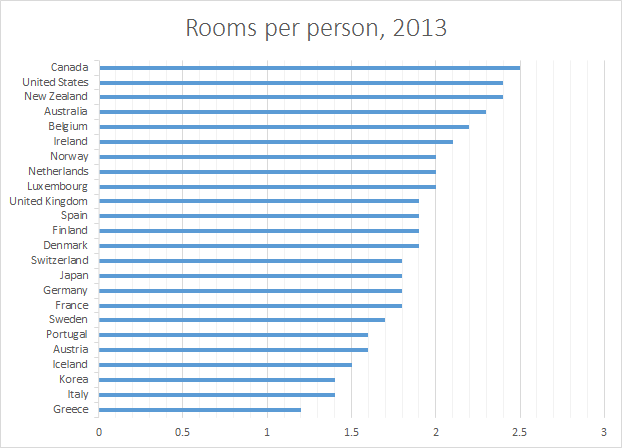
There are quite large differences in the number of rooms per person in the European offshoots and the countries in Europe. Americans have much more room per person than the much exalted welfare states of northern Europe.
The only major success in reducing sole parent beneficiary numbers anywhere has been time limits introduced as part of the 1996 US federal welfare reforms. Time limits on welfare for single parents reduced caseloads by two thirds, 90% in some states.
Source and Notes: OECD Family Database; Australian data are available only from 2005.
The subsequent declines in welfare participation rates and gains in employment were largest among the single mothers previously thought to be most disadvantaged: young (ages 18-29), mothers with children aged under seven, high school drop-outs, and black and Hispanic mothers. These low-skilled single mothers were thought to face the greatest barriers to employment. Blank (2002) found that
nobody of any political persuasion predicted or would have believed possible the magnitude of change that occurred in the behaviour of low-income single-parent families.
With the enactment of welfare reform in 1996, black child poverty fell by more than a quarter to 30% in 2001. Over a six-year period after welfare reform, 1.2 million black children were lifted out of poverty. In 2001, despite a recession, the poverty rate for black children was at the lowest point in national history. Employment are never married mothers increased by 50% after the US reforms; employment a single mothers with less than a high school education increased by two thirds; employment of single mothers aged of 18 in 24 approximately doubled.
This great success of US welfare reforms was that after decades of no progress in their war on poverty, poverty among both single mothers and black children declined dramatically.
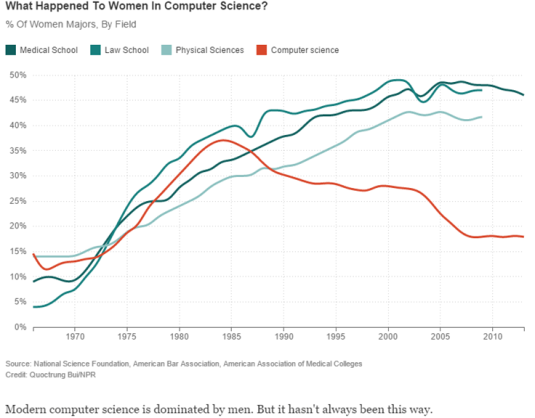
Women started drifting away from computer science in the mid-1980s. The interpretation put forward by the professional grievance industry, that is, by National Public Radio in the USA is:
The share of women in computer science started falling at roughly the same moment when personal computers started showing up in U.S. homes in significant numbers.
These early personal computers weren’t much more than toys. You could play pong or simple shooting games, maybe do some word processing.
And these toys were marketedalmostentirely to men and boys. This idea that computers are for boys became a narrative. It became the story we told ourselves about the computing revolution. It helped define who geeks were, and it created techie culture.
Another interpretation is there are systematic differences between teenage boys and teenage girls in verbal and written skills. Young women moved away from enrolling in computer…
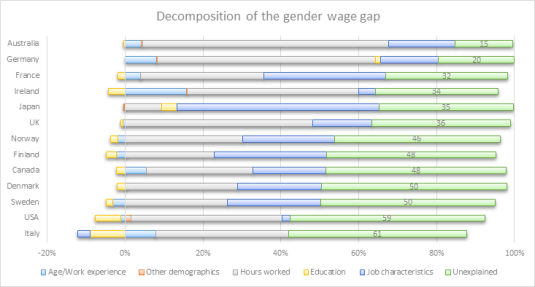
There are vast differences in the percentage of the gender wage gap that is left unexplained after adjusting for age, work experience, hours worked, education and job characteristics.
Attributing this residual in gender pay gaps to discrimination implies vast differences in sex discrimination between countries with similar cultures. Furthermore, a large part of the gender wage gap is unexplained in countries such as Scandinavia which are held up as models in commitment to gender equality and have many family friendly policies including maternity leave that is generous by New Zealand and American standards.
Union membership was in a long-term decline in New Zealand before the passage of the hated Employment Contracts Act in 1991. If anything, union membership stopped falling after the passage of that law.
Source: OECD Stat.
As for the other countries, steady decline in membership has been the trend since 1980. The already low level of union membership in the USA has been in a steady decline since at least 1960.
I have updated my estimates of Australian and New Zealand detrended real GDP growth for the 2014 working age population statistics from the OECD. The charts show:
the lost decades of New Zealand growth between 1974 and 1992;
the return of trend growth between 1992 and 2007 but no rebounding to recover lost ground;
the effects of the global financial crisis in Australia and New Zealand; and
a return to trend growth in New Zealand since about 2010 but not in Australia.
The real GDP data in the above chart is detrended by 1.9% per annum. 1.9% growth per year is the trend real GDP growth rate of the USA in the 20th century. The growth rate of the USA is taken as the growth rate of the global technological frontier. A flat line in the above chart is real GDP growth at 1.9% per year. A falling line is real GDP growth in that year of less than 1.9%; a rising line is growth that is greater than 1.9% in that year.
Japanese Americans interned during World War II jumped at the chance to volunteer to fight. They saw it as their last chance to prove their undivided loyalty to their country.
One Japanese father, when saying goodbye to his son, stressed that showing his loyalty to his country, if necessary through the last full measure of devotion was far more important that his returning safely to his family.
The 442nd Combat Regiment Team was the most decorated unit in World War II. Its motto was “Go for Broke”. The 4,000 Nisei soldiers in April 1943 had to be replaced nearly 2.5 times. In total, about 14,000 men served, earning 9,486 Purple Hearts.
Pearl Harbor was attacked 74 years ago today. Also, Roosevelt signed an executive order 75 days later that did this: pic.twitter.com/y4FhR5nMEC
Migrants are a cut above regarding initiative and judgement. They pass many of these traits on to their children. These Japanese Americans, both migrants and native born knew that counter-signalling was required. They had to go out of their way to show their loyalty no matter how unfair any suspicions of disloyalty among Japanese Americans might have been at the time.
This is a really important article to understand what is driving recruitment to ISIS. https://t.co/QamGhL6U0K
I am reminded of that counter-signalling by Japanese Americans during the darkest days of World War II when I read the remarks of Julie Anne Genter and Jeremy Corbyn. Both focused their pleas on the need to be inclusive and understanding why people join violent, radical groups. They and the rest of the Twitter Left had nothing to contribute regarding strategies to deter the next attack and disrupt those that are in the planning stage, but that is not new.
The notion that bad behaviour towards minority communities leads to more recruitment to the terrorists is overrated. There will be a few wind-bags who say harsh things after each terrorist attack, but if they cross the line, they will be dealt with by the police and courts in a democracy governed by the rule of law.
Acrimony towards your community following the latest terrorist attacks has little to do with the level of recruitment to these terrorist groups either now or in the past. As Alan Krueger explains:
One of the conclusions from the work of Laurence Iannaccone—whose paper, “The Market for Martyrs,” is supported by my own research—is that it is very difficult to effect change on the supply side. People who are willing to sacrifice themselves for a cause have diverse motivations. Some are motivated by nationalism, some by religious fanaticism, some by historical grievances, and so on. If we address one motivation and thus reduce one source on the supply side, there remain other motivations that will incite other people to terror.
Malcontents join the jihadists today for the same reasons they joined the Red Brigade, the Japanese Red Army Faction and Baader-Meinhof gang in the 1970s and 1980s.
Plenty of young people were attracted to communism in previous generations as a way of sticking it to the man. Now as then economic conditions were good as were political freedoms. Italy, Japan and Germany were all at the peak of recoveries from war. Japanese incomes are doubled in the previous decade. Germany and Italy were rich countries. As Alan Krueger explains:
Despite these pronouncements, however, the available evidence is nearly unanimous in rejecting either material deprivation or inadequate education as important causes of support for terrorism or participation in terrorist activities. Such explanations have been embraced almost entirely on faith, not scientific evidence.
Each generation has its defining oppositional identity. Radical Islam is the oppositional identity of choice for today’s angry young men and women. Mind you, they have to buy Islam for dummies to understand what they’re signing up for.
In previous generations, it was communism, weird Christian sects, eco-terrorism, animal liberationist terrorism and a variety of domestic terrorists of the left and right with conspiratorial motivations. Look at the level of diversity of the angry young men and women on the domestic terrorists list of the FBI. One jihadists when interviewed said that 30 years ago he would probably have become a Communist as his vehicle for venting his frustrations.
There is always an ample supply of troubled and angry people so trying to redress their grievances is overrated as Alan Krueger explains:
…it makes sense to focus on the demand side, such as by degrading terrorist organizations’ financial and technical capabilities, and by vigorously protecting and promoting peaceful means of protest, so there is less demand for pursuing grievances through violent means. Policies intended to dampen the flow of people willing to join terrorist organizations, by contrast, strike me as less likely to succeed.
The current appeal of radical Islam rests on what psychologists call personal significance. The quest for personal significance by these angry young men and women is the desire to matter, to be respected, to be somebody in one’s own eyes and in the eyes of others.
A person’s sense of significance may be lost for many reasons, including economic conditions. The anger can grow out of a sense of disparagement and discrimination; it can come from a sense that one’s brethren in faith are being humiliated and disgraced around the world.
Extremist ideologies, be they communism, fascism or extreme religions are effective in such circumstances because it offers a quick-fix to a perceived loss of significance and an assured way to regain it. It accomplishes this by exploiting primordial instincts for aggression, sex and revenge. MI5’s behavioural science unit found that
“far from being religious zealots, a large number of those involved in terrorism do not practise their faith regularly. Many lack religious literacy and could… be regarded as religious novices.” The analysts concluded that “a well-established religious identity actually protects against violent radicalisation”
Most evidence point to moral outrage, disaffection, peer pressure, the search for a new identity, for a sense of belonging and purpose as drivers of radicalisation. Anthropologist Scott Atran pointed out in testimony to the US Senate in March 2010:
“. . . what inspires the most lethal terrorists in the world today is not so much the Quran or religious teachings as a thrilling cause and call to action that promises glory and esteem in the eyes of friends, and through friends, eternal respect and remembrance in the wider world”. He described wannabe jihadists as “bored, underemployed, overqualified and underwhelmed” young men for whom “jihad is an egalitarian, equal-opportunity employer . . . thrilling, glorious and cool”.
Chris Morris, the writer and director of the 2010 black comedy Four Lions – which satirised the ignorance, incompetence and sheer banality of British Muslim jihadists – said “Terrorism is about ideology, but it’s also about berks”.
Why Evolution is True is a blog written by Jerry Coyne, centered on evolution and biology but also dealing with diverse topics like politics, culture, and cats.
In Hume’s spirit, I will attempt to serve as an ambassador from my world of economics, and help in “finding topics of conversation fit for the entertainment of rational creatures.”









Recent Comments