
Smoking in 20th century Australia
27 Oct 2015 Leave a comment
in economic history, health economics, politics - Australia
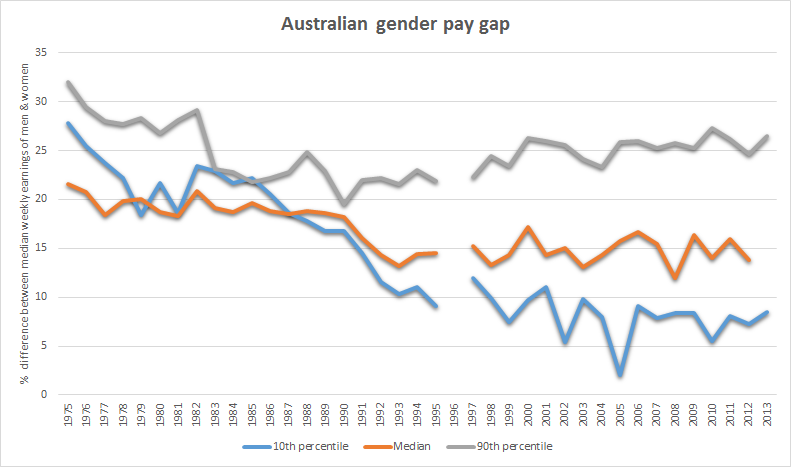
No gender equality down under – Australian gender pay gap at 10th, 50th and 90th percentile since 1975
27 Oct 2015 Leave a comment
in discrimination, economic history, gender, human capital, labour economics, occupational choice, politics - Australia Tags: Australia, gender wage gap
@arindube Vernon Smith on the cruelty of the minimum wage
25 Oct 2015 Leave a comment
in economics of education, human capital, labour economics, labour supply, minimum wage, occupational choice, politics - Australia, politics - New Zealand, politics - USA Tags: living wage, minimum wage, on-the-job training
Great quote on the cruelty of the minimum wage from Nobel economist Vernon Smith, illustrated by Henry Payne https://t.co/Lwch51acEY—
Mark J. Perry (@Mark_J_Perry) October 24, 2015
The Economics of Red State vs. Blue State Carbon Politics
25 Oct 2015 Leave a comment
in applied price theory, climate change, constitutional political economy, economics of climate change, economics of media and culture, economics of regulation, energy economics, environmental economics, environmentalism, politics - Australia, politics - New Zealand, politics - USA, Public Choice, transport economics, urban economics
1. My JPAM 2000 paper documents that suburbanites drive more and consume more electricity than urban residents.
2. My 2011 JUE paper documents that center city liberal resident NIMBY zoning regulation has deflected more development to the suburbs where people live a high carbon life (see paper #1 above) and then oppose carbon pricing.
3. My co-authored 2013 JPUBE paper documents that energy intensive manufacturing industries seek out cheap electricity price areas. Whether U.S carbon pricing and the resulting higher electricity prices would nudge them to move oversees remains an open question.
4. My co-authored 2012 EER paper documents that more educated people are more likely to have installed solar panels and to go off the grid and thus not pay higher electricity prices.
5. My 2013 EI paper documents that Congress Representatives oppose carbon mitigation regulation when they are conservative, their district is poorer and their district is high carbon. Nancy Pelosi and Tom Steyer are in liberal, rich, low carbon San Francisco. There, it is easy to comply with carbon regulation. They will pay few new costs for such low carbon regulation.
6. My co-authored 2015 JAERE paper documents that even in California and within counties that suburbanites vote against low carbon regulation relative to center city residents. Since we control for the fact that liberals live in center cities, this 3rd variable does not explain the urban form/voting correlation.
7. In my co-authored 2015 JUE paper we document that U.S protectionism through the Buy America Act has hindered the improvement of our bus fleet as a green technology.
Source: Environmental and Urban Economics: The Economics of Red State vs. Blue State Carbon Politics
Tertiary educational attainment by age and gender, USA, UK, Canada and Australia, 2013
25 Oct 2015 Leave a comment
in discrimination, economics of education, gender, human capital, labour economics, occupational choice, politics - Australia, politics - USA Tags: Australia, British economy, Canada, reversing gender gap
There are marked differences in progress in tertiary educational attainment between countries and across the generations. For example, while a few more American women have tertiary degrees as compared to their mothers, there’s been no change for American men for a generation.

Source: Indicators of Gender Equality in Education – OECD.
Canada is firing ahead in both tertiary educational attainment and reversing the gender gap in education for good. Two thirds of prime age Canadian women have a tertiary degree as compared to half of their mothers.
The number of British women with tertiary degrees is also much higher than their mothers. British men are trying their best to keep up.
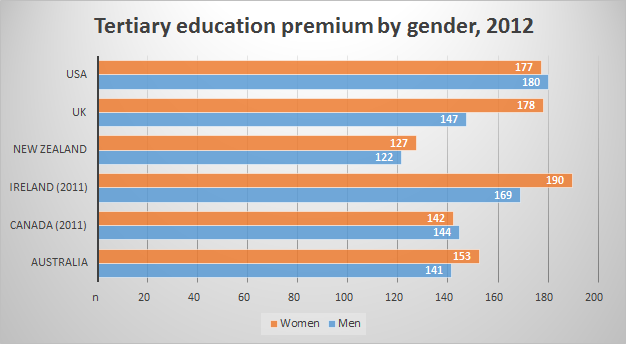
Tertiary education premium by gender in the English-speaking countries, 2012
19 Oct 2015 1 Comment
in discrimination, economics of education, gender, human capital, labour economics, occupational choice, politics - Australia, politics - New Zealand, politics - USA Tags: Australia, British economy, Canada, College premium, education premium, gender wage gap, Ireland, New Zealand, reversing gender gap
There are large differences in the education premium between English speaking countries and also by gender. The tertiary premium in New Zealand is pretty poor compared to the USA, UK or Ireland and is still mediocre when compared to Australia and Canada.
Source: Education at a Glance 2014.
@GreenpeaceNZ @jamespeshaw The Futility and Farce of Global Climate Negotiations @RichardTol
18 Oct 2015 Leave a comment
in constitutional political economy, development economics, economics of bureaucracy, environmental economics, environmentalism, global warming, growth disasters, growth miracles, international economics, politics - Australia, politics - New Zealand, politics - USA, Public Choice, rentseeking Tags: bootleggers and baptists, climate alarmism, expressive voting, free-riders, global warming, green tariffs, international public goods, Leftover Left, New Zealand Greens, Twitter left
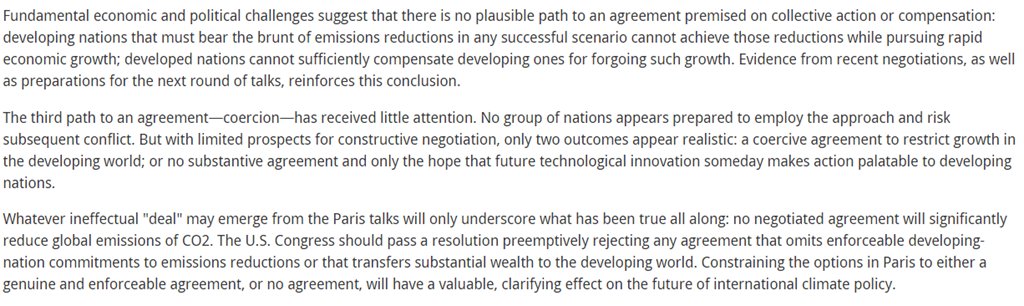
It is time for the environmental movement to face up to the fact that there never will be an international treaty to restrain carbon emissions. The practical way to respond to global warming is healthier is wealthier, richer is safer. Faster economic growth creates more resources for resilience and adaptation to a changing environment.
NEW REPORT: The Futility and Farce of Global Climate Negotiations bit.ly/1LvFFv3 http://t.co/TwbFUwaPlm—
Manhattan Institute (@ManhattanInst) October 17, 2015
India's target compared to its recent history http://t.co/pIvwhoSTpL—
Richard Tol (@RichardTol) October 02, 2015
@AndrewLittleMP @jamespeshaw @BillEnglishMP Real housing prices New Zealand, Australia & USA: 1975 January quarter – 2015 June quarter
17 Oct 2015 Leave a comment
in economic history, economics of regulation, politics - Australia, politics - New Zealand, politics - USA, rentseeking, urban economics Tags: green rentseeking, housing affordability, land supply, New Zealand Greens, New Zealand Labour Party, RMA
mg src=”https://utopiayouarestandinginit.com/wp-content/uploads/2015/10/101715_0817_andrewlittl1.png” alt=”” />
Source and notes: International House Price Database – Dallas Fed June 2015; nominal housing prices for each country is deflated by the personal consumption deflator for that country.
New Zealand housing prices were pretty stable until the passage of the Resource Management Act in 1993. After that, prices took off New Zealand and didn’t slow that much for the recession subsequent to the Global Financial Crisis.
American prices just had a bubble because of loose monetary policy by the Fed and loose lending criteria by banks at the behest of regulators. Real housing prices in the USA started to rise again last year after a dramatic fall.
Australian prices were rising steadily until about 2000 but then took off with a strong economy and the usual restrictions on land supply by local governments at the behest of the existing homeowners.
Oppressed by randomness
16 Oct 2015 Leave a comment
Legalize All Drugs by Jeff Miron
16 Oct 2015 Leave a comment
in economics of crime, economics of regulation, law and economics, liberalism, politics - Australia, politics - New Zealand, politics - USA Tags: Jeff Morin, marijuana decriminalisation, war on drugs
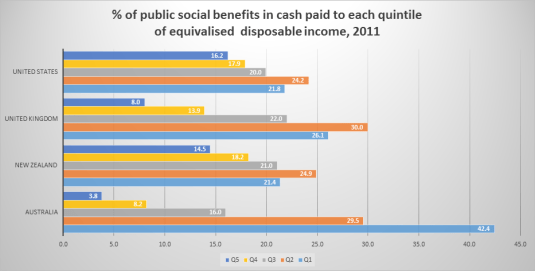
% of public cash benefits paid to the bottom income quintile, USA, UK, Australia and New Zealand – corrected
15 Oct 2015 Leave a comment
in applied welfare economics, politics - Australia, politics - New Zealand, politics - USA, poverty and inequality
Australia does far better than any other country in targeting its welfare state to the bottom of the income distribution. Having an old age pension that is asset tested and income tested has a lot to do with that. New Zealand has an old age pension that is not income tested or asset tested. The USA has a contributory social insurance system that also ensures a considerable amount of its public social benefits are paid to the well off because they paid in Social Security taxes.
Source: OECD Income Distribution database, via http://oe.cd/idd
@janlogie The dramatic closing of the gender pay gap at the 10th percentile in the US, UK, Australia and NZ since 1970 but not at the 90th percentile!
15 Oct 2015 4 Comments
in discrimination, economic history, gender, human capital, labour economics, politics - Australia, politics - New Zealand, politics - USA Tags: asymmetric marriage premium, compensating differentials, gender wage gap, marriage and divorce
It seems that the top 10% of men are so busy oppressing the top 10% of women that they forgot to keep up the violence inherent in the capitalist system against the bottom 10% of women. The gender pay gap at the bottom of the economic strata closed quite dramatically and consistently since 1970 or as far back as data was available in Australia, New Zealand, the UK and USA. Much of the closing of the gender pay gap for the low-paid was under the scourge of Reagan, Thatcher, Hawke and Keating and Rogernomics.
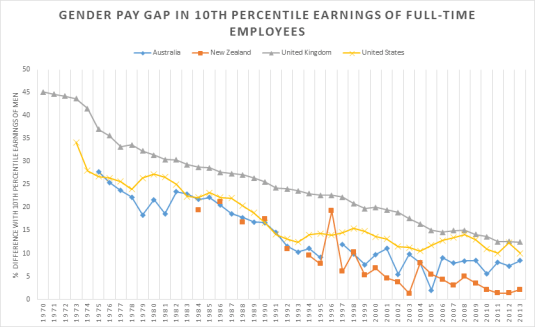
Source and Notes: OECD Employment Database. The gender gap plotted below is unadjusted. It is calculated as the difference between the 10th percentile earnings of men and the 10th percentile earnings of women relative to the 10th percentile earnings of men. Estimates of earnings used in the calculations refer to gross earnings of full-time wage and salary workers. However, this definition may slightly vary from one country to another.
By comparison to this dramatic liberation of women from the gender pay gap at the bottom, the gender pay gap for full-time employees has not really tapered down that much at the top of the income distribution and has been pretty flat for coming on 20 years. It seems the class war is over and has been won by women at the bottom but not at the top?
Younger, more educated women delay having families and can earn as much as their partners. bit.ly/1jw98Ky http://t.co/BaDIlBIBA2—
Ninja Economics (@NinjaEconomics) October 14, 2015
Rather than up the workers, the battle cry of the Posh Trots is up the managers, liberate them from insidious pay inequities imposed upon them by a vast sexist conspiracy of male managers.
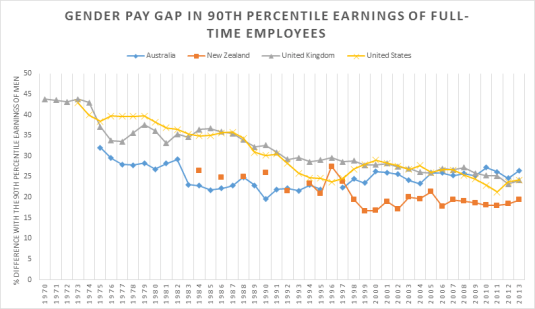
Source and Notes: OECD Employment Database. The gender gap plotted below is unadjusted. It is calculated as the difference between the 10th percentile earnings of men and the 10th percentile earnings of women relative to the 10th percentile earnings of men. Estimates of earnings used in the calculations refer to gross earnings of full-time wage and salary workers. However, this definition may slightly vary from one country to another.
This failure to close the gender pay gap at the top requires more investigation. The available of reliable contraceptives in the late 1960s led to an explosion of investment by women in long duration professional education and in careers where absences because of motherhood in their 20s and 30s was penalised in terms of human capital depreciation and promotional opportunities.

The reason for the endurance of the gender pay gap at the top of the income distribution is compensating differentials. Women at the top were able to have it all.

Professional women could invest in a career and a family and mix-and-match according to their own preferences for career and family and timing of births rather than the preferences of others who looked upon them as some sort of pathfinder for their gender. It is at the top of the income distribution where short absences from the workplace can has very large consequences for wages and promotion.

@nzlabour @greencatherine @johnkeymp @actparty Australia and New Zealand country of asylum numbers since 1965
10 Oct 2015 1 Comment
in Economics of international refugee law, International law, politics - Australia, politics - New Zealand Tags: Australia, economics of migration, refugees
Australia and New Zealand at times has taken in a great many refugees from abroad according to the United Nation’s High Commissioner for Refugees data. Oddly enough these bursts of generosity coincided with a Liberal Country party government in Australia and National Party governments in New Zealand. The Left of New Zealand politics was too busy fighting to be nuclear free to make New Zealand a place of refuge for the victims of oppression when they had their hands on the wheels of power.
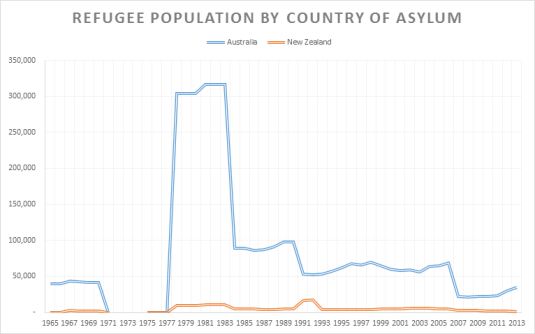
Source: UNHCR – UNHCR Statistical Online Population Database.
Because Australia took in so many hundreds of thousands of refugees, it is difficult to read the New Zealand data so I have reproduced the New Zealand data on refugees as a separate graph.

Source: UNHCR – UNHCR Statistical Online Population Database.
At times of crisis such as after the Vietnam War and the chaos in the Balkans, New Zealand has taken in a great many refugees – many times its current generosity.
What will it take to finish the Last Mile in ending extreme poverty
09 Oct 2015 Leave a comment
in development economics, economic history, growth disasters, growth miracles, politics - Australia, politics - New Zealand, politics - USA, poverty and inequality Tags: capitalism and freedom, The Great Escape, The Great Fact
What will it take to finish the “Last Mile” in ending extreme #poverty? brook.gs/1LiFT8E http://t.co/YxSZ36VCSW—
Brookings (@BrookingsInst) October 07, 2015
@jamespshaw @nzlabour @actparty inflow of asylum seekers into Australia and New Zealand since 1987
08 Oct 2015 Leave a comment
in International law, politics - Australia, politics - New Zealand, war and peace Tags: asylum seekers, Australia, economics of migration, refugees
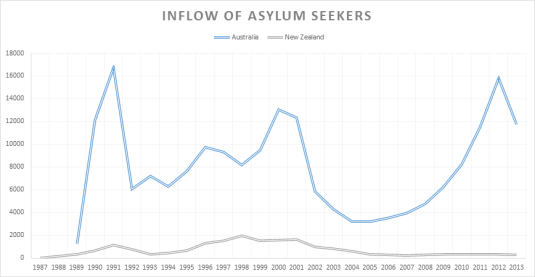
Data extracted on 08 Oct 2015 09:06 UTC (GMT) from OECD.Stat; Dataset: International Migration Database.


Recent Comments