30 Sep 2015
by Jim Rose
in comparative institutional analysis, constitutional political economy, economics of crime, law and economics, politics - Australia, politics - New Zealand, politics - USA, Public Choice
Tags: economics of federalism, laboratory federalism, marijuana decriminalisation, meddlesome preferences, medical marijuana, nanny state
In representative democracy that is a unitary state such as New Zealand, the issue on marijuana decriminalisation is who will change their vote to vote against a party who advocates marijuana decriminalisation under a MMP system where all elections are close.
In a strong federal state, where some states allow citizen initiated referendums to change the law, it is possible to pioneer reform without that backlash. Then laboratory federalism takes over. Subsequent to the decriminalisation of marijuana or medical marijuana by various state governments, the Congress defunded federal marijuana drug law enforcement in states who had decriminalised marijuana. That major reform was underreported.
25 Sep 2015
by Jim Rose
in economic history, income redistribution, politics - Australia, Public Choice, public economics
Tags: Australia, incidence of taxation, social insurance, taxation and entrepreneurship, taxation and investment, taxation and labour supply, top 1%, top tax rates, welfare state
25 Sep 2015
by Jim Rose
in environmental economics, global warming, politics - Australia, politics - New Zealand, politics - USA, Public Choice
Tags: China, climate alarmism, climate treaties, global warming, green tariffs, Greenpeace, international environmental law, Paris Summit 2015, Twitter left
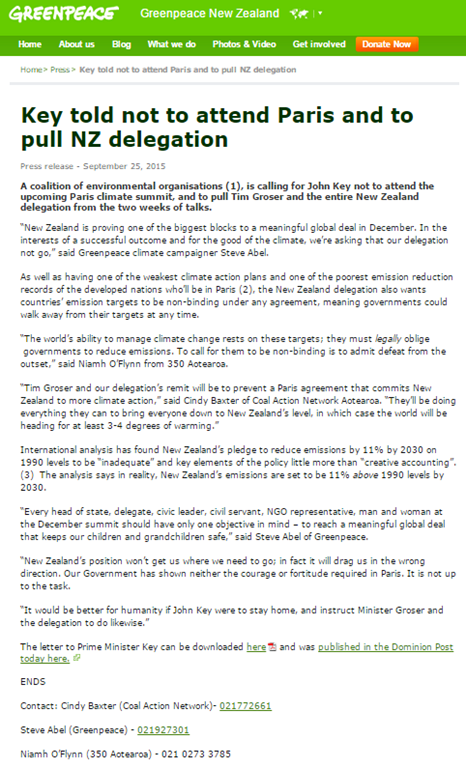
Greenpeace is right in saying in their open letter with others that New Zealand should not send a minister to the climate talks in Paris later this year. I agree for different reasons.
In common with many previous climate summits, the Paris talks will be a futile gesture that will have no significant effect on the pace of global warming and holding the summit is a waste of taxpayers money.
Nothing will come of them because the developing countries have no interest in postponing their development because of a minor inconvenience from global warming.
The easy way to tell if there is anything going to happen at a climate summit is the seniority of the delegation.

The Chinese made it clear at the Copenhagen summit in 2009 that they were not interested in an agreement by sending a Vice Minister of Foreign Affairs to a key side meeting of the American and French presidents, the British Prime Minister and the German Chancellor. All subsequent policy manoeuvrings by the Chinese on global warming are an attempt to head off green tariffs on their exports.

18 Sep 2015
by Jim Rose
in applied welfare economics, development economics, environmental economics, global warming, growth disasters, growth miracles, politics - Australia, politics - New Zealand, politics - USA
Tags: climate alarmism, global warming, Richard Tol
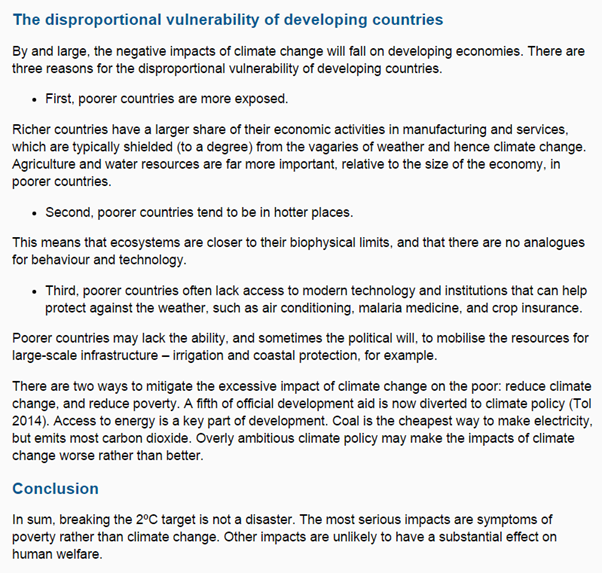
A nice summary of the latest research showing that once again the welfare cost of climate change is small except under the most extreme scenarios.

2% of national income is not something to declare a national emergency over unless you are in a very poor country.

Richard Tol also mentions that there has only been 27 studies of the economic costs of climate change:
Twenty-seven estimates is a thin basis for any conclusion. Researchers disagree on the sign of the net impact; climate change may lead to a welfare gain or loss. At the same time, researchers agree on the order of magnitude. The welfare change caused by climate change is equivalent to the welfare change caused by an income change of a few percent.
- That is, a century of climate change is about as good/bad for welfare as a year of economic growth.
As Tol wrote elsewhere, the reason why there are so few studies of the welfare cost of global warming is governments and bureaucracies do not like the small numbers they yield so they pre-emptively do not fund such research.
Few economists work full-time on the economics of climate change as their research results are too moderate to win repeat business and further research grants. Importantly, there is vicious criticism of what you say. Much better to just work on other topics.
One of the great tactical victories of the climate activists, I resisted the temptation to call them climate alarmists, is they keep going on about the science is settled and whether you are accepting the scientific results.
I have long argued let the science be settled, only the economics matters. The climate change activists do not want to talk about the economics that much except for the estimates by that political hack Lord Stern. Lord Stern has been on the losing side of history ever since he wrote a bad review of PT Bauer’s Dissent on Development where he said:
Dissent on Development is not a valuable contribution to the study of development.
The Stern Review puts the costs of unmitigated climate change at 5–20% of GDP (now and forever). The Fifth Assessment Report of the Intergovernmental Panel on Climate Change (IPCC) finds differently.

HT: Lorenzo M Warby
11 Sep 2015
by Jim Rose
in economic history, politics - Australia, war and peace
Tags: Australia, economics of migration, Poland, Russia, Ukraine, World War II
An old Uni mate’s dad was rounded up by the Nazis in the Polish Ukraine in 1941 and carted off as a slave in factories in Germany. He survived the war. He ended up in a refugee camp. He met and married a Dutch lass.

He did not want to go back to the Ukraine because that part of the Ukraine was now Russian under Stalin. That part of the Ukraine was Polish before the war.
Australia was the first country to accept them as refugees. He raised a family in Tasmania, working in a factory to support them.
I knew one of his two sons who became economists both at the University of Tasmania and in Canberra. One of his daughter’s was elected to the Australian Senate in the 2007 general election.
After such a rough start in life, my old mate’s dad must regard Australia as paradise for him, his wife and their family.
05 Sep 2015
by Jim Rose
in health economics, politics - Australia, politics - New Zealand, politics - USA
Tags: agricultural economics, antiscience left, conjecture and refutation, conspiracy theories, conspiracy theorists, creative destruction, GMOs, infotopia, risk risk trade-offs
02 Sep 2015
by Jim Rose
in business cycles, economic growth, economic history, fiscal policy, global financial crisis (GFC), great recession, macroeconomics, monetary economics, politics - Australia, politics - New Zealand, politics - USA
Tags: Australia, recessions and recoveries
25 Aug 2015
by Jim Rose
in applied price theory, applied welfare economics, economics of regulation, health economics, politics - Australia, politics - New Zealand, politics - USA, Public Choice, rentseeking
Tags: bootleggers and baptists, economics of smoking, meddlesome preferences, nanny state, pressure groups, special interests
24 Aug 2015
by Jim Rose
in energy economics, environmental economics, global warming, politics - Australia, politics - New Zealand, politics - USA, poverty and inequality
Tags: carbon tax, climate alarmism, expressive voting, fuel poverty, global warming
Previous Older Entries Next Newer Entries
Recent Comments