Any new strategy after Feb's "Good govt starts today" yet to pay dividends for LNP #auspoI #ipsos http://t.co/cnbksuQAvL—
Danny Rose (@_DannyRose) August 16, 2015
The next Australian election will be much more competitive than I thought
23 Aug 2015 Leave a comment
in politics - Australia, Public Choice Tags: 2016 Australian federal election
How big is Uber
23 Aug 2015 Leave a comment
CHART: How Big is Uber vs. Legacy Taxis? VERY, VERY BIG nationalpost.com/m/wp/blog.html… http://t.co/gz0vXPZDip—
Mark J. Perry (@Mark_J_Perry) August 22, 2015
via Summer of Uber: Everything you need to know about the upstart ride-sharing service.
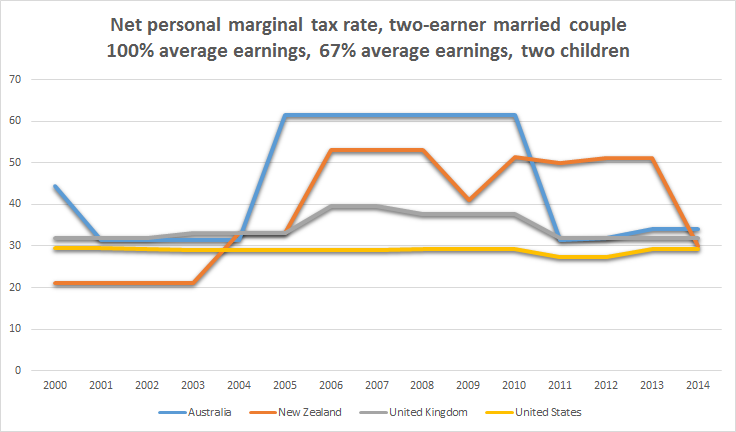
Marginal tax rates of 2-income couples with 2 children in USA, UK, Australia and New Zealand since 2000
23 Aug 2015 Leave a comment
in economic history, economics of love and marriage, labour economics, labour supply, politics - Australia, politics - New Zealand, politics - USA, public economics Tags: Australia taxation and labour supply, British economy, marriage and divorce
Why some billionaires are bad for growth, and others aren’t
22 Aug 2015 Leave a comment
in applied price theory, applied welfare economics, economics of bureaucracy, economics of regulation, financial economics, income redistribution, industrial organisation, politics - Australia, politics - New Zealand, politics - USA, Public Choice, rentseeking, survivor principle Tags: Australia, billionaires, Russia, top 0.1%, top 1%
…Bagchi and Svejnar carefully went through the lists of all the Forbes billionaires, and divided them into those who had acquired their wealth due to political connections, and those who had not. This is kind of a slippery slope — almost all billionaires have probably benefited from government connections at one time or another.
But the researchers used a very conservative standard for classifying people as politically connected, only assigning billionaires to this group when it was clear that their wealth was a product of government connections. Just benefiting from a government that was pro-business, like those in Singapore and Hong Kong, wasn’t enough.
Rather, the researchers were looking for a situation like Indonesia under Suharto, where political connections were usually needed to secure import licenses, or Russia in the mid-1990s, when some state employees made fortunes overnight as the state privatized assets.
…The negative effects of wealth inequality are largely being driven by politically connected wealth inequality. That seems to be the primary channel that drives this relationship…
a 3.72 percent increase in the level of wealth inequality would cost a country about half a percent of real GDP per capita growth. That’s a big impact, given that average GDP growth is in the neighbourhood of two percent per year
@guardianeco slimes New Zealand’s record on #climatechange @NZGreens @GreenpeaceNZ
22 Aug 2015 Leave a comment
in economics of information, energy economics, environmental economics, global warming, politics - Australia, politics - New Zealand, Public Choice Tags: Australia, climate alarmism, global warming, Left-wing hypocrisy, The Guardian
https://twitter.com/guardianeco/status/634681114527797248
Excellent wrap up of carbon pricing globally, found here: worldbank.org/en/news/featur… #renewables http://t.co/Hocf9Z5cEC—
Danny Rose (@_DannyRose) August 19, 2015
Carbon pricing expanded in the last 21 months. New report shows where & how:
wrld.bg/R0EuZ http://t.co/VB69szI1je—
World Bank (@WorldBank) August 19, 2015
A carbon price gives investors a clearer view of the future risks of high-carbon assets: wrld.bg/R0GLE http://t.co/GuNnzlMMlZ—
World Bank (@WorldBank) August 21, 2015
Marginal tax rates of a nuclear family in USA, UK, Australia and New Zealand since 2000
22 Aug 2015 Leave a comment
in economic history, economics of love and marriage, labour economics, labour supply, politics - Australia, politics - New Zealand, politics - USA Tags: Australia, British economy, marriage and divorce, taxation and labour supply
Taxes on dividend income across the OECD
21 Aug 2015 Leave a comment
The U.S. places a high #tax on corporate income: tax.foundation/1Jf0ytp http://t.co/6inEfqftpQ—
Tax Foundation (@taxfoundation) August 18, 2015
The U.S. has the highest corporate income #tax rate in the developed world: tax.foundation/1WlGhIf http://t.co/Cp35sRwHjo—
Tax Foundation (@taxfoundation) August 13, 2015
The U.S. corporate #tax rate is out of line with our trading partners: tax.foundation/1UO4gy5 http://t.co/FzWDDTNrvC—
Tax Foundation (@taxfoundation) August 17, 2015
Why did @jeremycorbyn never split from @UKLabour despite 30 years on the outer? #torysforcorbyn
21 Aug 2015 1 Comment
in constitutional political economy, politics - Australia, politics - New Zealand, politics - USA, Public Choice, rentseeking Tags: British general election, British politics, Leftover Left
If you think equality and fairness in Britain is important you should do this: labour.tw/1MH6f4M http://t.co/7gCDkX7fj5—
The Labour Party (@UKLabour) August 06, 2015
Jeremy Corbyn had 30 years to split from the Labour Party, which he voted against 25% of the time, establish his own party and receive the same reception presumably he would have got without needing to have to run for leader of the Labour Party.
Conservatism and nationalism destroy the Labour Party nickcohen.net/2015/06/02/con… http://t.co/ue0XzXTEFo—
Nick Cohen (@NickCohen4) June 02, 2015
The reasoning Corbyn never split from the Labour Party, and the reason why the left never splits from the Labour Party, is the left knows that it would get far fewer votes on its own rather than piggybacking on the right wing of that party.
The right split from the British Labour Party in the early 1980s to form the Social Democratic party. The right-wing split from the Australian Labor Party at least four times over its history.
The left is never split from the New Zealand Labour Party because it knows that it could never get anywhere even under proportional representation without the image of being part of the traditional Labour Party, centre-left, social democratic, not socialist. Jeremy Corbyn and the rest of the left of British Labour are practising mild mannered entryism. By stealing the brand of the Labour Party, the left obtains far more power than it ever could standing on its own two feet as true believers.
Our vision is of an economy that works for all, provides opportunity for all and invests in all. #jeremy4leader http://t.co/59Gk9AN7Xf—
JeremyCorbyn4Leader (@Corbyn4Leader) July 22, 2015
The working hypothesis of the far left everywhere is if the Labour Party were to adopt hard left policies is many more votes.
Fabulous scenes wherever we go, but this picture of the Opera House in Newcastle is quite something. #voteCorbyn http://t.co/GzB96CjB7d—
JeremyCorbyn4Leader (@Corbyn4Leader) August 18, 2015
Labour would win many more votes because the offer of a genuine socialist alternative would shake voters loose of their false consciousness.

The left of the Labour Party never went out on its own to test that hypothesis because they knew in their hearts be lucky to not to lose their deposits.

This is despite the strong rise in third parties in British politics despite first past the post.

The remnants of the communist parties do well at elections in countries such as France, Germany (Linke or Left Party) and Japan and are in government in Greece.
- 53 communist and anti-capitalist parties have been elected worldwide to freely elected parliament in 39 countries.
- The Trots regularly get 4% in French presidential elections while the British SWP is still in the same league as the monster raving loony party.

The right wing of the Labour Party was willing to take its chances under first past the post voting in the House of Commons because it knew that a large part the electorate would vote for it in preference to the remnant of a left-wing run Labour Party.
The combination of these splitters from the British Labour Party and the Liberal party won 25% of the vote, two percentage points behind the British Labour Party.
Marginal tax rate of average earners in USA, UK, Australia and New Zealand since 2000
21 Aug 2015 Leave a comment
in applied price theory, business cycles, economic growth, economic history, labour economics, labour supply, macroeconomics, politics - Australia, politics - New Zealand, politics - USA, public economics Tags: Australia, British economy, productivity shocks, real business cycles, taxation and labour supply
Interesting to notice that in New Zealand and the USA after these increases in marginal tax rates on single taxpayers, their economies slowed down. What appears to have happened is a number of people reached the next income tax marginal tax rate threshold.
Source: OECD StatExtract.
Best 2 Minimum Wage Cartoons
21 Aug 2015 Leave a comment
in labour economics, minimum wage, politics - Australia, politics - New Zealand, politics - USA Tags: antimarket bias, expressive voting, Leftover Left, offsetting behaviour, rational ignorance, rational irrationality, The fatal conceit, The pretense to knowledge, unintended consequences
Best 2 Minimum Wage Cartoons Ever, from Henry Payne, Updated for Seattle's $15 "Economic Death Wish" @HenryEPayne http://t.co/vatUzkHMss—
Mark J. Perry (@Mark_J_Perry) August 18, 2015
Some tax cuts for families! Average tax rates on married couple with one income, 2 kids in USA, UK, Australia and New Zealand since 2000
20 Aug 2015 Leave a comment
in economic history, labour economics, labour supply, politics - Australia, politics - New Zealand, politics - USA, public economics Tags: Australia, British economy, taxation and labour supply
Marginal tax rates of New Zealand average households since 2000
19 Aug 2015 Leave a comment
in economic growth, fiscal policy, labour economics, labour supply, macroeconomics, politics - Australia, politics - New Zealand Tags: Australia, lost decades, marriage and divorce, productivity shocks, real business cycles, taxation and labour supply
In 2000 in New Zealand, the marginal tax rates of single earners, married couples and dual income couples were 21%.
Sources: OECD StatExtract.and OECD Taxing Wages.
Net personal marginal income tax rates increased:
- to 51% for one earner couples with two children in 2001 and stayed up above 50% until 2014; and
- to 33% for single earners with no children in 2004 because income growth pushed them into the next tax rate bracket which then dropped down to 30% in 2011.
Sources: OECD StatExtract.and OECD Taxing Wages.
Net personal marginal income tax rates increased:
- to 33% in 2004 for two earner couples with the second earner earning 33% of average earnings and then increased to 53% in 2006 and stayed high thereafter;
- to 33% in 2004 for a two earner couple with the second earner earning 67% of average earnings and then increased further to 53% in 2006 and stayed high until 2014 when their marginal income tax rate dropped to 30%; and
Sources: OECD StatExtract.and OECD Taxing Wages.
These large increases in marginal tax rates on single earners and families coincided with a slowing of the economy in about 2005. The economy started to pick up again when there were tax cuts introduced by the incoming National Party Government. Is that more than a coincidence?
Sources: Computed from OECD StatExtract and The Conference Board. 2015. The Conference Board Total Economy Database™, May 2015, http://www.conference-board.org/data/economydatabase/.
A flat line in the above figure is growth at the trend growth rate of 1.9% of the USA in the 20th century. A rising line is above trend growth for that year while a falling lined is below trend rate in GDP per working age person.
In the lost decades of New Zealand growth between 1974 In 1992, New Zealand lost 34% against trend growth which was never recovered. There was about 13 years of sustained growth at about the trend rate or slightly above that between 1992 and 2005. The entire income gap between Australia and New Zealand open up during these lost decades of growth between 1974 and 1992.
Sources: Computed from OECD StatExtract and The Conference Board. 2015. The Conference Board Total Economy Database™, May 2015, http://www.conference-board.org/data/economydatabase/.
Australia grew pretty much in its trend rate of growth since the 1950s. The so-called resources boom is not visible such as showing up as above trend rate growth.
No tax cuts for you? Net personal average tax rate of single American, British, Australian and New Zealander on average earnings, no children, since 2000
19 Aug 2015 Leave a comment
in economic history, labour economics, labour supply, politics - Australia, politics - New Zealand, politics - USA Tags: Australia, British economy, taxation and labour supply
Recent Comments