New Zealand is as rich as Mississippi on a PPP basis
01 Nov 2015 Leave a comment
in economic growth, politics - New Zealand, politics - USA
Did the New Zealand film industry just eat our lunch? By Jason Potts
01 Nov 2015 Leave a comment
in applied price theory, economics of media and culture, fiscal policy, industrial organisation, job search and matching, labour economics, labour supply, macroeconomics, politics - Australia, politics - New Zealand, Public Choice, rentseeking, survivor principle Tags: film subsidies, Hollywood economics, industry policy, offsetting behaviour, The fatal conceit, The pretense to knowledge, unintended consequences

James Cameron is going to film the next three instalments of the Avatar franchise in New Zealand. He promises to spend at least NZ$500 million, employ thousands of Kiwis, host at least one red-carpet event, include a NZ promotional featurette in the Avatar DVDs, and will personally serve on a bunch of Film NZ committees, and probably even bring scones, all in return for a 25% rebate on any spending he and his team do in the country (up from a 20% baseline to international film-makers) that is being offered by the New Zealand Government.
The implication that many media reports are running with is that this is a loss to the Australian film industry, that we should be fighting angry, and that we should hit back at this brilliantly cunning move by the Kiwi’s by increasing our film industry rebates, which currently are about 16.5% (these include the producer and location offsets, and the post, digital and visual effects offset) to at very least 30%. These rebates cost tax-payers A$204 million in 2012, which hardly even buys you a car industry these days.
So what are the economics of this sort of industry assistance? Is this something we should be doing a whole lot more of? Was the NZ move to up the rebate especially brilliant? First, note that James Cameron has substantial property interests in New Zealand already, so this probably wasn’t as up for grabs as we might think. But if that’s how the New Zealand taxpayers want to spend their money, that’s up to them. The issue is should we follow suit?
The basic economics of this sort of give-away is the concept of a multiplier “”), which is the theory that an initial amount of exogenous spending becomes someone else’s income, which then gets spent again, creating more income, and so on, creating jobs and exports and all sorts of “economic benefits” along the way.
People who believe in the efficacy of Keynesian fiscal stimulus also believe in the existence of (>1) multipliers. Consultancy-based “economic impact” reports do their magic by assuming greater-than-one multipliers (or equivalently, a high marginal propensity to consume coupled with lots of dense sectoral linkages). With a multiplier greater than one, all government spending is magically transformed into “investment in Australian jobs”.
So the real question is: are multipliers actually greater-than-one? That’s an empirical question, and the answer is mostly no. (And if you don’t believe my neoliberal bluster, the progressive stylings of Ben Eltham over at Crikey more or less make the same point.)
But to get this you have to do the economics properly, and not just count the positive multipliers, but also account for the loss of investment in other sectors that didn’t take place because it was artificially re-directed into the film sector, which no commissioned impact study ever does.
This is why economists have a very low opinion of economic impact studies, which are to economics what astrology is to physics.
What does make for a good domestic film industry then? Look again at New Zealand, and look beyond the great Weta Studios in Wellington, for Australia and Canada both have world-class production studios and post-production facilities. Look beyond New Zealand’s natural scenery, for Vancouver is an easy match for New Zealand and Australia pretty much defines spectacular.
No, the simple comparison is that New Zealand is about 20% cheaper than Australia and 30% cheaper than Canada. New Zealand has lower taxes, easy employment conditions and relatively light regulations (particularly around insurance and health and safety). It’s just easier to get things done there.
If Australia really wants to boost its film industry, it might look more closely at labour market restrictions (including minimum wages) and regulatory burden and worry less about picking taxpayer pockets and bribing foreigners.
This article was originally published on The Conversation in December 2013. Read the original article. Republished under the a Creative Commons Attribution No Derivatives licence.
Cuts in spending less costly than tax increases @jeremycorbyn @johnmcdonnellMP
01 Nov 2015 Leave a comment
The low skilled won’t be hired for living wage jobs @nmjyoung @EtuUnion @WellingtonMayor @FIRST_Union
30 Oct 2015 3 Comments
in applied price theory, human capital, labour economics, minimum wage, personnel economics, politics - New Zealand, rentseeking Tags: entrepreneurial alertness, expressive voting, living wage
The upshot of the Wellington City Council paying a living wage to employees and including those of sub-contractors is over time the composition of their low skilled labour force will change. The Council will recruit people who can earn in other jobs $19.25. Workers who don’t have the capability of producing at that level of productivity will never be interviewed.
The Council is required by law to recruit on merit and to be a good employer. Workers who would never have previously applied for Wellington City Council jobs covered by the living wage decision because they can earn better pay elsewhere will now do so because of the higher pay of these council jobs.
These higher skilled workers will crowd out the lower skilled workers that currently apply for the low paid jobs covered by the upcoming living wage increase. The workers with the type of skills that currently win those jobs covered by the living wage increase will not be shortlisted because the quality of the recruitment pool will increase because of the living wage. There will be an influx of more skilled workers attracted by the higher wages for council jobs because of the living wage policy. They will go to the head of the queue and displaced workers who currently apply for and win those council jobs.
A living wage is an exclusionary policy where ordinary workers, often with families who are not productive enough to produce $19.25 per hour plus overheads will never be interviewed by the Wellington City Council or council subcontractors for a job covered by the living wage increase.
In a cruel twist of fate, because the council is implementing its living wage on 1 July 2016, higher quality workers will start applying for jobs covered by the living wage increase now. This will further reduce the number of initial beneficiaries of the living wage increase. Council workers recruited between now on 1 July 2016 will be applying in anticipation of that increase.
The living wage adopted by the Wellington City Council is a classic case of rent capitalisation. With the council paying over the odds for a job, workers will have every incentive to compete for the higher wages. The most obvious way of winning that race for these limited number of higher paying jobs is to be a more productive worker than the other job applicants.
The living wage jobs will attract a higher quality pool of job applicants. These higher quality job applicants who would not otherwise applied but for the living wage will outcompete existing low skilled low paid workers who would otherwise benefited from the living wage increase. In some cases, these higher quality, more skilled recruits will be taking a job at the Council or its contractors covered by the living wage increase on much the same pay as they command anywhere else in the labour market. As such, ratepayers are paying about 20% more for no reduction in poverty.
The existing employees of the Wellington City Council and its subcontractors will be locked into golden handcuffs. Workers who lack the labour productivity to command a wage equivalent of the living wage elsewhere in the job market will never quit. Wellington City Council employees covered by the living wage will also have a much reduced incentive to up-skill will seek promotion. There will be no internal reward for undertaking additional training or job responsibilities among low skilled is because the living wage will mean they will not get a wage rise at the Council.
The windfall gains to the current low paid council employees but no future council employees illustrate the folly of a living wage policy at the Wellington City Council. Some of these existing Wellington City Council employees will have children so child poverty rates may improve. That is all that will be gained for a permanent increase of about 20% in the price paid for council services.
Because of the change in the recruitment pool for all future vacancies, the impact on the poverty rates among future council employees will be minimal. These recruits to future council vacancies covered by the living wage increase will be recruited from other jobs where they already earn a similar pay to the living wage paid at the Council. Ratepayers will pay about 20% more for services in return for a small reduction in child poverty among its existing council employees.
As these existing employees move on, and they will one day, ratepayers will continue to pay about 20% more until either the Council sees the errors of its ways or the policy is overturning on judicial review. There will be no reduction in family poverty because new recruits are switching to the Council for the usual wage premium from moving to one job to another and that’s it. As the existing council employees leave, any child poverty reduction from the living wage policy will fade to zero.
As mentioned, potential recruits who are productive enough to earn a competitive market wage equal to the living wage level in their existing jobs will be the most qualified applicants. The best of these higher quality applicants will fill future council vacancies covered by the living wage policy. Workers who are not productive enough to earn the living wage in other jobs simply won’t be shortlisted for council jobs. The Council must by law hire the best qualified applicant for any vacancy.
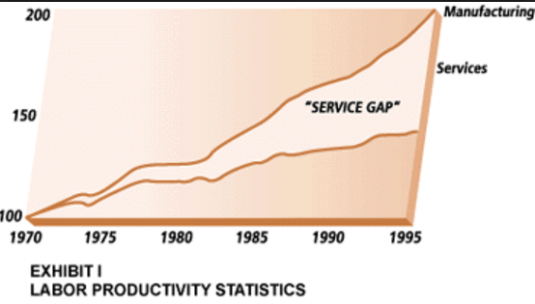
Source: Peter Kolesar, Garrett van Rysin and Wayne Cutler.
Any extra labour productivity from a living wage at the Wellington City Council is in doubt because low skilled service sectors are notorious for their low potential for productivity gains. They are the bread-and-butter of Baumol’s disease.
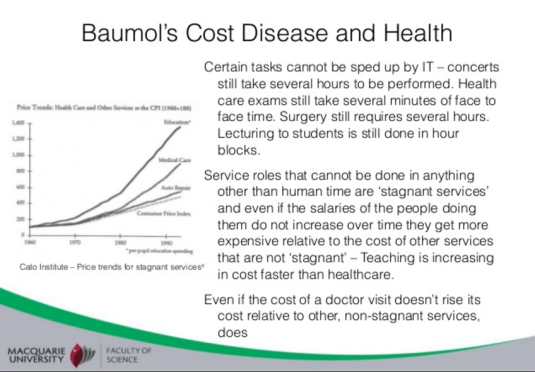
Source: Chris Rauchle.
It’s kicking the Wellington City Council when it is down to mention that low paid workers with families will lose a considerable part of the living wage increase because of reductions in their family tax credits – reductions in the Working for Families in-work tax credit. Any living wage increase at the Wellington City Council is the subject of multiple clawbacks by IRD. There is income tax, a 25% abatement rate on Working for Families tax credits on any family income above about $36,000 and 15% GST. All in all, the transfer out of the pockets of ratepayers to IRD would be at least one-third.
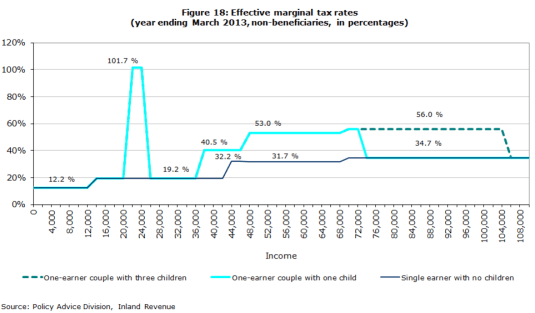
I have not included any accommodation supplement, childcare subsidy or community services card the low paid worker is receiving from WINZ. The winding back of these social benefits to the low paid worker and his or her family is a pointless transfer from Wellington City ratepayers to the national taxpayer.
It will be kicking Wellington City Council even further to remind of the enforcement and compliance costs of living wage ordinances in the USA at the city level.
The Wellington City Council this week acted against legal advice to require contractors under joint services agreements with other councils in the Wellington region to pay employees who work within the boundaries of Wellington city the living wage. The American cities had to define the minimum number of hours in a day that minimum wage workers who are mobile for their jobs had to spend within their city limits before their employer was subject to their living wage ordinance.
It is standard to put forward an efficiency wage argument for a living wage. The higher wage paid as result of the introduction of the living wage will motivate workers to work harder and cheer each other on.

Source: John Horton.
These workers paid the efficiency wage will require less supervision because under an efficiency wage, a rate of pay that is more than the going rate for their skills and experience with other employers and in other industries and occupations, these workers paid the efficiency wage have more to lose if disciplined or dismissed. By the way, the theory of the efficiency wages is an American theory where there is employment at will.
This additional effort and greater motivation from the efficiency wage, from the above market rate of pay, will reduce the costs of supervision to the employer of teams of employees as well as increase output per worker. This is supposed to offset some of the costs of the living wage increase.
At bottom, this efficiency wage hypothesis is entrepreneurs are unaware of the higher quality and greater self-motivation of better paid recruits for vacancies but wise bureaucrats and farsighted politicians notice these gaps in the market. Bureaucrats and politicians notice these gaps in the market before those who gain from superior entrepreneur alertness to hitherto untapped opportunities for profit do so and instead leave that money on the table.
I won’t mention that many of the modern theories of the firm focus, in part or in full on reducing opportunistic behaviour, cheating and fraud in employment relationships. The cost of discovering prices and making and enforcing contracts and getting what you pay for are central to the Coase’s theory of the firm put forward in 1937.
In Barzel’s (1982) theory of the firm, measurement costs drive the emergence and organisation of the firm. The firm arose to minimising the cost of measuring what is to be exchanged by bringing some of those measuring tasks in-house. Much of the organisation of the firm, including the degree of vertical and horizontal integration and many different forms of contracting are driven by ensuring owners and managers get what they pay for and are not overcharged through manipulation or cheating.
Alchian and Demsetz’s (1972) theory of the firm focused on moral hazard in team production. As they explain
Two key demands are placed on an economic organization-metering input productivity and metering rewards.
The main rationale in personnel economics from everything ranging from employer funding of retirement pensions to the structure of promotions and executive pay including stock options is around better rewarding self-motivating employees and reducing the costs of monitoring employee effort.

Source: Department of Labour (2009).
The profits of entrepreneurs for running a firm is directly linked from their successful policing of the efforts of employees and sub-contractors to ensure the team and each member perform as promised and individual rewards matched individual contributions (Alchian and Demsetz 1972; Barzel 1987). The entrepreneur is a residual claimant to the revenues of the firm net of paying all other inputs. Entrepreneurs must successfully police the contributions of their employers and contractors if they are to survive in competition. The better they are at this, the more the alert entrepreneur profits.
Every profit minded entrepreneur seeks to hire the group of workers with the lowest cost per unit of output produced by them. Those that do not will not survive in competition with more alert rivals. The trade-off between worker quality and wages in setting hiring standards is a routine entrepreneurial decision in every firm when recruiting:
Managers often say that their goal in hiring is to obtain the best quality workers. It sounds like a good idea, but is it? The most productive workers are also likely to be the most expensive. Should the goal instead be to hire the least expensive workers? …The best worker is not the cheapest, nor the most productive, but the one with the highest ratio of productivity to cost. We should hire as long as the marginal productivity of the last worker hired is greater than or equal to the cost of the worker.
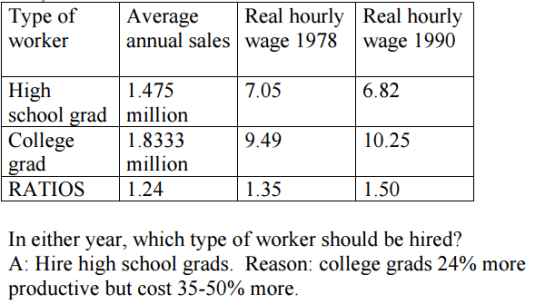
Source: Lazear and Gibbs.
New Zealand child poverty compared internationally
30 Oct 2015 Leave a comment
in labour economics, politics - Australia, politics - New Zealand, politics - USA, poverty and inequality Tags: child poverty
Every 3rd Child in the US lives in poverty.
(in #Norway & #Finland: https://t.co/K5Ub2QuPoE—
Max Roser (@MaxCRoser) October 21, 2015
Medsafe is a waste of time
29 Oct 2015 1 Comment
in applied welfare economics, economics of regulation, health economics, politics - New Zealand Tags: drug lags, Drug safety
Medsafe denied New Zealanders access to four drugs approved in comparable regulatory jurisdictions in the last three years. Medsafe rejected two other drugs in the last three years but these drugs were not approved in comparable jurisdictions. Doxorubicin Liposomal, chemotherapy drug, is not as yet actually refused, its application is pending. Medsafe is not involved in the funding of medicines; this is the responsibility of PHARMAC.

Source: data released 29 October 2015 pursuant to an Official Information Act request to the Ministry of Health.
What’s the point of this regulatory arm of the Ministry of Health? Is it a waste of space? Should not New Zealand automatically register any drug approved in the USA, UK, Canada, Australia or Germany? What can medical trials in New Zealand find out were not already found out overseas? Medsafe targets processing applications for the approval of new drugs in New Zealand to be done within 200 days. That’s 200 days too many.
Barriers to entry – costs ($s) of bringing new drugs to the market have risen manyfold #econ3 http://t.co/MFHTFhTLrj—
Geoff Riley (@tutor2u_econ) November 30, 2014
It should be lawful under the Medicines Act 1981 to market any drug in New Zealand which any of Australia, UK, USA, Canada or Germany has approved for prescription to patients.
SEEN & UNSEEN/ How much illness & death could be averted by limiting the FDA to safety, leaving efficacy to markets? http://t.co/4QkUuCCMDN—
Robert Graboyes (@Robert_Graboyes) March 11, 2015
If economists have a bitter drinking song, a battle cry that unites the warring schools of economic thought all, it would be “how many people has the FDA killed today”. For example, drugs became available years after they were on the market outside the USA because of drug approval lags at the FDA. The dead are many. To quote David Friedman:
In 1981… the FDA published a press release confessing to mass murder. That was not, of course, the way in which the release was worded; it was simply an announcement that the FDA had approved the use of timolol, a ß-blocker, to prevent recurrences of heart attacks. At the time timolol was approved, ß-blockers had been widely used outside the U.S. for over ten years. It was estimated that the use of timolol would save from seven thousand to ten thousand lives a year in the U.S. So the FDA, by forbidding the use of ß-blockers before 1981, was responsible for something close to a hundred thousand unnecessary deaths.
In 1962, an amended law gave the FDA authority to judge if a new drug produced the results for which it had been developed. Formerly, the FDA monitored only drug safety. It previously had only sixty days to decide this. Drug trials can now take up to 10 years.
Sam Peltzman showed in a famous paper in 1973 that these 1962 amendments reduced the introduction of new drugs in the USA from an average of forty-three annually in the decade before the 1962 amendments to sixteen annually in the ten years afterwards. No increase in drug safety was identified.
Halving every 9 years.
New approved drugs per billion dollars spent on research & development
bit.ly/1StxuV9 http://t.co/Hvx6mQ0lBa—
Max Roser (@MaxCRoser) August 01, 2015
Medsafe is a cost with no benefits to the New Zealand public. Medsafe has around 60 staff operating out of two offices, with centralised administrative functions, product approval and standard setting at the head office in Wellington.

How much of this budget of several million for Medsafe could be redirected to funding more life-saving and life changing drugs for use in New Zealand? This is rather than wasted on duplicating clinical trials already completed overseas or at the minimum duplicating regulatory approval processes, paperwork already completed overseas but not requiring a duplicate clinical trial in New Zealand.
At a minimum, the net benefits of the entire drug approval framework over the past three years in New Zealand is riding out on rejecting for approval half a dozen drugs, four of which are approved as safe in other comparable jurisdictions. That’s a pretty thin reed on which to hang a large budget that could be used by PHARMAC to fund life-saving drugs.
There should be a post box at the Ministry of Health to receive the certifications from overseas drug regulation agencies. Anything more is a deadly waste of taxpayers’ money.
My next round of Official Information Act requests will ask whether the minister and associate ministers of health were briefed on refusals of new medicines approved in other jurisdictions. Next I will ask:
- for any evidence that a separate regulatory authority for drug approvals in New Zealand has any benefits, and
- whether the Medsafe regime has ever been subject to a cost benefit analysis.
I have previously asked for information on drug approval lags. That was refused on the grounds I can look it up for myself on a rather complicated public database that requires knowledge of the names of medicines submitted for approval. Still mulling over what to do about that.
Real hourly minimum wage, PPP, USA, UK, Canada, New Zealand, Ireland, Germany, Australia and France before & after taxes, 2013
27 Oct 2015 Leave a comment
in labour economics, minimum wage, politics - Australia, politics - New Zealand, politics - USA

Source: OECD (2015), “Minimum wages after the crisis: Making them pay”.
Malcolm Turnbull sure is popular
27 Oct 2015 Leave a comment
in politics - New Zealand, Public Choice Tags: Australia, expressive voting, opinion polls, rational ignorance, rational irrationality, voter demographics
https://twitter.com/Mark_Graph/status/658769666748346368/photo/1
All the bookies I follow now giving the Coalition >80% #auspol bit.ly/1GwJgc4 https://t.co/2y3iPBnnnn—
Mark the Graph (@Mark_Graph) October 23, 2015
@PeterDunneMP The dangerous political opportunism of the marijuana decriminalisation lobby
26 Oct 2015 Leave a comment
in economics of crime, economics of regulation, health economics, politics - New Zealand, Public Choice
Preview of @NZQandA tomorrow https://t.co/svYBRTpUeR—
Peter Dunne (@PeterDunneMP) October 23, 2015
Associate Health Minister Peter Dunne was onto something when he pointed out that a number of those supporting the legalisation of medicinal cannabis oils are using it as a stalking horse to legalise the marijuana leaf.
After reading the wonderful investigation in Saturday’s Dominion Post, it’s quite clear that cannabis oil has nothing to do with marijuana liberalisation.
The Associate Health Minister pointed out on television yesterday that there is already one cannabis oil derivative product approved by Medisafe and available on prescription. It is open to any pharmaceutical company to submit any other cannabis oil and marijuana derivative medicine for approval. There will be a fair hearing.
Medical marijuana is already legal in New Zealand. Few cannabis oil and marijuana leaf derivatives have been approved under the Medicines Act because few have shown to be an effective medication.
Those campaigned for a marijuana law reform would do a lot of sick people a service by saying that the campaign from better access and government funding of cannabis oil and other marijuana derivatives is a separate issue from which they stand apart. They should be not trying to follow in medicinal cannabis deregulation to liberalise recreational use of marijuana.
The issues have nothing to do with each other. Those who want marijuana liberalisation should stand on their own political feet.
US deaths (2013)
Tobacco 437k
Alcohol 29k
Opoids 16k
Heroin 8k
Cocaine 5k
Marijuana 0vox.com/2014/5/19/5727… http://t.co/o8yMDf7oE0—
Conrad Hackett (@conradhackett) August 04, 2015
By infiltrating the medical marijuana lobby, their entryism slows any deregulation of the medicinal uses of cannabis oil and marijuana leaf because of slippery slope arguments.
A group of men and women gleefully demonstrate against Prohibition in 1932. http://t.co/686SwVHyC0—
Old Pics Archive (@oldpicsarchive) January 29, 2015
The marijuana decriminalisation lobby should be honest and say that it happens to be a coincidence that marijuana has other constituents that have medicinal uses. They want to decriminalise marijuana because they just want to get high.

@arindube Vernon Smith on the cruelty of the minimum wage
25 Oct 2015 Leave a comment
in economics of education, human capital, labour economics, labour supply, minimum wage, occupational choice, politics - Australia, politics - New Zealand, politics - USA Tags: living wage, minimum wage, on-the-job training
Great quote on the cruelty of the minimum wage from Nobel economist Vernon Smith, illustrated by Henry Payne https://t.co/Lwch51acEY—
Mark J. Perry (@Mark_J_Perry) October 24, 2015
The Economics of Red State vs. Blue State Carbon Politics
25 Oct 2015 Leave a comment
in applied price theory, climate change, constitutional political economy, economics of climate change, economics of media and culture, economics of regulation, energy economics, environmental economics, environmentalism, politics - Australia, politics - New Zealand, politics - USA, Public Choice, transport economics, urban economics
1. My JPAM 2000 paper documents that suburbanites drive more and consume more electricity than urban residents.
2. My 2011 JUE paper documents that center city liberal resident NIMBY zoning regulation has deflected more development to the suburbs where people live a high carbon life (see paper #1 above) and then oppose carbon pricing.
3. My co-authored 2013 JPUBE paper documents that energy intensive manufacturing industries seek out cheap electricity price areas. Whether U.S carbon pricing and the resulting higher electricity prices would nudge them to move oversees remains an open question.
4. My co-authored 2012 EER paper documents that more educated people are more likely to have installed solar panels and to go off the grid and thus not pay higher electricity prices.
5. My 2013 EI paper documents that Congress Representatives oppose carbon mitigation regulation when they are conservative, their district is poorer and their district is high carbon. Nancy Pelosi and Tom Steyer are in liberal, rich, low carbon San Francisco. There, it is easy to comply with carbon regulation. They will pay few new costs for such low carbon regulation.
6. My co-authored 2015 JAERE paper documents that even in California and within counties that suburbanites vote against low carbon regulation relative to center city residents. Since we control for the fact that liberals live in center cities, this 3rd variable does not explain the urban form/voting correlation.
7. In my co-authored 2015 JUE paper we document that U.S protectionism through the Buy America Act has hindered the improvement of our bus fleet as a green technology.
Source: Environmental and Urban Economics: The Economics of Red State vs. Blue State Carbon Politics
Why does Housing New Zealand pay dividends? @chrishipkins @metiria
23 Oct 2015 Leave a comment
in applied price theory, economics of bureaucracy, financial economics, industrial organisation, managerial economics, organisational economics, politics - New Zealand
The current controversy over payment of dividends by Housing New Zealand is misplaced because of the subtle connections between payment of dividends and greater value for money.
By paying dividends, the investment priorities of Housing New Zealand are subject to additional ministerial scrutiny. Its capital program is scrutinised in greater detail by the Cabinet because ministers must fund it against competing bids across the entire budget and parliamentary scrutiny process.
Each budget bid is championed by a minister, each of whom must make their case every year against all-comers. This annual competition for a central pool of capital filters out lower value investment bids.
If dividends were not paid but were instead retained as free cash flows in the agency, there would be less ministerial scrutiny of Housing New Zealand because it would have a smaller role in annual budget rounds. Ministers and the Parliament sit up and pay attention when money is to be spent, as they should, and the larger is the sum in the budget, the more attention is paid to value for the money sought. Funding projects with retained dividends may reduce ministerial and parliamentary scrutiny.
Payment of dividends does not reduce the ability of Housing New Zealand to engage in new capital spending. If the dividends were not paid, the amount of new capital spending from budget appropriations would be reduced dollar for dollar.
Keep calm and carry on – the British gender pay gaps at the 10th, 50th and 90th percentiles
23 Oct 2015 Leave a comment
in discrimination, gender, human capital, labour economics, occupational choice, politics - New Zealand, politics - USA, population economics Tags: gender wage gap
Unlike New Zealand or the USA, there is been steady progress up and down the entire British labour market in closing the gender pay gap.
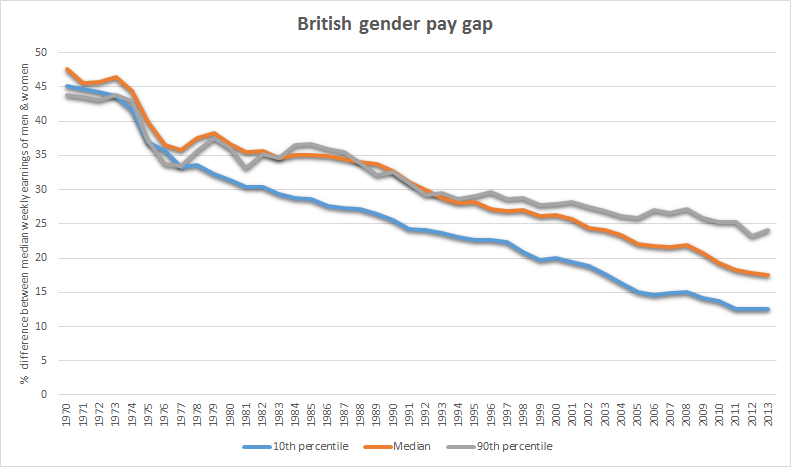
Source: OECD Employment Database.
@EricCrampton @KhyaatiA should New Zealand divide into Cantons?
22 Oct 2015 Leave a comment
in comparative institutional analysis, constitutional political economy, economics of bureaucracy, politics - New Zealand, Public Choice Tags: economics of federalism, Switzerland
Suggestions by the New Zealand Initiative for regions to be able to ask to be exempt from some national policies was against a background that New Zealand is too small to be a federal state. The New Zealand provinces were abolished in 1876. Switzerland seems to still put bread in the shops despite having many tiny Cantons and half-Cantons.
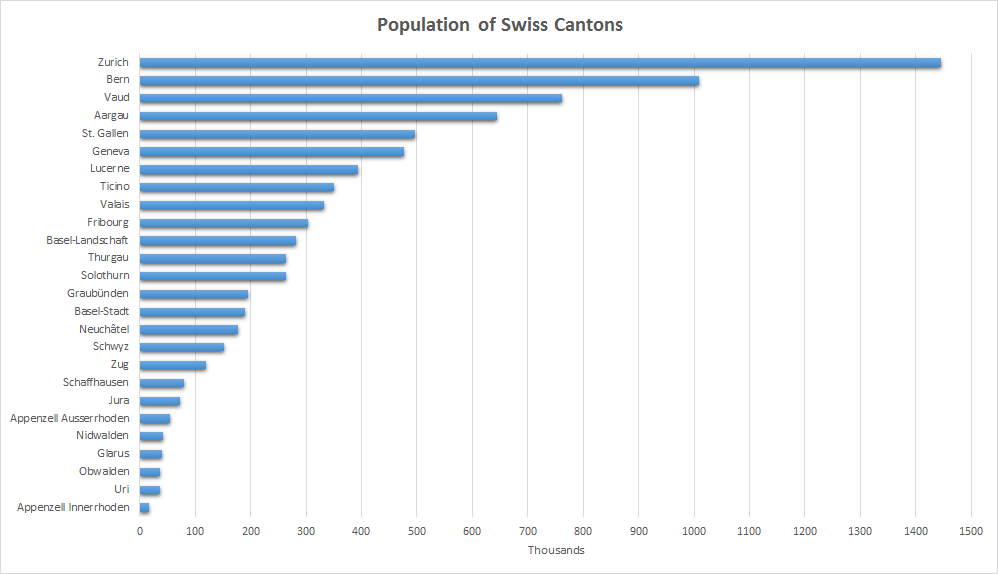
Source: Swiss Statistics – Cantons, communes.
So many American states have smaller populations are New Zealand, half in all, that is difficult to present them on a chart. All managed to be richer the New Zealand despite the horrors of federalism or because of it. These small state populations are before considering how much local government legislative power there is, including taxing and spending powers, city income taxes and city sales taxes, and county and local police forces.
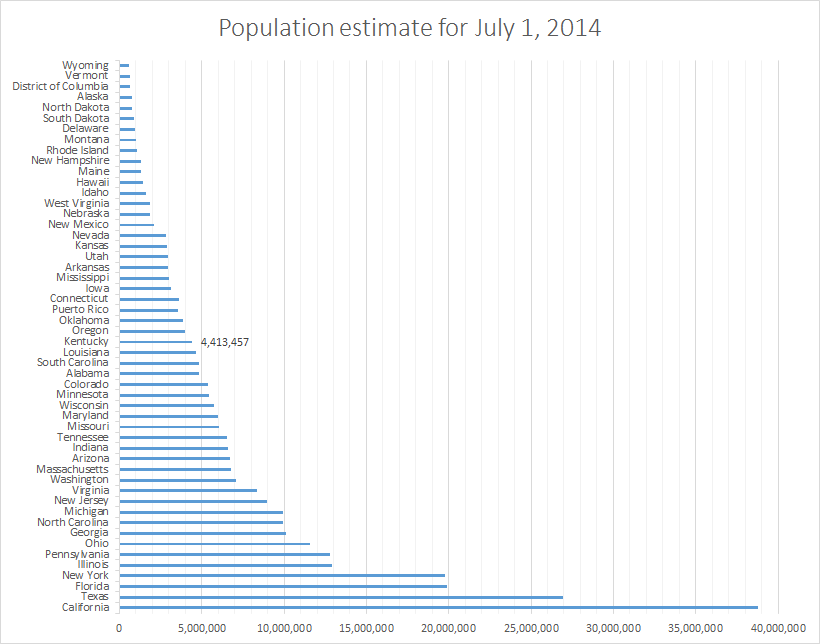
Source: List of U.S. states and territories by population – Wikipedia, the free encyclopedia.
The median national population size of countries is not much more than New Zealand’s current population.
- Controlling for location, Easterly and Kraay (2002) found that smaller states were richer than other states in per capita real GDP.
- Rose (2006) reviewed the impact of size on the level of income, inflation, material well-being, health, education, and the quality of a country’s institutions and found that small countries are more open to trade than large countries, but are not systematically different otherwise.
As I argued in my previous post on distance, New Zealand were prosperous from the time of European settlement despite a small population and their great distance from the main markets of the world on each side of the Atlantic.
Half the world's population lives inside this circle. http://t.co/XlTeEsTZkn—
Weird Science (@weird_sci) October 17, 2015
Of the ten richest countries in terms of GDP per capita, only four have populations above one million people (Alesina 2003). These countries are the USA (290 million people), Switzerland (7 million people), Norway (4 million people) and Singapore (3 million people). Of these four nations, two are below the global national population median of six million (Alesina 2003).
@RusselNorman tried to outthink, outsmart @JohnKey unlike @nzlabour who just tried to smear him
22 Oct 2015 Leave a comment
in environmental economics, Marxist economics, politics - New Zealand, Public Choice, rentseeking Tags: Leftover Left, New Zealand Greens, New Zealand Labour Party, rational ignorance, rational rationality, Russel Norman, Twitter left


Recent Comments