https://twitter.com/FurchtgottRoth/status/717362503160881152
Privatizing local bus services could save $5.7 billion
19 May 2016 Leave a comment
in industrial organisation, politics - New Zealand, politics - USA, privatisation, survivor principle, theory of the firm, transport economics, urban economics Tags: privatisation, state owned enterprises
How big are @JohnKeyPM’s $3 billion tax cuts in 2017 going to be?
16 May 2016 Leave a comment
in politics - USA, public economics Tags: 2017 New Zealand election
On morning radio this morning, Prime Minister John Key said "We are not ruling that out for 2017 or campaigning on it for a fourth term in 2017, but having a bigger one, to be blunt, than $1 billion." Asked how much was needed to deliver meaningful tax cuts, he said: "$3 billion, I reckon."
The table below uses the Treasury scoring of how much tax cuts can be delivered through $3 billion. That scoring is static. That is, no behavioural changes are assumed as the result of the tax cuts on labour supply, investment or entrepreneurship.

Source: computed from Revenue Effect of Changes to Key Tax Rates, Bases & Thresholds for 2015/16 — The Treasury – New Zealand.
The big sensitivity is how the company tax rate cut scoring treats offsets for dividend imputation credits. If there is no change in the other tax rates, a cut in the company tax forgoes $225 million a year per percentage point because some of it is clawed back through dividend imputation. The costing of the company tax cut by the Treasury when the other income tax rates are changed is assumed to be $350 million per percentage point. When calculating the dividend imputation offset, the Treasury assumes that shareholders are on an average tax rate of 30%.
If the Prime Minister chooses not to match the company tax rate announced by the Liberal National party government in Australia ahead of their election, there is certainly more room for individual income tax cuts.
What happened when a restaurant chain abolished tipping?
16 May 2016 Leave a comment
in labour economics, labour supply, managerial economics, minimum wage, occupational regulation, organisational economics, personnel economics, politics - USA, theory of the firm Tags: Edward Lazear, performance pay, tipping

Joe’s Crab Shack tested a no-tip model in 18 of its 130 restaurants. A 12-15% service charge replaced tips. Joe’s Crab capture is the first major restaurant chain to experiment with a tipping policy to experiment with abolishing it. The tipping minimum wage is far less than the federal, state and local minimum wages.

Joe’s Crab Shack had high hopes. The aims were customers would pay less, get a greater value experience, reduce labour costs and increase profits. The reactionary left represented by Salon and Huffington Post have quite strong views on tipping. Salon says
Tipping is a repugnant custom. It’s bad for consumers and terrible for workers. It perpetuates racism. Tipping isn’t even good for restaurants, because the legal morass surrounding gratuities results in scores of expensive lawsuits.
Tipping does not incentivize hard work. The factors that correlate most strongly to tip size have virtually nothing to do with the quality of service. Credit card tips are larger than cash tips. Large parties with sizable bills leave disproportionately small tips.
We tip servers more if they tell us their names, touch us on the arm, or draw smiley faces on our checks. Quality of service has a laughably small impact on tip size.
According to a 2000 study, a customer’s assessment of the server’s work only accounts for between 1 and 5 percent of the variation in tips at a restaurant.
Salon adds that federal and state law requires restaurants to ensure that tips bring employees up to minimum wage, but few diners know that.

Huffington Post managed to marshal 9 reasons why tipping should be abolished arguing that it was in no one’s interests either employers, employees or customers. The old efficiency at wage argument was rolled out arguing that employers gain in terms of diligent motivate employees by paying a straight wage rather than leaving it up to customer judgements of the services tended.
Not surprisingly this sounded like a business opportunity to Joe’s Crab Shack. Better customer service, better motivated employees and lower labour costs were promised by abolishing tips. You wonder why tipping survived in competition against alternative forms of restaurant service formats for all these decades?

Well, Joe’s Crab Shack got more than it bargained for when it abolished tipping. The pilot restaurants lost an average of 8-10% of customers during the test run.
The restaurant’s research showed that around 60% of customers disliked the policy because it took away an incentive for good service and that they don’t necessarily trust that management is passing along the money to workers.
The no tipping structure worked at four restaurants and will continue to work out why it succeeded there but failed at 14 other places.
What is even more interesting that the abolition of tipping lead to some workers quitting. This outcome at Joe’s Crab Shack is inconsistent with the notion that tipping is a by-product of the inequality of bargaining power between workers and employees. Turnover is supposed to reduce when tipping is abolished rather than increase with the employer losing their best workers.

Lazear found in data for Safelite Glass that average productivity will rise and the firm will attract a more able workforce will rise when it shifts to piece rates. The 44% increase in output per worker suggested the firm previously had a suboptimal compensation system. Half of the increase in labour productivity came from workers quitting when piece rates are introduced and being replaced by workers motivated to apply by the lure of piece rates. The average worker received a 10% increase in pay as a result of the switch to piece rates.
The only economic analysis of any value on tipping was written in 1985 by David Sisk at the Federal Trade Commission. He wrote a paper about both tipping and commissions. Sisk approached tipping not as a motivational device but a form of contracting.
Sisk points out that tipping takes the place of reputation as a way of guaranteeing good services are at a restaurant. Many do not plan to return to a restaurant so an alternative form of contracting emerges to ensure good service because the threat of taking future custom elsewhere does not work.
In the case of a tip, the buyer (or customer) is provided with a final means of automatic redress which serves to prevent unsatisfactory performance on the part of the seller.
The possibility of unsatisfactory performance arises when the brand-name, repeat purchase mechanism is not effective or because employees of the seller are too costly to monitor.
An example is tourists. They are protected from inferior service relative to the locals because they pay tips too and are well able to judge good and bad service.

Sisk argues that once a customer sits down at a restaurant, the customer commits ever increasing amounts of time and the restaurant commits ever increasing amounts of physical resources. As one commits more irrevocable resources, the greater is the incentive of the other to renege on the contract.
A tip allows the customer to withhold a portion of the price without further negotiation. The tip serves to protect the customer from bad service and to protect the restaurant from bad service by an errant employee
The system of tipping provides the motivation for the waiter to properly identify and accommodate the individual desires of customers subject to the profit maximizing constraint of the restaurant owner…
The tip protects the buyer from exploitation by a seller (when the brand-name mechanism is insufficient) or from exploitation by the shirking employees of the seller
The worst tippers are single males; the best are couples and groups. The biggest tippers are single males on a date.
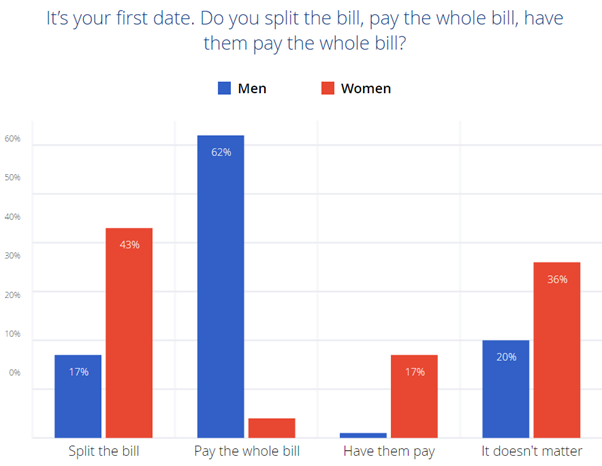
Source: OkCupid, A woman’s advantage.
Most @BernieSanders’ supporters don’t want to #FeelTheBern in their hip-pocket
13 May 2016 Leave a comment
in politics - USA, public economics Tags: 2016 presidential election, Bernie Sanders, expressive voting, Left-wing hypocrisy, rational ignorance, rational irrationality
66 percent of Sanders supporters are unwilling to pay more than $1,000 in higher taxes for universal health care. This includes the 8 percent of Sanders supporters who aren’t willing to pay anything more!
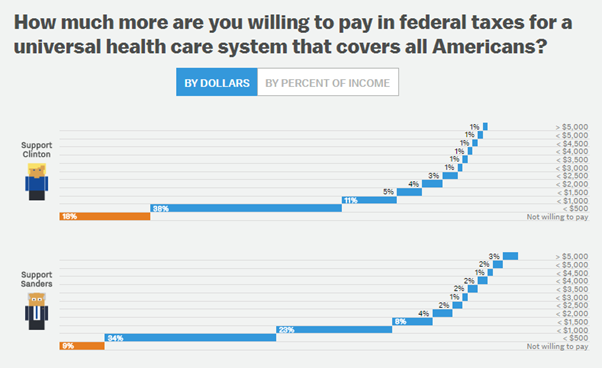
Source: Most Bernie Sanders supporters aren’t willing to pay for his revolution – Vox.
Sanders supporters want free public college tuition but 14 percent said they don’t want to pay additional taxes for it; another half said they would only pay up to $1,000 a year!
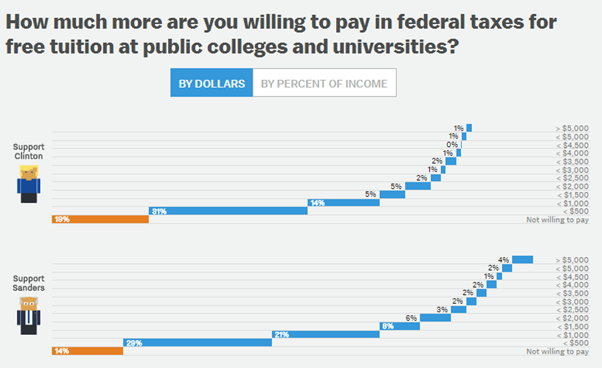
Source: Most Bernie Sanders supporters aren’t willing to pay for his revolution – Vox.
With friends like these, the #UBI will not live to face its enemies @jordNZ
09 May 2016 Leave a comment
in applied price theory, applied welfare economics, politics - New Zealand, politics - USA, public economics, rentseeking Tags: universal basic income
Running around saying that Universal Basic Income will make work optional leaves open the question of who will be the suckers who actually do the work and pay enormous taxes to fund the idyllic lifestyle of the bohemian rest.

Source: What If Everybody Didn’t Have to Work to Get Paid? – The Atlantic.
@BernieSanders should be the @realdonaldtrump’s running mate
08 May 2016 Leave a comment
in applied price theory, applied welfare economics, international economics, politics - USA Tags: 2016 presidential election, comparative advantage, free trade, left-wing popularism, rational ignorance, rational rationality, right-wing popularism
The dual concepts of Businesses Cannot Discriminate and Her Body, Her Choice have intersected
08 May 2016 Leave a comment
in economics of regulation, health economics, politics - USA Tags: alcohol regulation, meddlesome preferences, nanny state
New York drinking establishments must post warnings against pregnant women drinking but still must serve them.
Blacks shot dead by US police by threat level, January – April 2016
08 May 2016 Leave a comment
in economics of crime, law and economics, politics - USA Tags: crime punishment, law and order, media bias, police shootings
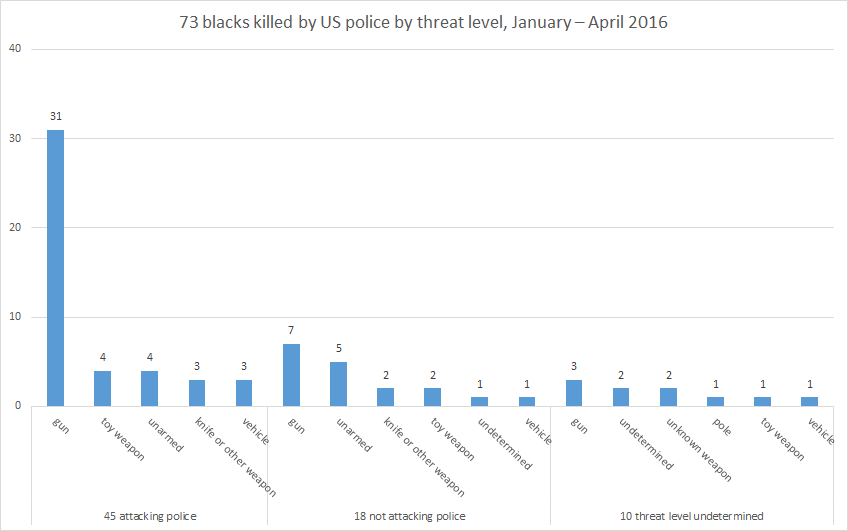
This is what the Washington Post and The Guardian said on the 5 blacks the Washington Post classified as unarmed and not attacking police:
“Antronie Scott, an unarmed 36-year-old black man, was shot on Feb. 4, 2016, in San Antonio, Tex. Undercover San Antonio police officers were monitoring Scott, who had outstanding arrest warrants. When a uniformed officer approached Scott, he spun around with something in his hand. Police later determined that Scott was holding a cellphone.” Source: Fatal force: A Washington Post investigation of people shot and killed by police in 2016 – Washington Post

Source: The Counted: people killed by police in the United States – interactive | US news | The Guardian.
"David Joseph, an unarmed 17-year-old black male, was shot on Feb. 8, 2016, in Austin, Tex. Austin police were responding to reports of an erratic, aggressive person. Joseph, who was naked, rushed toward the officer." Source: Fatal force: A Washington Post investigation of people shot and killed by police in 2016 – Washington Post.

Source: The Counted: people killed by police in the United States – interactive | US news | The Guardian.
"Calin Roquemore, an unarmed 24-year-old black man, was shot on Feb. 13, 2016, in Beckville, Tex. Roquemore fled a traffic stop by a Texas state trooper. Roquemore refused the trooper’s orders to show his hands. No weapon was found at the scene." Source: Fatal force: A Washington Post investigation of people shot and killed by police in 2016 – Washington Post.

Source: The Counted: people killed by police in the United States – interactive | US news | The Guardian.
"Marquintan Sandlin, an unarmed 32-year-old black man, was shot on Feb. 21, 2016, in Inglewood, Calif. The man was a passenger in a car stopped at an intersection. Inglewood police approached the car and noticed that the woman who was driving had a gun. Officers shot and killed Sandlin and the woman, Kisha Michael." Source: Fatal force: A Washington Post investigation of people shot and killed by police in 2016 – Washington Post.

Source: The Counted: people killed by police in the United States – interactive | US news | The Guardian.
"Peter Gaines, an unarmed 37-year-old black man, was shocked with a stun gun and shot on March 12, 2016, in Houston, Tex. A Houston police officer approached Gaines after he vandalized a traffic sign. Gaines lunged at the officer.” Source: Fatal force: A Washington Post investigation of people shot and killed by police in 2016 – Washington Post.

Source: The Counted: people killed by police in the United States – interactive | US news | The Guardian.
I will leave it up to readers to work out how many of these police shootings were suspicious and indicate police misconduct.
Straight talking from @BernieSanders on #sugartaxes @JordNZ
06 May 2016 Leave a comment
in applied price theory, health economics, income redistribution, politics - USA, Public Choice, rentseeking Tags: 2016 presidential election, do gooders, heavy-handed Samaritans, meddlesome preferences, nanny state, regressive taxes, sin taxes, soda taxes, sugar taxes
The cost of regulation in the USA
27 Apr 2016 Leave a comment
in applied price theory, applied welfare economics, comparative institutional analysis, economic growth, economic history, economics of regulation, macroeconomics, politics - USA Tags: cost of economic regulation, endogenous growth theory
U.S. Presidential Election Results (1789-2012)
26 Apr 2016 Leave a comment
in economic history, economics of media and culture, politics - USA Tags: presidential elections
A Mall divided by different city minimum wage laws @SueMoroney @GreenCatherine
26 Apr 2016 1 Comment
in applied price theory, applied welfare economics, economics of regulation, labour economics, minimum wage, politics - New Zealand, politics - USA, Robert E. Lucas Tags: Alan Manning, city minimum wage laws, living wage, monopsony
The Westfield Valley Fair Mall is half in San Jose city and half in Santa Clara city. In 2012, San Jose raised its minimum wage from $8 to $10 per hour.
National Public Radio in 2014 had a brilliant broadcast on the implications of this new city minimum wage law on the Westfield Valley Fair Mall. As the broadcast said:
This change created two economic worlds within a single, large building. Employees doing more or less the same work, just steps away from each other, started making different wages.
The radio show discussed what happened on the $8 side of the Mall and then on the $10 side through interviews with employers and workers.
On the then $8 per hour minimum wage side of the Mall, employers quickly noticed that many of their employees quit to jobs elsewhere in the same Mall. These same employees found that the quality of job applicants also fell away seriously. There were noticeable differences in the personalities traits and dress standards presented by the $8 an hour job applicants and $10 an hour job applicants.
As is to be expected because information about job opportunities is costly, some of the minimum wage employees did not know that other parts of the Mall paid more.
(This change in job turnover rates and applicant pool quality subsequent to the minimum wage increase in San Jose has implications for the inequality of bargaining power between workers and employers. Minimum wage workers do keep an eye on competing opportunities and take them up when better options arise – JR aside).
Since 2012, the minimum wage rates in the Mall have changed again: Santa Clara’s minimum wage initially increased to $9 an hour – the state-wide minimum wage, which had increased from $8 per hour; San Jose’s $10.15 per hour.
Those city minimum wages were increased further this year to $11 in Santa Clara city and $10.30 in San Jose city respectively by the respective city councils.
The state-wide minimum wage in California is to increase to $15 per hour by 2020 under a law just passed. California’s current $10-per-hour minimum wage is already among the highest in the country — only Washington, DC, has a higher minimum wage at $10.50 per hour.
Getting back to what was said in the National Public Radio broadcast, the show then moved on to the Gap Store, which straddled the two city boundaries.
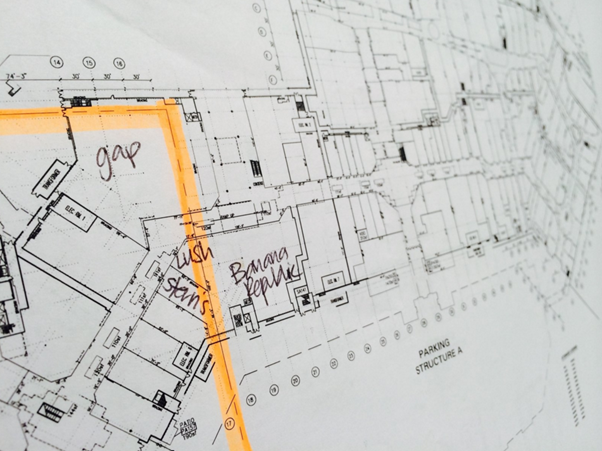
Source: Episode 562: A Mall Divided : Planet Money : NPR.
The Gap Store had the option of keeping a record of how much time employees spent in each city within its store and pay accordingly under each city law. The Gap raised everybody’s wage to $10.
There was then a fascinating interview with a Pretzels store owner. The question she asked herself every time she bought anything was how many pretzels se had to sell to cover the cost. She quickly concluded that she could not sell enough additional pretzels to cover the wage rise.
There is another Pretzels store just around the corner from her in the same mall but in the other city so she could not raise her prices by that much. She had a picture of that day’s menu and price list of the competing Pretzels store on her smart phone.
She instead took a cut in her profit. This flowed back to her employers because they received an annual bonus based on 15% of each year’s profit. They did not like that reduction in their bonus.
In a delicious irony, this same entrepreneur owned another Pretzels store in a different part of the Mall but which was in the other city subject to the lower minimum wage law. She owned two of the three pretzels stores in that Mall.
She solved the problem in staff morale by rotating her staff in alternate weeks between her two stores in the same Mall but different cities and paying them accordingly.
In my opinion, this NPR story is pretty much a vindication of standard microeconomics of minimum wage laws. Minimum wage workers are alert to their opportunities and take the best ones available to them but this is not perfect because of cost of information. As Manning observed in his superb book Monopsony in Motion:
That important frictions exist in the labor market seems undeniable: people go to the pub to celebrate when they get a job rather than greeting the news with the shrug of the shoulders that we might expect if labor markets were frictionless.
And people go to the pub to drown their sorrows when they lose their job rather than picking up another one straight away. The importance of frictions has been recognized since at least the work of Stigler (1961, 1962).
As George Stigler argued, information is costly to obtain in the labour market and this leads to price and wage dispersion with this variance related to the cost of searching for information. He concluded that the one-price (one-wage) market will occur only where the cost of information about the prices (wages) offered by buyers and sellers is zero.
Finally, minimum wages rises threaten the profitability of businesses and therefore their survival. That puts low-pay jobs at risk. As Bhaskar, Manning and To (2002) explain in their survey paper on monopsony:
Notice also that because a binding minimum wage reduces employers’ profits when there is free entry into and exit out of the labor market, some employers will be forced to exit. Employer exit has a negative effect on total employment through the loss of exiting employer payrolls.
That is, although establishments that remain after the imposition of a minimum wage increase their employment, some employers are forced out of business.
Thus, minimum wages have two opposing effects: the employment-increasing “oligopsony” effect and the employment-reducing “exit” effect. The overall effect of a minimum wage depends on which effect dominates.
An increase in the family tax credit puts no jobs at risk and is a superior alternative to minimum wage laws. Minimum wage increases throw some low page workers onto the social scrapheap.
Some look upon these large minimum state and city wage increases as worthwhile policy experiments. As Dube said:
… 30 to 40 percent of the California workforce will get a raise … This will be a big experiment. It’s far outside of our evidence base… If you’re risk-averse, this would not be the scale at which to try things.
On the other hand, if you think that wages are really low and they’ve been low for a really long time and we can afford to take some risks, doing things at this scale will get us more evidence.
“Big experiments” to use Dube’s words such as these with state and city minimum wages laws are wrong as Robert Lucas explained in 1988:
I want to understand the connection between in the money supply and economic depressions.
One way to demonstrate that I understand this connection–I think the only really convincing way–would be for me to engineer a depression in the United States by manipulating the U.S. money supply.
I think I know how to do this, though I’m not absolutely sure, but a real virtue of the democratic system is that we do not look kindly on people who want to use our lives as a laboratory. So I will try to make my depression somewhere else.
@Economicpolicy shows that top CEO pay has been a miserable rollercoaster for 15 years
25 Apr 2016 Leave a comment


Recent Comments