Page 47 from "An Illustrated Guide to Income" more economic #dataviz at: bit.ly/10QWgyR http://t.co/d1dhSYKWDC—
Catherine Mulbrandon (@VisualEcon) June 03, 2013
More evidence on the rise and rise of the working super rich – the top income earners are top wage earners now
28 Jul 2015 Leave a comment
in economic history, economics of education, entrepreneurship, financial economics, human capital, labour supply, occupational choice, politics - USA Tags: creative destruction, entrepreneurial alertness, top 1%, top income earners, top wage earners
Down and out in America in 2009
28 Jul 2015 Leave a comment
in applied welfare economics, labour economics, politics - USA, population economics, poverty and inequality Tags: living standards, The Great Enrichment

Tax revenues as a percentage of GDP, selected OECD member countries
28 Jul 2015 Leave a comment
in politics - Australia, politics - USA, public economics Tags: Eurosclerosis, growth of government, sick man of Europe, size of government, taxation and entrepreneurship, taxation and investment, taxation and the labour supply
How does America's tax revenue compare to the average collected by OECD countries? bit.ly/1HTtRTg #TaxDay http://t.co/Q17jMuwtNI—
The Hamilton Project (@hamiltonproj) April 15, 2015
Crimes by age and offence category
27 Jul 2015 Leave a comment
in economics of crime, human capital, labour economics, labour supply, law and economics, occupational choice, politics - USA Tags: crime and punishment, criminal deterrence
I thought America’s poor never had health insurance cover!? I’ve watched too much American TV?
26 Jul 2015 1 Comment
in applied welfare economics, economic history, economics of media and culture, health economics, industrial organisation, politics - USA, Public Choice, rentseeking, survivor principle Tags: adverse selection, expressive voting, health insurance, Leftover Left, media bias, medicaid, Medicare, moral hazard, Obamacare, rational ignorance, rational irrationality
#Medicaid expands access to health coverage and supports work: bit.ly/1RKHQ2x #Medicaidat50 http://t.co/mydZMggcXg—
Center on Budget (@CenterOnBudget) July 20, 2015
6.4 million seniors get the vital support & care they need thanks to Medicaid: bit.ly/1HqYvNG #Medicaidat50 http://t.co/onWMiYj301—
Center on Budget (@CenterOnBudget) July 23, 2015
Reminder: #Medicaid helps millions of babies: bit.ly/1RS7ME5 #Medicaidat50 http://t.co/SeJ7MFPGWE—
Center on Budget (@CenterOnBudget) July 20, 2015
#Medicaid help millions of children across the country live healthier lives. #Medicaidat50: bit.ly/1RS7ME5 http://t.co/LT6rXhNzUg—
Center on Budget (@CenterOnBudget) July 16, 2015
50 years of coverage that every American deserves. #Medicare http://t.co/uRtERV2k9K—
American Progress (@amprog) July 30, 2015
Mann: Celebrating historic gains in coverage for kids CCF#2015 http://t.co/g7CYQ7DuwN—
Georgetown CCF (@GeorgetownCCF) July 22, 2015
#Medicare has been keeping seniors insured and healthy for 50 years. http://t.co/mXW4x12Rhi—
American Progress (@amprog) July 30, 2015
The majority of Americans of all ages don't recognize that gov subsidizes their health care: vox.com/2015/3/1/81257… http://t.co/ivq5eLThsi—
(@SocImages) April 22, 2015
How to make the case for arming British police when attacking American police shootings
26 Jul 2015 Leave a comment
in economics of crime, health and safety, labour economics, law and economics, politics - USA Tags: common law, crime and punishment, law enforcement, occupational health and safety, police, rule of law
More British English, Scottish and Welsh police (68) have been murdered by gunfire than British police have shot people dead (52) in over a century.
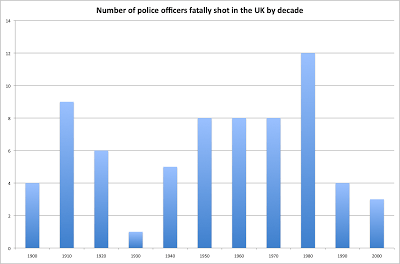
Source: Number of police officers shot dead in the UK by decade | John Graham-Cumming.
This suggests to me that the ledger is in the wrong direction. This list does not include British police stabbed or beaten to death nor are Northern Ireland deaths.
According to the FBI, from 1980–2014, an average of 55 law enforcement officers are feloniously killed per year in the USA. Those killed in accidents in the line of duty are not included in this number.
More law enforcement officers are murdered every year in the USA than ever murdered by gunfire in Britain. Police have the same common law right as any other to defend their own lives and the lives of others.
/cdn0.vox-cdn.com/uploads/chorus_asset/file/2849636/Screen_Shot_2014-12-21_at_1.42.15_PM.0.png)
Hourly minimum wages before and after taxes, USA, UK, Canada, Australia, New Zealand and Japan
26 Jul 2015 Leave a comment
in labour economics, minimum wage, politics - Australia, politics - New Zealand, politics - USA, population economics, public economics Tags: Australia, British economy, Canada, Japan, social insurance, Social Security taxes, taxation and labour supply
Figure 1: Hourly minimum wage before and after taxes, 2013, US dollars at purchasing power parities, single-person household
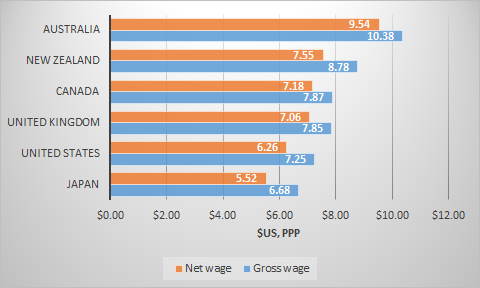
Source: OECD Focus on Minimum Wages after the crisis (2015).
If Roe v Wade was to fall
26 Jul 2015 Leave a comment
in constitutional political economy, economic history, economics of media and culture, health economics, politics - USA, Public Choice Tags: abortion, constitutional law, expressive voting, median voter, rational ignorance, rational irrationality, social change
On abortion, the USA is split on pro-life versus pro-choice. State legislatures pass laws safe in the knowledge that they will be struck down the next day. they were playing to a grandstand made up of values voters.
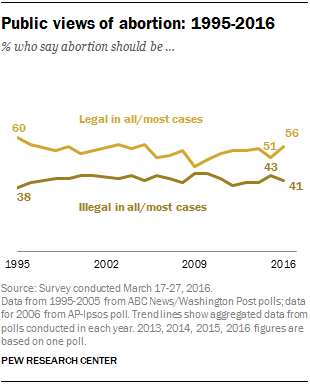
When the supreme court became a little vague on some procedural aspects of abortion law in the early 1990s, the state legislatures started showing much more restraint because the median voter would be annoyed.
Where Roe v. Wade to fall, some states would permit abortion, some would not. The Center for Reproductive Rights predicts that 21 states are likely to outlaw abortion immediately where Roe v. Wade to fall. This assessment is based not only on current law, but on the political makeup of the state legislatures. On the other hand, abortion is likely to remain legal in many states, according to these groups.
A key reason why self-funded candidates often falter
26 Jul 2015 Leave a comment
in constitutional political economy, economics of bureaucracy, politics - USA, Public Choice, rentseeking Tags: 2016 presidential election, campaign finance reform, campaign finance regulation, congressional elections


via Sometimes, Money Can’t Buy You Votes | FiveThirtyEight and Four Ways To Fund A Presidential Campaign | FiveThirtyEight.
Takings, property rights and democracy
25 Jul 2015 Leave a comment
in politics - USA, property rights Tags: constitutional law, rule of law, takings
Who has heavily guarded borders?
25 Jul 2015 Leave a comment
in international economic law, international economics, International law, politics - Australia, politics - USA Tags: Australia, British politics, economics of immigration, EU, illegal immigration, Mexico, North Korea, Spain
The walled world
– http://t.co/dXmzCUrjpD—
Amazing Maps (@Amazing_Maps) July 13, 2015
Average effective retirement ages by gender in the USA, UK, Germany and France, 1970 – 2012
25 Jul 2015 1 Comment
in economic history, gender, labour economics, labour supply, politics - USA Tags: ageing society, British economy, demographic crisis, economics of retirement, effective retirement ages, female labour force participation, female labour supply, France, Germany, male labour force participation, male labour supply, old age pensions, older workers, retirement ages, social insurance, Social Security, welfare state
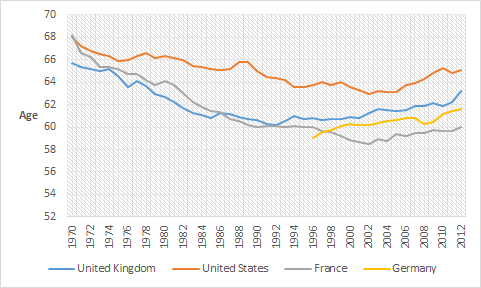
Figure 1 shows a divergence from a common starting point in 1974 effective retirement ages. The French in particular were the first to put their feet up and start retiring by the age of 60 by the early 1990. There was also a sharp increase in the average effective retirement age for men in the UK over a short decade. After that, British retirement ages for men started to climb again in the late 1990s. Figure 1 also shows that the gentle taper in the effective retirement age for American men stopped at the 1980s and started to climb again in the 2000s. The German data is too short to be of much use because of German unification. France only recently stopped seeing its effective retirement age fall and it is slightly increased recently – see figure 1
Figure 1: average effective retirement age for men, USA, UK, France and Germany, 1970 – 2012, (five-year average)
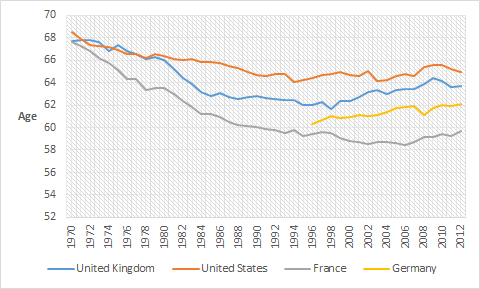
Source: OECD Pensions at a Glance.
Figure 2 shows similar results for British and American women as for men in the same country shown in figure 1 . That is, falling effective retirement ages for both British and American women in the 1970s and 1980s followed by a slow climb again towards the end of 1990s. French effective retirement ages for women followed the same pattern as for French retirement ages for men – a long fall to below the age of 60 with a slight increase recently. The German retirement data suggest that effective retirement ages for German women is increasing.
Figure 2: average effective retirement age for women, USA, UK, France and Germany 1970 – 2012, (five-year average)
Source: OECD Pensions at a Glance.
Obama’s report card – second quarter 2015
25 Jul 2015 Leave a comment
in economic history, politics - USA Tags: obama


Recent Comments