What is New Keynesian macroeconomics?
20 Mar 2020 Leave a comment
in budget deficits, business cycles, economic growth, fiscal policy, history of economic thought, macroeconomics, Milton Friedman, monetarism, monetary economics Tags: Keynesian macroeconomics, New Keynesian macroeconomics

Batteries Not Included: $Trillions Spent on Storage Won’t Save Intermittent Wind & Solar
20 Mar 2020 7 Comments


Chaotic intermittency means wind and solar cannot, and will never, replace coal, gas or nuclear.
The fact that wind and solar output plummets whenever the sun sets and/or calm weather sets in has been treated by RE zealots as (yet another) inconvenient truth, that just won’t go away.
In the first few years of the great wind power fraud in Australia, its promoters kept telling us that all we needed to do was spread these things far and wide and we would have an endless supply of ‘free’ electricity, lovingly caressed from mother nature. Well, that didn’t pan out, as any South Australia will tell you.
So, talk soon turned to mega-batteries, as if the wind and solar industry was like some ditzy shopper who’d forgotten to add milk and bread to their shopping list.
The meme is that the chaos delivered by wind and solar can all be solved…
View original post 1,518 more words
Overhyped: Europe’s Largest RE Battery Can Power Britain For 60 Seconds When Wind Power Fails
20 Mar 2020 Leave a comment

The hyperbole that greets the announcement of another giant battery is like the toxic plume they give off when they explode in flames. And, as we recently reported, that’s an increasingly likely occurrence: Giant Batteries Bomb: Renewable Energy Storage Systems Literally Setting The World On Fire
At a loss to deal with the hopeless and chaotic intermittency of wind and solar, renewable energy rent seekers and zealots have had to retreat behind the “batteries will fix it” barricades, as a last redoubt.
So, it’s only natural that they’ll overplay their hands every time a piddling 100 MW of lithium-ion storage gets tacked on to the grid.
Paul Homewood sets out to douse their misplaced exuberance with a little mathematics and physics.
Shell’s New Battery Won’t Solve Wind Intermittency Problem
Not a Lot of People Know That
Paul Homewood
22 February 2020

Oil and gas giant Shell has plans for a 100-megawatt…
View original post 386 more words
Ireland’s worst bank strike lasted 6-months
20 Mar 2020 Leave a comment
in economic history, financial economics, labour economics, labour supply, macroeconomics, monetary economics, unions Tags: economics of banking, union power

Stephen Pinker on gender equity
20 Mar 2020 Leave a comment
in discrimination, economics of education, gender, health and safety, human capital, labour economics, labour supply, law and economics, occupational choice Tags: gender wage gap, offsetting behaviour, political correctness, regressive left, The fatal conceit, unintended consequences

How was the war on poverty going?
20 Mar 2020 Leave a comment
in economic history, income redistribution, labour economics, politics - USA, poverty and inequality
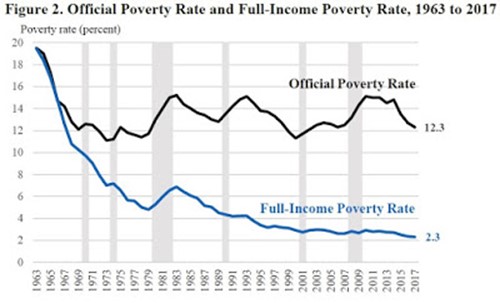
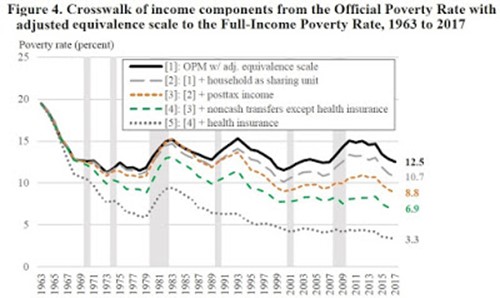
the Full-income Poverty Measure estimates the share of people in poverty using a post-tax, (comprehensive or full) post-transfer definition of income. Similar to the Official Poverty Measure, it includes market income (wages and salaries, self-employment and business income, farm income, retirement income from pensions, dividends, interest, rent and alimony) and cash transfers (Aid to Families with Dependent Children/Temporary Assistance for Needy Families, Social Security and workers’ compensation). It then adds the market value of health and non-health in-kind transfers (food stamps/SNAP, subsidized school lunches, rental housing assistance, and Medicare and Medicaid) as well as the market value of employer-provided health insurance. It subtracts Federal income and payroll taxes but adds tax credits including the Earned Income Tax Credit, Child Tax Credit, and Additional Child Tax Credit (the refundable portion of the CTC) based on estimated tax liabilities using NBER Taxsim 9.3 (Feenberg and Coutts 1993). We impute several of these income sources in the early years of our analysis because they were not collected in the CPS-ASEC.
From https://www.iza.org/publications/dp/12855/evaluating-the-success-of-president-johnsons-war-on-poverty-revisiting-the-historical-record-using-a-full-income-poverty-measure via http://conversableeconomist.blogspot.com/2020/03/us-poverty-over-time-how-to-compare.html
Barro on Ricardian equivalence
20 Mar 2020 3 Comments
in fiscal policy, macroeconomics, public economics

From https://www.wiwi.uni-wuerzburg.de/fileadmin/12010500/user_upload/skripte/ws05/themensozueb/Barro.pdf
By Ramelli and Wagner
20 Mar 2020 Leave a comment
in financial economics, health economics Tags: economics of pandemics, efficient markets hypothesis

My local super
20 Mar 2020 Leave a comment
in economics of information, entrepreneurship, health economics Tags: economics of pandemics


Plosser on money and business cycles
20 Mar 2020 Leave a comment
in business cycles, econometerics, economic history, financial economics, great depression, industrial organisation, labour economics, labour supply, macroeconomics, Milton Friedman, monetarism, monetary economics Tags: Keynesian macroeconomics, real business cycle theory




Recent Comments