WSJ Dares to Doubt: What if Wind & Solar ‘Transition’ Aren’t ‘Inevitable’, After All?
08 Jun 2019 Leave a comment


When the Wall Street Journal starts to question the inevitability of our ‘transition’ to an all wind and sun powered future, you know the gig is up.
Until now, the WSJ has been a champion for the wind and solar ‘industries’ in the US. Playing to the myth that the wind and sun are ‘free’, and that wind and solar power are both cheap and reliable, the Wall Street Journal has hitherto rarely fired an angry shot in the direction of the greatest State-sponsored fraud, in history.
So, when Mark Mills penned the piece below, we expect he also drew up his resignation notice, at the same time.
Mills expresses serious doubt, where perfect certainty once ruled the day. You see, amongst the intelligentsia, the future is already written, and its pages spell out the doom of conventional power generation – fossil fuels and nuclear power are already ‘dead-men-walking’, apparently…
View original post 906 more words
Bank robbers are so dumb that there are now sentencing enhancements for those bright enough to wear a mask @sst_nz
08 Jun 2019 Leave a comment
in applied price theory, economics of crime, law and economics Tags: crime and punishment, criminal deterrence, law and order

End Software Patents Alex Tabarrok
08 Jun 2019 Leave a comment
in applied price theory, comparative institutional analysis, economics of information, industrial organisation, law and economics, politics - USA, property rights, Public Choice Tags: patents and copyright
Will this criticism of a religion and those that follow that religion soon be illegal?
08 Jun 2019 Leave a comment

Why are Democrats so against the American revolution?
08 Jun 2019 Leave a comment
in defence economics, politics - USA, war and peace

Why are women paid less than men? | The Economist
08 Jun 2019 Leave a comment
in discrimination, economics of education, gender, human capital, labour economics, labour supply, occupational choice, poverty and inequality Tags: gender wage gap


Macros With Mythili – With Nobel Prize Winning Economist Finn Kydland
08 Jun 2019 Leave a comment
in budget deficits, business cycles, comparative institutional analysis, economic growth, history of economic thought, macroeconomics, monetary economics, Public Choice Tags: game theory, time inconsistency
Why I’m No Longer a Vegan (I Lied to You and I’m Sorry)
08 Jun 2019 Leave a comment
in economics of media and culture, health economics Tags: vegans
Milton Friedman – Why Economists Disagree
08 Jun 2019 Leave a comment
in applied price theory, applied welfare economics, budget deficits, business cycles, comparative institutional analysis, economic growth, economics of regulation, fiscal policy, international economics, macroeconomics, Milton Friedman, monetary economics
Squeezing blood from a stone: eighteenth century debtors’ prisons worked
07 Jun 2019 Leave a comment

by Alex Wakelam (University of Cambridge)
 Wood Street Compter, 1793. Image extracted from page 384 of volume 1 of Old and New London, Illustrated, by Walter Thornbury. Available at Wikimedia Commons.
While it is often assumed that debtors’ prisons were illogical and ineffective, my research demonstrates that they were extremely economically effective for creditors though they could ruin the lives of debtors.
The debtors’ prison is a frequent historical bogeyman, a Dickensian symptom of the illogical cruelty of the past that disappeared with enlightened capitalism. As imprisoning someone who could not afford to pay their debts, keeping them away from work and family, seems futile it is assumed creditors were doing so to satisfy petty revenge.
But they were a feature of most of English history from 1283, and though their power was curbed in 1869, there were still debtors imprisoned in the 1920s. The reason they persisted, as my…
View original post 519 more words
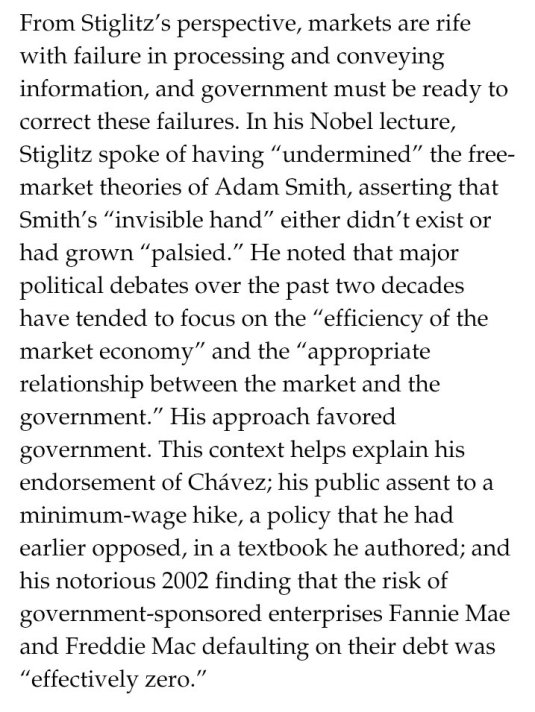
Joe Stiglitz was a consultant to Freddie and Fanny in 2002 on the chances of their mortgage underwriting portfolio going south
07 Jun 2019 Leave a comment
in applied price theory, business cycles, financial economics, global financial crisis (GFC), great recession, law and economics, macroeconomics, monetary economics, politics - USA Tags: moral hazard


Recent Comments