Joe Biden’s Suicidal Energy Bill Threatens to Destroy America’s Power Grid
14 Jan 2022 Leave a comment


From the outside it looks like treason, to the insider it’s merely the extension of the most massive subsidy scam in history. For nearly 40 years, the wind and solar industries have been telling us that they’ll soon be standing on their own two feet. But their greatest fear is being given the chance to actually do so.
The renewable energy rent seekers traipsing the halls of power in Washington are desperate to ensure that the subsidies upon which the greatest economic and environmental fraud of all time critically depend are extended in perpetuity.
With the Squad firmly in charge, and Joe Biden wandering the Oval Office in a befuddled daze, crony capitalists have already given a list of demands to Democrats ready to deliver: decade-long extensions of the Federal tax credits that will allow wind and solar generators to continue to profit obscenely at taxpayers’ expense.
Alex Epstein describes…
View original post 828 more words
Socialism(s) – Part Two
14 Jan 2022 Leave a comment

Sweden’s Imaginary Socialism as a Non-Model
Part One of this essay was posted a couple of days ago. In it, I reviewed some of the avatars and zombies of the vague words “socialist” and “socialism.” I arrived at the inescapable conclusion that Sen. Sanders “democratic socialism” means only Scandinavian and, specifically, Swedish “socialism.” I look at that social and fiscal arrangement below.
First, let me say that Sweden is a good place to live; it’s a very civilized country. I just don’t know in what sense it’s “socialist.” Center-left parties took part in governing the country for most of the 20th century, true. Yet, little of Swedish commerce or industry is nationalized, or in any way public property. The Swedish government tends not to be invasive with regulations or direct intervention. Sweden even ranks a little higher than the US in “business freedom” on the 2016 (international) Index of…
View original post 1,289 more words
Climate Realism & Alarmism, with Bjorn Lomborg & David Wallace-Wells
14 Jan 2022 Leave a comment
in energy economics, environmental economics, global warming Tags: climate alarmism
Yes, Starve the Beast
14 Jan 2022 Leave a comment

As part of a recent discussion with Gene Tunny in Australia, I explained why I support “Starve the Beast,” which means keeping taxes as low as possible to help achieve the goal of spending restraint.
The premise of Starve the Beast is very simple.
Politicians like to spend money and they don’t particularly care whether that spending is financed by taxes or financed by borrowing (both bad options).
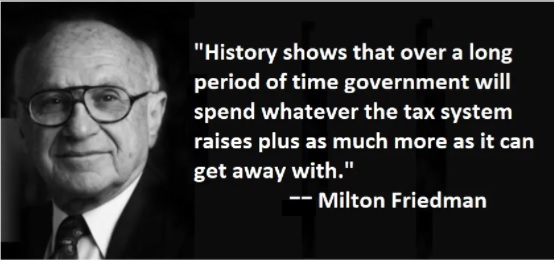 As Milton Friedman sagely observed, that means they will spend every penny they collect in taxes plus as much additional spending financed by borrowing that the political system will allow.
The IMF published a study on this issue about 10 years ago. The authors (Michael Kumhof, Douglas Laxton, and Daniel Leigh) assert that there’s no way of knowing whether Starve the Beast will lead to good or bad results.
…there is no consensus regarding the macroeconomic…
View original post 740 more words
Protecting our precious democracy: professors tutor PM on governance (and how “Treaty partnership” has been misinterpreted)
14 Jan 2022 Leave a comment

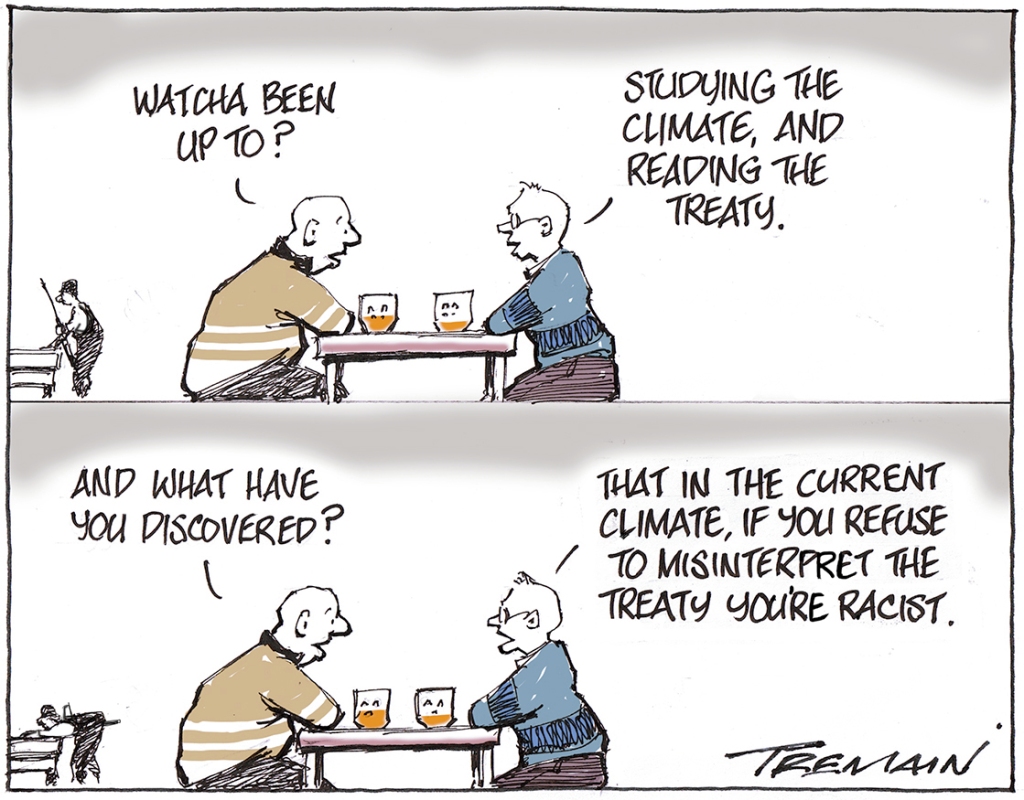
Dame Anne Salmond, a Distinguished Professor in anthropology at the University of Auckland and 2013 New Zealander of the Year, had good advice for the Ardern government in an article on the Three Waters plan and The Treaty.
She was writing about the comprehensive Three Waters reform and the manner in which it is being imposed on local authorities, making nonsense of any notion they and the citizenry are being consulted.
This must be an opportunity for listening, not for a government imposing its view of water as ‘assets’, she urged in an article which concluded:
“In dealing with the Three Waters debate, the Sixth Labour Government should learn from the mistakes of the Fourth, and not try to operate by executive fiat.
“Democracy is too precious to be set aside, even by those with the best of intentions; and waterways are not ‘assets,’ but the lifeblood of the land.”
View original post 1,383 more words
Richard Clayton QC: The Government’s New Proposals for the Human Rights Act Part 2: An Assessment
13 Jan 2022 Leave a comment


The Government explains its Proposals in its Human Rights Act Reform: A Modern Bill Of Rights: A consultation to reform the Human Rights Act 1998 (CP 588), which represent a radical departure from the HRA. The specific Proposals are developed in the context of broader themes:
- respecting our common law traditions and strengthening the role of the UK Supreme Court;
- restoring a sharper focus on protecting fundamental rights;
- preventing the incremental expansion of rights without proper democratic oversight;
- emphasising the role of responsibilities within the human rights framework; and
- facilitating consideration of and dialogue with Strasbourg, while guaranteeing Parliament its proper role.
The Government’s Proposals are designed to recast the HRA profoundly. They seek to create a framework for human rights which focuses principally on British law rather than ECtHR judgments and propose that the UK courts should give greater weight to the views of Parliament. The most important proposed…
View original post 1,958 more words
Jeremy Ogilvie-Harris: A Comparative Perspective on the Constitutionality of Clause 9 of the Nationality and Borders Bill
13 Jan 2022 Leave a comment

Introduction
The Nationality and Borders Bill (NABB) proposes controversial amendments to the UK’s citizenship deprivation power under s. 40 British Nationality Act 1981 (BNA). The Home Secretary seeks a power to dispense with the requirement to give notice of deprivation decisions to those affected, in an act of “striking back” (Harlow and Rawlings at Chamberlain J’s decision in D4 v SSHD. This post aims to analyse Clause 9 NABB from a comparative perspective, drawing on the provisions for depriving citizenship without notice in Australia’s Australian Citizenship Act 2007 (ACA) and New Zealand’s Citizenship Act 1977 (CA). It argues that, although Australia and New Zealand have similar powers to withhold/dispense with notice, the proposed UK power would be broader and more draconian, yet subject to fewer constitutional control mechanisms.
Sheppelle, considering a “forensic legal analytical framework” to assess constitutional changes, argues that “[t]he only way we can tell…
View original post 2,660 more words
Chris Monaghan: Reimagining impeachment: A new blueprint for our challenging times
13 Jan 2022 Leave a comment
 Henry Dundas, the first Viscount Melville (1742-1811), holds an infamous place in British constitutional history: he was the last person to be impeached. His acquittal by the House of Lords in 1806 marked the beginning of what has become a long pause in the use of an impeachment procedure against politicians or public officials. The last time that events got anywhere near interrupting this long pause came in 2004 when a number of MPs, including our present Prime Minister Boris Johnson, sought to impeach Tony Blair over the invasion of Iraq. The impeachment motion was co-drafted by experienced MPs and placed on the House of Common’s order paper, though proceeded no further (for the motion and background see J Simson Caird, ‘Impeachment’ House of Commons Briefing Paper).
But could it be that the turbulence of recent years when there have been many complaints about the government’s disrespect for accepted…
View original post 1,859 more words
‘So much dignity and efficiency’: John Evelyn Denison, Speaker of the House of Commons, 1857-72
13 Jan 2022 Leave a comment

The new year calls for a new blog series, so throughout 2022 we’re taking a closer look at some of the figures who held the post of Speaker of the House of Commons. Today we hear from Dr Kathryn Rix, assistant editor of our Commons 1832-1868 project, who explores the career of J E Denison, Speaker from 1857-72.
On 8 April 1857 John Evelyn Denison was in the library at his Nottinghamshire residence, Ossington Hall, when he received a letter from the prime minister.
My dear Denison,
We wish to be allowed to propose you for the Speakership of the House of Commons. Will you agree?
Yours sincerely,
Palmerston
Lord Palmerston to J. E. Denison, 7 Apr. 1857
This brief epistle marked the beginning of Denison’s fifteen-year tenure of the Speaker’s chair: just over three weeks later, on 30 April, the Commons chose him as Speaker, with no…
View original post 1,114 more words


Recent Comments