Do Living Wage advocates realise it helps richer households more than poorer ones? My take: telegraph.co.uk/finance/budget… … http://t.co/YPTB6v7tSB—
Fraser Nelson (@FraserNelson) July 10, 2015
A living wage helps well-off households more!
10 Jul 2015 Leave a comment
in applied price theory, applied welfare economics, econometerics, income redistribution, politics - Australia, politics - New Zealand, politics - USA, Public Choice, rentseeking Tags: activists, British economy, British politics, do gooders, expressive voting, living wage, rational ignorance, rational irrationality, The fatal conceit, The pretence to knowledge, unintended consequences
Doing Business in France, Germany and the UK – World Bank rankings compared
10 Jul 2015 Leave a comment
in applied price theory, applied welfare economics, comparative institutional analysis, economics of regulation, industrial organisation, law and economics, property rights Tags: British economy, doing business, France, Germany, World Bank
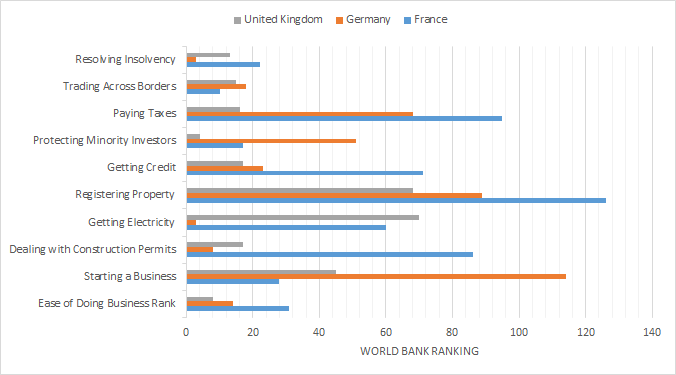
Figure 1: World Bank Doing Business rankings, France, Germany and the UK, 2014
Source: Doing Business – Measuring Business Regulations – World Bank Group.
Some things are decidedly harder to do in Germany and France than for businesses in the UK. On the other hand, it is surprisingly hard to register property in all three countries including the UK after 700 years of the blessings of the British common law.
Paying taxes in Germany and France are far harder than in the UK. Don’t have anything to do with construction permits in France unless you must. It is surprisingly hard to get the electricity on in the UK and France.
The European Union must have some benefits when it comes to trading across the borders of all three countries. Only problem is in Germany where it is very difficult to start a business in the first place. Why is for a later posting.
OECD starting a business rankings (New Zealand (1st) to Germany (114th)) – World Bank Doing Business rankings
09 Jul 2015 Leave a comment
in applied price theory, applied welfare economics, comparative institutional analysis, economics of regulation, industrial organisation, law and economics, politics - Australia, politics - New Zealand, politics - USA, property rights Tags: British economy, doing business, France, Germany, Italy, World Bank
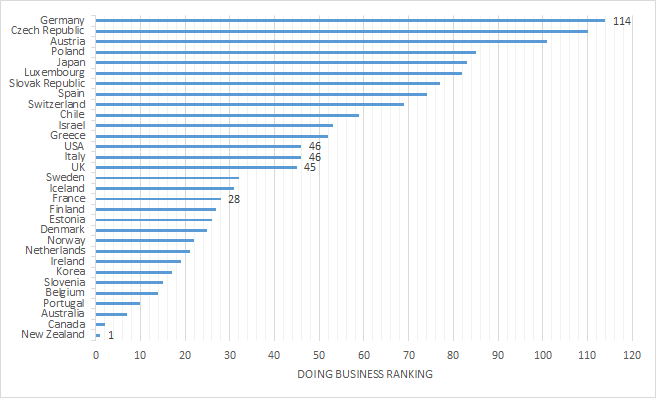
Figure 1: Starting a business rankings – World Bank Doing Business rankings, OECD countries, 2014
Source: Doing Business – Measuring Business Regulations – World Bank Group.
There is surprising wide range in the World Bank Doing Business ranking of the difficulty and delays in starting a business across the OECD.
Germany is ranked 114 from the world for starting a business. New Zealand is ranked first with the USA, Italy and the UK ranked in the mid 40s in the Doing Business database.
Scotland already has its own currency ripe for a currency board?
07 Jul 2015 Leave a comment
in currency unions, economic history, macroeconomics, monetary economics Tags: British economy, British politics, currency boards, free banking, Ireland, Scotland, Scottish independence
Since 1844, the Bank of Scotland, Clydesdale Bank and The Royal Bank of Scotland have been allowed to issue banknotes in denominations of £5, £10, £20, £50 and £100. Only the Royal Bank of Scotland continues to issue a small volume of £1 notes. Two Northern Irish banks have similar prerogatives.

These Scottish banknotes are not legal tender in England. No banknotes have legal tender status in Scotland, whether issued by Scottish banks or the Bank of England. The Bank of England says:
Scottish and Northern Ireland banknotes are fully backed at all times by ring-fenced backing assets partly held in Bank of England notes and UK coin, and partly as balances on accounts maintained by the issuing banks at the Bank of England.
Consequently, holders of genuine Scottish and Northern Ireland banknotes have the same level of protection as that available to holders of genuine Bank of England notes.
The acceptability of any means of payment, including banknotes, is essentially a matter for agreement between the parties involved in a transaction in Scotland.

Bank of England keeps control Scottish bank notes in issue by stipulating that the issuing bank hold in their reserves the same amount of UK money (either in cash or on deposit at the Bank of England) as the Scottish notes they issue. These reserves could easily be converted to a currency board.
- A currency board issues local notes and coins anchored to a foreign currency (e.g. Sterling) backed by government bonds with 1 pound sterling pound sterling and British government bonds for every Scottish pound currency note issued.
- A currency board issues domestic notes and coins only when there are foreign-exchange reserves to back it. In the case of a Scottish currency board, there would be pounds Sterling reserves to back any Scottish pounds and currency notes on issue.
The Hong Kong currency board has operated successfully through 30 years of financial turbulence and radical constitutional change. There is no reason why a Scottish currency board could not do likewise, guaranteeing the convertibility of a Scots pound, initially at parity with the English pound sterling.

After independence, Ireland acted effectively as a currency board until the 1970s. Currency boards were commonplace throughout the British Empire and were highly successful.
- On the independence of the Irish Free State in 1922, the introduction of an independent currency was a low priority because 98% of exports and 80% of imports were with the UK.
- British banknotes and notes issued by Irish banks circulated (but only the first were legal tender) and coins remained in circulation.
Under the Currency Act 1927, the Saorstát Pound (Free State Pound) was created at parity with the British Pound Sterling. A Currency Commission kept British government securities, sterling cash, and gold to keep a 1:1 relationship between the two currencies.
Although a Central Bank of Ireland was created in 1943, the Irish punt remained linked to sterling with the central bank operated as a de facto currency board policy until joining the European Exchange Rate Mechanism in 1979.
A currency board has no capacity to act as a lender of last resort to a Scottish banking system.
Poverty in the UK
07 Jul 2015 Leave a comment
in poverty and inequality Tags: British economy, child poverty, family poverty
More young adults in poverty as rate drops to record low for pensioners bit.ly/1qZiPnZ http://t.co/3QhofXekWP—
Guardian Data (@GuardianData) November 24, 2014
Fabian Society and Church of England caught out as hypocrites on London Living Wage of £18,000
06 Jul 2015 Leave a comment
in income redistribution, industrial organisation, labour economics, minimum wage, poverty and inequality, Public Choice, rentseeking, survivor principle Tags: British economy, British politics, Church of England, expressive voting, Fabian Society, hard budget constraints, Left-wing hypocrisy, living wage, market selection


Gender wage gap, USA, UK, Australia and New Zealand since 2001
04 Jul 2015 Leave a comment
in discrimination, economic history, gender, labour economics, politics - Australia, politics - New Zealand, politics - USA Tags: Australia, British economy, gender wage gap
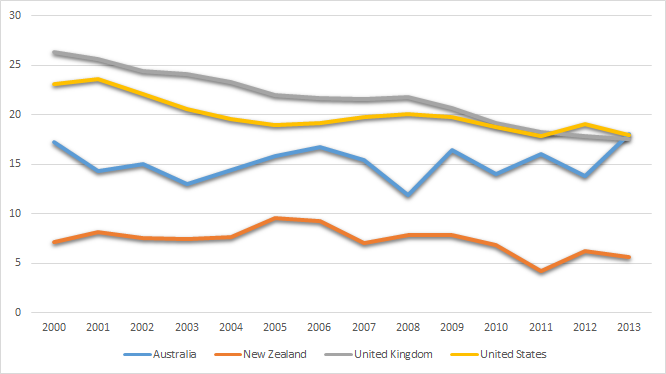
Figure 1: Gender wage gap (unadjusted % difference between median wages of male and female full-time employees)
Source: OECD StatExtract.
A blow to Director’s Law?
03 Jul 2015 Leave a comment
in constitutional political economy, income redistribution, Public Choice, public economics, rentseeking Tags: British economy, British politics, Director's Law, expressive voting, growth of government, median voter theorem, size of government
No, most U.K. homes do not get more in benefits than they pay in tax ow.ly/3y0nEo http://t.co/LaXvGa8ro2—
Bloomberg VisualData (@BBGVisualData) July 02, 2015
…the poorest 30 percent of households receive significantly more in cash benefits than they pay in tax. The next 10 percent receive on average £596 pounds a year more in cash benefits than they pay in tax, and the top 60 percent all pay more in tax than they get back in cash benefits.
New data from the ONS show the huge growth in state dependency under New Labour. Analysis at cps.org.uk/files/factshee… http://t.co/OLjRoxt3eg—
CPS Think Tank (@CPSThinkTank) June 29, 2015
Top performers in science by gender, USA, UK, Japan, Canada, Australia and New Zealand
02 Jul 2015 Leave a comment
in discrimination, economics of education, gender, human capital, labour economics Tags: Australia, British economy, Canada, Japan, lost boys, reversing gender gap
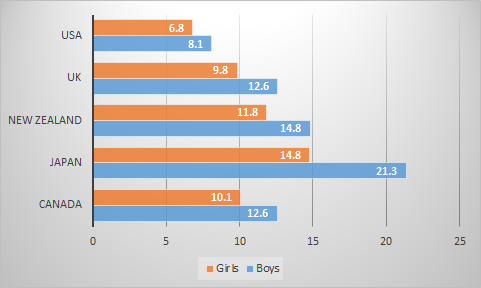
Why are Japanese 15-year-old girls as good at science as teenagers anywhere else in the world?
Figure 1: Percentage achieving the proficiency level 5 or higher in sciences by gender, USA, UK, Japan, Canada, Australia, New Zealand, 2012
Source: OECD StatExtract.
Top performers in maths by gender, USA, UK, Japan, Canada, Australia and New Zealand
01 Jul 2015 5 Comments
in economics of education, gender, human capital, labour economics Tags: Australia, British economy, Canada, Japan, lost boys, reversing gender gap
Figure 1: Percentage achieving the proficiency level 5 or higher in mathematics by gender, USA, UK, Japan, Canada, Australia, New Zealand, 2012

Source: OECD StatExtract.
1st 999 number introduced today 1937
30 Jun 2015 Leave a comment
in economic history, economics of crime, economics of media and culture, entrepreneurship, law and economics Tags: British economy, crime and punishment, London
999 – World's first emergency telephone number – was introduced in London #OnThisDay 30 June 1937 #emergencyservices http://t.co/I4gbrwJ2Vp—
BT Archives (@BTArchives) June 30, 2014
Top performers in reading by gender, USA, UK, Japan, Canada, Australia and New Zealand
30 Jun 2015 Leave a comment
in discrimination, economics of education, gender, human capital, labour economics Tags: Australia, British economy, Canada, Japan, lost boys, reversing gender gap
Figure 1: percentage achieving the proficiency level 5 or higher in reading by gender, USA, UK, Japan, Canada, Australia, New Zealand, 2012

Source: OECD StatExtract.
Poverty rates in Canada, UK and USA since 1985
28 Jun 2015 Leave a comment
in labour economics, politics - USA, poverty and inequality, welfare reform Tags: British economy, Canada, top 1%
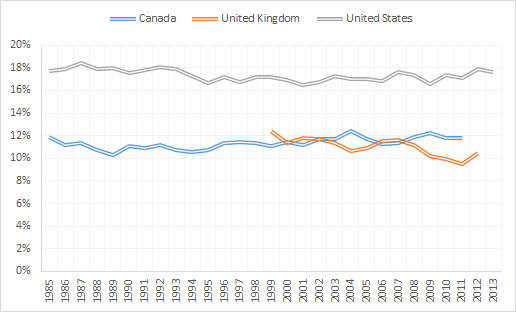
Despite 30 years of the ravages of neoliberalism, Reagan, Thatcher, and Blair, the whole lot, poverty has not gone up or down much at all.
Figure 1: relative poverty rate (% of persons living with less than 50% of equivalised disposable income), USA, UK and Canada
Source: In It Together – Why Less Inequality Benefits All – © OECD 2015
All in less cash transfers average income tax rates at average wage, USA, UK, Australia and New Zealand
27 Jun 2015 Leave a comment
in labour supply, politics - Australia, politics - New Zealand, politics - USA, poverty and inequality, public economics Tags: Australia, British economy, family tax credits, family taxation, in-work tax credits, social insurance, taxation and the labour supply, welfare state
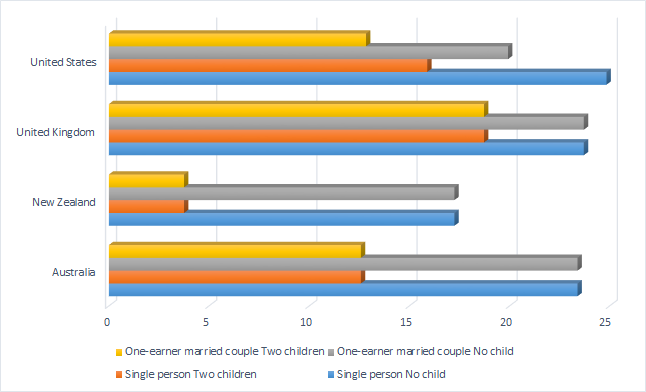
Figure 1: All in less cash transfers average income tax rates at average wage, 2014
Source: OECD tax database
Why is the Australian top 0.1% far less greedy than the UK, US and Canadian top 0.1%?
26 Jun 2015 Leave a comment
in economic history, entrepreneurship, human capital, labour economics, labour supply, Marxist economics, occupational choice, politics - Australia, politics - USA, poverty and inequality Tags: Australia, British economy, Canada, Leftover Left, top 0.1%, top 1%
Figure 1: top 0.1% share of gross income, Australia, UK, USA and Canada since 1946

Source: Chartbook of Economic Inequality.
The top 0.1% in Australia is earning not much more than it did in 1946. For most of the post-war period, the Australian top 0.1% earned less than what it earned in 1946. The only spike in the earnings of the Australian top 0.1% occurred after the top tax rate of 66% was reduced to 49% in 1986.
There were major cuts in the top tax rates in Australia,the USA and UK in the early 1980s. Figure 1 shows that these top tax rate cuts were matched with a spike in the earnings of the top 0.1% subsequent to those large tax cuts.
 Utopia, you are standing in it!
Recent Comments