
Source: Why Are Women Paid Less? – The Atlantic.
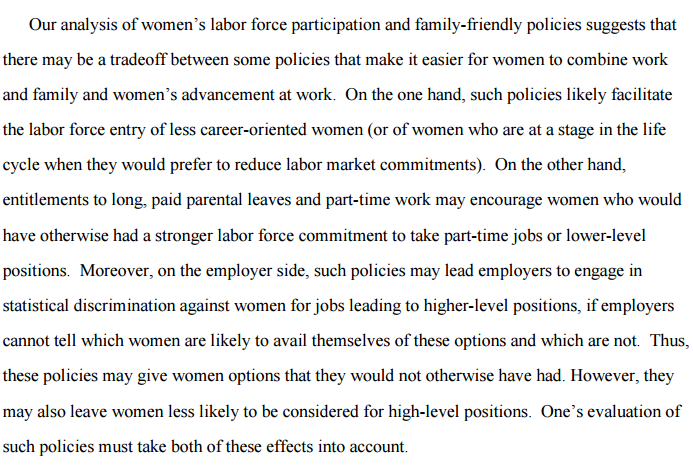
Source: AEAweb: AER (103,3) p. 251 – Female Labor Supply: Why Is the United States Falling Behind?
Celebrating humanity's flourishing through the spread of capitalism and the rule of law
07 Dec 2015 Leave a comment
in applied price theory, discrimination, economics of love and marriage, gender, labour economics, labour supply, law and economics, occupational choice, politics - New Zealand Tags: do gooders, expressive voting, female labour force participation, gender wage gap, maternal labour supply, maternity leave, The fatal conceit, unintended consequences
Source: Why Are Women Paid Less? – The Atlantic.
Source: AEAweb: AER (103,3) p. 251 – Female Labor Supply: Why Is the United States Falling Behind?
24 Oct 2015 Leave a comment
in environmental economics, environmentalism Tags: activists, do gooders, green hypocrisy, Left-wing hypocrisy
07 Oct 2015 Leave a comment
5 Ways People Power Helped Defeat Shell >> bit.ly/1L4KgAP #savethearctic http://t.co/e3Bn319yOe—
Greenpeace Canada (@GreenpeaceCA) October 06, 2015
Today in Energy: Sustained low oil prices could reduce exploration and production investment go.usa.gov/3twad http://t.co/zH8EpFc4Xx—
EIA (@EIAgov) September 24, 2015
CHART: Thanks to #fracking, US produced >89% of energy consumed this year (through June) for 1st time since 1984 http://t.co/8yEUac1pBA—
Mark J. Perry (@Mark_J_Perry) September 29, 2015
CHART: Thanks to #fracking, US petroleum imports this year through August (25.3%) are lowest in 44 years, since 1971 http://t.co/ThSbPTVDkH—
Mark J. Perry (@Mark_J_Perry) September 29, 2015
New EIA Data: US oil output fell to 9.1 bpd last week, down by 508,000 bpd from July peak ir.eia.gov/wpsr/overview.… http://t.co/VwAjeQ2dEN—
Mark J. Perry (@Mark_J_Perry) September 30, 2015
Energy Milestone: Thanks #fracking US Nat Gas Production Increased in July to New Record High eia.gov/dnav/ng/ng_pro… http://t.co/8KECE6ftxm—
Mark J. Perry (@Mark_J_Perry) September 30, 2015
Humanity keeps finding new reserves of energy: buff.ly/1LbOCcW #progress http://t.co/QhzgYkjWEi—
HumanProgress.org (@humanprogress) October 04, 2015
29 Sep 2015 Leave a comment
in applied price theory, applied welfare economics, development economics, econometerics, economic history, growth disasters, growth miracles, human capital, labour economics, Marxist economics, poverty and inequality, rentseeking Tags: activists, do gooders, expressive voting, Leftover Left, Oxfam, rational ignorance, rational irrationality, Twitter left
27 Sep 2015 Leave a comment
in comparative institutional analysis, constitutional political economy, development economics, economic history, growth disasters, growth miracles Tags: do gooders, MDG, ODA, overseas aid, United Nations
Parliament debates the Sustainable Development Goals today. But how did the MDGs fare? bit.ly/1gbcH6W http://t.co/r12PKVmPzK—
Commons Library (@commonslibrary) September 10, 2015
23 Sep 2015 Leave a comment
in applied price theory, development economics, entrepreneurship, environmental economics, growth disasters, growth miracles, law and economics, property rights Tags: Africa, agricultural economics, do gooders, economics of conservation, economics of endangered species, endangered species, expressive voting, Leftover Left, Twitter left, unintended consequences
https://twitter.com/ConversationUK/status/646227223716872197/photo/1
https://twitter.com/dlAfrican/status/646215227076292608
Capturing the economic value of wildlife for the benefit of wildlife. New in PERC Reports: bit.ly/1JHerwj http://t.co/yijFIChPDo—
PERC (@PERCtweets) September 13, 2015
How private ownership and trophy hunting saved the southern white rhino: bit.ly/1HhZy55 #WorldRhinoDay http://t.co/s4PudPwrrI—
PERC (@PERCtweets) September 22, 2015
23 Jul 2015 Leave a comment
in development economics, economic history, growth disasters, growth miracles, Marxist economics Tags: activists, anticapitalist mentality, antiforeign bias, antimarket bias, do gooders, expressive voting, Left-wing hypocrisy, Leftover Left, mass kidnappings, ODA, overseas aid, rational ignorance, rational irrationality, The Guardian
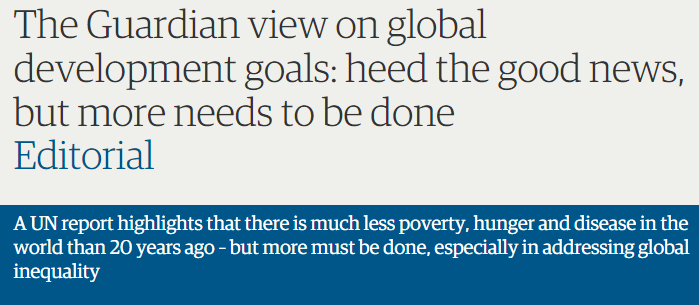
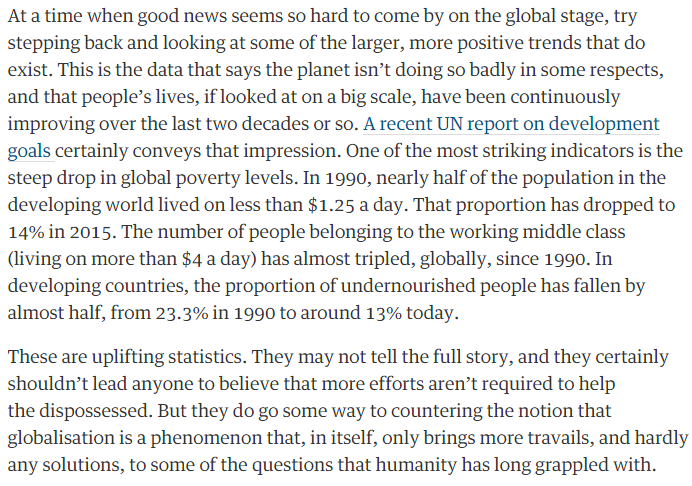
The role of the spread of capitalism and globalisation in massively reducing extreme poverty just gets a mention, begrudgingly, but it’s better than nothing From a newspaper of record of the Left over Left.
15 Jul 2015 Leave a comment
in development economics, growth disasters, growth miracles, health economics, technological progress Tags: activists, do gooders, extreme poverty, global poverty, infant mortality, Left-wing hypocrisy, life expectancies, mass kidnappings, ODA, overseas aid, Oxfam, The Great Escape, The Great Fact
https://twitter.com/MaxCRoser/status/621132860657897472/photo/1
The biggest success of our time: Child mortality is decreasing rapidly. Everywhere!
More at: OurWorldInData.org/data/populatio… http://t.co/FhdbQeheUd—
Max Roser (@MaxCRoser) July 13, 2015
Staggering #inequality: top 1% will own 50% of world's wealth by 2016. Help #EvenitUp! act.oxfam.org/new-zealand/ev… http://t.co/KX9GR2VSo5—
Oxfam New Zealand (@oxfamnz) January 19, 2015
Fossil fuel companies get more subsidies than all the public health spending globally. It's time to #GoCoalFree http://t.co/gsDIocxAq9—
Oxfam New Zealand (@oxfamnz) June 08, 2015
12 Jul 2015 Leave a comment
in comparative institutional analysis, development economics, economic history, growth disasters, growth miracles Tags: activists, do gooders, evidence-based policy, extreme poverty, global poverty, Naomi Klein, The Great Enrichment, The Great Fact
71% of the world live on less than $10 per day buff.ly/1D5kA3c http://t.co/GLCifBBOGP—
Business Insider (@businessinsider) July 11, 2015
Extreme poverty declined > 50% from 1.9 bil in '90 to 836 mil today: on.undp.org/Ppj00 #WPD2015 #MDGs http://t.co/vUDO5AYd4H—
UN Development (@UNDP) July 12, 2015
10 Jul 2015 Leave a comment
in applied price theory, applied welfare economics, econometerics, income redistribution, politics - Australia, politics - New Zealand, politics - USA, Public Choice, rentseeking Tags: activists, British economy, British politics, do gooders, expressive voting, living wage, rational ignorance, rational irrationality, The fatal conceit, The pretence to knowledge, unintended consequences
Do Living Wage advocates realise it helps richer households more than poorer ones? My take: telegraph.co.uk/finance/budget… … http://t.co/YPTB6v7tSB—
Fraser Nelson (@FraserNelson) July 10, 2015
10 Jul 2015 1 Comment
in applied welfare economics, economics of regulation, industrial organisation, labour economics, law and economics, politics - New Zealand, poverty and inequality, property rights, survivor principle, urban economics Tags: consumer products standards, do gooders, economics of regulation, nanny state, offsetting behaviour, rent control, The fatal conceit, The pretence to knowledge, urban economics
The Government admits that its proposed insulation and smoke alarm standards for rental properties could push up rents by more than $3 a week. Under legislation to be introduced in October, social housing would have to be retrofitted with ceiling and underfloor insulation by next July, and all other rental homes by July 2019.

An important driver of lower quality housing in New Zealand is the restrictions on land supply. The costs of those restrictions, land makes up 60% of the cost of new houses rather than 40%. Land prices have doubled and tripled in a number of cities. As the Ministry of Business, Innovation and Employment has said:
The median price of sections has increased from $94,000 in 2003 to over $190,000 today (compared with $NZ 100,000 per section in the US), ranging from Southland ($82,000) to Auckland ($308,000)…
Section costs in Auckland account for around 60% of the cost of a new dwelling, compared with 40% in the rest of New Zealand.
The RMA is the Resource Management Act and was passed just before New Zealand housing prices started to rise rapidly.

Source: Dallas Fed; Housing prices deflated by personal consumption expenditure (PCE) deflator.
Higher land prices for new houses spill into the prices of existing houses, which are now much more expensive than they need to be but for the RMA inspired land supply restrictions in Auckland and elsewhere in New Zealand.

One way in which homeowners and landlords can keep costs down when buying a house either for their own use or as an investment property is not to invest in insulation and smoke alarms. Deposits are less, mortgages are less and rents are less. It all adds up.
$3 is not much for some but it is enough that some parents cannot find $3 or so per week to feed their children breakfast. Joe Trinder, the Mana News editor blogged about the great expense of feeding the kids for ordinary families.

Put simply, you cannot argue that a few dollars is a lot of money to people on low incomes but ignore the consequences for their welfare of a $3 per week increase in their rents.
If tenants were willing to pay for insulation, landlords would provide well-insulated rental properties to service that demand. Walter Block wrote an excellent defence of slumlords in his 1971 book Defending the Undefendable:
The owner of ghetto housing differs little from any other purveyor of low-cost merchandise. In fact, he is no different from any purveyor of any kind of merchandise. They all charge as much as they can.
First consider the purveyors of cheap, inferior, and second-hand merchandise as a class. One thing above all else stands out about merchandise they buy and sell: it is cheaply built, inferior in quality, or second-hand.
A rational person would not expect high quality, exquisite workmanship, or superior new merchandise at bargain rate prices; he would not feel outraged and cheated if bargain rate merchandise proved to have only bargain rate qualities.
Our expectations from margarine are not those of butter. We are satisfied with lesser qualities from a used car than from a new car.
However, when it comes to housing, especially in the urban setting, people expect, even insist upon, quality housing at bargain prices.
Richard Posner discussed housing habitability laws in his Economic Analysis of the Law. The subsection was titled wealth distribution through liability rules. Posner concluded that habitability laws will lead to abandonment of rental property by landlords and increased rents for poor tenants.
https://twitter.com/childpovertynz/status/618985237628858368
What do-gooder would want to know that a warranty of habitability for rental housing will lead to scarcer, more expensive housing for the poor! Surprisingly few interventions in the housing market work to the advantage of the poor.
Certainly, there will be less rental housing of a habitability standard below that demanded by do-gooders in the new New Zealand legislation. In the Encyclopaedia of Law and Economics entry on renting, Werner Hirsch said:
It would be a mistake, however, to look upon a decline in substandard rental housing as an unmitigated gain.
In fact, in the absence of substandard housing, options for indigent tenants are reduced. Some tenants are likely to end up in over-crowded standard units, or even homeless.
The straightforward way to increase the quality of housing in New Zealand without increasing poverty is to increase the supply of land.
As land prices fall, both homebuyers and tenants will be able to pay for better quality fixtures and fittings because less of their limited income is paying for buying or renting the land.
24 May 2015 Leave a comment
in politics - Australia, politics - New Zealand, Public Choice, rentseeking Tags: animal rights, Australian Greens, do gooders, expressive voting, New South Wales election, New Zealand Greens, voter demographics, workers rights
14 May 2015 1 Comment
in discrimination, economics of love and marriage, gender, human capital, labour economics, occupational choice, politics - USA Tags: asymmetric marriage premium, do gooders, economics of families, gender wage gap, maternity leave, Sweden, The fatal conceit, unintended consequences
The gender wage gap is no better than the OECD average, despite generous maternity and paternity leave. What gives?
America: one day a year celebrating mothers, fathers.
Sweden: 480 days paid leave per child. vox.com/2014/5/12/5708… http://t.co/weFDrTj7Jb—
Ezra Klein (@ezraklein) May 11, 2015
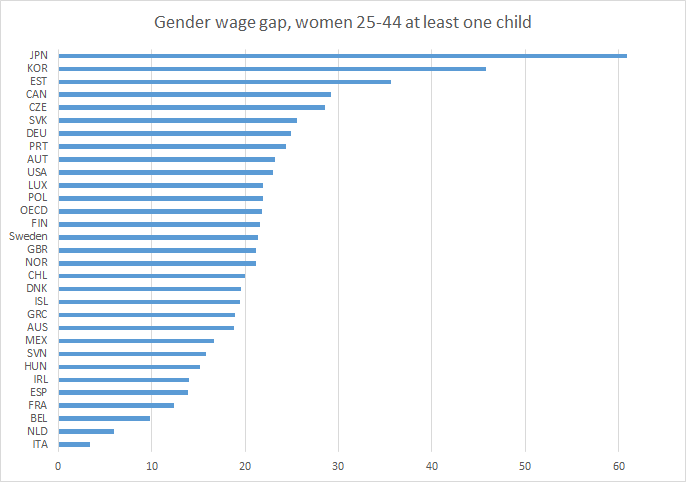
Source: Closing the gender gap: Act now – http://dx.doi.org/10.1787/9789264179370-en
How big is the wage gap in your country? bit.ly/18o8icV #IWD2015 http://t.co/XTdntCRfDQ—
(@OECD) March 08, 2015
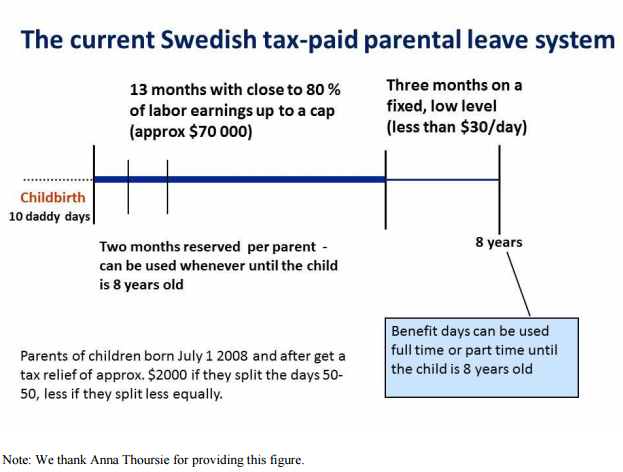
One important question is whether government policies are effective in reducing the gap. One such policy is family leave legislation designed to subsidize parents to stay home with new-born or newly adopted children.
One of the RLE articles shows that for high earners in Sweden there is a large difference between the wages earned by men and women (the so-called “glass ceiling”), which is present even before the first child is born. It increases after having children, even more so if parental leave taking is spread out.
These findings suggest that the availability of very long parental leave in Sweden may be responsible for the glass ceiling because of lower levels of human capital investment among women and employers’ responses by placing relatively few women in fast-track career positions. Thus, while this policy makes holding a job easier and more family-friendly, it may not be as effective as some might think in eradicating the gender gap.
via New volume on gender convergence in the labour market | IZA Newsroom.
12 May 2015 Leave a comment
in economic history, economics of regulation, economics of religion, environmental economics, global warming, liberalism Tags: climate alarmism, David Hockney old man, do gooders, economics of smoking, global warming, meddlesome preferences, nanny state
Celebrating humanity's flourishing through the spread of capitalism and the rule of law
Scholarly commentary on law, economics, and more
Beatrice Cherrier's blog
Celebrating humanity's flourishing through the spread of capitalism and the rule of law
Celebrating humanity's flourishing through the spread of capitalism and the rule of law
Celebrating humanity's flourishing through the spread of capitalism and the rule of law
Why Evolution is True is a blog written by Jerry Coyne, centered on evolution and biology but also dealing with diverse topics like politics, culture, and cats.
Celebrating humanity's flourishing through the spread of capitalism and the rule of law
Celebrating humanity's flourishing through the spread of capitalism and the rule of law
A rural perspective with a blue tint by Ele Ludemann
DPF's Kiwiblog - Fomenting Happy Mischief since 2003
Celebrating humanity's flourishing through the spread of capitalism and the rule of law
The world's most viewed site on global warming and climate change
Tim Harding's writings on rationality, informal logic and skepticism
A window into Doc Freiberger's library
Let's examine hard decisions!
Commentary on monetary policy in the spirit of R. G. Hawtrey
Thoughts on public policy and the media
Celebrating humanity's flourishing through the spread of capitalism and the rule of law
Politics and the economy
A blog (primarily) on Canadian and Commonwealth political history and institutions
Reading between the lines, and underneath the hype.
Economics, and such stuff as dreams are made on
"The British constitution has always been puzzling, and always will be." --Queen Elizabeth II
Celebrating humanity's flourishing through the spread of capitalism and the rule of law
Celebrating humanity's flourishing through the spread of capitalism and the rule of law
WORLD WAR II, MUSIC, HISTORY, HOLOCAUST
Undisciplined scholar, recovering academic
Celebrating humanity's flourishing through the spread of capitalism and the rule of law
Res ipsa loquitur - The thing itself speaks
Celebrating humanity's flourishing through the spread of capitalism and the rule of law
Researching the House of Commons, 1832-1868
Articles and research from the History of Parliament Trust
Reflections on books and art
Posts on the History of Law, Crime, and Justice
Celebrating humanity's flourishing through the spread of capitalism and the rule of law
Exploring the Monarchs of Europe
Cutting edge science you can dice with
Small Steps Toward A Much Better World
“We do not believe any group of men adequate enough or wise enough to operate without scrutiny or without criticism. We know that the only way to avoid error is to detect it, that the only way to detect it is to be free to inquire. We know that in secrecy error undetected will flourish and subvert”. - J Robert Oppenheimer.
The truth about the great wind power fraud - we're not here to debate the wind industry, we're here to destroy it.
Celebrating humanity's flourishing through the spread of capitalism and the rule of law
Celebrating humanity's flourishing through the spread of capitalism and the rule of law
Economics, public policy, monetary policy, financial regulation, with a New Zealand perspective
Celebrating humanity's flourishing through the spread of capitalism and the rule of law
Restraining Government in America and Around the World


 Utopia, you are standing in it!
Recent Comments