Since I’m currently in Europe as part of the Free Market Road Show, I’m going to share some more data (for other examples, see here, here, here, and here) on why the United States should not become more like Europe. As I noted a few years ago, people in the United States enjoy much higher levels […]
In our textbook, Modern Principles, Tyler and I write: Imagine how difficult it would be to get a date if every date required marriage? In the same way, it’s more difficult to find a job when every job requires a long-term commitment from the employer. In two new excellent pieces, Brian Albrecht and Pieter Garicano…
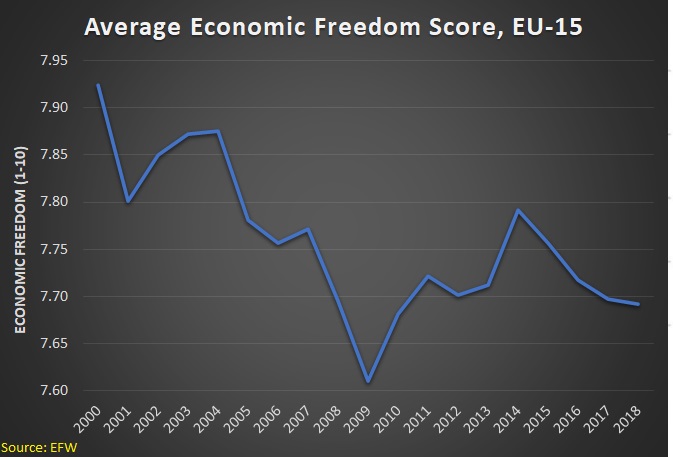
The good news is that Europe has a lot of economic freedom by world standards. Especially Western Europe. The bad news is that economic freedom has been declining in Western Europe. To make matters worse, Europe has a big demographic problem, with a growing number of older people over time who have been promised benefits […]
About five years ago, I fretted about the gradual erosion of economic liberty in Western Europe. And I followed up two years ago with similar analysis, grousing that the entire western world was joining Western Europe in the drift toward more statism. When you combine this grim trend with data about demographic decline, which is […]
Simple arithmetic already raises red flags. EU emissions fell by 37% over the 33 years from 1990 to today. Achieving an additional 68% reduction in just 17 years would require nearly tripling the pace of decarbonization.
If you want to know why I’m pessimistic about Europe (particularly compared to the U.S.), this chart is a good example. It shows that many European nations have enormous long-run liabilities for their Social Security systems. It’s an understatement to observe that Spain, Austria, and Italy have very grim fiscal futures. Keep in mind that […]
The Constitution of Innovation The continent faces two options. By the middle of this century, it could follow the path of Argentina: its enormous prosperity a distant memory; its welfare states bankrupt and its pensions unpayable; its politics stuck between extremes that mortgage the future to save themselves in the present; and its brightest gone…
I put a lot of focus on “convergence” and “divergence” because economic theory says rich countries should not grow faster than poor countries. So when there are examples of divergence, especially when looking at decades of data, we can learn very important lessons about economic policy. Those lessons, in every single case, teach us that […]
WSJ: Europe is Losing Europeans live longer, have more leisure time and less income inequality, and often live in stunning cities and towns built over the centuries. But increasingly, Americans enjoy a higher standard of living. They have over 50% more living space on average per person. More than four in five Americans have air…
That is the new book by John H. Cochrane, Luis Garicano, and Klaus Masuch, and the subtitle is Challenges, Evolution, and Future of the Euro. Excerpt: Our main theme is not actions taken in crises, but that member states and EU institutions did not clean up between crises. They did not reestablish a sustainable framework […]
The IMF puts the hidden cost of trading goods inside the EU at the equivalent of a 45% tariff. For services the figure climbs to 110%, higher than Trump’s “Liberation day” tariffs on Chinese imports—measures many saw as a near-embargo. These barriers are not direct taxes. Instead, a construction company might find its building materials or plans, […]
There’s an enormous amount of data showing that people in the United States enjoy much higher livings standards than Europeans. That’s not too surprising since most European governments have adopted large-sized welfare states while Americans are (comparatively!) lucky in that we have a medium-sized welfare state. That’s all very straightforward and uncontroversial. What’s not completely […]
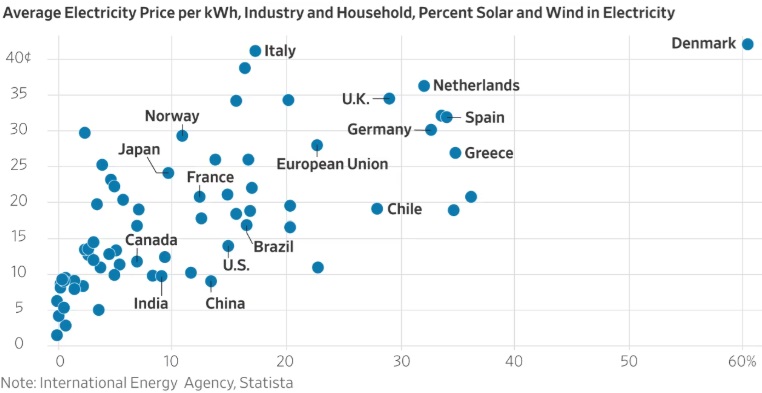
The American version of the Green New Deal included some subsidies for inefficient wind and solar, but it was largely just a marketing gimmick for a big expansion in the burden of government (everything from Medicare for All to student loan bailouts). The European version, by contrast, has been more focused on making energy more […]
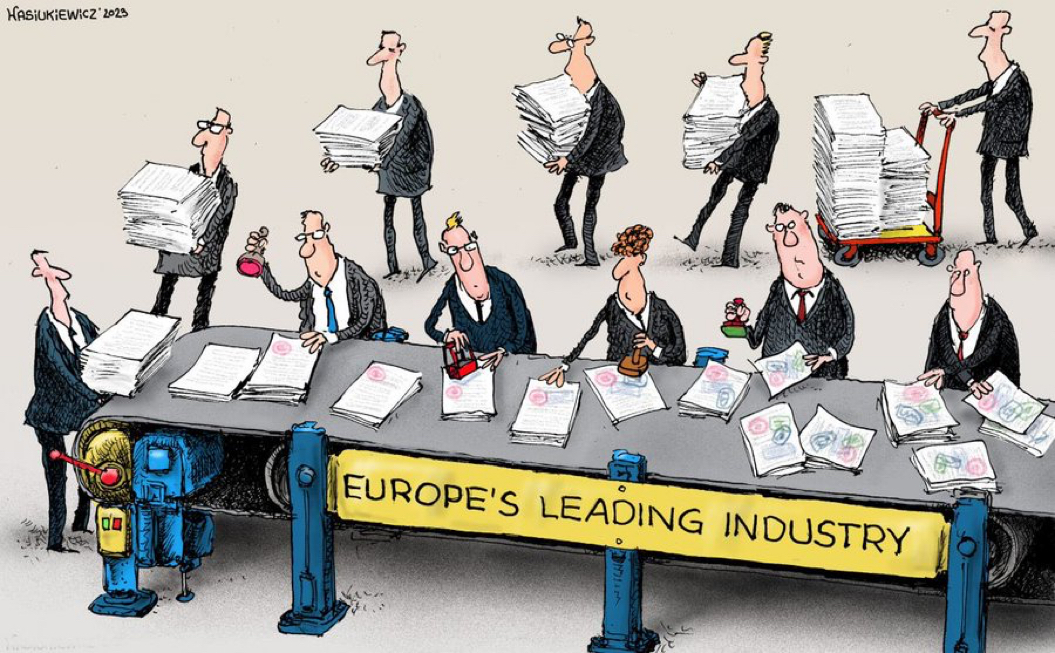
I have a special page for humor involving Europe, but I have not added to it since sharing some Brexit humor in 2016. Let’s being the process of catching up with some amusing cartoons and memes mocking our government-loving cousins on the other side of the Atlantic Ocean. I’ve made the serious point that bureaucrats […]
Why Evolution is True is a blog written by Jerry Coyne, centered on evolution and biology but also dealing with diverse topics like politics, culture, and cats.
“We do not believe any group of men adequate enough or wise enough to operate without scrutiny or without criticism. We know that the only way to avoid error is to detect it, that the only way to detect it is to be free to inquire. We know that in secrecy error undetected will flourish and subvert”. - J Robert Oppenheimer.



 Utopia, you are standing in it!
Recent Comments