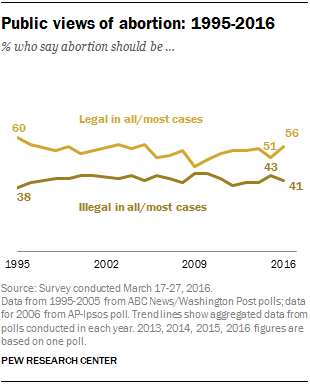
On abortion, the USA is split on pro-life versus pro-choice. State legislatures pass laws safe in the knowledge that they will be struck down the next day. they were playing to a grandstand made up of values voters.
When the supreme court became a little vague on some procedural aspects of abortion law in the early 1990s, the state legislatures started showing much more restraint because the median voter would be annoyed.
Where Roe v. Wade to fall, some states would permit abortion, some would not. The Center for Reproductive Rights predicts that 21 states are likely to outlaw abortion immediately where Roe v. Wade to fall. This assessment is based not only on current law, but on the political makeup of the state legislatures. On the other hand, abortion is likely to remain legal in many states, according to these groups.
Fascinating. Yawning chasm between why Labour members think they lost and why voters think they did. From @thetimeshttp://t.co/MvhZYI2CTr— Joe Watts (@JoeWatts_) July 23, 2015
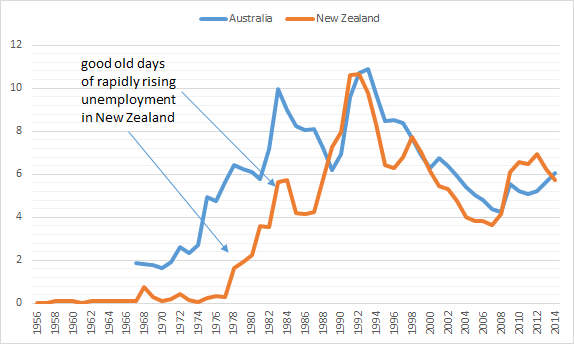
There is an Internet on computers now where it is easy to find data showing that the unemployment rate was rising rapidly in New Zealand in the 1970s and in double digits by the end of the 1980s – see figure 1.
Figure 1: harmonised unemployment rates, Australia and New Zealand, 1956-2014
Source: OECD StatExtract.
Figure 1 shows unemployment was rising rapidly in the 1970s and wasn’t much different by the end of the 1970s to the unemployment rates recorded after about 2000 in New Zealand.
One of the reasons that Sir Roger Douglas wrote There’s Got To Be A Better Way was the rapidly rising unemployment in New Zealand and the stagnant economic growth in the late 1970s and early 1980s.
New Zealand was one of the most regulated economies, so much so that Prime Minister David Lange said:
We ended up being run very similarly to a Polish shipyard.
Railways cut its freight rates by 50 percent in real terms between 1983 and 1990, reduced its staff by 60 percent, and made an operating profit in 1989/90, the first for six years.
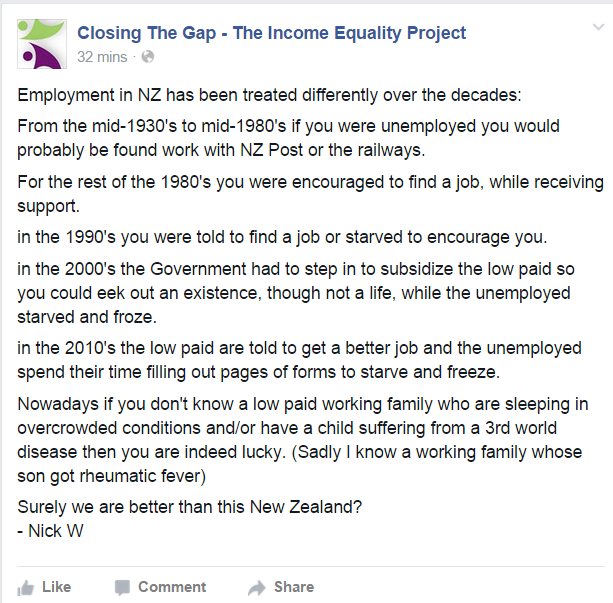
More on unemployment: In 1955 the New Zealand’s prime minister knew all unemployed personally.
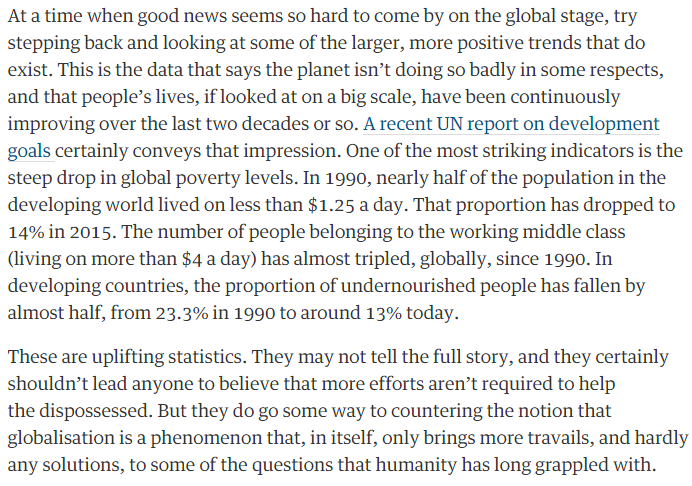
The role of the spread of capitalism and globalisation in massively reducing extreme poverty just gets a mention, begrudgingly, but it’s better than nothing From a newspaper of record of the Left over Left.
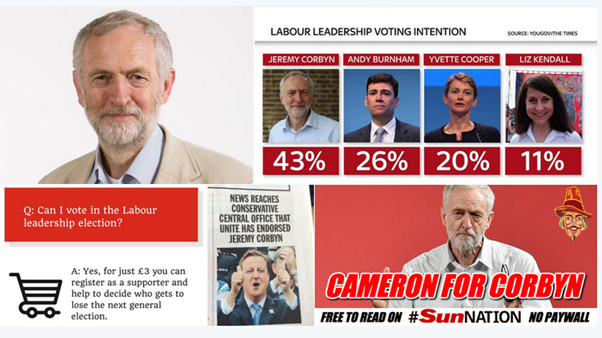
Jeremy Corbyn has done it. The working hypothesis of the far left everywhere is if the Labour Party were to adopt hard left policies, they would win many more votes.
The new votes include shy Labour voters parking their vote with the Tory party pending the call home to a true Labour Party.
They are parking their votes with other parties because they are fed up with a middle of the road Labour Party, such as the Blairite Labour Party. They are withholding their vote as punishment until the Labour Party returns to its roots and adopts hard left policies.
Rather than accept that their day has come, the left of the Labour Party is deeply suspicious of Tory party supporters wanting to join the Labour Party in anticipation of voting in hard left leadership in their current leadership election. What’s going on?
What seems to terrify the Labour Party is its old dream coming true: a large number of Tory party voters switching their support to Labour and joining the Labour Party because it might adopt hard left policies and a hard left leader who makes Michael Foot look like a pussycat.
What is more jarring than the fear of the Labour Left having its dreams come true is the Left of the British Labour is not showing against any insight into the genuine enthusiasm that the Tory party has for Jeremy Corbyn winning the election as leader of the Labour Party
There is no misdirection here or double play. The Tory party wants Jeremy Corbyn to be elected leader of the Labour Party.
The Liberal Democratic party must see their resurrection coming in the form of Jeremy Corbyn as do UKIP in terms of making inroads into working-class labour electorates.
There are left-wing and fairly left-wing people who do vote for the Tory party and the LDP, but there’s not that many of them, and overall they only make up about 15% of the British electorate, and a small part of the left-wing vote not voting for left-wing parties.
It would seem more reasonable to follow the median voter theorem and go for those in the centre because there are plenty of them and only minor modifications of your platform are required to win their votes.
Anti-establishment candidate with fringe views draws huge crowds in sure-fire guarantee of electoral success http://t.co/P7waxqUXrR— Alex Wickham (@WikiGuido) August 03, 2015
Why is the far left chasing with these shy Labour voters when there are plenty more middle of the road voters willing to vote for them in 2015 in the right circumstance?
…while the average UKIP or Tory voter is well to the right of Labour there are many Conservative and UKIP supporters who are in the centre ground and whose votes Miliband cannot afford to write off. For example, nearly four in ten UKIP supporters and 16% of Conservative voters place themselves on the centre point or to the left of centre.
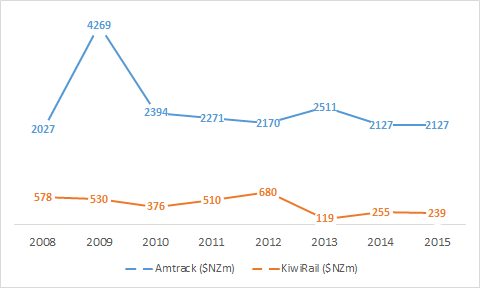
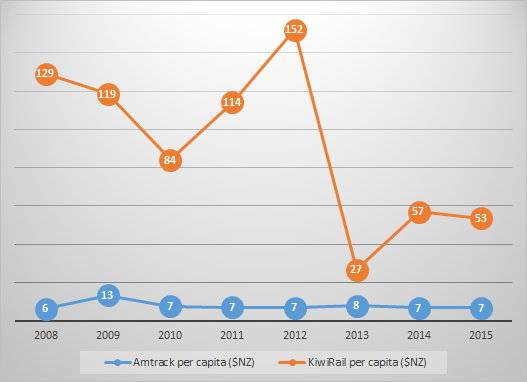
New Zealand with its KiwiRail does a good job of keeping up with the Amtrak bailout especially when you look at figure 2, which computes the bailouts on a per capita basis.
Figure 2: Amtrak and KiwiRail bailouts per capita (2014 populations), (exchange rate US$1:NZ$1.53), 2008 – 2015
Why Evolution is True is a blog written by Jerry Coyne, centered on evolution and biology but also dealing with diverse topics like politics, culture, and cats.
“We do not believe any group of men adequate enough or wise enough to operate without scrutiny or without criticism. We know that the only way to avoid error is to detect it, that the only way to detect it is to be free to inquire. We know that in secrecy error undetected will flourish and subvert”. - J Robert Oppenheimer.








 Utopia, you are standing in it!
Recent Comments